


Damascus, Paris Forge New Economic Partnership for Reconstruction

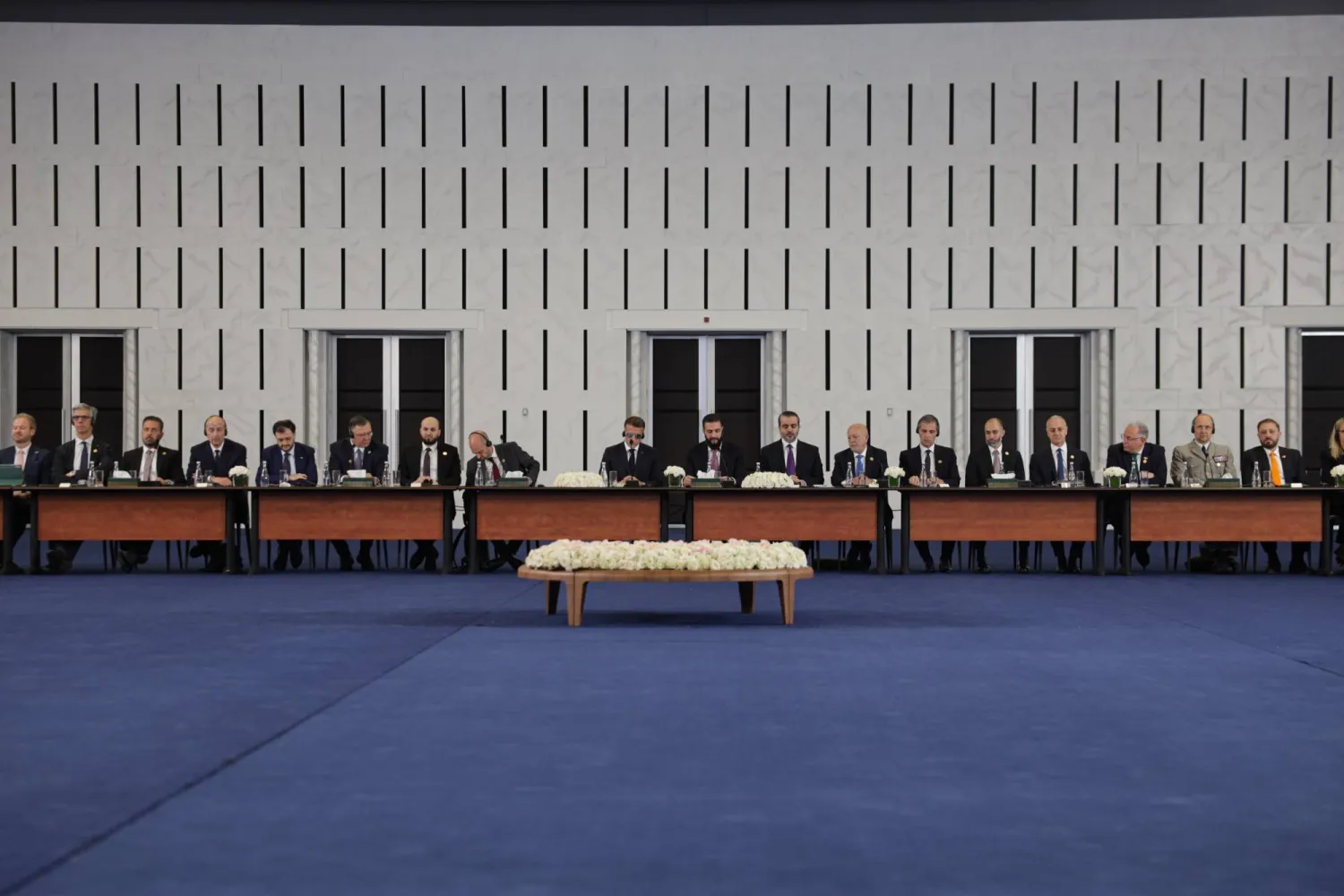
 Macron attends a meeting with al-al-Sharaa in Damascus (EPA)
Macron attends a meeting with al-al-Sharaa in Damascus (EPA)
TT

Damascus, Paris Forge New Economic Partnership for Reconstruction

 Macron attends a meeting with al-al-Sharaa in Damascus (EPA)
Macron attends a meeting with al-al-Sharaa in Damascus (EPA)

Syria is moving to reshape its investment landscape and turn the page on the legacy of war, driven by complex geopolitical shifts that have redrawn trade and energy routes across the Middle East.

At the forefront is the crisis caused by the closure of the Strait of Hormuz amid the conflict with Iran, a development that has renewed international focus on Syria’s geography as a “safe corridor and vital alternative” for global trade flows.

At the People’s Palace in Damascus, Syrian President Ahmed al-Sharaa and French President Emmanuel Macron laid the groundwork for what officials described as a “strategic shift” by launching a broad economic partnership for reconstruction.

The initiative took shape at a roundtable that brought together senior officials, investors, and leaders of French business during Macron’s first official visit since the end of the civil war in 2024.

The visit aims to move bilateral ties into a new phase based on mutual respect and equal partnership.

Despite security explosions caused by explosive devices that targeted the heart of Damascus and shook the city center near the hotel where the French president spent the night during the talks, the French delegation pressed ahead with activating the partnership.

The high-level French presence, which included major players in shipping, energy and industry, reflected a decisive French and European decision to move beyond security challenges and build an equal partnership based on mutual interests rather than slogans.

In his extended opening remarks, al-Sharaa welcomed leading French industrialists and business figures, saying there was a comprehensive road map for reconstruction and partnership.

He stressed Syria’s geopolitical advantage, saying: “Syria has a strategic location linking the Mediterranean to the Gulf and Iraq, and is only a few hours by sea from Marseille. After the Strait of Hormuz crisis, the world understood the value of safe and stable corridors.”

“Here lies the importance of Syrian geography, which has today regained its vital role as an indispensable hub in the global corridors market. We want France to be our first partner on this path.”

Al-Sharaa outlined the sectors covered by the investment map, saying: “We are talking about an integrated system, from renewing our air fleet, operating our airports and modernizing air navigation systems, to energy exploration in our territorial waters, upgrading electricity and water networks, and developing university hospitals, food industries, digital infrastructure and the civil registry.”

He added: “Syrian industrial cities are ready to serve as a launchpad for your factories. Supporting this is our reliance on Syria’s revival through a sovereign decision. We are building a modern investment environment governed by laws and institutions.”

He concluded by saying the strategic partnership was the model Damascus wanted with Europe and the world because it is “built on interests that serve the peoples of both countries, not on slogans.”

Logistics cooperation

Logistics and shipping emerged as strategic sectors, with the talks resulting in greater commercial influence for the French global shipping group CMA CGM.

Al-Sharaa cited the successful partnership with the group, saying it had signed a contract 14 months earlier to develop the port of Latakia with an investment of 230 million euros, and that within a year, it had decided to inject an additional 200 million euros to raise the port’s capacity.

In that context, CMA CGM Chief Executive Rodolphe Saadé stressed the importance of investment opportunities in Syria, saying: “Today we are reactivating the port of Latakia, and we expect important partnerships with Damascus in various fields.”

Syrian Economy and Industry Minister Nidal al-Sha’ar said Syria was looking for an active French presence in industry, transport, infrastructure, education and health in a way that would add value to both economies.

He said the country had “chosen to open a new page in its economic approach so that it becomes more competitive and more able to integrate into the global economy.”

Talal al-Hilali, head of the Syrian Investment Authority, echoed that view, describing the meeting as “a pivotal stop in Syria’s path toward building a modern economy and investment partnerships.”

Oil meetings

Energy also emerged as one of the most important areas of French engagement. TotalEnergies Chief Executive Patrick Pouyanné met Syrian officials to discuss signing a formal oil exploration contract.

The meetings build on a memorandum of understanding signed by the French company in May with Syria’s General Petroleum Corporation, granting TotalEnergies the right to explore a historically unexplored offshore block in the Mediterranean.

Pouyanné said his company had entered into an alliance with other companies to conduct preliminary studies and analyze technical data for the targeted block, with the aim of converting the memorandum of understanding into a formal contract binding on both parties.

In his assessment of the available technical opportunities, Pouyanné said TotalEnergies usually preferred to find crude oil, but added that the nature of historical discoveries in the eastern Mediterranean, as in Cyprus and Israel, showed that the stronger indicators pointed toward natural gas.

Pouyanné described Syria as strategically important because it is a key transit state at the “crossroads of the Middle East,” enabling the transport of Iraqi oil to the Mediterranean and bypassing the Strait of Hormuz.

He referred to Iraq’s April announcement that it had begun transporting its oil overland by truck through Syrian territory, as well as to talks between Damascus and Baghdad to establish mechanisms for energy transit and to rehabilitate the shared oil pipeline.

But his view was marked by cautious realism. He acknowledged that the current security situation did not allow for immediate fieldwork, saying his visit was aimed at building trust and establishing initial logistical contacts.

He urged investors to show some patience and give the government enough time to impose full control after a civil war that lasted more than 13 years and ended in 2024.

He called on the international community and investors to be patient, giving the Syrian government enough time to consolidate full control and stability.

For his part, the French president said Paris was ready to build trust and enter into partnerships in several fields, including energy, banking, and infrastructure.

He said the two sides had agreed to form joint, expanded economic committees to support efforts to rebuild Syria, adding that there would be a close partnership with Gulf countries within this framework.

Macron acknowledged that Damascus faced many challenges, but said there were also promising opportunities for partnership. He renewed his pledge that France would always stand by the Syrian people to help create a safe and stable investment environment.

As part of supporting financial measures, the Elysee Palace announced the start of formal procedures with Damascus to return 51 million euros, about $58.29 million, to the Syrian state. The funds had been seized from Rifaat al-Assad, the uncle of former President Bashar al-Assad.

The meetings were capped by strong political statements from the leaders of both countries outlining the features of a “new Syria.”

Addressing French business leaders, the Syrian president said the People’s Palace was opening its doors to anyone wishing to contribute to building the future. He stressed that the world had recognized the value of safe and stable trade corridors through Syria after the Strait of Hormuz crisis.


Middle East Bears Brunt of Tanker War as Saudi Arabia Weathers Crisis with Alternative Logistics Network

 A vessel at the Strait of Hormuz, as seen from Musandam, Oman, July 8, 2026. (Reuters)
A vessel at the Strait of Hormuz, as seen from Musandam, Oman, July 8, 2026. (Reuters)
TT

Middle East Bears Brunt of Tanker War as Saudi Arabia Weathers Crisis with Alternative Logistics Network

 A vessel at the Strait of Hormuz, as seen from Musandam, Oman, July 8, 2026. (Reuters)
A vessel at the Strait of Hormuz, as seen from Musandam, Oman, July 8, 2026. (Reuters)

At a time when the global economy is struggling to avoid a sharp recession, the International Monetary Fund’s updated World Economic Outlook showed a deeply divided picture.

A surge in artificial intelligence investment, productivity gains and US tax cuts helped keep global growth at 3% this year, slightly below the 3.1% forecast in April, absorbing part of the severe energy shock caused by the Iran war and the closure of the Strait of Hormuz.

But the regional cost was steep and unprecedented. The prolonged closure of the Gulf shipping artery prompted the IMF to sharply downgrade its outlook for the Middle East and North Africa, pushing the region into a 0.5% contraction, one of its worst annual performances since the start of the century.

Major oil producers were caught between lower output and disrupted supply logistics.

At the center of the turmoil, Saudi Arabia emerged as one of the most resilient economies.

Although the IMF cut its growth forecast for the Kingdom this year to 1.7%, it raised its projection for next year to 5.5%, defying the darker regional scenario.

The Kingdom was supported by alternative routes that protected its momentum, while major producers such as Iraq, Kuwait and Qatar face temporary contractions before a broad regional rebound in 2027.

Recent military developments delivered a severe logistics shock that paralyzed flows equivalent to one-fifth of global oil and gas. Although releases from strategic oil reserves and commercial production eased the crisis, prices remained 25% to 32% above pre-war levels.

The jump in energy costs directly froze two years of global progress against inflation.

The IMF raised its global inflation forecast by 0.3 percentage point to 4.7% in 2026, saying the monetary easing cycle had seen a “temporary pause, not a break in the broader trend.”

Regional growth map

The IMF’s new baseline scenario assumes the Strait of Hormuz will begin reopening gradually in mid-July and return to normal by March 2027. The prolonged closure redrew the region’s growth map as follows:

  • The Middle East and North Africa region is expected to contract. The IMF cut its 2026 estimate for the region for the second time in three months, forecasting a 0.5% contraction, down from 1.1% growth in its April update. That would make it the only region in the world expected to record a decline in gross domestic product, before a strong rebound in 2027 as exports recover and trade through the Strait of Hormuz returns to pre-war levels. Deniz Igan, head of the IMF’s research department, described the expected recovery as “V-shaped”.
  • Iraq, Kuwait and Qatar, among the commodity exporters most affected by transport disruptions and energy production constraints, are expected to face sharp, painful contractions this year, followed by a surge in expansion and double-digit growth in 2027.
  • Türkiye is also under pressure. The IMF cut its 2026 growth forecast for Türkiye for the second time this year to 2.9%, down from 3.4% in April, under pressure from weak domestic demand, higher energy prices and tighter financial conditions.
  • Iran, despite resilient oil exports early in the year and an upward revision to its forecast, remains weighed down by sanctions and war. Its economy is expected to contract sharply by 5.4% in 2026, pending the broader regional rebound in 2027.

Saudi resilience

At the center of the regional disruption, Saudi Arabia’s official indicators appeared more resilient. The IMF said the Saudi economy was “less affected” by the shock than its Gulf neighbors.

The Fund’s revisions to Saudi figures reflected recent geopolitical developments compared with its April report, lowering its 2026 growth forecast for the Kingdom by 1.2 percentage points to 1.7% this year.

By contrast, the outlook carried a more optimistic revision for 2027. The IMF raised its forecast for Saudi Arabia's growth by 1 percentage point from its April estimate, projecting growth of 5.5% as tensions ease and waterways reopen.

US and China hold up, Europe bears the cost

The IMF’s documentation showed a stark divergence among major powers, depending on their exposure to the technology boom and energy sources.

The United States stood apart. The world’s largest economy retained its strength, with its growth forecast steady at 2.3% in 2026. It was supported by a dual boost from massive investment in artificial intelligence, the effects of President Donald Trump’s 2025 tax cuts and strong stock markets.

China, the world’s second-largest economy, received a slight upward revision and is now expected to grow by 4.6%. Despite its property-sector crisis and the energy shock, Beijing was supported by public works spending, booming exports and a surge in high-tech manufacturing.

Asia seized the technology opportunity. The four major exporters of AI equipment and hardware — Taiwan, South Korea, Thailand and Malaysia — recorded strong and resilient growth, reflecting gains from the surge in technology demand.

Europe paid the price. The 21 eurozone countries were directly hit by rising prices, with their collective growth forecast falling to just 0.9%. France’s forecast retreated to only 0.6%, reflecting its direct exposure to the energy shock.

Conflict risks remain

Although the global economy proved more resilient than feared, the IMF ended its report with a sharp warning. Igan said renewed military conflict and the latest strikes between the United States and Iran in recent hours could leave the global economy in a “much worse position.”

The Fund warned that the depletion of countries’ strategic oil reserves would quickly narrow their room for maneuver, opening the door to sharp swings in commodity prices, disruption in global trade flows, or a sudden and painful correction in overblown expectations for technology and artificial intelligence markets.


Libya Signs Exploration and Production Deal for Ghadames Basin with UCC Holding

The headquarters of Libya's National Oil Corporation. Reuters
TT

Libya Signs Exploration and Production Deal for Ghadames Basin with UCC Holding

The headquarters of Libya's National Oil Corporation. Reuters

Libya's National Oil Corporation signed an exploration and production sharing agreement for zone 47 in the Ghadames Basin with ⁠the Libyan Investment ⁠Authority and Qatari-based UCC Holding, Chairman Massoud Suleman ⁠said on Wednesday.

The partnership aims to boost oil output to about 80,000 barrels per day and use associated gas for ⁠power ⁠generation, with the investor funding the project in full.


Alswaha at LEAP East: Saudi Arabia is Global Hub Connecting AI Ecosystem Between East, West

Minister of Communications and Information Technology Abdullah Alswaha. SPA
TT

Alswaha at LEAP East: Saudi Arabia is Global Hub Connecting AI Ecosystem Between East, West

Minister of Communications and Information Technology Abdullah Alswaha. SPA

Minister of Communications and Information Technology Abdullah Alswaha affirmed that under the Saudi leadership, the Kingdom is advancing toward building one of the world’s most accessible and AI-ready digital infrastructures, reinforcing its position as a trusted partner in enabling the digital economy and connecting the East and the West.

Speaking at the opening of LEAP East 2026 in Hong Kong, Alswaha noted that LEAP, which was launched in Riyadh five years ago, has evolved into a global technology movement that has generated a multiplier effect not only across the Kingdom and the region but around the world.

He added that LEAP’s expansion to the East reflects the region’s growing importance as a global hub for shaping the future of technology and artificial intelligence.

The minister highlighted that the East today represents a $34 trillion economy, accounting for nearly 30% of global GDP, with a $10 trillion digital economy and a population of 3.7 billion people, representing approximately 46% of the world’s population.

He emphasized that the East offers not only scale but is also building the very foundation of the artificial intelligence age.

He further noted that 82% of the world’s AI patents originate from the East, while the region accounts for 60% of the global semiconductor market and 90% of advanced chip manufacturing, making it a global powerhouse for computing and artificial intelligence.

Alswaha also highlighted Saudi Arabia’s achievements over the past several years, noting that the Kingdom’s digital economy has grown by 75% in the past eight years to reach $139 billion.

The contribution of the non-oil digital economy to GDP has increased to 16%, while the Kingdom’s operational data center capacity has reached 467 MW, representing 47% of the total data center capacity across the Middle East and North Africa.

He emphasized that the empowerment of Saudi women represents one of the Kingdom’s greatest global success stories.

Women’s participation in the ICT workforce has increased from 7% to 35%, surpassing the averages of both the European Union and Silicon Valley, while Saudi women now rank among the world’s leaders in AI participation and empowerment.

On digital infrastructure, Alswaha emphasized that Saudi Arabia is building 6.9 GW of data center capacity by 2034, including 3 GW by 2030, supported by 12.8 GW of available power capacity today.

This positions the Kingdom among the fastest countries globally in providing power for computing and AI infrastructure projects.

The minister stated that Saudi Arabia brings together the three essential pillars for success in the AI era—compute, customers, and capital—adding that leading global companies from the East have already begun investing and expanding in the Kingdom, including ByteDance, Lenovo, and Tencent.
