


Study Says 93% of Sudanese Want Peace

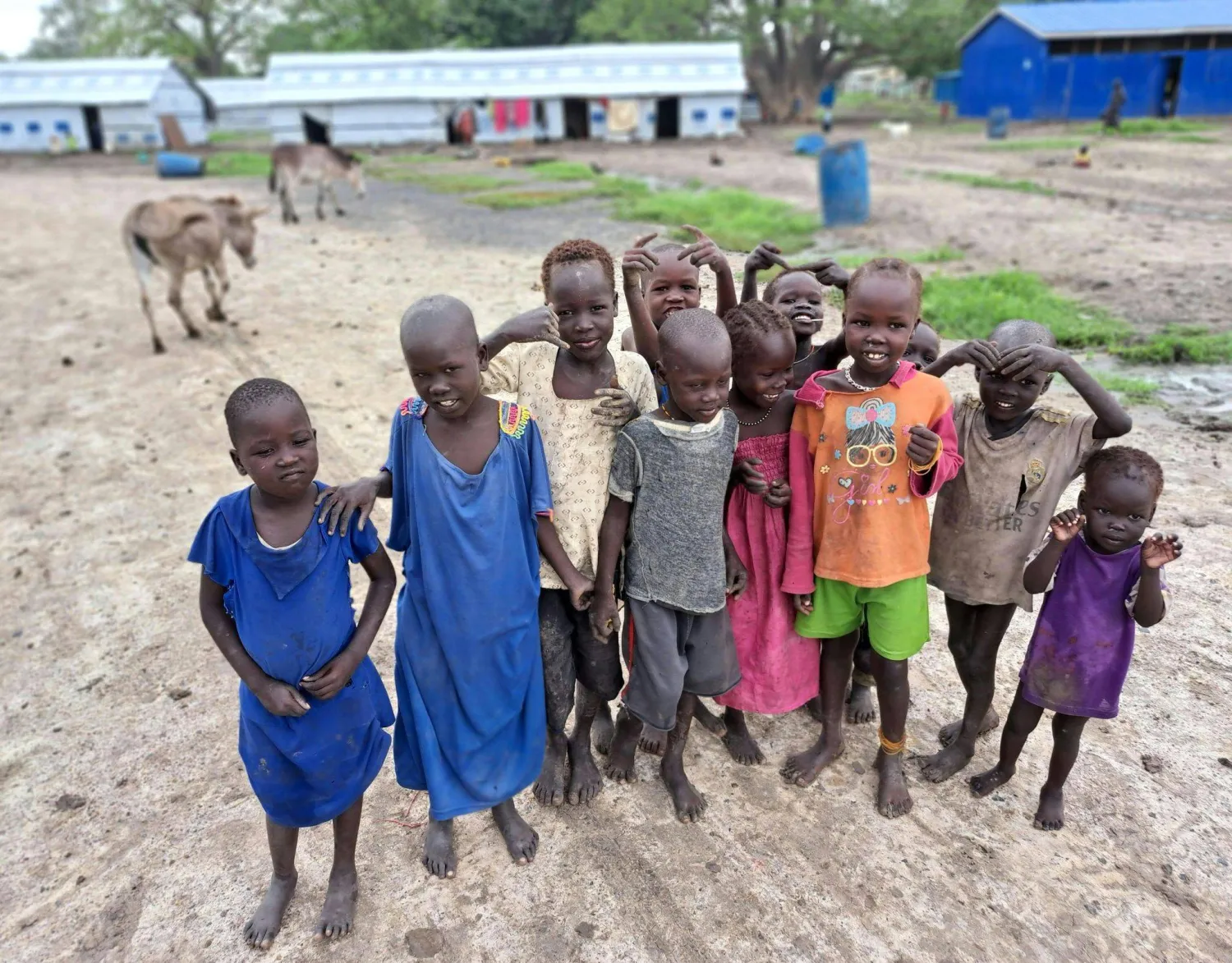
24 June 2026, Sudan, Juba: Children gather at the Renk Returnees Camp during a Caritas press trip in Renk, Upper Nile State. Photo: Martin Hanser/APA/dpa
TT

Study Says 93% of Sudanese Want Peace

24 June 2026, Sudan, Juba: Children gather at the Renk Returnees Camp during a Caritas press trip in Renk, Upper Nile State. Photo: Martin Hanser/APA/dpa

A comprehensive Sudanese study has revealed that 93.2% of Sudanese support peace negotiations, a finding that participants described as “digital evidence refuting claims used to justify the continuation of the war in the name of the Sudanese people.”

The Advocacy Group for Peace in Sudan (AGPS) said in a press statement that it presented the preliminary results of the study during a workshop attended by researchers, journalists, civil society representatives, and public policy experts.

According to the group, the study was based on 1,668 online surveys, 30 in-depth qualitative interviews, and a random sample covering all 18 Sudanese states, in addition to Sudanese communities in Chad, Egypt, South Sudan, Uganda, the Gulf states, and several other countries.

Dr. Issam Abbas, one of the study’s supervisors, explained that “the use of the Python programming language in data analysis, together with the stratified random sampling method, enhanced the reliability and scientific accuracy of the results.”

The findings showed that 74.3% support an immediate ceasefire, 88.3% of those who favor a political settlement are willing to actively support it and Central Darfur State recorded the highest level of support for peace, at 94.7%.

The study found that competition over power and wealth was viewed as the leading cause of the conflict, followed by the legacy of the former regime, marginalization, and foreign interference.

It also found that 80.9% of respondents hold both branches of the military establishment responsible for the war, 79.2% blame the former regime and 73.7% blame armed movements.

Confidence in peace agreements was low, with only 14.4% expressing high confidence, compared with 9% who said they had no confidence in such deals.

The results further showed that 90% of participants demand accountability, while 8% favor a hybrid justice system combining national and international mechanisms. The study identified key red lines for any future settlement, including the rejection of Sudan’s partition, the existence of multiple armies, and ontinued military involvement in politics.

Meanwhile, 77.9% of respondents said that social media is their primary source of information, while 93.4% believed that tribal and regional rhetoric poses a direct threat to citizenship and national cohesion.

Dr. Asmaa Elnaiem, Executive Director of the Advocacy Group for Peace in Sudan and a member of the Executive Office of the Sudan Peace Appeal, said the results presented so far represent only about 20% of the full analysis.

She noted that the study was designed to be expandable and regularly updated to reflect developments on the ground.

Sudan has been engulfed in war between the Sudanese Armed Forces (SAF) and the Rapid Support Forces (RSF) since April 2023. The conflict has killed at least 59,000 people, displaced around 13 million others, and pushed large parts of the country into famine. More than 30 million people are now in need of humanitarian assistance.



Israeli Threat to Expand Lebanon’s Occupation, Displace More Than a Million Lebanese

File photo of Israeli Defense Minister Israel Katz in the Tulkarm refugee camp in the northern West Bank (Israeli Army)
TT

Israeli Threat to Expand Lebanon’s Occupation, Displace More Than a Million Lebanese

File photo of Israeli Defense Minister Israel Katz in the Tulkarm refugee camp in the northern West Bank (Israeli Army)

Defense Minister Israel Katz has ⁠warned Hezbollah against attacking Israel, saying the Israeli army was capable of occupying more Lebanese territories and displacing more than a million Shiites.

"Hezbollah will suffer a severe blow and lose additional territories in southern Lebanon within the Nabatieh and Litani regions, which will become part of Israel's permanent security zone. The IDF (Israel Defense Forces) is prepared to carry out the maneuver," Katz said on Wednesday.

Speaking from the self-declared security zone Israeli forces are ⁠occupying in southern Lebanon, Katz said that a million Shiites would be displaced and that Hezbollah's stronghold in Beirut would not be spared.

Israel launched airstrikes and a ground invasion in southern Lebanon this year in parallel with the war in Iran, after Hezbollah fired into Israel in revenge ​for Israeli-American attacks against Tehran.

Hundreds of ​thousands of people from Lebanon's Shiite community were uprooted by the fighting.


UN Peacekeeping Chief Says Talks on Future of Lebanon Mission Must Begin Soon

 United Nations Under-Secretary-General for Peace Operations Jean-Pierre Lacroix in Beirut, speaks during an interview with The Associated Press, in Beirut, Wednesday, Oct. 14, 2026. (AP)
United Nations Under-Secretary-General for Peace Operations Jean-Pierre Lacroix in Beirut, speaks during an interview with The Associated Press, in Beirut, Wednesday, Oct. 14, 2026. (AP)
TT

UN Peacekeeping Chief Says Talks on Future of Lebanon Mission Must Begin Soon

 United Nations Under-Secretary-General for Peace Operations Jean-Pierre Lacroix in Beirut, speaks during an interview with The Associated Press, in Beirut, Wednesday, Oct. 14, 2026. (AP)
United Nations Under-Secretary-General for Peace Operations Jean-Pierre Lacroix in Beirut, speaks during an interview with The Associated Press, in Beirut, Wednesday, Oct. 14, 2026. (AP)

UN peacekeeping chief Jean-Pierre Lacroix on Wednesday urged the UN Security Council to begin negotiations on the future of peacekeepers deployed in Lebanon, as Beirut campaigns for an extension to the mandate set to expire at the end of this year.

The UN Interim Force in Lebanon (UNIFIL) has been deployed in southern Lebanon since 1978, but the Security Council last year ordered the mission to begin withdrawing at the end of 2026.

Since a new war erupted in March between Israel and Iran-backed Lebanese armed group Hezbollah, ‌the Lebanese government has ‌campaigned for an extension to UNIFIL's mandate, citing its ‌role ⁠in monitoring hostilities ⁠and facilitating aid deliveries to villages in Israeli-occupied zones.

UN Secretary-General Antonio Guterres earlier this year presented proposals for a continued uniformed UN presence in Lebanon, but no action has been taken yet, Lacroix told Reuters in Beirut.

"These proposals are on the table of the Security Council. There has been no movement in the Security Council until now, but I believe that the negotiations will begin ... shortly, in earnest," he said.

"I think ⁠it would be better to have a decision soon ‌rather than later, right? Because that would clarify ‌also the horizon for us, certainly from the more limited point of view of our ‌own planning," he said.

FORCES OPERATE HOTLINE TO EASE TENSIONS

Diplomats say the US ‌is not supportive of an extended mandate for UNIFIL, but Lacroix said it was important to focus on Lebanon’s request and that negotiations at the Security Council could yield a constructive outcome.

Some 7,500 UNIFIL peacekeepers are still deployed at about 50 positions in southern Lebanon, which ‌would be expected to be handed over to Lebanese army troops if no new UN force is agreed.

But since most ⁠of those ⁠posts lie in territory now occupied by the Israeli military, it remains unclear how Lebanese soldiers could deploy to take over the positions.

Lacroix said that clarity on whether a new UN force would deploy to southern Lebanon would help UNIFIL make sure it does not "leave those positions prematurely before we know what could come next".

In addition to facilitating aid deliveries and monitoring hostilities, the force operates a hotline to ease any tensions between the Lebanese and Israeli militaries.

Lacroix said the deconfliction role was particularly crucial given the presence of Israeli troops in a self-declared security zone deep in Lebanese territory.

He said that Israeli and Lebanese troops in the same geographic area presented "the risk of escalation, the risk of incidents getting out of control" and that "there is a need for a third party to de-escalate".


Gaza Officials Say Israeli Strikes Kill Four

 Palestinians walk along a street lined with buildings destroyed during the Israel-Hamas war in Gaza City Wednesday, Oct. 14, 2026. (AP)
Palestinians walk along a street lined with buildings destroyed during the Israel-Hamas war in Gaza City Wednesday, Oct. 14, 2026. (AP)
TT

Gaza Officials Say Israeli Strikes Kill Four

 Palestinians walk along a street lined with buildings destroyed during the Israel-Hamas war in Gaza City Wednesday, Oct. 14, 2026. (AP)
Palestinians walk along a street lined with buildings destroyed during the Israel-Hamas war in Gaza City Wednesday, Oct. 14, 2026. (AP)

Palestinian officials said Israeli strikes killed four people in Gaza on Wednesday, days after the anniversary of the declaration of a US-mediated ceasefire.

Two young men died when Israeli forces struck a vehicle near Khan Yunis in the southern Gaza Strip, civil defense spokesman Mahmoud Bassal and Nasser Hospital said.

Two other people, including a woman, were killed when an Israeli aircraft struck an apartment building in Gaza City, according to Bassal and Al-Shifa hospital.

The Israeli military did not immediately give details on the strikes. Earlier Wednesday, it said it had killed more than 100 "terrorists" over the past four months in an operation in the north of the Gaza Strip.

The military said it also destroyed around eight kilometers (five miles) of tunnels used by fighters.

Israeli Prime Minister Benjamin Netanyahu, who faces a tight reelection battle this month, has vowed no let-up in targeting Hamas despite the ceasefire that went into effect on October 10, 2025, leading Hamas to free its remaining living hostages.

Hamas stormed into Israel on October 7, 2023, the deadliest day ever for the country. The attack resulted in the deaths of 1,221 people, according to an AFP tally from official Israeli figures, with fighters also dragging 251 hostages into Gaza, 44 of them already dead.

Israel's massive offensive in Gaza has since killed more than 74,300 people, according to the territory's health ministry, which operates under Hamas and whose figures are generally considered reliable by the United Nations.