


Australia, India Strike Deal on Uranium Exports During Modi Visit

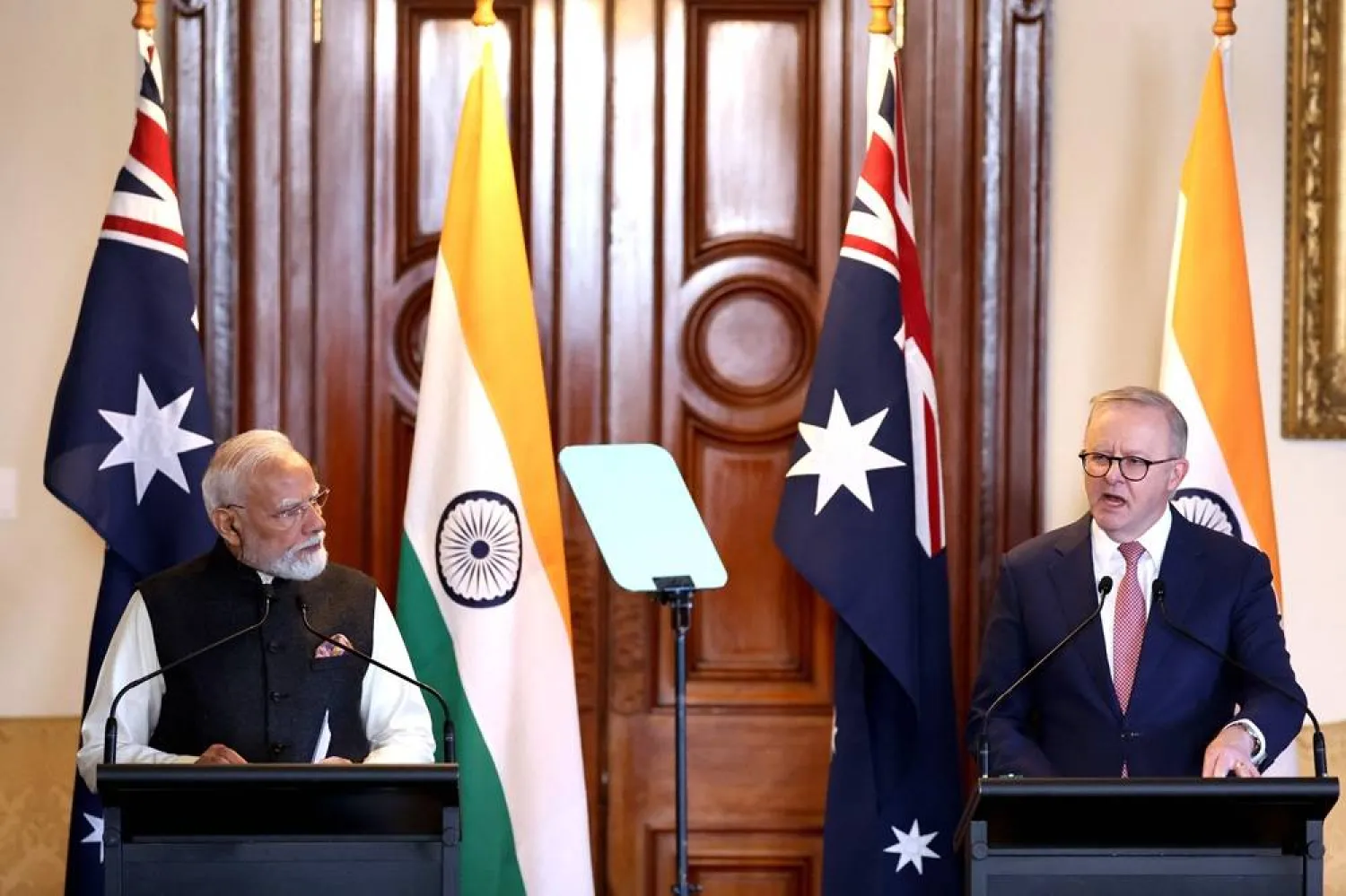
 Australia's Prime Minister Anthony Albanese (R) talks as he stands with Indian Prime Minister Narendra Modi (L) during a press conference at Government House Victoria in Melbourne on July 9, 2026. (AFP)
Australia's Prime Minister Anthony Albanese (R) talks as he stands with Indian Prime Minister Narendra Modi (L) during a press conference at Government House Victoria in Melbourne on July 9, 2026. (AFP)
TT

Australia, India Strike Deal on Uranium Exports During Modi Visit

 Australia's Prime Minister Anthony Albanese (R) talks as he stands with Indian Prime Minister Narendra Modi (L) during a press conference at Government House Victoria in Melbourne on July 9, 2026. (AFP)
Australia's Prime Minister Anthony Albanese (R) talks as he stands with Indian Prime Minister Narendra Modi (L) during a press conference at Government House Victoria in Melbourne on July 9, 2026. (AFP)

Australia and India reached a deal on Thursday to export Australian uranium to India for use in the nuclear energy industry, while agreeing to deepen cooperation in renewables, critical minerals and green hydrogen.

India has long eyed Australia's uranium reserves to help meet a target of 100 gigawatts of nuclear energy capacity by 2047, while Australia is looking to diversify trade beyond its reliance on China, its top partner.

"Australia and India are close partners and even closer friends," Australian Prime Minister Anthony Albanese ‌told reporters in Melbourne ‌on Thursday, after finalizing the deal with visiting Indian Prime ‌Minister ⁠Narendra Modi.

"The arrangement ⁠facilitates Australian uranium exports to India to help increase the share of non-fossil fuel power capacity, providing an additional market for the Australian resources sector."

Though both nations agreed to a nuclear cooperation pact in 2014, uranium exports have been limited over concerns about ensuring nuclear fuel is used solely for peaceful purposes, such as energy generation.

Modi said on Thursday India's relationship with Australia presented "historic opportunities" for both countries to cooperate across several areas.

Australia's technology, capital and resources could ⁠help accelerate India's energy transition, Modi said.

He also signaled possible cooperation ‌in low-carbon aluminium projects.

"We have historic opportunities to ‌cooperate in this field," Modi said, as he urged Australia's business community to invest long-term in ‌India's road, port, rail and urban infrastructure projects.

"India provides a safe, stable and sustainable ‌growth option for your funds," he said.

Australia's largest pension fund, AustralianSuper, said on Thursday it would invest a further A$500 million ($347 million) in India's National Investment and Infrastructure Fund.

'LIVING BRIDGE'

After meeting Modi at the business event, Albanese called the Indian leader a "living bridge" between Australia and India, saying Modi's vision ‌had helped reshape the roadmap for Australia's economic engagement with India.

India is Australia's fifth-largest trading partner after China, Japan, the US ⁠and South Korea, ⁠while around 1 million people in Australia claim Indian ancestry, out of a population of 28 million.

Modi, who previously visited Australia in 2023, is expected to meet thousands of expatriate Indians at an event in one of the biggest stadiums in Melbourne on Thursday evening.

The Indian leader has staged large-scale events during his overseas trips and has addressed packed stadiums in Britain, the United States and other countries that have large expatriate Indian populations.

Thousands of supporters thronged one of Sydney's biggest indoor stadiums during his last visit three years ago.

Modi arrived in Australia after visiting Indonesia, where he signed a raft of deals on agriculture and defense, including for the BrahMos cruise missile system. He will leave for New Zealand on Friday afternoon before returning to India.



Asian Shares Mostly Rise amid Market Optimism about AI, Despite Iran Worries

A financial data screen in the dealing room of Hana Bank shows the Korea Composite Stock Price Index (KOSPI) after South Korean shares closed higher in Seoul, South Korea, 23 September 2026. EPA/YONHAP SOUTH KOREA OUT
TT

Asian Shares Mostly Rise amid Market Optimism about AI, Despite Iran Worries

A financial data screen in the dealing room of Hana Bank shows the Korea Composite Stock Price Index (KOSPI) after South Korean shares closed higher in Seoul, South Korea, 23 September 2026. EPA/YONHAP SOUTH KOREA OUT

Asian shares mostly rose in early Thursday trading amid investor interest in technology-related issues, despite ongoing worries about the war in Iran.

Japan's benchmark Nikkei 225 jumped 2.4% in morning trading to 68,355.81. Australia's S&P/ASX 200 lost 1.7% to 8,638.10. South Korea's Kospi edged up 0.5% to 6,873.06. Hong Kong's Hang Seng added 0.4% to 24,613.27, while the Shanghai Composite gained 0.3% to 3,842.19.

In Tokyo trading, issues expected to get a boost from the solid demand in computer chips and AI-related growth have been rising in recent sessions, including Advantest Corp., Tokyo Electron and SoftBank Group Corp.

US stocks mostly fell Wednesday, despite indications that the US economy remains strong. On Wall Street, the S&P 500 slipped 0.3% to close out its third losing month in the last four. The Dow Jones Industrial Average dropped 443 points, or 0.9%, and the Nasdaq composite added 0.2%.

The report that said inflation wasn’t as bad across the United States last month as economists expected. It said the cost of living for US consumers was 3.4% higher overall in August than a year earlier. That was not as high as the 3.7% inflation rate that economists expected, even if it remained worse than the Fed’s 2% target.

In energy trading, benchmark US crude lost 0.56% to $89.91 a barrel. Brent crude, the international standard, fell 0.35% to $97.69 a barrel.

Oil prices have been swinging wildly in recent months amid uncertainty about when the war with Iran will allow the flow of crude to be fully restored. Iranian officials indicated Wednesday they have received an official US response to Tehran’s latest proposal to end the seven-month war. The officials did not say what the latest response contained and whether it was a rejection.

US President Donald Trump publicly rejected Iran's proposal just days earlier to reopen the Strait of Hormuz within a week if the US meets certain conditions.

The yield on the 10-year Treasury, which is the centerpiece of the bond market, rose to 5.29%, up from 5.26% late Tuesday, and it’s back to where it was more than two decades ago in 2002.

The 30-year Treasury yield, which takes into account expectations for inflation and economic growth many years down the line, climbed to 5.64% from 5.59% late Tuesday.

All told, the S&P 500 fell 19.30 points to 7,651.54. The Dow Jones Industrial Average dropped 443.87 to 50,906.05, and the Nasdaq composite added 63.52 to 26,861.06.

In currency trading, the US dollar rose to 158.17 Japanese yen from 157.33 yen. The euro cost $1.1328, down from $1.1334.


Gold Firms as Softer US Inflation Dims October Fed Hike Bets

UK gold bullion bars are stacked at Baird & Co in Hatton Garden in London, Britain, October 8, 2025. REUTERS/Hiba Kola/File Photo
TT

Gold Firms as Softer US Inflation Dims October Fed Hike Bets

UK gold bullion bars are stacked at Baird & Co in Hatton Garden in London, Britain, October 8, 2025. REUTERS/Hiba Kola/File Photo

Gold rose on Thursday after a softer-than-expected US inflation report tempered expectations for a Federal Reserve rate hike this month, with markets looking to upcoming jobs data for further policy signals.

Spot gold gained 0.8% to $4,187.43 per ounce by 0625 GMT, starting the month on a positive note after a more than 6% fall in September. US gold futures for December delivery firmed 0.7% to $4,217.50, Reuters reported.

Data on Wednesday showed US inflation rose ⁠less than expected in ⁠August, while price pressures were revised lower for the prior month.

The data reduced expectations of a rate hike in October, with markets pricing in a 36% chance, down from 45% before the release. Traders, however, still see an 89% probability of an increase in December.

Higher interest rates reduce the ⁠appeal of gold, which does not pay interest.

"Incoming data is going to be important... to see how the market deals with it and shapes rate-hike expectations," said Ilya Spivak, head of global macro at Tastylive.

"We are in a situation where the market is dealing with a lot of conflicting forces."

The crucial US nonfarm payrolls report for September is scheduled for release on Friday.

Limiting gains for gold, the US dollar drifted higher. A stronger greenback makes dollar-priced metals costlier for holders of ⁠other currencies.

All ⁠of gold's "September losses are unlikely to be recovered, but there are reasons to believe that the worst of the correction is over for now and that there is a case for higher prices," said Bart Melek, global head of commodity strategy at TD Securities.

On the geopolitical front, Iran said on Wednesday it had received a US response to its latest proposal to resurrect the collapsed ceasefire, days after US President Donald Trump said he had rejected it.

Spot silver rose 1.4% to $61.23, platinum climbed 1.2% to $1,727.18 and palladium gained 0.6% to $1,210.75.


Trump Says He Is Still Considering Diesel Export Ban

 A semi drives past a sign advertising the price of diesel along Interstate 5 in Williams, California, US, September 28, 2026. (Reuters)
A semi drives past a sign advertising the price of diesel along Interstate 5 in Williams, California, US, September 28, 2026. (Reuters)
TT

Trump Says He Is Still Considering Diesel Export Ban

 A semi drives past a sign advertising the price of diesel along Interstate 5 in Williams, California, US, September 28, 2026. (Reuters)
A semi drives past a sign advertising the price of diesel along Interstate 5 in Williams, California, US, September 28, 2026. (Reuters)

US President Donald Trump said on Wednesday that he has conversations about banning diesel exports "every day" as the White House races to curb soaring energy prices.

Speaking from the Oval Office, Trump said an export ban would "have a negative impact on gasoline" prices, but could lower diesel costs.

He said Russia's war in Ukraine, with strikes ‌from either side ‌impacting energy production and exports, is ‌the ⁠main cause of ⁠rising diesel prices.

He added: "We think we're in a very good place."

Gasoline prices have jumped more than 40% over the past year and diesel climbed to a record of $6.53 a gallon a week ago, according to AAA data. The price spike ⁠is largely driven by a combination of ‌a reduction in supply ‌due to the Iran war and interruptions to refining, in ‌part because of Ukraine's attacks on Russian energy ‌facilities.

The Trump administration and Republican candidates have been under pressure to bring down fuel costs as November's midterm elections approach and Trump's economic approval ratings remain under strain.

Energy Secretary ‌Chris Wright said the disruptions were more widespread.

"We've lost some diesel exports from the ⁠Middle ⁠East, although we're restoring those, and we've lost diesel exports from China," he said. "So that's a lot of interruptions."

He said the administration expected announcements soon from Europe about new diesel supplies.

The White House has urged the European Union to release emergency diesel stocks to help ease prices, Reuters reported.

The Trump administration has also weighed a blanket diesel export ban, voluntary export limits by refiners and allowing broader sales of tax-exempt diesel.