

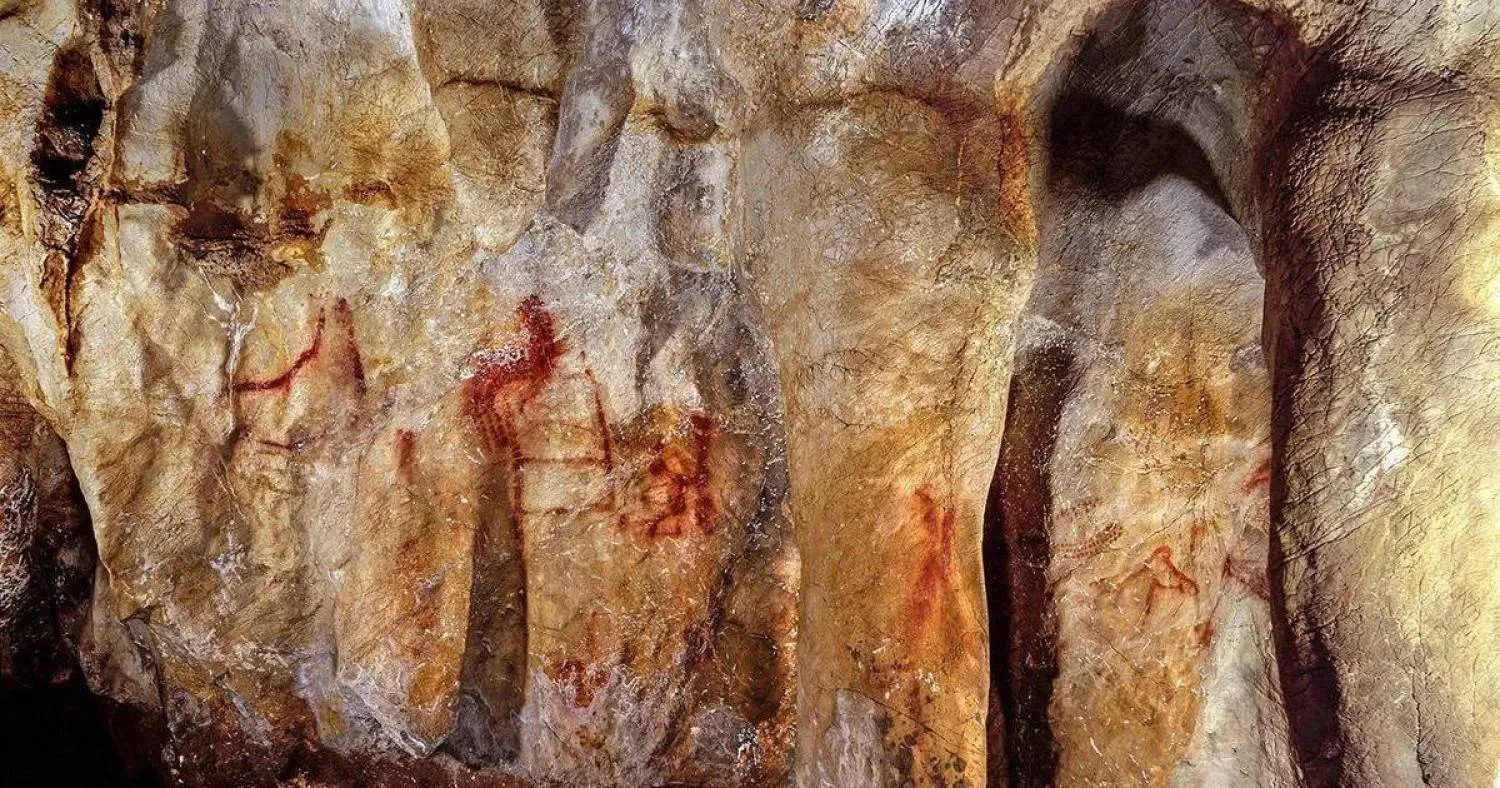

Ancient Cave Discovery Reshapes Scientists' Understanding of Neanderthals and Modern Humans

Modern humans and Neanderthals may have lived as friends (Instagram) 
TT

Ancient Cave Discovery Reshapes Scientists' Understanding of Neanderthals and Modern Humans

Modern humans and Neanderthals may have lived as friends (Instagram) 

Groundbreaking archaeological research from southern Türkiye suggests a surprising new narrative: modern humans and Neanderthals may have lived as friends, sharing elements of their culture.

Evidence unearthed at Ucagizli II Cave indicates that these two closely related human species coexisted between 50,000 and 60,000 years ago, adopting remarkably similar technologies, survival strategies, and even symbolic traditions between 50,000 and 60,000 years ago, according to The Independent.

The revelations could profoundly reshape scientists’ understanding of how Homo sapiens and Homo neanderthalensis interacted during a pivotal period in human evolution.

While modern humans undertook their significant “Out of African” migration into Eurasia, fossil evidence from the Levant – a crucial geographical corridor connecting the two continents – has historically remained relatively scarce.

To shed further light on this era, an international team of researchers from Türkiye, France, and Japan, including scientists from Kyoto University, embarked on extensive excavations at Ucagizli II Cave.

Over a painstaking five-year period, archaeologists meticulously excavated the site millimeter by millimeter.

Their efforts uncovered compelling proof that both Neanderthals and modern humans not only occupied the cave but also used identical stone tool technologies and employed the same hunting methods.

Crucially, researchers also discovered clear indications that the two groups engaged in shared behaviors extending well beyond the necessities of daily survival, hinting at a deeper cultural exchange.

Both Neanderthals and modern humans appear to have deliberately collected the same type of marine seashell, despite it having little or no value as a food source.

Such shells had previously been regarded as being associated only with modern humans.

The researchers say the shared preference for these non-utilitarian objects may point to the exchange of symbolic or cultural practices between the two species.

“Our findings indicate a deep level of cultural interaction,” said a corresponding author Naoki Morimoto of KyotoU.

“These two distinct but closely related human groups were not just adapting to the same environment: they were probably sharing symbolic preferences.”

The modern human remains recovered from the cave have been dated to between 50,000 and 60,000 years ago, placing them within the period when genetic evidence suggests modern humans were dispersing from Africa into Eurasia.

According to the researchers, the individuals may represent close relatives of the population that gave rise to all present-day people living outside Africa.

Alternatively, they could belong to a previously unknown population descended from an earlier migration into the Levant.

The team says the discoveries help fill a significant gap in the archaeological record, offering new insights into how modern humans and Neanderthals may have lived, interacted and exchanged ideas during a prolonged period of coexistence spanning more than 20,000 years.


Sydney Marathon Unveils Medal with Wrong Stadium

The two-sided medal is engraved with a Sydney skyline showing course landmarks including the Opera House, the Sydney Harbour Bridge -- and the Allianz Arena in Munich (Sydney Marathon)
TT

Sydney Marathon Unveils Medal with Wrong Stadium

The two-sided medal is engraved with a Sydney skyline showing course landmarks including the Opera House, the Sydney Harbour Bridge -- and the Allianz Arena in Munich (Sydney Marathon)

Organizers of the 2026 Sydney Marathon have sparked online mirth by unveiling a finishers' medal depicting a stadium in far-away Munich, Germany.

The two-sided medal is engraved with a Sydney skyline showing course landmarks including the Opera House, the Sydney Harbour Bridge -- and the Allianz Arena in Munich.

Marathon bosses admitted the "unfortunate error" in the medal, which displays the German arena's shape and diamond-patterned exterior instead of the flatter features of Allianz Stadium in Sydney.

"A little too much international flavor has found its way onto the back of the finishers medal, with an incorrect depiction of the stadium," AFP quoted a Sydney Marathon spokesperson as saying.

"We're not going to run from it, it was an unfortunate error, though it's certainly given everyone something to talk about this weekend, mostly in good humor."

The medal's reception on social media was light-hearted.

"Oh, dear. Oh, this is bad," said Instagram account @morningcoffeerun, speculating that someone may have mixed up the stadiums in an online search for Allianz.

Munich's Allianz Arena treated the medal muddle with good humor.

"Oh wow, we didn't have that on our bingo card!" it posted on Instagram.

"Perhaps they tried to find something else they had in common: Allianz Arena -- Sydney Opera -- Unique Architecture -- Both are worth a visit!"

Australian media also had fun with the slip.

"The medal that will put Sydney on the map. The wrong map," ran a headline in the Sydney Morning Herald.

The other side of the Sydney Marathon medal shows a widely praised blue-and-gold design by Indigenous artist Ambrose Killian, who told AFP he was not involved in the creation of the Sydney skyline.

Marathon organizers say they expect a record of more than 40,000 participants who will earn the medal as a "badge of honor" for completing the 42.2-kilometre (26.2-mile) course.

"With the event a week away, this is the medal our finishers will receive," the Sydney Marathon spokesperson said.

"Behind every one of these medals is months of early mornings, long runs and quiet determination, and having it placed around your neck at the Sydney Opera House is a moment our participants will never forget," the spokesperson added.

"It's a beautiful medal, and now a little more unique."


Indonesia Deploys Hundreds of Soldiers to Tackle Borneo Fires

 In this aerial photo released by Indonesia's National Disaster Mitigation Agency (BNPB) on Friday, Aug. 21, 2026, smoke billows as a wildfire rages through a peatland forest in Bulungan, North Kalimantan, Indonesia. (BNPB via AP)
In this aerial photo released by Indonesia's National Disaster Mitigation Agency (BNPB) on Friday, Aug. 21, 2026, smoke billows as a wildfire rages through a peatland forest in Bulungan, North Kalimantan, Indonesia. (BNPB via AP)
TT

Indonesia Deploys Hundreds of Soldiers to Tackle Borneo Fires

 In this aerial photo released by Indonesia's National Disaster Mitigation Agency (BNPB) on Friday, Aug. 21, 2026, smoke billows as a wildfire rages through a peatland forest in Bulungan, North Kalimantan, Indonesia. (BNPB via AP)
In this aerial photo released by Indonesia's National Disaster Mitigation Agency (BNPB) on Friday, Aug. 21, 2026, smoke billows as a wildfire rages through a peatland forest in Bulungan, North Kalimantan, Indonesia. (BNPB via AP)

Indonesia is deploying an additional 1,500 soldiers to Borneo, an official said Saturday, to help tackle wildfires that have burned through swathes of the island and created thick smog choking some areas.

Fires between January and July burned over 200,000 hectares of land -- an area three times the size of the capital Jakarta, the government said this week, as dry conditions driven by a powerful El Nino weather pattern take hold.

President Prabowo Subianto, on a visit to Borneo on Saturday to lead wildfire response meetings, ordered increased troop deployment, said Cabinet Secretary Teddy Indra Wijaya.

"An additional three Indonesia National Armed Forces battalions, or around 1,5000 personnel, will be brought in from outside Kalimantan starting today," Teddy said in a statement.

Kalimantan is Indonesia's part of Borneo, which the country shares with Brunei and Malaysia.

Six helicopters were also set to arrive on Saturday to boost waterbombing operations, Teddy said.

The government is monitoring the situation closely, mobilizing resources to help contain the spread of the blaze, Prabowo told reporters in the Central Kalimantan provincial capital of Palangkaraya.

"We're taking mitigation measures. The important thing is to immediately stop the spread of fire spots," said the president.

Smog from the fires has prompted local governments in Borneo, home to pristine rainforest and vast plantations, to advise residents to wear masks and reduce outdoor activities.

The fires have sent smoke into Malaysian Borneo, with six areas of Sarawak state recording "unhealthy" air quality.

The area burned is already larger than during previous El Nino seasons in 2019 and 2023, but not as large as in 2015, during a particularly strong El Nino.

El Nino is a naturally occurring climate phenomenon that brings worldwide changes in winds, air pressure and rainfall patterns. It typically brings drought in Indonesia.

Human-caused climate change can amplify its impacts because a warmer ocean and atmosphere make more energy and moisture available to feed extreme weather events.


Heavy Rain Lashes Northeast Spain, Injuring 11

Three people were injured when a wall collapsed at the port of Roda de Bera. (AFP file)
TT

Heavy Rain Lashes Northeast Spain, Injuring 11

Three people were injured when a wall collapsed at the port of Roda de Bera. (AFP file)

Heavy rain battered northeast Spain, flooding streets, trapping people in cars, forcing the evacuation of a campsite and injuring 11 people, officials said Saturday. 

Three people were injured, one critically, when a wall collapsed near the seafront at the port of Roda de Bera, about 75 kilometers (45 miles) southwest of Barcelona, emergency services said. Firefighters had to free two people trapped under the rubble. 

Seven people were taken to hospital following other incidents, including two who were injured when another wall collapsed during the overnight storm at a campsite in Roda de Bera. 

Firefighters evacuated around 300 people staying at the campsite, with about 100 taking shelter at a municipal sports centre, officials said. 

Around 100 people were evacuated from a nightclub in El Vendrell, a town of about 40,000 people, and taken to a school. 

The seafront in El Vendrell was submerged under more than half a meter (20 inches) of water, while several streets in nearby Coma-ruga and Torredembarra were also flooded, Catalan public television reported. 

El Vendrell was among the areas worst affected, recording 145.4 liters of rain per square meter (26.7 imperial gallons per square yard) in 24 hours, according to the Catalan Meteorological Service. 

Emergency services received more than 800 calls, with firefighters rescuing people from vehicles trapped in floodwater and dealing with flooded premises, the service said in a statement. 

The storm came a week after a flood and landslide triggered by torrential rain killed two women in northwest Spain.
