


Aoun Rejects Linking Lebanon to Iran Talks, Says Hezbollah Must Prove it Prioritizes Lebanon

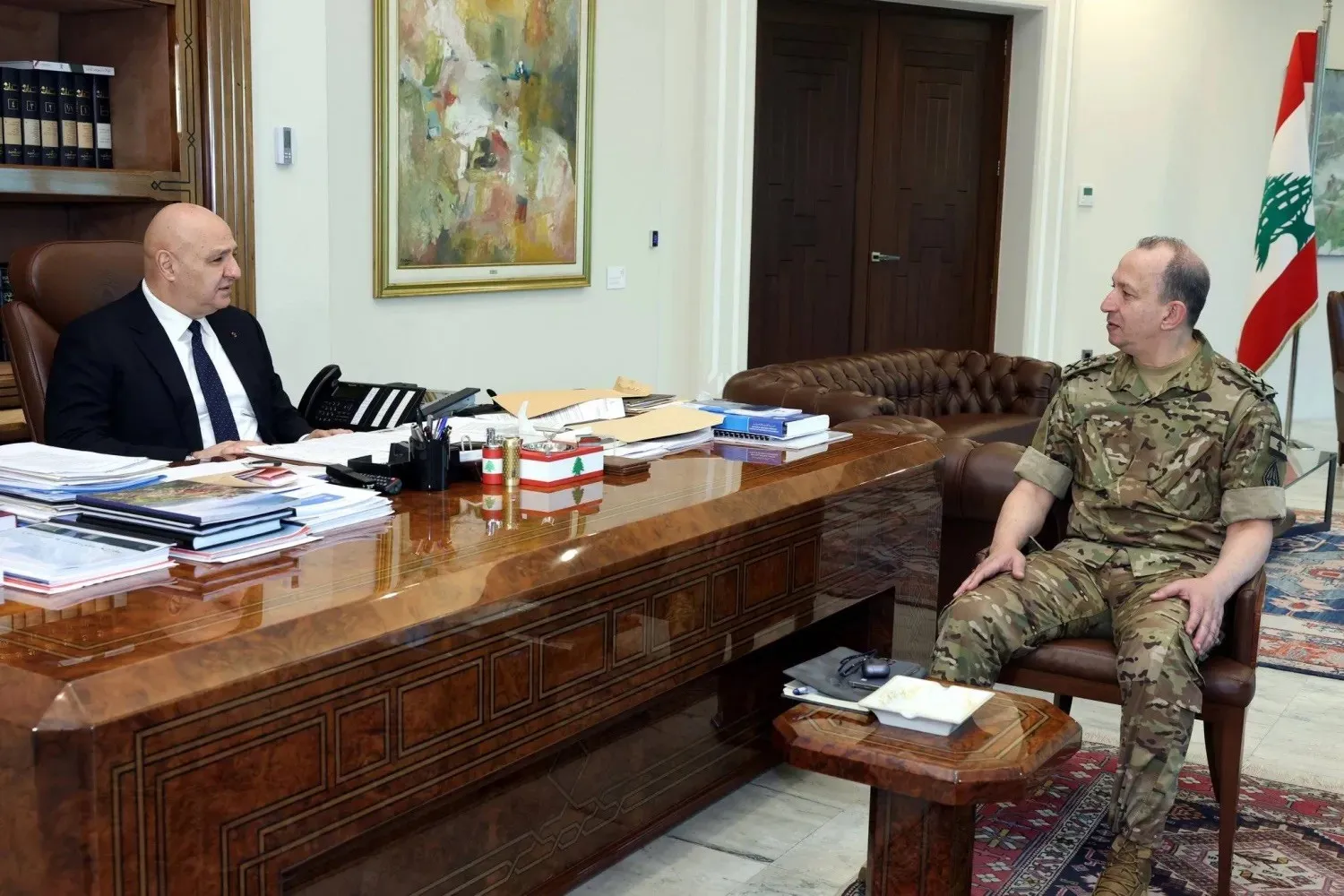
Lebanese President Joseph Aoun meets with Army Commander Gen. Rodolphe Haykal to discuss ongoing preparations for implementing the provisions of the framework agreement in the pilot areas. (Lebanese Presidency)
TT

Aoun Rejects Linking Lebanon to Iran Talks, Says Hezbollah Must Prove it Prioritizes Lebanon

Lebanese President Joseph Aoun meets with Army Commander Gen. Rodolphe Haykal to discuss ongoing preparations for implementing the provisions of the framework agreement in the pilot areas. (Lebanese Presidency)

Lebanese President Joseph Aoun rejected attempts to tie Lebanon’s future to the Iranian negotiations, declaring that “we are now separate from the Iranian situation and the Islamabad agreement.”

He also urged all parties to give the US-sponsored framework agreement between Lebanon and Israel a chance, accusing both Tehran and Tel Aviv of trying to undermine it. Hezbollah has also rejected it.

Aoun warned that if Hezbollah refuses to cooperate with efforts to end the war in South Lebanon, “it will bear responsibility for its decision” and prove that it places Iran’s interests above Lebanon’s.

The Lebanese state is pressing ahead with US-mediated negotiations with Israel despite Hezbollah’s continued rejection and insistence on retaining its weapons.

The diplomatic track has won broad international backing and growing support among Lebanon’s Christian parties. On Friday, the Lebanese Forces reiterated that “there is currently no alternative to negotiations.”

Speaking to journalists on Friday, Aoun said war had proved futile and that negotiations, backed by US guarantees, offered the best path forward.

He noted that Hezbollah’s stated objectives — an Israeli withdrawal from southern Lebanon, the return of bodies, and reconstruction — are the same goals Lebanon has pursued in talks with Israel under US mediation.

“The difference is the means,” Aoun said, reiterating that war “is not a good option.”

He urged all parties to give the agreement a chance while warning that Israeli Prime Minister Benjamin Netanyahu “always wants to complicate matters,” adding that Iran is doing the same.

Turning to Hezbollah’s weapons, Aoun said: “As long as the party’s choice is Iranian, there will be no point. Matters will be resolved only when its choice becomes Lebanese rather than Iranian.”

He stressed that Hezbollah cannot be dealt with by force because it is not just an armed groups “but also a social constituency.”

Trump meeting

Ahead of his July 21 meeting with US President Donald Trump in Washington, Aoun said he would present “the true reality in Lebanon today,” seek continued US support for the Lebanese Armed Forces, and call for an international conference to support Lebanon.

He described Trump’s invitation to the White House as a “golden opportunity” to tell the US administration that “America’s credibility is at stake” in implementing the framework agreement.

He added that resolving Hezbollah’s weapons issue requires cooperation with the group rather than simply talking about “disarmament,” noting that the weapons are concealed in numerous locations rather than stored in identifiable military barracks.

Aoun also revealed that Lebanon has yet to appoint its representative to the committee established under the Washington-Tehran memorandum of understanding following the Islamabad negotiations, pending a formal US request, particularly since Iran has not yet named its own representative.

He stressed that he, Prime Minister Nawaf Salam, and Parliament Speaker Nabih Berri “do not want sedition or internal fighting,” adding: “We are now separate from the Iranian situation and the Islamabad agreement.”

At the same time, he cautioned that any broader regional conflict would inevitably spill over into Lebanon.

On the border issue, Aoun said talks with Israel would be confined to the 13 disputed border points. He also disclosed that Lebanon had sent Syria a border file and was still awaiting a response.

Geagea

Meeting a delegation from the Lebanese Forces led by party chief Samir Geagea, Aoun pledged not to retreat from negotiations, saying the framework agreement could restore Lebanon’s rights through diplomacy, provided Israel respects it.

He argued that criticism of the process stems from attempts to place the Lebanese file back in Iran’s hands.

Geagea endorsed the negotiating track, saying Lebanon cannot function without “one army and one set of arms.”

Decisions on national issues and the Israeli presence must be made by the Lebanese state, not by any political party, he urged.

“None of us is enamored with the agreement, but at present we have no alternative but negotiations,” he remarked.

In contrast, Hezbollah MP Hussein Hajj Hassan dismissed the agreement as one imposed by the United States on both Israel and Lebanon’s authorities, which he said lack negotiating experience and represent only part of the Lebanese people.

Rejecting what he described as threats to bring in foreign forces to disarm Hezbollah, he said neither foreign troops nor the Lebanese authorities would succeed in stripping the “resistance” of its weapons.



Israeli Strikes Kill at Least 3 in Gaza, Including Worker with UN Palestinian Agency

23 November 2026, Palestinian Territories, Gaza: Mourners attend the funeral and bid farewell to the body of Adel al-Helo, an employee of the United Nations Relief and Works Agency (UNRWA), who was killed in an Israeli airstrike while performing his duties in the Jabalia refugee camp. (dpa)
TT

Israeli Strikes Kill at Least 3 in Gaza, Including Worker with UN Palestinian Agency

23 November 2026, Palestinian Territories, Gaza: Mourners attend the funeral and bid farewell to the body of Adel al-Helo, an employee of the United Nations Relief and Works Agency (UNRWA), who was killed in an Israeli airstrike while performing his duties in the Jabalia refugee camp. (dpa)

Israeli airstrikes killed at least three people in Gaza on Monday, including a man working for the UN Palestinian refugee agency UNRWA, the relief agency and local health officials said.

The UNRWA worker, whom medics named as Adel Al-Helo, was working near a well in the Jabalia refugee camp in the enclave's north, the ‌agency and ‌medics said. Three others were wounded in the strike, they ‌said.

"The ⁠initial reports indicate ⁠that the strike hit a target on the street near the water well, which was manned by UNRWA staff and a guard. The staff were engaged in their regular duties associated with water well operations," an UNRWA spokesperson told Reuters.

The Israeli military said it was checking the report in response to Reuters' request for comment.

Helo's body was wrapped in a white shroud, his blue vest bearing ⁠UNRWA's logo stained with blood, as friends and relatives bade ‌farewell outside the hospital's morgue.

"(He) has been ‌killed by an Israeli strike in Jabalia camp by the Israeli army, they don't ‌make any difference (between) the civilian people and other people, even the people ‌of the United Nations," said Helo's brother Nizar, kneeling beside the body, speaking in English.

"He went to run the water well to supply the residents of Jabalia camp with water. He's worked at the agency for 35 years," he told Reuters.

Later on Monday, another ‌Israeli airstrike targeted a vehicle in western Gaza City, killing two people and wounding others, medics said. The Israeli ⁠military did not ⁠immediately comment.

An October 2025 US-backed ceasefire halted major fighting in the shattered territory, but has not stopped Israeli attacks on Gaza or secured Hamas' disarmament.

At least 1,600 Palestinians and five Israeli soldiers have been killed since then, according to respective Palestinian and Israeli tallies.

Israeli troops now control around two-thirds of Gaza, up from more than half at the time of the ceasefire, with Hamas controlling a sliver of territory along Gaza's coast.

Israel's more than two-year-long assault on Gaza has killed tens of thousands, caused a hunger crisis, internally displaced Gaza's entire population and led to assessments of genocide from scholars and a United Nations inquiry.

Israel says its actions were in self-defense after Hamas-led fighters killed 1,200 people and took more than 250 hostages in an October 2023 attack on Israel.


Does the Jurf al-Sakhar Experience Serve as a Model for What Awaits Lebanon’s Hezbollah?

Residents of the town of Nabatieh al-Fawqa carry Lebanese flags as they march toward their hometown on Lebanon’s 83rd Independence Day in the Nabatieh district, southern Lebanon, 22 November 2026. (EPA)
TT

Does the Jurf al-Sakhar Experience Serve as a Model for What Awaits Lebanon’s Hezbollah?

Residents of the town of Nabatieh al-Fawqa carry Lebanese flags as they march toward their hometown on Lebanon’s 83rd Independence Day in the Nabatieh district, southern Lebanon, 22 November 2026. (EPA)

When Lebanese citizens watched Iraqi government forces enter Jurf al-Sakhar to reclaim control from the Iran-aligned Kataib Hezbollah faction, a single question crossed the minds of many: Could the same scenario unfold in Lebanon, leaving no weapons in the country other than those of the legitimate state?

Recent developments in Iraq’s Jurf al-Sakhar region restored a security deployment to an area that had remained outside effective state control for years. What transpired with Iraq’s Iran-aligned Kataib Hezbollah, which was forced to accept the entry of government troops into one of its most prominent strongholds, as well as the possibility of its agreement to surrender its weapons, opens the door to questions regarding the future of Iran-linked armed factions across the region.

This most notably means Hezbollah in Lebanon and whether these events reflect a shift in Tehran’s approach to its military proxies beyond its borders.

For Lebanon, the significance of the Jurf al-Sakhar experience lies in the indication that the military and political clout accumulated by Iran-aligned factions is not necessarily irreversible, even in areas that have evolved into strategic strongholds for them.

Sectarian structure

Dr. Hilal Khashan, a professor of political science at the American University of Beirut, said that "following the US invasion of Iraq, a Lebanese-style sectarian system took shape there. The systems in both Lebanon and Iraq are fundamentally incompatible with a democratic system."

"In Iraq, the Popular Mobilization Forces (PMF) were legalized, whereas in Lebanon, legitimacy was recently stripped from Hezbollah's weapons," he told Asharq Al-Awsat.

He characterized the post-2003 political order in both countries as "a sectarianism held in Iran's grip.”

"Despite current developments, we do not appear to be heading toward radical solutions in either Iraq or Lebanon. What is currently being pursued is a patchwork policy on both fronts,” he explained.

"One can speak of a current isolationist trend among Shiites in Lebanon and Iraq... and there is no doubt that the collapse of the Iranian regime will happen sooner or later from within as a result of the economic blockade and ongoing sanctions, which will automatically weaken its regional proxies,” he stressed.

Risks of integration

Despite clear parallels between the experience of Hezbollah and that of Iran-linked Iraqi armed factions, particularly Kataib Hezbollah, there are also differences in their legal, political, and military structures that cannot be overlooked.

Jad al-Akhaoui, head of the Lebanese Democratic Coalition and a Shiite opponent of Hezbollah, said: "In both cases, we are dealing with armed organizations that emerged or grew stronger outside the traditional military establishment, acquiring political and security influence that enables them to sway state decisions.”

“The difference, however, is that the PMF in Iraq enjoy official legal status, whereas the military structure of Lebanon’s Hezbollah has become independent of state institutions and operates outside the law,” he told Asharq Al-Awsat.

He stressed that "just as Iraq requires weapons and military capabilities to be placed exclusively under the authority of the Iraqi army and official security institutions, within a unified national command subject to constitutional accountability, this same principle must be applied in Lebanon.”

“The danger lies not merely in the existence of weapons outside the state, but in the state itself turning into a legal umbrella for weapons over which it exercises no actual decision-making power," he added.

Al-Akhaoui said that "the lesson Lebanon can draw from the Iraqi experience is not that Jurf al-Sakhar will necessarily be repeated, but rather that resolving the weapons issue must culminate in strengthening state authority, not reproducing dual authority under a new label."

He urged Lebanese officials "to recognize that integrating Hezbollah into the military institution while it retains its organizational structure and independent leadership risks importing the problem into the state rather than solving it."

He added: "What is required is a binding government decision and an executive plan not exceeding six months, beginning within 30 days with an inventory of weapons and military sites, followed by specific phases to hand over weapons to the Lebanese Army and place military facilities under its exclusive authority."

Hezbollah’s hardline stance

Although there are still no decisive indicators that Iran has decided to abandon its model of armed proxies or that it will push toward their disarmament, it is clear that the regional environment in which this model emerged and expanded is no longer what it was years ago.

Retired Brigadier General George Nader noted that "what happened with the entry of Iraqi armed forces into Jurf al-Sakhar is the outcome of negotiations with Iran."

"Legitimate deployment there paves the way for disarmament or the handover of weapons; otherwise, the step remains incomplete,” he told Asharq Al-Awsat.

Nader said that "should a weapons handover take place in Iraq, it will inevitably affect Hezbollah in Lebanon, though the impact will be limited because the latter, unlike the Iraqi faction formed in 2004, has existed since the 1980s and controls political decision-making in the country, as well as the deep state together with Parliament Speaker Nabih Berri.”

“Consequently, it is unlikely that the current scenario in Jurf al-Sakhar will apply to Hezbollah in Lebanon, which we do not expect to accept any withdrawals or handover of weapons, just as the state does not appear ready to enforce its decisions by force,” he added.


Oil Thefts Span All Iraqi Governorates... Losses Estimated at $150 Billion

20 November 2026, Iraq, Jurf al-Sakhar: Iraqi security forces take up positions in Jurf al-Sakhar, in Babil governorate, south of Baghdad, during the establishment of a new military command center in the area. (dpa)
TT

Oil Thefts Span All Iraqi Governorates... Losses Estimated at $150 Billion

20 November 2026, Iraq, Jurf al-Sakhar: Iraqi security forces take up positions in Jurf al-Sakhar, in Babil governorate, south of Baghdad, during the establishment of a new military command center in the area. (dpa)

Shock and anger continue to grip broad segments of Iraqi society following recent government efforts that culminated in uncovering large-scale oil theft and smuggling operations across multiple governorates. Near-certain information indicates that organized oil theft spans most of Iraq's oil-producing governorates, as well as those traversed by oil transport pipelines.

Since the scandal involving Deputy Oil Minister for Refining Affairs Adnan al-Jumaili erupted in May, Iraqi authorities have arrested roughly 70 oil sector officials.

In the latest development, the Najaf governorate's Intelligence and Security Directorate announced on Monday that its units "seized an excavator used to dig a trench near one of the oil pipelines in the governorate and arrested its driver."

It added that the operation followed close, continuous intelligence tracking, leading to the arrest of the driver red-handed.

According to the statement, the operation is part of intensive security efforts by intelligence agencies to protect infrastructure and public property, and to thwart any attempts targeting the governorate's security and economic resources.

On Saturday, judicial authorities conducted a field inspection at the encroachment site in Najaf's Al-Haidariya area, confirming oil smuggling operations through a pipeline running inside a plot of land owned by provincial council member and Energy Committee head Mohammed Ali al-Hasnawi, brother of lawmaker Abdul-Hadi al-Hasnawi and Sheikh Hussein al-Abbasi.

Authorities issued arrest warrants for all three, apprehending the eldest brother, Hussein al-Abbasi, amid reports that the other two had fled to an unknown location.

The oil theft in Najaf was uncovered roughly a week after intelligence reports exposed large-scale oil siphoning and smuggling in the Jurf al-Sakhar area by the Iran-aligned Kataib Hezbollah armed faction, which had controlled the area since 2012.

Those reports, backed by evidence and satellite imagery, showed that the operation had been underway since 2021, before government forces succeeded in halting it and entering the area last Friday.

Decades of theft and smuggling

Former head of the Federal Commission of Integrity Judge Rahim al-Ugaili told to Asharq Al-Awsat that "oil theft and smuggling date back two decades.”

“In 2013, the Commission uncovered a prominent politician at the time who was smuggling oil by building a large poultry hatchery directly over a pipeline in the Babil governorate,” he revealed.

"Political pressure and influence prevented him from being held accountable or having his case brought to justice at the time."

Although smuggling has been widespread for years, public suspicion had long centered on ordinary smuggling networks and gangs until recent developments exposed the direct involvement of armed factions, political figures, members of parliament, and tribal sheikhs in the thefts.

Semi-official figures indicate that Iraq has lost more than $150 billion to theft and damage inflicted on its oil pipeline network since 2003, laying bare the scale of disregard for public funds and the nation's primary source of wealth.

Many observers of the oil sector tend to hold the Ministry of Oil squarely responsible for the ongoing smuggling and theft.

Reports have circulated regarding the possible dismissal of current Oil Minister Basim Mohammed al-Abbadi in the wake of the recent crackdown on smuggling networks. Al-Abbadi dismissed on Monday the reports as baseless.

A former Oil Ministry official places the blame for the past and ongoing crimes on most of the influential political blocs and parties that have held power over the past two decades.

The official, who requested anonymity, told Asharq Al-Awsat that "the smuggling file encompasses every Iraqi governorate from the far south to the far north."

He added that "all political forces have known about the smuggling for years, but they have no desire to address it given that most of them are involved. Oil is the shortest path to self-enrichment and securing massive funds to finance political parties."

In his view, "a final resolution to the oil smuggling file is impossible, because the very groups and parties that stole or shielded the theft rings still wield broad influence in the government and parliament. They are now merely trying to absorb public anger."

In a related development, the Supreme Judicial Council announced measures against suspects implicated in crude oil smuggling between the governorates of Dhi Qar and Basra.

One suspect has been detained, as well as several members of the Energy Police tasked with guarding the pipeline.