


Iraqi Factions Pledge Allegiance to Khamenei, Reject Disarmament

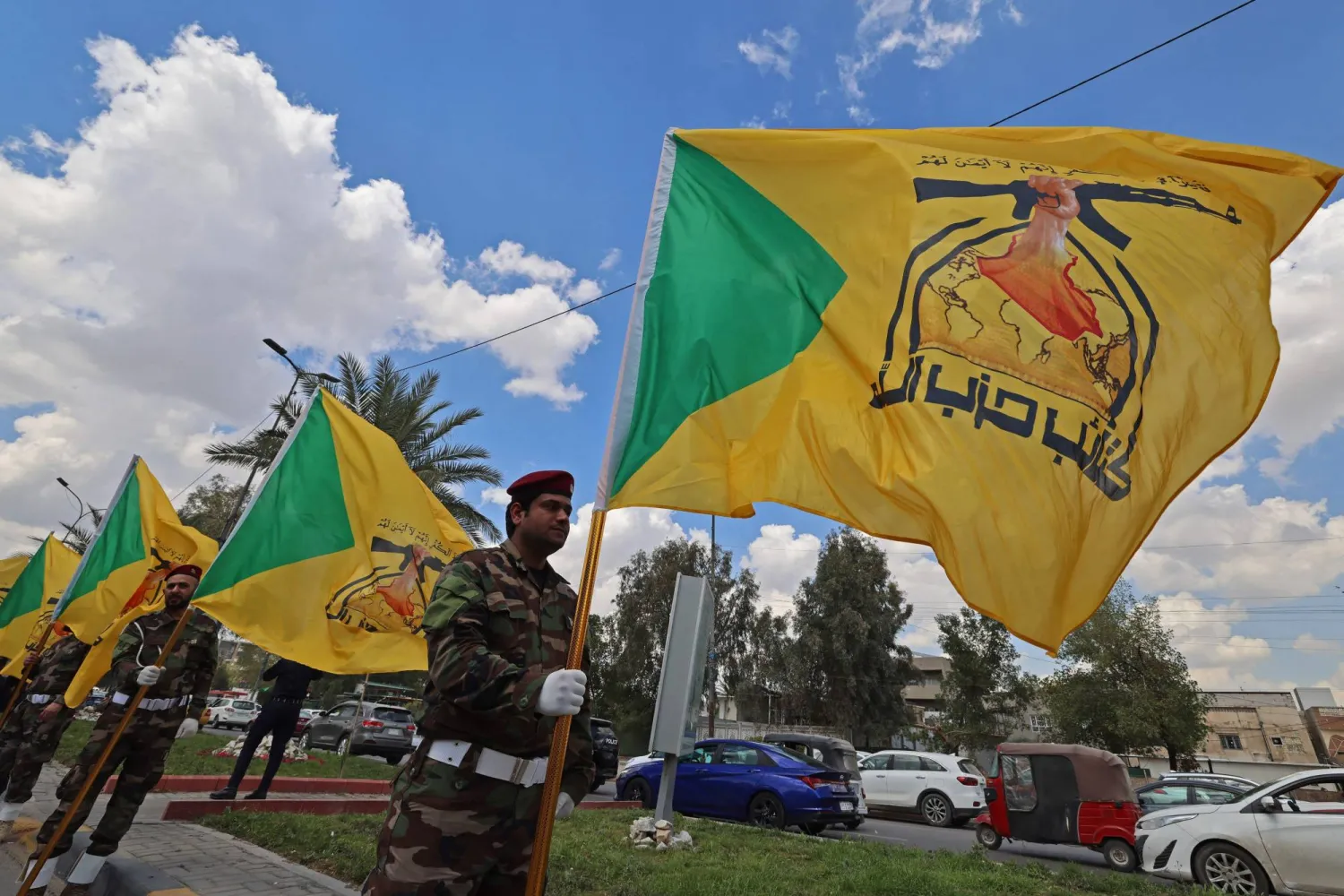
Members of Iraq's Hezbollah Brigades (Kataib Hezbollah) gather in a mourning procession for one of their comrades who was killed the previous day in a strike in Basra, during the funeral in Baghdad on April 8, 2026. (Photo by AHMAD AL-RUBAYE / AFP)
TT

Iraqi Factions Pledge Allegiance to Khamenei, Reject Disarmament

Members of Iraq's Hezbollah Brigades (Kataib Hezbollah) gather in a mourning procession for one of their comrades who was killed the previous day in a strike in Basra, during the funeral in Baghdad on April 8, 2026. (Photo by AHMAD AL-RUBAYE / AFP)

About a week before Iraqi Prime Minister Ali al-Zaidi is due to visit Washington, factions and groups linked to the so-called Islamic Resistance in Iraq have rejected calls to hand over their weapons to the state.

As the US administration presses Baghdad to disarm the factions and sever their ties with Iran, the latest positions of these factions confront al-Zaidi with complex political and security challenges.

The government had previously set the end of September as the final deadline for weapons to be surrendered and dismantled, coinciding with the end of the international coalition’s military presence under an agreement with the Iraqi government.

Al-Zaidi said last week that the government had entered into talks with the factions, whose activities would “later shift to the political and social arenas.”

Once the deadline for disarmament and the transfer of weapons to government security institutions expires, “arms will be held exclusively and entirely by the official institutions of the state and its specialized armed and security forces,” al-Zaidi said.

Kataib Hezbollah warning

In a strongly worded statement, Kataib Hezbollah official Abu Hussein al-Hamidawi demanded that the Iraqi government “submit” to the resistance.

In April, the US State Department offered a reward of up to $10 million for information leading to the capture or conviction of al-Hamidawi, who is regarded as one of the faction leaders closest to Iran.

Al-Hamidawi said Kataib Hezbollah was founded by the late Iranian Supreme Leader Ali Khamenei and on his orders, adding that its members “were and remain loyal to this path.”

“At this historic juncture, we draw the attention of political leaders and government officials to the need to submit to the will of the people of resistance and jihad, and to exercise extreme caution against being drawn into arrogant projects or aligning themselves with their malicious agendas,” al-Hamidawi said, referring to the disarmament plan.

“We warn them that our people will make their position and decision known if the compass deviates,” he added.
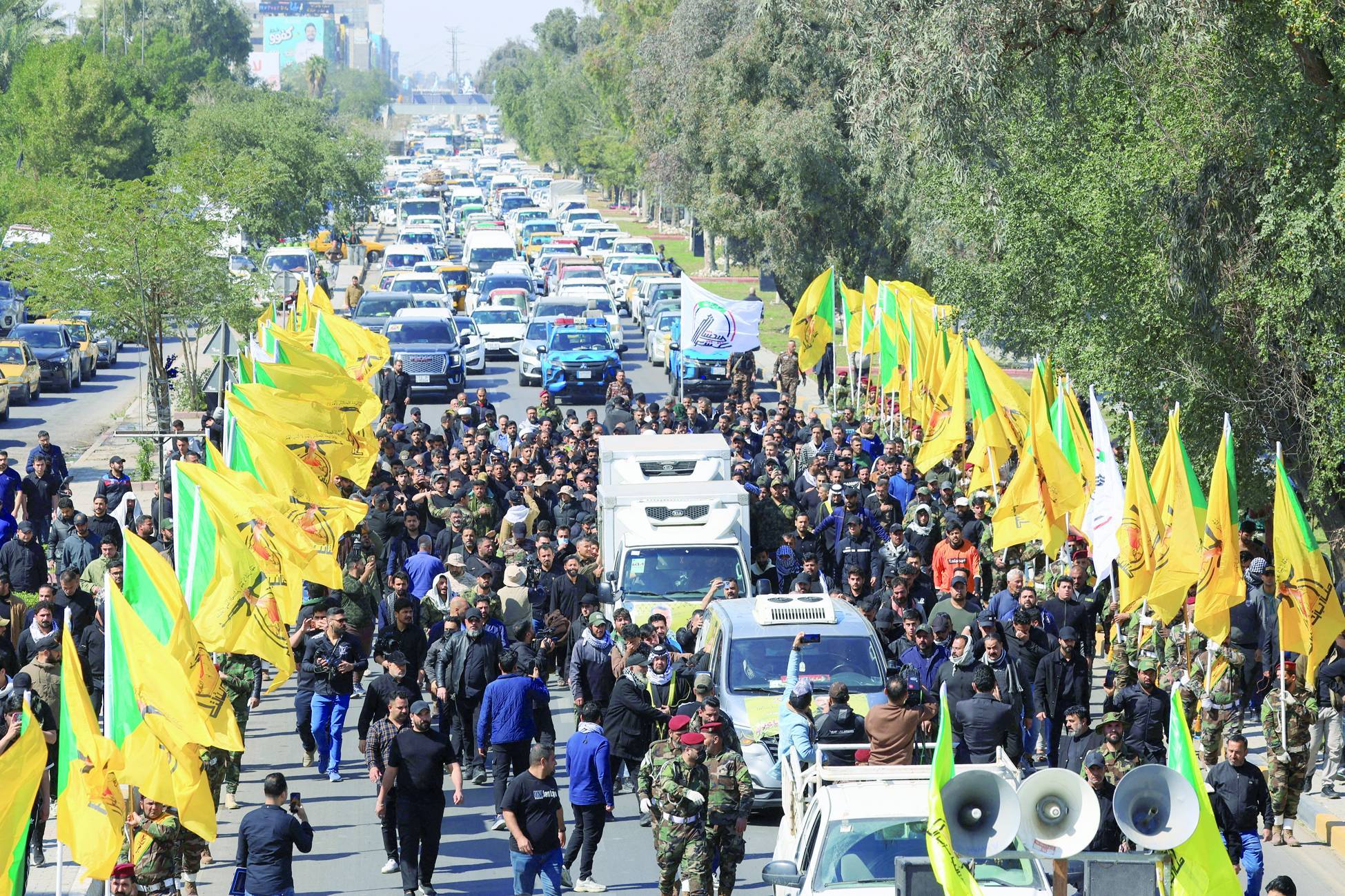
A funeral procession in Baghdad for members of Iraq's Kataib Hezbollah killed in a raid targeting a Popular Mobilization Forces headquarters in March 2025 (Reuters)

The so-called Islamic Resistance in Iraq also rejected calls to surrender its weapons. The armed coalition comprises a range of undeclared factions whose agendas align with the activities of Iran’s Revolutionary Guards. They are also widely viewed as covert wings of known Iran-backed factions.

The group said in a statement on Saturday that it remained “committed to the path of resistance.”

“Let the enemies know that the forces of the axis of truth are one body, operating according to the jihadist framework laid down for us by our leader, Khamenei,” it said.

“Hardships will not deter us, but will only strengthen our determination to continue on our path of supporting the oppressed and expelling the occupiers from Iraq and the region.”

“Our weapons have never been open to bargaining. They are a doctrine and a pledge for which we are responsible, and with them we will move forward to break the chains of domination and restrain the arrogant powers,” the group added.

“We therefore affirm to those near and far that we will not stop at what we have achieved. Rather, we will work to develop our military and security capabilities, both quantitatively and qualitatively, and raise our readiness in proportion to the scale of the growing challenges and threats.”

So far, Shiite cleric Moqtada al-Sadr, leader of the Sadrist movement, has responded to calls to bring all weapons under state control. Last month, he ordered his armed faction, Saraya al-Salam, to hand over its weapons and official headquarters to the state.

Asaib Ahl al-Haq and Kataib Imam Ali have also complied with the demand. However, some factions’ continued rejection of the move is likely to increase the challenges and complications the government faces on the issue, according to observers.
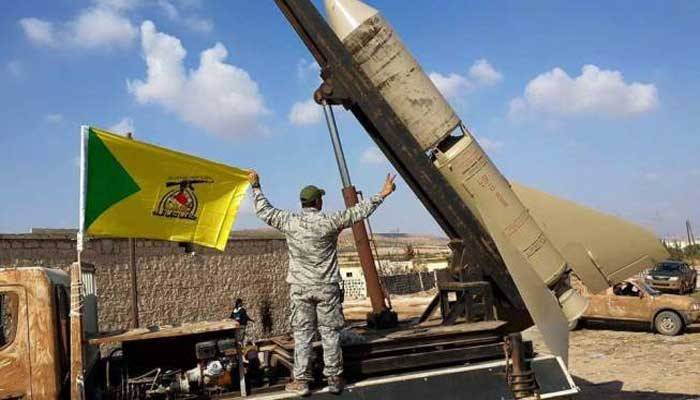
A member of Iraq's Kataib Hezbollah waving the faction's banner on a missile launch platform (Faction media)

Expected judicial action

Observers are divided over the prospect of disarming the factions. Some consider it impossible without flexibility or clear approval from Iran, while others believe the government can achieve it amid rapidly changing regional circumstances.

Political analyst Nizar Haidar told Asharq Al-Awsat that it was necessary to distinguish between what the militias publicly declared and what they concealed.

That included “secret understandings that will ultimately lead to the complete surrender of their weapons and the dismantling of their military formations,” he said.

Haidar said he expected the Iraqi judiciary to take a deterrent position against groups that violated the law by retaining weapons outside state control. He added that the judiciary was preparing, for the first time since 2003, to announce a legal code.

“Any military formation or military activity outside the state is expected to be classified as a terrorist act, punishable under existing Iraqi laws by up to the death penalty,” Haidar said.

He said the legal code, if issued, would “contribute significantly to helping the government implement its plans to place all weapons under state control.”

Efforts to disarm and dismantle the factions would also be reinforced by “government plans to purge the security and military institutions of militia members who refuse to sever their ties with their leaders and place their security and military decisions under the authority of the commander-in-chief of the armed forces, following the example of the factions that have announced such steps in recent months,” Haidar added.



Syrian Authorities Say Killed Assad-Era Officer After Clash

A member of Syria's internal security forces in Tartus city. (SANA)
TT

Syrian Authorities Say Killed Assad-Era Officer After Clash

A member of Syria's internal security forces in Tartus city. (SANA)

Syrian security forces said on Sunday that they killed an army commander who served under ousted ruler Bashar al-Assad, after he opened fire on them as they tried to arrest him.

In a statement, the forces accused Firas Abdul Karim Hammoud of having taken part in anti-government insurrections that killed security personnel.

Since Assad's fall in December 2024, Syria's new authorities have arrested dozens of security officials from his rule, and trials began in April.

The security forces said they "neutralized Firas Abdul Karim Hammoud... following an armed clash and a raid on his hideout in the town of Safita" in Tartus province in the coastal Alawite heartland.

Hammoud had previously "opened fire on security personnel during an attempt to arrest him", they added.

"During the recent operation, he again opened fire and initiated a firefight with the security forces... necessitating their response."

They said Hammoud served as a commander of the special forces in the so-called "25th Division" under Assad's rule.

They accused him of working under Assad-era general Ghiath Dalla in leading pro-Assad groups on the coast after the former president's fall.

They added that he was involved in "armed insurrection operations" against state institutions that killed security personnel.

Dalla, a former officer in the much-feared Fourth Brigade, had announced on social media last year the formation of a "military council for the liberation of Syria".

The announcement came shortly before deadly violence targeting the Alawite minority, to which Assad's family belongs, erupted on the Syrian coast in March 2025.

Authorities accused armed Assad supporters of sparking the violence by attacking security forces in an ambush.


Iraq Sentences US-Sanctioned Oil Official to Prison

The sun sets behind apartment buildings in Baghdad, Iraq, Friday, Aug. 28, 2026. (AP)
TT

Iraq Sentences US-Sanctioned Oil Official to Prison

The sun sets behind apartment buildings in Baghdad, Iraq, Friday, Aug. 28, 2026. (AP)

Iraq sentenced a US-sanctioned oil official to seven years in prison after he was arrested as part of a government-led anti-corruption campaign, the country's anti-graft body said on Sunday.

Deputy oil minister for distribution affairs Ali al-Bahadli is among dozens of officials who were detained in June during anti-graft raids that took place in several areas, mostly in Baghdad's fortified Green Zone.

The Commission of Integrity said in a statement that an anti-corruption court sentenced Bahadli to seven years in prison for "illicit gains".

The ruling requires Bahadli to return to the state an amount equivalent to more than $20 million in ill-gotten gains, in addition to paying a fine of the same amount.

The United States imposed sanctions on Bahadli in May, accusing him of fraudulently mixing Iraqi and Iranian oil as part of a scheme to help Iran avoid sanctions.

At the time, Iraq's oil ministry denied the accusations against Bahadli, who was then arrested during the anti-graft raids.

Iraqi authorities said that the raids were part of new Prime Minister Ali al-Zaidi's campaign to fight the corruption that has plagued Iraq for decades.

But several Iraqi officials told AFP that the raids were also part of al-Zaidi's campaign against funding for pro-Iran armed groups and the smuggling of Iranian oil.

Iraq has been under mounting pressure from the United States to curb Tehran's influence and rein in Iran-backed armed factions, which Washington designates as terrorist groups.

Al-Zaidi, who took office this year with the blessing of the United States, has pledged to ensure the armed factions that emerged after the US-led invasion hand over their weapons to the state.

In Iraq, corruption is especially rampant across public institutions, but convictions typically target mid-level officials or minor players and rarely those at the top of the power hierarchy.


US News Agency Says Crew Attacked by Israeli Settlers in West Bank

 Israeli settlers look out through a metal fence, as an Israeli flag flutters nearby, on the day of their weekly tour in Hebron, in the Israeli-occupied West Bank, August 29, 2026. (Reuters)
Israeli settlers look out through a metal fence, as an Israeli flag flutters nearby, on the day of their weekly tour in Hebron, in the Israeli-occupied West Bank, August 29, 2026. (Reuters)
TT

US News Agency Says Crew Attacked by Israeli Settlers in West Bank

 Israeli settlers look out through a metal fence, as an Israeli flag flutters nearby, on the day of their weekly tour in Hebron, in the Israeli-occupied West Bank, August 29, 2026. (Reuters)
Israeli settlers look out through a metal fence, as an Israeli flag flutters nearby, on the day of their weekly tour in Hebron, in the Israeli-occupied West Bank, August 29, 2026. (Reuters)

Israeli settlers attacked an NBC crew in the central West Bank Saturday, as they were interviewing a Palestinian woman who said she’d been driven out of her house by settlers, the network said.

NBC’s American correspondent Matt Bradley, two other crew members and the woman they were interviewing were all treated for injuries sustained during the attack, NBC said. There were no further details on their injuries.

The assault was caught on video and shared by NBC, with footage showing masked settlers approaching the crew with sticks and beating the crew’s vehicles.

Israel’s military said it was “aware of reports of Palestinian injuries, including a Palestinian woman who sustained non-life-threatening injuries and was evacuated by the Red Crescent for medical treatment.” It did not comment on the attack on the NBC crew.

It was the latest in a growing wave of violence by West Bank settlers. Prime Minister Benjamin Netanyahu issued a rare condemnation of the violence on Saturday. The Israeli leader has come under heavy US criticism for the settler attacks.

Settlers seized British activist and held him locked in shed

Israeli settlers seized a British activist from a Palestinian village in the West Bank and locked him in a shed before turning him over to police, his lawyer said Sunday.

The lawyer, Inbar Shaked Vardi, said settlers held her client, Finn Joughin, for half an hour Saturday before turning him over to Israeli police. Joughin was set to appear before a Jerusalem court later Sunday, she said.

Video showed two settlers, one armed, restraining Joughin and marching him away from the village.

It was not immediately clear what led to his capture. Settlers say he assaulted a child, accusations Vardi vehemently denied.

Settlers point to a video where the activist uses his body in an apparent attempt to block a settler boy from passing through a fence. Vardi said the video shows he was trying to protect the village.

Police said they were investigating and holding Joughin in custody on suspicion of committing an indecent act against a minor.