


New Era for Gibraltar as Border Controls with Spain Set to End

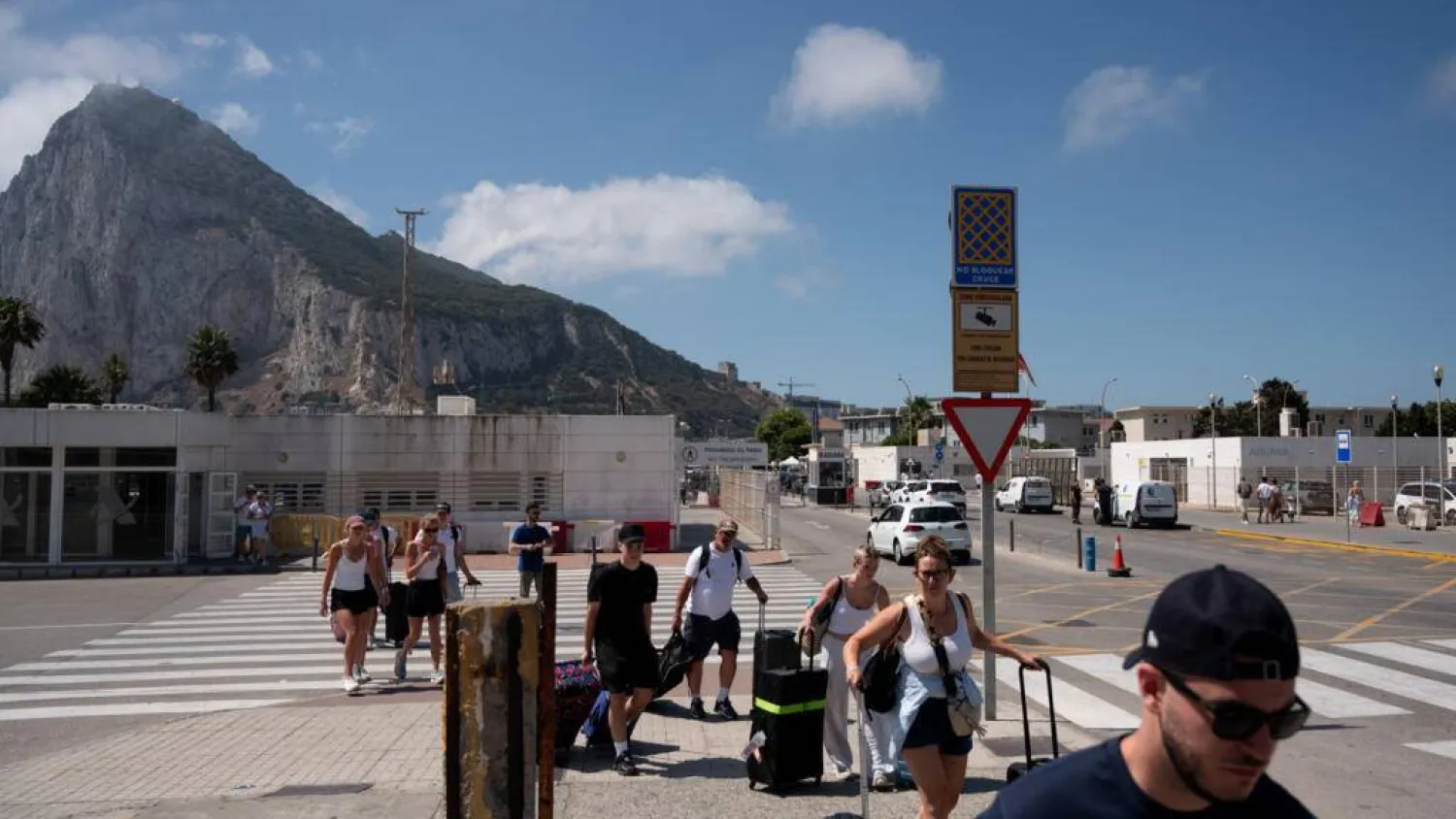
Thousands of workers who cross daily between Spain and Gibraltar will no longer need to go through border controls. JORGE GUERRERO / AFP
TT

New Era for Gibraltar as Border Controls with Spain Set to End

Thousands of workers who cross daily between Spain and Gibraltar will no longer need to go through border controls. JORGE GUERRERO / AFP

Thousands of workers crossing daily between Spain and Gibraltar will enter a new era of easier travel on Wednesday, as border checks that have long been a source of tension are lifted.

Home to only around 40,000 people, the tiny self-governing British territory at the southern tip of the Iberian Peninsula relies on about 15,500 daily cross-border workers from Spain, who make up nearly half of its workforce, said AFP.

During rush hours, long lines can form at the land border and documents are checked -- especially during periods of tension between Britain and Spain, which claims sovereignty over Gibraltar.

But under an agreement reached between Brussels and London following Britain's exit from the European Union, border controls between Gibraltar and Spain will be eliminated from July 15.

A smoother border will make it easier for Gibraltar businesses to recruit and retain workers who live in Spain, as the "hassle" of crossing the frontier can be "significant", said Owen Smith, head of the Gibraltar Federation of Small Businesses.

"It's been a big factor in retention, and certainly a fluid border is going to make life much easier," he told AFP, calling it "very, very positive".

The agreement, which will be signed on Tuesday in Brussels, will align Gibraltar with the rules of Europe's passport-free Schengen travel area.

It was reached after years of talks between Spain, Britain and the EU.

Travelers arriving from outside the Schengen zone will still have to show their passports to officials at Gibraltar's airport and port.

Spanish Prime Minister Pedro Sanchez is set to visit the frontier zone on Wednesday, where workers have in recent weeks taken down the old chain-link fencing between Gibraltar and Spain.

He has hailed the new arrangements as bringing down "the last wall" inside the EU, saying they would create a zone of shared prosperity.

- 'Bygone era of friction'

Gibraltar Chief Minister Fabian Picardo has described the agreement as removing "the physical barriers of a bygone era of friction" while keeping "the keys to our own front door".

The border was closed by Spanish dictator Francisco Franco in 1969 after Gibraltar, which relies on London for defense and foreign policy, voted overwhelmingly in a referendum to remain British.

The closure, which lasted 13 years, cut off the daily movement of workers from Spain into Gibraltar and separated families.

Since then, long queues have repeatedly formed at the Gibraltar-Spain border when diplomatic tensions over the territory's sovereignty have led to tighter controls by Spain.

"It is important that this sword of Damocles disappears," said Manuel Triano Paulete, secretary general of the CCOO trade union in Spain's Campo de Gibraltar region which surrounds the British territory, saying cross-border workers often did not know how long it would take them to get to work.

With an economy based on financial services and online gaming, Gibraltar -- which covers just under seven square kilometers (2.7 square miles) -- has one of the highest per capita incomes in the world.

It has long been a lifeline for people who live in Campo de Gibraltar, which has historically had one of Spain's highest jobless rates.

London and Madrid have disputed control of Gibraltar since the tiny territory was ceded to Britain in the 1713 Treaty of Utrecht.



EU Opens Second Membership Negotiation Area with Ukraine

Smoke rises in the city during a Russian missile strike, amid Russia's attack on Ukraine, in Kyiv, Ukraine July 11, 2026. (Reuters)
TT

EU Opens Second Membership Negotiation Area with Ukraine

Smoke rises in the city during a Russian missile strike, amid Russia's attack on Ukraine, in Kyiv, Ukraine July 11, 2026. (Reuters)

The European Union on Tuesday opened up a second area of membership negotiations with Ukraine, as Kyiv pushes for faster progress in its bid to join.

The move comes after the 27-nation bloc formally kicked off a first phase of membership talks with Ukraine last month after a long delay caused by opposition from Hungary.

Joining the EU involves candidate countries negotiating their way through six "clusters" of subjects to align with the bloc's laws on everything from the environment and agriculture to justice.

On Tuesday, EU Europe ministers meeting in Brussels with their Ukrainian counterpart opened the talks on security, defense and foreign policy.

Despite the momentum forward, the move falls short of hopes in Ukraine and Brussels to launch negotiations on all six "clusters" by the start of Europe's summer holiday break.

War-torn Ukraine -- which applied to join in the wake of Russia's 2022 invasion -- still faces a long and arduous journey to gain full EU membership.

But Kyiv was not the only would-be EU member making progress.

"Today is a super Tuesday for EU enlargement," said EU commissioner Marta Kos.

"Today's momentum must now be turned into delivery on the ground."

Moldova -- which asked for membership at the same time as Ukraine -- was also opening its second area of talks.

Montenegro, frontrunner to be the bloc's next month, was meanwhile wrapping up some more negotiation topics, along with Albania.


Heavy Rain Collapses Roof and Kills 11 People in Northwest Pakistan

A woman walks along a road amid heavy monsoon rain in Lahore, Pakistan, 12 July 2026. EPA/A. HUSSAIN
TT

Heavy Rain Collapses Roof and Kills 11 People in Northwest Pakistan

A woman walks along a road amid heavy monsoon rain in Lahore, Pakistan, 12 July 2026. EPA/A. HUSSAIN

Eleven people were killed overnight when heavy rain caused the roof of a mud-brick house to collapse in northwest Pakistan, police and rescue officials said Tuesday.

The accident occurred in Kohat district in Khyber Pakhtunkhwa province, according to Bilal Faizi of the provincial emergency service, The Associated Press said.

Rescuers recovered 11 bodies, mostly women and children, and handed them over to relatives for burial, Faizi said.

Heavy monsoon rains also lashed the Gilgit-Baltistan region on Monday, triggering landslides that blocked several roads and damaged homes, according to a statement from regional emergency services.

The government advised tourists to avoid travel to northern Pakistan because of the risk of landslides and flash flooding.

Pakistan experiences heavy monsoon rains every year and the downpours frequently trigger floods and landslides that cause deaths and widespread damage.

In 2022, unprecedented monsoon rains and flooding submerged nearly a third of the country, killing 1,739 people and causing an estimated $30 billion in damage.


North Korea Urges ‘Maximum Vigilance’ as Typhoon Bavi Approaches

North Korean leader Kim Jong Un speaks during the second plenary meeting of the Ninth Central Committee of the Workers' Party of Korea (WPK), in Pyongyang, North Korea, in this picture released June 23, 2026, by North Korea's official Korean Central News Agency. (KCNA via Reuters)
TT

North Korea Urges ‘Maximum Vigilance’ as Typhoon Bavi Approaches

North Korean leader Kim Jong Un speaks during the second plenary meeting of the Ninth Central Committee of the Workers' Party of Korea (WPK), in Pyongyang, North Korea, in this picture released June 23, 2026, by North Korea's official Korean Central News Agency. (KCNA via Reuters)

North Korea warned of heavy rain and strong winds on Tuesday as Typhoon Bavi drew near, with leader Kim Jong Un urging "maximum vigilance" to prevent damage.

Natural disasters tend to have an outsized impact on isolated North Korea due to its weak infrastructure and economy.

The typhoon is expected to weaken into a low-pressure system before crossing the country's central region via the Yellow Sea between Tuesday and Wednesday, according to Pyongyang's state-run Rodong Sinmun newspaper.

The country's weather agency issued warnings for heavy rainfall and strong winds, the paper said.

All officials and workers are "urged to remain on maximum vigilance and take steps to minimize damage," Kim was quoted as saying.

Rodong said rainfall of 80-120 millimeters (3.1-4.7 inches), with downpours of 30-60 millimeters per hour, is forecast on Tuesday across parts of the country's northern and central regions.

The southern regions, among others, are set for 150-200 millimeters of rain, as well as winds of 10-15 meters per second along the west coast and in some inland areas.

North Korea has stepped up disaster prevention efforts, the Korean Central News Agency reported last week.

Heavy rain also battered South Korea recently, dumping up to 200 millimeters in some areas.

Hundreds of residents in the central Chungcheong province evacuated the area or were stranded by flooding.

A man in his 70s was reported missing after being swept away by a swollen river in the southern region of Gyeongsang, according to broadcaster KBS.

Seoul's weather agency forecast rain across the country from Tuesday through Wednesday, with heavy downpours expected in central regions and the southern province of Jeolla.

Scientists say human-driven climate change is making extreme weather more frequent, prolonged and intense.

Last summer was South Korea's hottest on record, and both Koreas recorded their warmest June.

This year's return of El Nino, a natural Pacific warming pattern linked to heat, drought and heavy rain across parts of Asia, has added to the risks.

North Korea also suffers chronic power shortages, and experts say most residents lack air conditioning.

The impoverished country was hit by severe flooding in its northern regions in 2024, with South Korean media reporting that as many as 1,500 people could be dead or missing -- estimates Pyongyang dismissed at the time.