


US Strikes Iran for Third Day, Will Reimpose Blockade

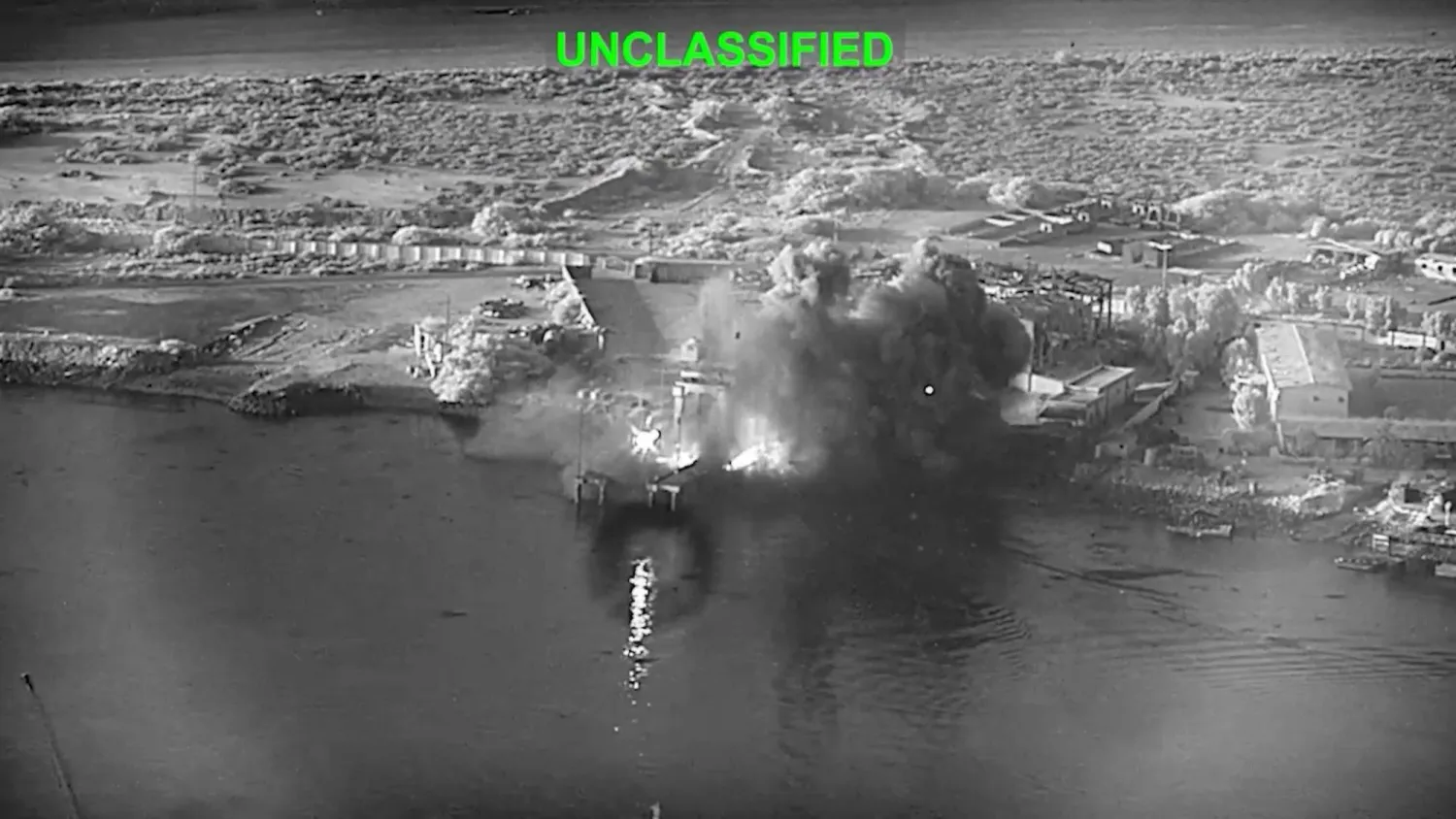
 This image from video released by US Central Command, shows an explosion at Bandar Abbas Naval Base, Iran, as three Corsair unmanned surface vessels, also called one-way attack surface drones, fired by the US military, hit the port July 12, 2026. (US Central Command via AP)
This image from video released by US Central Command, shows an explosion at Bandar Abbas Naval Base, Iran, as three Corsair unmanned surface vessels, also called one-way attack surface drones, fired by the US military, hit the port July 12, 2026. (US Central Command via AP)
TT

US Strikes Iran for Third Day, Will Reimpose Blockade

 This image from video released by US Central Command, shows an explosion at Bandar Abbas Naval Base, Iran, as three Corsair unmanned surface vessels, also called one-way attack surface drones, fired by the US military, hit the port July 12, 2026. (US Central Command via AP)
This image from video released by US Central Command, shows an explosion at Bandar Abbas Naval Base, Iran, as three Corsair unmanned surface vessels, also called one-way attack surface drones, fired by the US military, hit the port July 12, 2026. (US Central Command via AP)

The United States launched a third night of strikes on Iran as President Donald Trump planned to reimpose a blockade Tuesday on Iranian ports and floated a 20 percent fee on cargo in the vital Strait of Hormuz.

Trump said a deal with Iran was still possible even as attacks were carried out, with Iran striking two ships in the strategic waterway and killing one crew member, according to the United Arab Emirates.

The US military said its five-hour mission hit targets across Iran including coastal Bushehr and Bandar Abbas to "degrade Iran's ability to attack commercial shipping".

After the strikes, Iran's Revolutionary Guards announced they had in turn fired missiles and drones on Bahrain.

"We're going to hit them very hard tonight, and we're going to hit them hard tomorrow," Trump said at the White House on Monday.

Trump's declaration on the Hormuz blockade followed US and Iranian attacks of a scale unseen since an April ceasefire in the Middle East conflict, adding to doubts about efforts to bring a permanent end to the war.

Iran started blocking the strait after US-Israel attacks in February, which prompted Washington's blockade on Tehran's ports -- but restrictions eased after the sides agreed a preliminary deal in June.

Trump said Monday that the United States was "taking over" the strait and would slap a levy of 20 percent on all cargo shipped through it, in an announcement that drew mockery from Iran and accusations of "piracy".

US Central Command (CENTCOM) said Iran's ports on the waterway would be blockaded from 2000 GMT on Tuesday.

Oil prices shot up more than nine percent Monday over fears of renewed conflict and rose again Tuesday, piling on more than one percent.

Tehran launched attacks on other US allies in the region, including Jordan, which said it had shot down four missiles from Iran.

These attacks came after Iran's Revolutionary Guards announced strikes on Monday on Bahrain, Jordan, Kuwait and Oman.

- Resumed conflict -

Trump formally notified Congress last week that the United States had resumed military conflict against Iran, the White House confirmed to AFP, giving the Pentagon an additional 60 days to operate in the region without congressional approval.

In addition to the moves in Hormuz, the US president also threatened to destroy Pickaxe Mountain, a deeply buried nuclear site near Natanz where Western intelligence suspects Iran is building an undeclared enrichment facility.

"Tell the Iranians to be ready. Let them know we're coming (and) there's not a damn thing they can do about it," he told conservative radio host Hugh Hewitt.

Trump declared on Truth Social that the United States would be "known as 'THE GUARDIAN OF THE HORMUZ STRAIT'" and levy a 20 percent fee on all cargo shipped through the waterway.

While Iran's ports would again be blockaded, Trump said "all other countries will have fair and open use of the strait".

Iranian Foreign Minister Abbas Araghchi responded mockingly on X that Trump was "absolutely right" that whoever guarantees safe passage should be compensated -- but that Tehran would charge less.

"20% is of course too much," he said.

Washington has vehemently opposed Tehran's desire to charge tolls in the strait, which international law generally forbids.

- 'In crisis' -

Despite all signs to the contrary, Trump said Monday that a deal with Tehran to end the war was still possible.

Iran's Foreign Ministry spokesman Esmaeil Baqaei said earlier Monday that the June memorandum of understanding that formed the basis for the negotiations and lifted the US blockade was "in crisis".

Baqaei said Iran would ignore its obligations under the deal if the Washington did the same, but added that Tehran was continuing talks with mediators from Qatar, Pakistan and Oman to prevent further escalation.

Bader Al-Saif, an associate fellow at Chatham House, said the escalating attacks would merely delay a permanent agreement.

"Both sides want to end the impasse on their own terms, and they are increasingly finding it difficult to do so," he said.

"Hence the return to and increase in the scale of attacks."


EU Opens Second Membership Negotiation Area with Ukraine

Smoke rises in the city during a Russian missile strike, amid Russia's attack on Ukraine, in Kyiv, Ukraine July 11, 2026. (Reuters)
TT

EU Opens Second Membership Negotiation Area with Ukraine

Smoke rises in the city during a Russian missile strike, amid Russia's attack on Ukraine, in Kyiv, Ukraine July 11, 2026. (Reuters)

The European Union on Tuesday opened up a second area of membership negotiations with Ukraine, as Kyiv pushes for faster progress in its bid to join.

The move comes after the 27-nation bloc formally kicked off a first phase of membership talks with Ukraine last month after a long delay caused by opposition from Hungary.

Joining the EU involves candidate countries negotiating their way through six "clusters" of subjects to align with the bloc's laws on everything from the environment and agriculture to justice.

On Tuesday, EU Europe ministers meeting in Brussels with their Ukrainian counterpart opened the talks on security, defense and foreign policy.

Despite the momentum forward, the move falls short of hopes in Ukraine and Brussels to launch negotiations on all six "clusters" by the start of Europe's summer holiday break.

War-torn Ukraine -- which applied to join in the wake of Russia's 2022 invasion -- still faces a long and arduous journey to gain full EU membership.

But Kyiv was not the only would-be EU member making progress.

"Today is a super Tuesday for EU enlargement," said EU commissioner Marta Kos.

"Today's momentum must now be turned into delivery on the ground."

Moldova -- which asked for membership at the same time as Ukraine -- was also opening its second area of talks.

Montenegro, frontrunner to be the bloc's next month, was meanwhile wrapping up some more negotiation topics, along with Albania.


Heavy Rain Collapses Roof and Kills 11 People in Northwest Pakistan

A woman walks along a road amid heavy monsoon rain in Lahore, Pakistan, 12 July 2026. EPA/A. HUSSAIN
TT

Heavy Rain Collapses Roof and Kills 11 People in Northwest Pakistan

A woman walks along a road amid heavy monsoon rain in Lahore, Pakistan, 12 July 2026. EPA/A. HUSSAIN

Eleven people were killed overnight when heavy rain caused the roof of a mud-brick house to collapse in northwest Pakistan, police and rescue officials said Tuesday.

The accident occurred in Kohat district in Khyber Pakhtunkhwa province, according to Bilal Faizi of the provincial emergency service, The Associated Press said.

Rescuers recovered 11 bodies, mostly women and children, and handed them over to relatives for burial, Faizi said.

Heavy monsoon rains also lashed the Gilgit-Baltistan region on Monday, triggering landslides that blocked several roads and damaged homes, according to a statement from regional emergency services.

The government advised tourists to avoid travel to northern Pakistan because of the risk of landslides and flash flooding.

Pakistan experiences heavy monsoon rains every year and the downpours frequently trigger floods and landslides that cause deaths and widespread damage.

In 2022, unprecedented monsoon rains and flooding submerged nearly a third of the country, killing 1,739 people and causing an estimated $30 billion in damage.


North Korea Urges ‘Maximum Vigilance’ as Typhoon Bavi Approaches

North Korean leader Kim Jong Un speaks during the second plenary meeting of the Ninth Central Committee of the Workers' Party of Korea (WPK), in Pyongyang, North Korea, in this picture released June 23, 2026, by North Korea's official Korean Central News Agency. (KCNA via Reuters)
TT

North Korea Urges ‘Maximum Vigilance’ as Typhoon Bavi Approaches

North Korean leader Kim Jong Un speaks during the second plenary meeting of the Ninth Central Committee of the Workers' Party of Korea (WPK), in Pyongyang, North Korea, in this picture released June 23, 2026, by North Korea's official Korean Central News Agency. (KCNA via Reuters)

North Korea warned of heavy rain and strong winds on Tuesday as Typhoon Bavi drew near, with leader Kim Jong Un urging "maximum vigilance" to prevent damage.

Natural disasters tend to have an outsized impact on isolated North Korea due to its weak infrastructure and economy.

The typhoon is expected to weaken into a low-pressure system before crossing the country's central region via the Yellow Sea between Tuesday and Wednesday, according to Pyongyang's state-run Rodong Sinmun newspaper.

The country's weather agency issued warnings for heavy rainfall and strong winds, the paper said.

All officials and workers are "urged to remain on maximum vigilance and take steps to minimize damage," Kim was quoted as saying.

Rodong said rainfall of 80-120 millimeters (3.1-4.7 inches), with downpours of 30-60 millimeters per hour, is forecast on Tuesday across parts of the country's northern and central regions.

The southern regions, among others, are set for 150-200 millimeters of rain, as well as winds of 10-15 meters per second along the west coast and in some inland areas.

North Korea has stepped up disaster prevention efforts, the Korean Central News Agency reported last week.

Heavy rain also battered South Korea recently, dumping up to 200 millimeters in some areas.

Hundreds of residents in the central Chungcheong province evacuated the area or were stranded by flooding.

A man in his 70s was reported missing after being swept away by a swollen river in the southern region of Gyeongsang, according to broadcaster KBS.

Seoul's weather agency forecast rain across the country from Tuesday through Wednesday, with heavy downpours expected in central regions and the southern province of Jeolla.

Scientists say human-driven climate change is making extreme weather more frequent, prolonged and intense.

Last summer was South Korea's hottest on record, and both Koreas recorded their warmest June.

This year's return of El Nino, a natural Pacific warming pattern linked to heat, drought and heavy rain across parts of Asia, has added to the risks.

North Korea also suffers chronic power shortages, and experts say most residents lack air conditioning.

The impoverished country was hit by severe flooding in its northern regions in 2024, with South Korean media reporting that as many as 1,500 people could be dead or missing -- estimates Pyongyang dismissed at the time.
