Report: US Sending Dozens of Refueling Planes to Israel

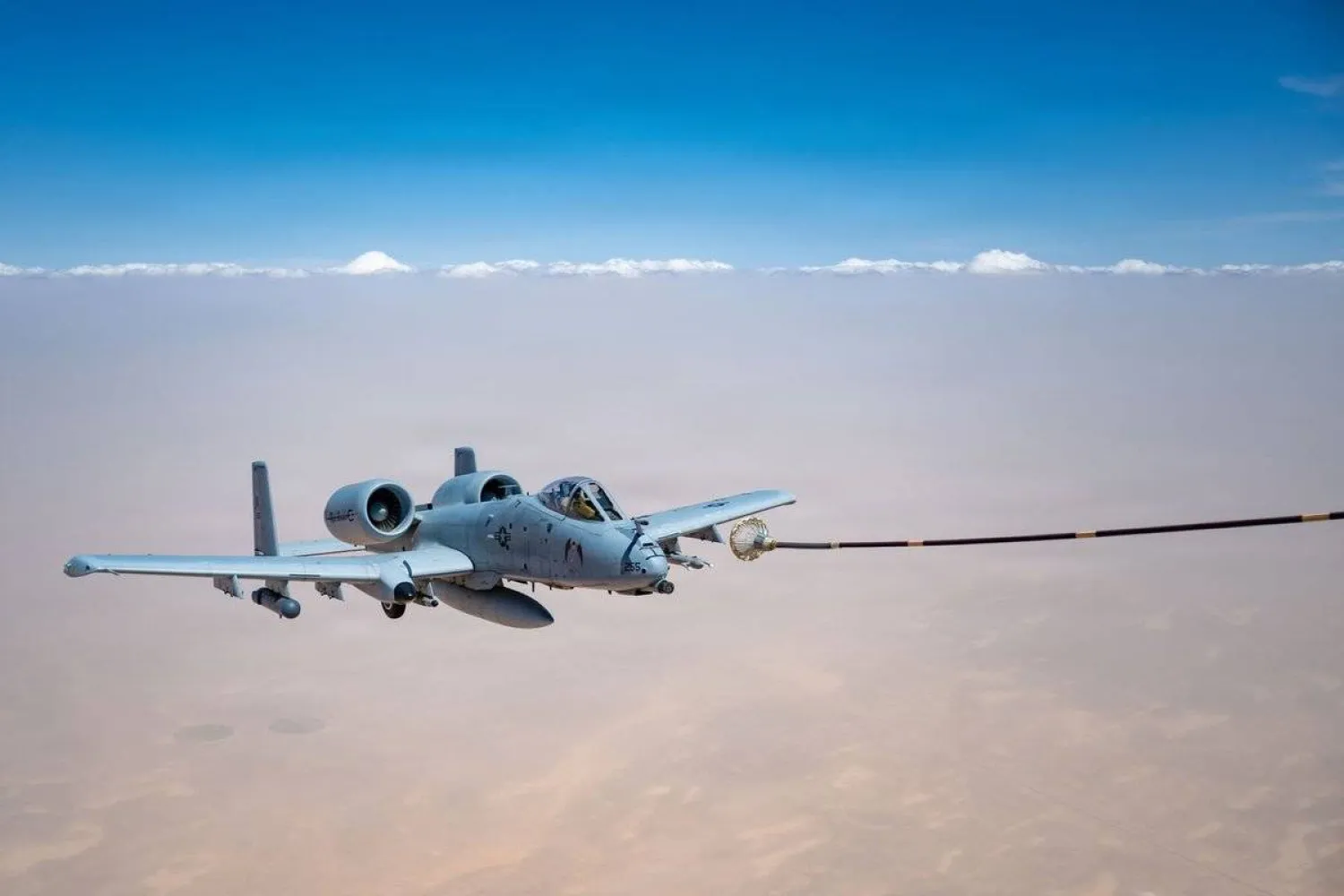
A US A-10 aircraft prepares for in-flight refueling during operations (US Central Command)
TT

Report: US Sending Dozens of Refueling Planes to Israel

A US A-10 aircraft prepares for in-flight refueling during operations (US Central Command)

The Trump administration notified Israel it is sending dozens more refueling planes to the country ahead of a potential expansion of military operations against Iran, three US and Israeli officials told Axios on Friday.

The officials said US President Donald Trump could order an escalation in the coming days.
Trump was presented with several new military plans in a Situation Room meeting on Tuesday.

Among the options being considered are bombing Iranian infrastructure facilities like power plants, conducting more attacks on Iran's nuclear facilities in order to bury Iran's enriched uranium even deeper, and bombing the Pickaxe Mountain underground site that is suspected to be a facility in the making, according to Axios.

On Thursday, the US military conducted strikes against Iranian targets in the Strait of Hormuz and the southern coast of Iran for the fifth day in a row.

A US official said the military bombed at least seven bridges around the city of Bandar Abbas, which is considered a hub for the Iranian Revolutionary Guard Corps (IRGC) operations in the Strait of Hormuz.

Ammunition, supplies and reinforcements go through Bandar Abbas to other parts of the strait, he said.

Iran also escalated attacks targeting US bases in Jordan, Qatar, Bahrain, Iraq and Kuwait. The IRGC also claimed it attacked an American base in Syria, although US troops withdrew from the base several months ago.

The US currently has about 30 military refueling planes at Ben Gurion International Airport near Tel Aviv and around the same number in Ramon Airport in southern Israel.

Israeli officials say the US military prefers operating the refueling planes from Ben Gurion Airport, because other air bases in the region are more exposed to Iranian attacks and less safe for US planes.


Netanyahu Pushes Off Washington Visit After US ‘Anger’ Over PM’s Behavior

US President Donald Trump and Israeli Prime Minister Benjamin Netanyahu (L) arrive for a press conference in the State Dining Room of the White House in Washington, DC on 29 September 2025. (AFP)
TT

Netanyahu Pushes Off Washington Visit After US ‘Anger’ Over PM’s Behavior

US President Donald Trump and Israeli Prime Minister Benjamin Netanyahu (L) arrive for a press conference in the State Dining Room of the White House in Washington, DC on 29 September 2025. (AFP)

Israeli Prime Minister Netanyahu has canceled his planned trip to the United States next week as both the US and Israeli sides do not want US President Donald Trump to meet with the PM in the White House.

On Friday, Netanyahu’s Office said the postponement was due to changes surrounding the funeral of Senator Lindsey Graham. However, sources in Tel Aviv affirmed that the scheduling issue was only part of the reason behind the decision.

The sources said efforts to schedule a meeting between Netanyahu and Trump during the visit have failed.

According to the same sources, the Israeli PM knows the US administration is rigged against him. He also knows why.

“The Americans are closely monitoring Netanyahu and his cabinet members, tracking their public and private statements,” they said.

In return, intelligence assessments detail an escalation of Israeli surveillance targeting US decision-makers.

Several reports in Israel said Netanyahu fears such a trip could end in humiliation in front of the cameras, similar to what Trump did with Ukrainian President Volodymyr Zelensky in early 2025.

Meanwhile, US officials believe that Netanyahu is obstructing Trump's policies and plans to reach a ceasefire in the Middle East.

The US-Israeli tension was highlighted by US Vice President JD Vance who accused some members of the Israeli government of trying to influence Americans' opinions to prolong the Iran war.

In an interview, Vance told podcaster Joe Rogan that while he trusts some people within the Israeli government, there are others “who are manipulating and trying to change American public opinion to keep the war going on indefinitely.”

Vance said that people within the Israeli government have been trying to shift the US away from its efforts to negotiate with Iran.

“I definitely think you have seen this very discreet, extremely well-funded campaign to try to derail the negotiation and try to derail the deal,” he said, adding there is “exact evidence” that some Israeli leaders “hate the deal.”

The Vice President also referenced a Time magazine article suggesting Israel had used funds to pay online influencers, some of whom Vance said had attacked him.

Political sources confirm that Trump has been delaying meeting with Netanyahu since the US-Iranian agreement on June 16. The President has expressed frustration over Israeli criticisms of the deal, which paves the way for a window to curb Iran’s nuclear program.

Israeli officials have strongly criticized the peace agreement, describing it as “terrible” and a disaster for Israel.

Their statements have reflected on Israeli public opinion toward the US.

Polling in Israel shows a remarkable drop in Trump's popularity, falling from 74% support to roughly 32% following his administration's negotiations and ceasefire agreements regarding Iran while 62% of Israelis believe Trump does not care about Israeli interests.

Many in Washington view these numbers as “ingratitude” and a “stab in the back.” US officials suspect Israel is escalating conflicts to evade specific promises previously made to Trump.

In several telephone conversations, Trump advised Netanyahu to “drive people behind him” as a “strong leader,” to pull Israeli troops from south Syria, Lebanon and to implement the peace deal in Gaza.

But sources noted that Netanyahu was said to have pushed back, citing Israel’s security needs. Washington came to the conclusion that Netanyahu was not willing to meet the necessary terms, including pulling troops out of Syria.

Currently, Netanyahu is relying on Strategic Affairs Minister Ron Dermer to soothe rising tensions with the US President, striving to realign Trump's support ahead of the upcoming Israeli elections.

The Israeli PM fears the US administration may pivot to support his rivals, following a five-day trip by Naftali Bennett to the US last week and reports of indirect US contacts with Gadi Eisenkot.


US and Iran Escalate Strikes

Smoke rises from an explosion at an unknown location, during what US Central Command (CENTCOM) says are strikes on Iran, in this screen grab taken from a handout video released July 17, 2026. US Central Command/Handout via REUTERS
TT

US and Iran Escalate Strikes

Smoke rises from an explosion at an unknown location, during what US Central Command (CENTCOM) says are strikes on Iran, in this screen grab taken from a handout video released July 17, 2026. US Central Command/Handout via REUTERS

The United States and Iran exchanged strikes aimed at infrastructure and military targets on Saturday as their battle over the Strait of Hormuz intensified.

The region has endured days of back-and-forth attacks in a conflict increasingly focused on control of the strait. The collapse of an interim ceasefire leaves no clear end in sight for the war that the US and Israel began more than four months ago.

The US Central Command said early Saturday that its seventh straight night of strikes had hit “surveillance sites, military logistics infrastructure, underground weapons storage, and maritime capabilities.”

Kuwait said Saturday it was intercepting Iranian missiles and drones, while Iraq said it had shot down attack drones over the city of Irbil. Jordan's state-run Petra news agency said that the kingdom's air defense systems had downed Iranian missiles, while air sirens sounded in Bahrain according to the government there.

Iranian officials say recent US strikes have killed dozens of people and wounded hundreds, with new casualties reported Friday, when the US military also acknowledged more injured service members.

Iran effectively closed the strait to shipping traffic after the war started Feb. 28. That sent the price of oil soaring and gave Iran significant leverage in negotiations. The price of oil rose Friday above $86 a barrel, close to its highest level in a month, as crossings through the strait fell to a three-week low, according to an international shipping tracker.

In an address to the American public on Thursday evening, Trump insisted the war was going well. “We are likewise winning big in Iran, and you will see the fruits of that labor very, very shortly,” he said.

Before the war began, the US had been in talks with Iran over its nuclear program. Trump now faces political pressure to bring the war to a close and avoid the kind of prolonged Middle East conflict he had campaigned against.

According to Reuters, Iranian ⁠media reported on ⁠Saturday that several missiles struck power facilities and desalination pumps in the southern Iranian city of Jask, citing a local official. The official said drinking water had been cut off in villages in Jask due to the attack.

The US said its forces redirected four commercial vessels, disabled one, and boarded another to enforce its naval blockade of Iran.

In turn Iran's Revolutionary Guards said four vessels violating its rules on shipping traffic were stopped from going through the strait with a combined missile and drone operation.

In addition, Iranian media, citing Iran's Revolutionary Guards, reported that two oil tankers exploded and caught fire after passing through a mined route south of the strait. The US military labelled that report as false.

Iran's state television quoted the Revolutionary Guards as saying that until US "aggression" comes to an end, it will not be possible to export chemical fertilizers or even a "single drop of oil and gas" from the region.

The US airstrikes had hit bridges in Iran’s southern Hormozgan province, Iranian state television reported. The attacks hit Bandar Khamir, a city on Iran’s coast on the Strait of Hormuz.

The highway and railway bridge strikes appeared aimed at cutting off Bandar Abbas, Iran’s main port, from roads leading into Iran’s central region onward to Tehran, the capital.

Iran acknowledged “attacks on power infrastructure” during the US airstrike campaign for the first time Friday when its Energy Ministry issued a call for people to use less power in southern provinces "experiencing extreme heat.”

The ministry did not specify what was hit.

Iranian authorities said at least 46 people have been killed and more than 400 wounded in recent US strikes, including eight killed in a strike on a bridge Friday.

US officials acknowledged 13 additional US service members — 10 Army soldiers and three Navy sailors — had been injured since Monday, but offered no further details. Since the war began, 14 US service members have been killed and 427 wounded, The Associated Press reported.

On Friday evening Iranian state media reported explosions around Iran, including in the central and south of the country. Local authorities said the US attacked around Ahvaz city without elaborating. IRNA also reported the sound of explosions in Lar, Yazd and Sirik.


New Labour Leader Burnham Vows to Renew Hope as Next UK PM

Andy Burnham speaks after being confirmed as the Labour Party's new leader and the country's next prime minister during "Labour’s Special Conference" in central London, Britain, 17 July 2026. (EPA)
TT

New Labour Leader Burnham Vows to Renew Hope as Next UK PM

Andy Burnham speaks after being confirmed as the Labour Party's new leader and the country's next prime minister during "Labour’s Special Conference" in central London, Britain, 17 July 2026. (EPA)

Andy Burnham vowed Friday to restore "hope" to the British people as he officially became the ruling Labour party's new leader, and incoming UK prime minister.

Nicknamed the "King of the North" for a nine-year spell as Manchester mayor, Burnham pledged to work to improve living standards in every region of the United Kingdom.

"People and places ... have been waiting too long for politics to let them hope again ... We're going to give them hope back," he promised at a special party conference.

"I am for us, for all of us," Burnham told cheering delegates.

The 56-year-old takes over from Keir Starmer, who resigned last month after months of political turmoil, scandal and domestic policy missteps.

Centre-left Labour retains an overwhelming majority in parliament after the 2024 general election. As the leader of the largest party he becomes the country's prime minister, without having to call new polls.

Burnham will enter Downing Street on Monday after meeting King Charles III, becoming the UK's seventh prime minister in a decade.

It is only four weeks since Burnham sensationally returned as a member of parliament following a nine-year absence, determined to replace Starmer.

Labour MPs reckon he is their best chance of reining in Nigel Farage's anti-immigrant Reform UK party, tipped in the polls to win the next general election, expected in 2029.

Burnham's flagship idea is devolving powers to cities and regions, including by setting up a "Number 10 North" office.

Hailing from the party's so-called soft left, he favors more public control of services, such as water, and reindustrialization.

"If we want an economy and a country that works for all people and places ... then it requires a new path to the one we've been on for the last 40 years," he said.

Burnham has pledged to boost the construction of public housing to try to resolve the homelessness crisis, and pump resources into social care.

After facing no challengers, he becomes leader at his third attempt, following failed bids in 2010 and 2015.

Burnham was an MP between 2001 and 2017, serving as a minister in Tony Blair and Gordon Brown's governments.

He has since reinvented himself as a man of the people, melding a relaxed folksy style with slick social media videos.

Labour MPs see him as a better communicator than Starmer and hope will take a more radical approach to reforming Britain's battered public services.

"It feels like a fresh start. There's reason to be hopeful," Labour MP Richard Baker told AFP after Burnham's speech.

- New leader, old problems -

Starmer returned Labour to power after 14 years in opposition in July 2024 with a landslide victory over the Conservatives, who had churned through five prime ministers in the tumult unleashed by the 2016 Brexit referendum.

But his premiership quickly became characterized by domestic policy missteps and controversies, including his appointment of ex-Jeffrey Epstein associate Peter Mandelson as ambassador to Washington.

Disastrous local and regional election results in May heaped further pressure on Starmer, which became impossible to withstand after Burnham won a parliamentary by-election on June 18, allowing him to run for leader.

Burnham, regularly seen in his trademark dark T-shirt and casual jacket, secured the backing of 379 of Labour's 403 MPs, with no one mustering the 81 nominations required to challenge him.

He will face the same unenviable challenges that beset Starmer: a tepid economy, high government borrowing costs, a ballooning welfare bill and irregular migrants arriving in small boats that have fueled support for Reform.

Unpredictable energy prices due to the US-Iran war and a volatile American president in Donald Trump also threaten to buffet his premiership.

Burnham has vowed not to raise the country's main taxes, but will need to fill a £4.7-billion ($6.3-billion) gap over four years in the country's defense investment plan.

"Most of what's been said by Burnham and his supporters so far has been pretty vague," politics professor Tony Travers told AFP.

"He's going to have to come out with a visible plan and policies people understand ... pretty quickly," or he risks "losing momentum," Travers added.