

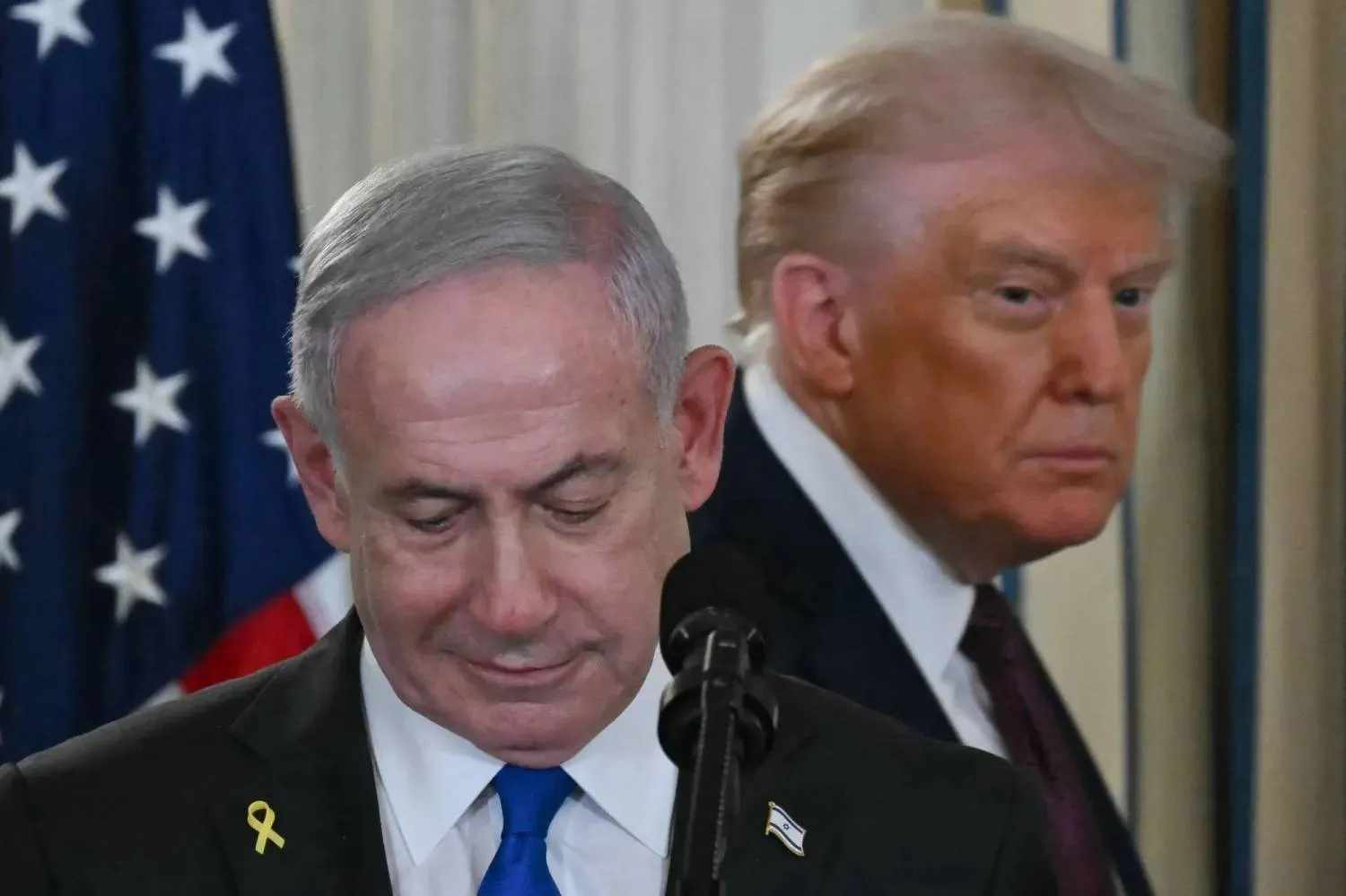

Netanyahu Pushes Off Washington Visit After US ‘Anger’ Over PM’s Behavior

US President Donald Trump and Israeli Prime Minister Benjamin Netanyahu (L) arrive for a press conference in the State Dining Room of the White House in Washington, DC on 29 September 2025. (AFP)
TT

Netanyahu Pushes Off Washington Visit After US ‘Anger’ Over PM’s Behavior

US President Donald Trump and Israeli Prime Minister Benjamin Netanyahu (L) arrive for a press conference in the State Dining Room of the White House in Washington, DC on 29 September 2025. (AFP)

Israeli Prime Minister Netanyahu has canceled his planned trip to the United States next week as both the US and Israeli sides do not want US President Donald Trump to meet with the PM in the White House.

On Friday, Netanyahu’s Office said the postponement was due to changes surrounding the funeral of Senator Lindsey Graham. However, sources in Tel Aviv affirmed that the scheduling issue was only part of the reason behind the decision.

The sources said efforts to schedule a meeting between Netanyahu and Trump during the visit have failed.

According to the same sources, the Israeli PM knows the US administration is rigged against him. He also knows why.

“The Americans are closely monitoring Netanyahu and his cabinet members, tracking their public and private statements,” they said.

In return, intelligence assessments detail an escalation of Israeli surveillance targeting US decision-makers.

Several reports in Israel said Netanyahu fears such a trip could end in humiliation in front of the cameras, similar to what Trump did with Ukrainian President Volodymyr Zelensky in early 2025.

Meanwhile, US officials believe that Netanyahu is obstructing Trump's policies and plans to reach a ceasefire in the Middle East.

The US-Israeli tension was highlighted by US Vice President JD Vance who accused some members of the Israeli government of trying to influence Americans' opinions to prolong the Iran war.

In an interview, Vance told podcaster Joe Rogan that while he trusts some people within the Israeli government, there are others “who are manipulating and trying to change American public opinion to keep the war going on indefinitely.”

Vance said that people within the Israeli government have been trying to shift the US away from its efforts to negotiate with Iran.

“I definitely think you have seen this very discreet, extremely well-funded campaign to try to derail the negotiation and try to derail the deal,” he said, adding there is “exact evidence” that some Israeli leaders “hate the deal.”

The Vice President also referenced a Time magazine article suggesting Israel had used funds to pay online influencers, some of whom Vance said had attacked him.

Political sources confirm that Trump has been delaying meeting with Netanyahu since the US-Iranian agreement on June 16. The President has expressed frustration over Israeli criticisms of the deal, which paves the way for a window to curb Iran’s nuclear program.

Israeli officials have strongly criticized the peace agreement, describing it as “terrible” and a disaster for Israel.

Their statements have reflected on Israeli public opinion toward the US.

Polling in Israel shows a remarkable drop in Trump's popularity, falling from 74% support to roughly 32% following his administration's negotiations and ceasefire agreements regarding Iran while 62% of Israelis believe Trump does not care about Israeli interests.

Many in Washington view these numbers as “ingratitude” and a “stab in the back.” US officials suspect Israel is escalating conflicts to evade specific promises previously made to Trump.

In several telephone conversations, Trump advised Netanyahu to “drive people behind him” as a “strong leader,” to pull Israeli troops from south Syria, Lebanon and to implement the peace deal in Gaza.

But sources noted that Netanyahu was said to have pushed back, citing Israel’s security needs. Washington came to the conclusion that Netanyahu was not willing to meet the necessary terms, including pulling troops out of Syria.

Currently, Netanyahu is relying on Strategic Affairs Minister Ron Dermer to soothe rising tensions with the US President, striving to realign Trump's support ahead of the upcoming Israeli elections.

The Israeli PM fears the US administration may pivot to support his rivals, following a five-day trip by Naftali Bennett to the US last week and reports of indirect US contacts with Gadi Eisenkot.



Iran Resumes Flights at Bandar Abbas Airport After Wartime Disruptions

The airport has been repeatedly closed since the conflict with the United States began in February. (Getty Images)
TT

Iran Resumes Flights at Bandar Abbas Airport After Wartime Disruptions

The airport has been repeatedly closed since the conflict with the United States began in February. (Getty Images)

Flights at the port city of Bandar Abbas resumed on Saturday after repeated interruptions during hostilities with the United States, state media reported.

Kazem Tavassoli, director general of airports in Hormozgan province, said "scheduled flights at Bandar Abbas International Airport on high-traffic domestic routes resumed today," according to the IRNA state news agency.

The reopening comes "following limited flights in recent days", Tavassoli said, adding that passengers can now buy tickets for the Tehran-Bandar Abbas, Mashhad-Bandar Abbas and Bandar Abbas-Isfahan routes, in both directions.

The airport "handled 35 to 40 domestic and international flights per day" before the war, Tavassoli said.

The airport has been repeatedly closed since the conflict with the United States began in February.


Iran Fires Back at Trump's Threat to Declare Hormuz a US Territory

A ship near the Strait of Hormuz (Reuters)
TT

Iran Fires Back at Trump's Threat to Declare Hormuz a US Territory

A ship near the Strait of Hormuz (Reuters)

Iran on Saturday fired back at US President Donald Trump's claim that he would soon declare the Strait of Hormuz part of US territory, saying the crucial energy waterway it has blockaded "will remain Iranian".

Trump has repeatedly insisted that the strait, which Tehran effectively closed at the start of the Middle East war in late February, is under US control despite traffic remaining throttled, reported AFP.

"The Strait of Hormuz has been Iranian, is Iranian, and will remain Iranian," Iranian Deputy Foreign Minister Kazem Gharibabadi said on X.

"This strait will only be closed and opened under Iran's command."

Trump told a political rally in New York state on Friday that after the US defeats Iran, "pretty soon I'll be declaring the Hormuz Strait a territory of the United States".

"It's true," he added.

An unnamed White House official later clarified that Trump was joking, the Wall Street Journal reported.

Last week, a top Iranian official set out a list of conditions for reopening the strait, including an end to the "war and aggression against Iran and its allies in Lebanon, Palestine, Yemen, and Iraq".

Mohammad Bagher Zolghadr also demanded the end of crippling sanctions, the release of frozen assets and compensation for wartime damage.

- Ongoing attacks -

As diplomacy stalls between the longtime foes, attacks in the Hormuz strait have continued, highlighting the continued risks to regional shipping.

The United Arab Emirates' state-owned oil giant ADNOC said on Saturday that one of its vessels came under attack the night before.

Abu Dhabi's foreign ministry later blamed Tehran, and said that Iran's Revolutionary Guards were engaged in "acts of piracy" in the strait.

On Friday the Gulf nation blamed Iran for other attacks on two vessels linked to ADNOC as they passed through the waterway.

Such attacks led to the collapse of an April ceasefire between the United States and Iran.

A June deal between Washington and Tehran -- meant to serve as a jumping-off point for negotiations on a permanent settlement -- had said Iran and Oman would hash out future arrangements for the Hormuz in discussion with other Gulf countries and "in line with the applicable international law".

Before the war, the strait carried around a fifth of the world's oil and LNG exports, and prices have repeatedly surged since the dispute over the waterway erupted, piling economic and political pressure on Washington.

Iran wants to control the strait and charge tolls, powers it did not exercise before the war and ones that the US fiercely opposes.

The closure of Hormuz has driven up prices for US voters, creating a political headache for Trump as November's midterm elections near.

US Vice President JD Vance said this week that Washington's top priority in the Iran war was keeping energy prices low for Americans, while preventing Tehran from acquiring a nuclear weapon ranked second.

Tehran signaled last week that it had agreed with Oman on a route for ships to transit the strait and were finalizing arrangements to jointly manage the waterway.

The US has imposed its own retaliatory blockade of Iranian ports in an attempt to cripple its economy.

"We have the blockade. No ships get through unless we want them to," Trump said to a cheering crowd of supporters on Friday.


Rescuers Search for Survivors as Indonesian Quake Toll Rises

A house damaged by a tsunami following a magnitude 7.7 earthquake is seen in Mbay, Nagekeo, East Nusa Tenggara province, Indonesia, 15 August 2026. EPA/IGNASIUS KUNDA
TT

Rescuers Search for Survivors as Indonesian Quake Toll Rises

A house damaged by a tsunami following a magnitude 7.7 earthquake is seen in Mbay, Nagekeo, East Nusa Tenggara province, Indonesia, 15 August 2026. EPA/IGNASIUS KUNDA

Rescuers combed through debris for survivors on Saturday after a powerful earthquake struck off Indonesia's eastern Flores island, killing at least 47 people, according to disaster officials.

The national disaster management agency (BNPB) raised the death toll from 40 late Saturday, and rescue official Fathur Rahman said 50 people were injured in the 7.7-magnitude quake.

Suharyanto, who leads the BNPB, said earlier that people were trapped in several buildings.

"These will be the initial targets of the disaster response teams," said Suharyanto, who like many Indonesians uses one name.

Nearly 160 houses, dozens of educational and health facilities and other public buildings were damaged when the earthquake struck the popular tourist island in Indonesia's east, the BNPB reported.

The International Federation of Red Cross and Red Crescent Societies said preparations were underway to bring aid to some 2,000 people in temporary shelters.

The government sent 50,000 aid packages weighing a total of 275 tons to the area, and European Union chief Ursula von der Leyen offered help from the bloc's Copernicus Earth observation satellites.

"Europe stands ready to deploy Copernicus, our eyes in the sky, to support search and rescue efforts. Indonesia, we stand with you," she wrote on X.

"I have never felt an earthquake this big," Yulian Juita Ekalia, who lives in Ruteng city more than 100 kilometers (60 miles) west of the epicenter, told AFP by telephone hours after the tremor.

"It felt like we were on a trampoline; it was really scary," said the 37-year-old university lecturer, who was jolted awake at around 5:30 am (2130 GMT on Friday).

"As I rushed to get outside, everything in the house fell down: the television, my son's trophies, the dish racks, suitcases on top of the wardrobes. When I got outside, my son and neighbors were already there, screaming in fear."

A handout photo made available by the National Search and Rescue Agency of Indonesia (BASARNAS) shows rescuers evacuating a victim after a 7.7 magnitude earthquake in Maumere, East Nusa Tenggara province, Indonesia, 15 August 2026. EPA/BASARNAS / HANDOUT

Rescue official Fathur told AFP the focus was on locating victims who may be buried under rubble, but rescue efforts have been complicated by landslides cutting off roads.

Many Flores inhabitants were left without electricity and telecommunications.

Residents in Nagekeo, an area close to the epicenter, raced for higher ground as the sea retreated early Saturday -- a possible sign of an approaching tsunami, AFP journalists witnessed.

While a tsunami warning was lifted, authorities urged people not to return to damaged buildings for fear that aftershocks may bring them down.

Hundreds remained outside hours later as dozens of aftershocks shook the island, the strongest measured at a magnitude of 6.1.

Waves of up to 1.6 meters (5.2 feet) were reported in some coastal regions of Flores, according to Indonesia's BMKG geological agency.

Yulian said she had dragged her stove outside and was cooking there, fearing further tremors.

She said she saw patients being treated under emergency tents outside a nearby hospital.

Nagekeo resident Yohanes Babo, 56, said he was at a market when the earth started shaking in the early morning hours.

"The shaking was strong. Thankfully, we were already outside the house," he told AFP.

"People were panicking, running here and there. We're evacuating for the time being... and trying to get to the hills," he said.

The epicenter of the shallow quake was located just off the north coast of the island, US and Indonesian authorities said.

The affected areas have few, if any, high-rise buildings.

A second, deep onland quake was measured at a magnitude of 6.9 near Pematangsiantar on Sumatra island -- thousands of kilometers away -- some 12 hours after the Flores tremor.

There were no initial reports of damage or casualties, and no tsunami alert was issued.

Indonesia experiences frequent earthquakes due to its location in the Pacific "Ring of Fire", an arc of intense seismic activity stretching from Japan through Southeast Asia and across the Pacific basin.

Flores was struck by a 7.7-magnitude earthquake in 1992, which triggered a tsunami and resulted in around 2,500 deaths.

A devastating 9.1-magnitude tremor in 2004 struck off the coast of Sumatra and triggered a tsunami that killed 220,000 throughout the region, about 170,000 of them in Indonesia, in one of the deadliest natural disasters in recorded history.