

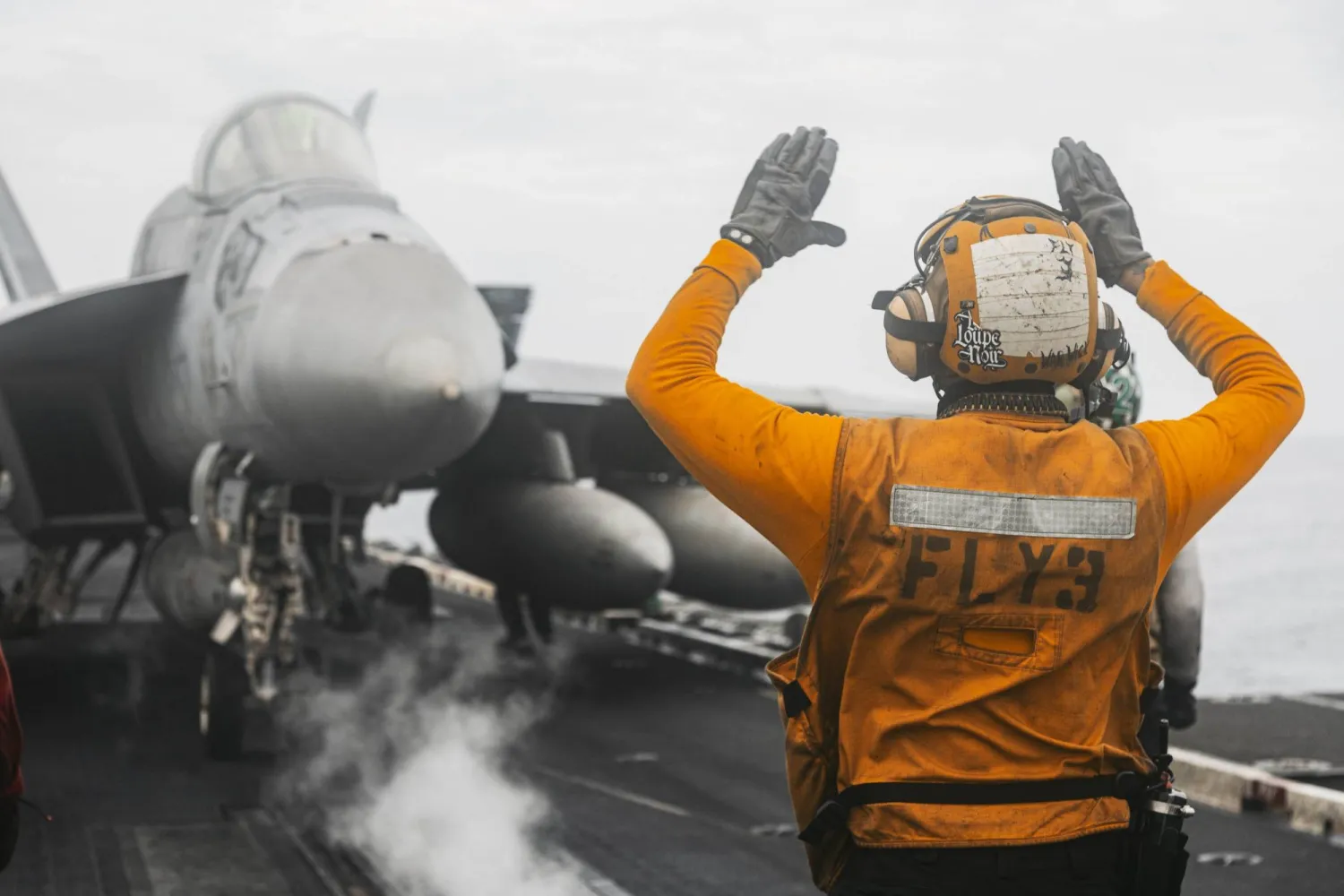

US Strikes Iran Over Troop Deaths as Israel Warns Tehran’s Attacks Are Coming Close

A US warplane takes off from an aircraft carrier to carry out raids on Iran (US Central Command)
TT

US Strikes Iran Over Troop Deaths as Israel Warns Tehran’s Attacks Are Coming Close

A US warplane takes off from an aircraft carrier to carry out raids on Iran (US Central Command)

The United States launched more airstrikes at Iran on Sunday in response to the killing of US troops, and Iran fired missiles toward Jordan that risked widening the conflict into neighboring Israel. 

Step by step, the US, and Iran have returned closer to all-out war as last month's interim deal meant to permanently end the fighting has crumbled and shipping traffic in the Strait of Hormuz has largely stalled. Both sides have targeted civilian infrastructure relied on by millions of people. 

The US military said the latest strikes targeted Iran's paramilitary Revolutionary Guard to retaliate for Friday's killing of troops in Jordan. The campaign, now in its second week, has seen the US target bridges, water desalination plants and electrical facilities in Iran. Tehran has hit countries throughout the Middle East. 

Kuwait, Jordan and Bahrain again activated air defenses for incoming Iranian drones and missiles. Israel warned that missiles launched toward neighboring Jordan could cause fire to spill over into Israeli territory for the first time in weeks. 

Iran says a nuclear site under construction was hit  

The US military’s Central Command said it hit “Iranian military coastal surveillance and air defense facilities, maritime capabilities and missile and drone storage sites.” It said the attack was designed to degrade Iran's ability to control the strait and “swiftly punish Revolutionary Guard Corps forces,” a power base in Iran's theocracy that controls its ballistic missile arsenal. 

Footage released by the US military appeared to show strikes carried out by fighter jets and by Tomahawk cruise missiles launched from the sea. One target site appeared to be in a valley of a mountainous region. The Guard often has missile bases and other military equipment tucked into mountain ranges. 

Iran’s atomic energy agency said US strikes targeted the construction site of a planned nuclear power plant in the southwest, state television reported. 

Satellite images from Planet Labs PBC of the Darkhovin nuclear plant site showed earth clearing but little construction as of July 9. Iran did not previously announce it as being targeted. 

The International Atomic Energy Agency said the site, in the “very early stages of construction,” contained no nuclear material when the UN watchdog last visited. 

Meanwhile, Jordan's military said it shot down several Iranian missiles. The country hosts major US bases and relies on US air-defense systems. The missiles did not cause casualties or damage, according to Jordan's military. 

Israel's military said Iranian missiles launched toward the Jordanian port city of Aqaba just across the border could spill over, warning Israelis to expect the first air-raid sirens in weeks. 

Eilat, the Israeli city that neighbors Aqaba, cited security officials as saying two interceptors were launched from its outskirts to prevent the fall of debris. 

During the latest fighting, Iran has focused attacks on Arab states rather than Israel, which launched the war with the US on Feb. 28. 

Kuwait said one of its power and water desalination plants was attacked for the second time in two days, causing fires. Its Ministry of Electricity, Water and Renewable Energy said the power grid remains stable. In Kuwait, about 90% of drinking water comes from desalination. 

The secretary-general of the six-nation Gulf Cooperation Council, Jasem AlBudaiwi, has accused Iran of war crimes for strikes on infrastructure and civilian facilities. 

International humanitarian law generally protects civilian infrastructure such as bridges and power plants from attack, but such sites can lose protections if used for military purposes. In such cases, attacks must be proportionate and minimize civilian harm. 

The Strait of Hormuz remains key to the conflict  

US President Donald Trump has threatened to target Iran’s power stations and bridges to try to compel Tehran to loosen its hold on the Strait of Hormuz, which saw one-fifth of global oil supplies transit before the war. Recent attacks suggest the US military is carrying out that plan. 

The US in the past week reimposed a naval blockade on Iranian ports to halt its shipments of crude oil. The military on Saturday said it had redirected five ships and disabled one since then. 

A maritime organization overseen by the US Navy said Sunday that the threat to mariners is severe after previous Iranian attacks, “with deliberate hostile action considered highly likely.” It said traffic remained low, with eight transits on Saturday and three on Friday. The daily average before the war was almost 140. 

Iranian Supreme Leader Mojtaba Khamenei, in a statement Saturday, warned of “unforgettable lessons” if the US keeps attacking his country. An Iranian negotiator said Tehran was suspending its commitments to the interim deal and accused the US of violating it. 

The halfway point has passed in the 60 days the deal set out to negotiate the permanent end of the war and other issues, including Iran's nuclear program. 

Since the war began, 16 US service members have been killed and over 430 wounded. Iranian authorities on Sunday said at least 50 people have been killed and 517 wounded in the latest US strikes. Iran has provided no overall information on its materiel losses. 

Far from the region, the war's effects on the prices of fuel and other goods have hit some of the world's most vulnerable areas hard. 


Türkiye Condemns Closing of 8 Turkish Schools in Greece

View of the island of Halki from a ferry sailing to the island of Rhodes, off the island of Halki, Greece, April 13, 2021. (Reuters)
TT

Türkiye Condemns Closing of 8 Turkish Schools in Greece

View of the island of Halki from a ferry sailing to the island of Rhodes, off the island of Halki, Greece, April 13, 2021. (Reuters)

Türkiye's foreign ministry on Sunday condemned a decision by Greece to close eight schools catering to the country's Turkish-speaking minority, accusing its neighbor of discrimination.

In a communique, the ministry condemned "systematic practices aimed at undermining the right to education of the Turkish minority in Western Thrace".

"We once again call on Greece to act in accordance with its contractual obligations regarding minority rights and fundamental rights," it added.

The number of Turkish-language schools left in the north-east region of Thrace -- near the border between the two countries -- is now 76.

Greek authorities have said they were closing schools, and not solely in Turkish-speaking areas, because of declining numbers of pupils.

According to 2021 statistics, some 120,000 Muslims of Turkish origin live in Thrace, where they enjoy specific rights in regards to religion and education under the Treaty of Lausanne, signed after the First World War.


5.5 Magnitude Earthquake Hits Peru’s Andes Region, Killing at Least 5 People

This handout picture released by Peru's Defense Ministry shows a collapsed house on the outskirts of Huancayo, about 300 km east of Lima, on July 19, 2026, following a 5.5 magnitude quake. (Handout / Peruvian Ministry of Defense / AFP)
TT

5.5 Magnitude Earthquake Hits Peru’s Andes Region, Killing at Least 5 People

This handout picture released by Peru's Defense Ministry shows a collapsed house on the outskirts of Huancayo, about 300 km east of Lima, on July 19, 2026, following a 5.5 magnitude quake. (Handout / Peruvian Ministry of Defense / AFP)

A 5.5 magnitude earthquake shook the Andes region of Peru, killing at least five people, local authorities said on Sunday.

More than 20 people were injured, and 300 have been displaced so far.

The US Geological Survey (USGS) reported the quake struck on Saturday at 9:24 p.m. local time, with its epicenter located 2 kilometers (1.24 miles) west-southwest of the city of Sicaya, in Huancayo province. The incident took place at a depth of 10 kilometers (6.21 miles).

Peru’s National Civil Defense Institute said in a statement the total number of people missing is still unknown.

Several buildings collapsed or suffered structural damage, including the local church and convent.

Images broadcast by local media captured the anguish of victims’ relatives in one of the hardest-hit areas, the agricultural region of Chongo Bajo, where residents huddled under blankets outside severely damaged homes. Animals were also seen under the rubble.

In 2007, a magnitude 7.9 earthquake struck the province of Pisco in the Ica region, leaving nearly 600 people dead.

Earthquakes are frequent in Peru, as the country is located in the so-called Pacific “Ring of Fire.”


UN Watchdog Calls for Restraint as Iran Says US Attacked Unfinished

Iranians walk past an anti-US banner in Tehran on July 19, 2026. (AFP)
TT

UN Watchdog Calls for Restraint as Iran Says US Attacked Unfinished

Iranians walk past an anti-US banner in Tehran on July 19, 2026. (AFP)

The UN's nuclear watchdog called for restraint on Sunday after Iran's Atomic Energy Organization said the United States had attacked an under-construction nuclear power plant in the country's southwest.

The US and Iran have been trading escalating attacks for days, and Washington carried out fresh airstrikes on Sunday to "punish" Iran for the deaths of two US service members in Jordan on Friday -- its first reported losses since the return to open hostilities in the Middle East war.

Tehran's Atomic Energy Organization said US forces "in an aggressive and brutal act contrary to international law, attacked the under-construction Darkhovin nuclear power plant... with a number of projectiles on Sunday", according to a statement carried by state TV.

The UN's International Atomic Energy Agency said it was looking into the reports, noting the plant "is in the very early stages of construction and contained no nuclear material when last visited by the IAEA".

While the incident "is not believed to pose any radiological risk", IAEA director Rafael Grossi reiterated his "call for military restraint in the vicinity of all nuclear-related sites", the agency said, in a post on X.

Iran's nuclear program has long been a major point of contention between it and the West, including in negotiations aimed at ending the current war.

While foreign powers including the US and Israel suspect it of seeking a bomb, Tehran has always maintained its program is peaceful, though it insists on its right to enrich uranium for civilian purposes.
