
Iran, Iraqi Factions Criticize Al-Zaidi’s Washington Visit

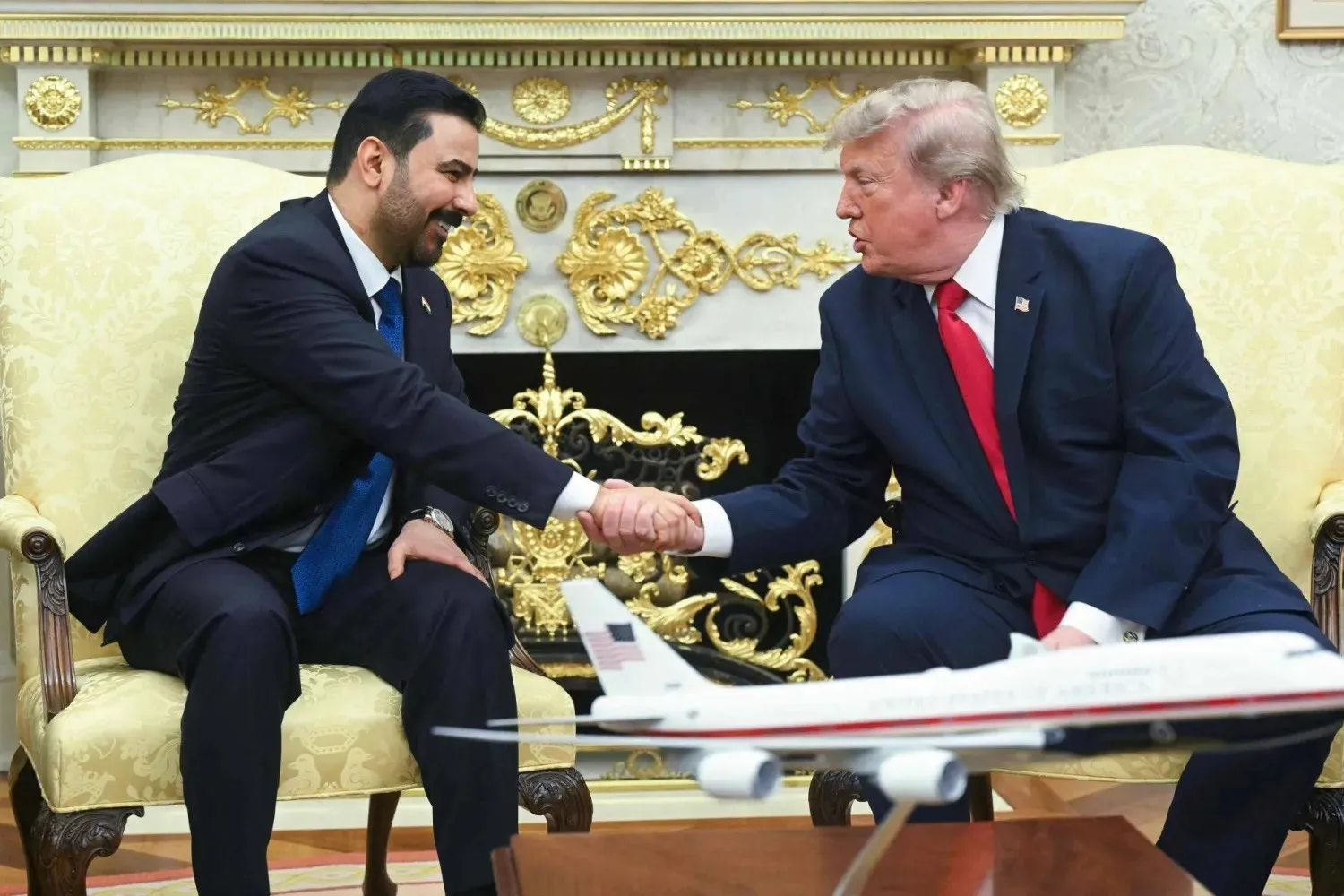
US President Donald Trump shakes hands with Iraqi Prime Minister Ali al-Zaidi at the White House on July 14, 2026. (AFP) 
TT

Iran, Iraqi Factions Criticize Al-Zaidi’s Washington Visit

US President Donald Trump shakes hands with Iraqi Prime Minister Ali al-Zaidi at the White House on July 14, 2026. (AFP) 

Iraqi Prime Minister Ali al-Zaidi received a notably warm welcome during his visit to the United States, where he met President Donald Trump and sought to translate political rapprochement into economic and investment partnerships.

Drawing on his business background, al-Zaidi told US companies they shared “a common language — the economy.” He stressed, however, that he had not come to the United States as a “contractor,” but to pursue broad-based development in Iraq, which he said had missed opportunities for growth over the past two decades despite its ties with successive US administrations.

Al-Zaidi linked Iraq’s next security and political phase to a new era of economic cooperation. He noted that the departure of the remaining US forces after September 30, under an agreement reached between the government of former Prime Minister Mohammed Shia al-Sudani and Washington, could open the door to broader economic and investment partnerships.

Before the visit, al-Zaidi said Iraq would no longer need the concept of “resistance” after the end of September, arguing that “resistance is not a profession, but a necessity” imposed by the country’s past circumstances.

His outreach drew criticism from Iran-aligned groups and their Iraqi allies, who argued that opening the door to US companies represented a political and economic shift requiring reassessment.

The criticism coincided with Iraq’s signing of about 48 memorandums of understanding and agreements with US companies, alongside energy deals that included an oil export route bypassing the Strait of Hormuz and a memorandum of understanding with Syria to transport Iraqi oil to the Syrian port of Banias.

Velayati Criticizes Al-Zaidi

The developments also drew criticism in Tehran, where Ali Akbar Velayati, an adviser to Iran’s supreme leader, described al-Zaidi as “inexperienced,” according to media reports.

Writing in the newspaper Farhikhtegan, Velayati said the Iraqi prime minister’s conduct during his meeting with Trump, shortly after the funeral of former Supreme Leader Ali Khamenei, was “a great disgrace.”

Observers say the dispute reflects intensifying competition over Iraq’s future relationship with both the United States and Iran, as Baghdad seeks to attract foreign investment while preserving its regional balance.

Analyst Iyad al-Samawi questioned whether Iraq was truly prepared to host major US companies and provide an adequate investment climate.

“Global companies do not invest on emotion or gamble with their decisions,” he underlined, stating that they look not only for oil, but also for security, stable legislation, judicial independence, efficient procedures, clear decision-making, and institutional integrity.

He added that major US companies operate under strict anti-bribery and anti-corruption laws and would not lower their standards to accommodate an unstable business environment. The success of the agreements signed in Washington, he said, “begins not with the companies, but with the Iraqi state itself.”

A former security official told Asharq Al-Awsat that the campaign against al-Zaidi was “not merely a passing political escalation,” but reflected concerns that his economic opening could create a more favorable environment for US companies.

Speaking on condition of anonymity, the official said al-Zaidi was seeking to apply his business experience to government by “blending politics with finance and business.” But major US companies, he added, would not invest in Iraq as long as political corruption and security instability persisted.

The official argued that pressure from Iran and allied Iraqi factions was intended to slow the economic opening championed by the prime minister.


Iraqi PM to Visit Tehran This Week

Iraqi Prime Minister Ali al-Zaidi attends a meeting with US President Donald Trump (not pictured) in the Oval Office of the White House in Washington, DC, USA, 14 July 2026. (EPA)
TT

Iraqi PM to Visit Tehran This Week

Iraqi Prime Minister Ali al-Zaidi attends a meeting with US President Donald Trump (not pictured) in the Oval Office of the White House in Washington, DC, USA, 14 July 2026. (EPA)

Iraqi Prime Minister Ali al-Zaidi will visit Tehran ‌within ‌the coming ‌week, ⁠the Iraqi state ⁠news agency reported on ⁠Sunday.

During ‌the visit, ‌the prime minister will ‌sign memoranda of ⁠understanding in ⁠Tehran in areas of cooperation.

Al-Zaidi had visited the United States earlier this week where he met with President Donald Trump.

Trump praised the new PM, saying the US is “going to have a long-term relationship with Iraq. We're going to have a long-term relationship with a man that will be a great leader.”

“It's a great honor to have the Prime Minister of Iraq with us. He's been a great fighter, and he's been a great fan of America,” he went on to say.

Iraq signed 48 agreements and partnerships with American companies, many in the oil sector, during al-Zaidi's visit.

Al-Zaidi, a businessman, came to power this year with US blessing after Trump vetoed another candidate.

He has vowed to boost Iraq's fragile economy and disarm pro-Iran armed groups in Iraq that have targeted US facilities.

Iraq has long walked a tightrope between the competing influences of allies the United States and neighboring Iran.


Rubio Hails Lebanon for Peace Efforts After Meeting Aoun

Lebanese President Joseph Aoun attends a press conference, at the presidential palace, in Baabda, Lebanon January 17, 2025. (Reuters)
TT

Rubio Hails Lebanon for Peace Efforts After Meeting Aoun

Lebanese President Joseph Aoun attends a press conference, at the presidential palace, in Baabda, Lebanon January 17, 2025. (Reuters)

US Secretary of State Marco Rubio met with Lebanese President Joseph Aoun in Washington on Sunday, praising the country for its "move towards peace" after the latest round of Lebanon-Israel talks. 

It was the first trip to the US capital by a Lebanese head of state since Michel Suleiman was received by Barack Obama in 2009. 

Aoun and Rubio held talks at the State Department, and Lebanese officials said Aoun is due to meet with President Donald Trump on Tuesday. 

Rubio commended the Lebanese government for its "determined effort to reclaim Lebanon's sovereignty, disarm Hezbollah and dismantle its terrorist infrastructure, and move towards peace," the State Department said following the talks. 

Lebanon and Israel, which do not have formal diplomatic relations, began US-sponsored negotiations in April aimed at reaching a peace deal and permanently ending the Israel-Hezbollah war. 

On June 26, they reached a framework agreement in Washington under which the Israeli military is to withdraw from southern Lebanon and the Lebanese army is to deploy, starting with two "pilot zones." 

But the agreement is contingent on the disarmament of Iran-backed group Hezbollah, which has flatly rejected both the deal and the Israel-Lebanon negotiations that underpin it. 

Following the latest round of talks last week in Rome, Israel and Lebanon agreed on the structure and guidelines for implementing the pilot zones, according to the United States. 

Rubio said Washington was committed "to supporting the successful implementation of the Trilateral Framework and to backing the Government of Lebanon's efforts to deliver peace, economic recovery, and a better future for the Lebanese people." 

Hezbollah pulled Lebanon into the Middle East war on March 2, when it began striking Israel in support of its backer Iran. 

Israel responded with airstrikes and a ground invasion, and despite a ceasefire it continues sporadic attacks and holds territory in the south in what it describes as a "security zone." 

While in Washington, Aoun planned talks "on the situation in Lebanon and ways to strengthen the ceasefire" as well as on "the withdrawal of Israel from the Lebanese regions it occupies," his office said earlier. 

The United States carried out airstrikes on Sunday to "punish" Iran after the first US military deaths since open hostilities rekindled the Middle East war. 


Jordan Summons Iranian Diplomat Over ‘Unjustified’ Attacks

The Jordanian capital, Amman. Petra file photo
TT

Jordan Summons Iranian Diplomat Over ‘Unjustified’ Attacks

The Jordanian capital, Amman. Petra file photo

Jordan has summoned Iran's charge d'affaires in Amman over what it ‌called "unjustified ‌and blatant Iranian ‌attacks" ⁠and "provocative and inflammatory ⁠statements targeting the Kingdom's territory," Jordan's ministry of foreign affairs ⁠said in ‌a ‌statement on ‌Sunday. 

Over the ‌last week, Jordan has repeatedly said that ‌it has intercepted Iranian missiles flying ⁠over ⁠its territory, including three that it shot down on Sunday, according to the country's military.