
Egypt, Türkiye Conclude Joint Military Exercise

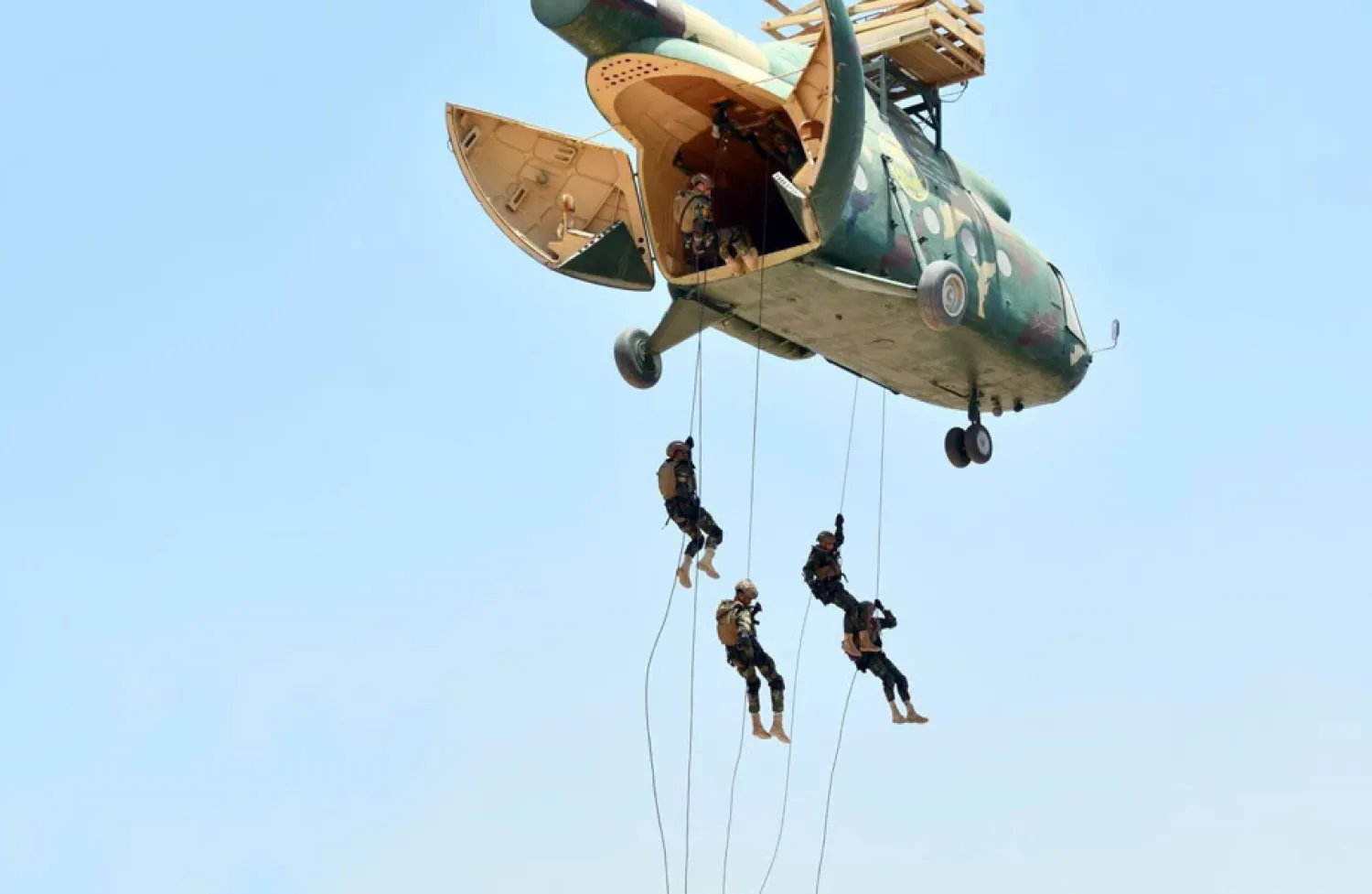
The training featured conventional and unconventional live-fire drills, vertical assault exercises using an aircraft simulator and training on handling improvised explosive devices. (Egyptian military spokesman on Facebook)
TT

Egypt, Türkiye Conclude Joint Military Exercise

The training featured conventional and unconventional live-fire drills, vertical assault exercises using an aircraft simulator and training on handling improvised explosive devices. (Egyptian military spokesman on Facebook)

Egypt and Türkiye have concluded a joint military exercise focused on countering drones and conducting unconventional live-fire drills, with the participation of Egyptian airborne and commando units and Turkish special forces.

According to a statement issued Saturday by the Egyptian military spokesperson, the final phase of the multi-day Golden Eagle exercise included “an operation to storm a terrorist stronghold in a residential area using helicopters, during which hostages were freed and the terrorist elements apprehended.”

The training featured conventional and unconventional live-fire drills, vertical assault exercises using an aircraft simulator and training on handling improvised explosive devices.

Participants trained in first aid and lifesaving procedures, the use of unmanned aerial vehicles and methods of countering them, free-fall simulation in a vertical wind tunnel and operational free-fall parachute jumps.

The exercise comes amid growing military cooperation between Egypt and Türkiye, reflected in a series of joint drills held since the two countries signed a military framework agreement five months ago during Turkish President Recep Tayyip Erdogan’s visit to Cairo in February.

The Egyptian military spokesperson said the exercise also included a “friendship jump” in which troops carried the flags of both countries, demonstrating the participants’ “high level of proficiency and advanced technical skills.”

The final phase was attended by several senior Egyptian and Turkish military commanders, as well as Türkiye’s military attaché in Cairo.

The first phase of Golden Eagle included theoretical lectures on a range of subjects aimed at standardizing operational concepts and improving integration and coordination among participating personnel. An exhibition of the weapons and equipment used during the exercise was also held.

Last week, Egypt’s commander-in-chief of the armed forces and minister of defense and military production, Ashraf Salem Zaher, met Turkish Defense Minister Yaşar Güler in Türkiye to discuss strengthening military cooperation in training and the transfer and exchange of expertise between the two countries’ armed forces.


Syria Restructures Security Authority in Response to Pressure

12 July 2026, Syria, Damascus: Syrian President Ahmed al-Sharaa attends the inaugural session of Syria's newly formed People's Assembly in Damascus. (Syrian Presidency)
TT

Syria Restructures Security Authority in Response to Pressure

12 July 2026, Syria, Damascus: Syrian President Ahmed al-Sharaa attends the inaugural session of Syria's newly formed People's Assembly in Damascus. (Syrian Presidency)

A sweeping round of senior security appointments announced Sunday by Syrian President Ahmed al-Sharaa amounts to a fundamental restructuring of the country’s security apparatus, driven by both domestic security concerns and mounting political and economic pressure from abroad, according to Syrian security and strategic affairs analyst Ismat al-Absi.

Speaking to Asharq Al-Awsat, al-Absi said the appointments reflect a clear effort to consolidate security authority in the hands of al-Sharaa and Interior Minister Anas Khattab by placing both Public Security, including policing and internal security, and National Security under a single command.

The move effectively ends the institutional divide and potential rivalry between the Interior Ministry and the intelligence services, making Khattab the sole authority overseeing both strategic and operational security decision-making, al-Absi said.

Hussein al-Salama will assume an executive role reporting directly to Khattab on national security affairs, while the General Intelligence Directorate will be headed by Abdul Qader Tahan within the unified structure.

Al-Absi said the appointments also mark a broader institutional overhaul, noting that the changes are intended to bring the transitional phase to a close by establishing a unified centralized security structure after concerns over overlapping authorities among agencies with different backgrounds, including Hayat Tahrir al-Sham (HTS) and the Syrian Democratic Forces (SDF).

According to al-Absi, the immediate catalysts were recent security pressures, including bombings in Damascus and the interception of weapons allegedly being smuggled from Iraq to Hezbollah in Lebanon.

He said the attacks and the foiled smuggling operations exposed gaps in interagency coordination, border security, and urban surveillance.

The Damascus bombings occurred during French President Emmanuel Macron’s July 6-7 visit - the first by a major Western head of state since al-Sharaa took office in late 2024 - when two explosive devices detonated a few hundred meters from the Four Seasons Hotel, where Macron was staying.

Syrian authorities later announced the arrest of the cell responsible, with preliminary investigations indicating it was affiliated with ISIS.

Economic researcher Firas Shaabo said the security restructuring is also intended to create a safe and stable environment for investment.

He explained that unifying the country’s top security leadership would reduce institutional fragmentation and strengthen coordination, making the changes an integral part of Syria’s broader economic vision.

Given the National Security Office broad oversight powers, the restructuring could reinforce stability, remove obstacles to development and reconstruction, attract foreign investment, stimulate the domestic economy, and reassure the international community and regional partners of the state’s ability to maintain internal stability, he added.