


In the Israeli-Occupied West Bank, Too Much Cash Is Breaking the Economy

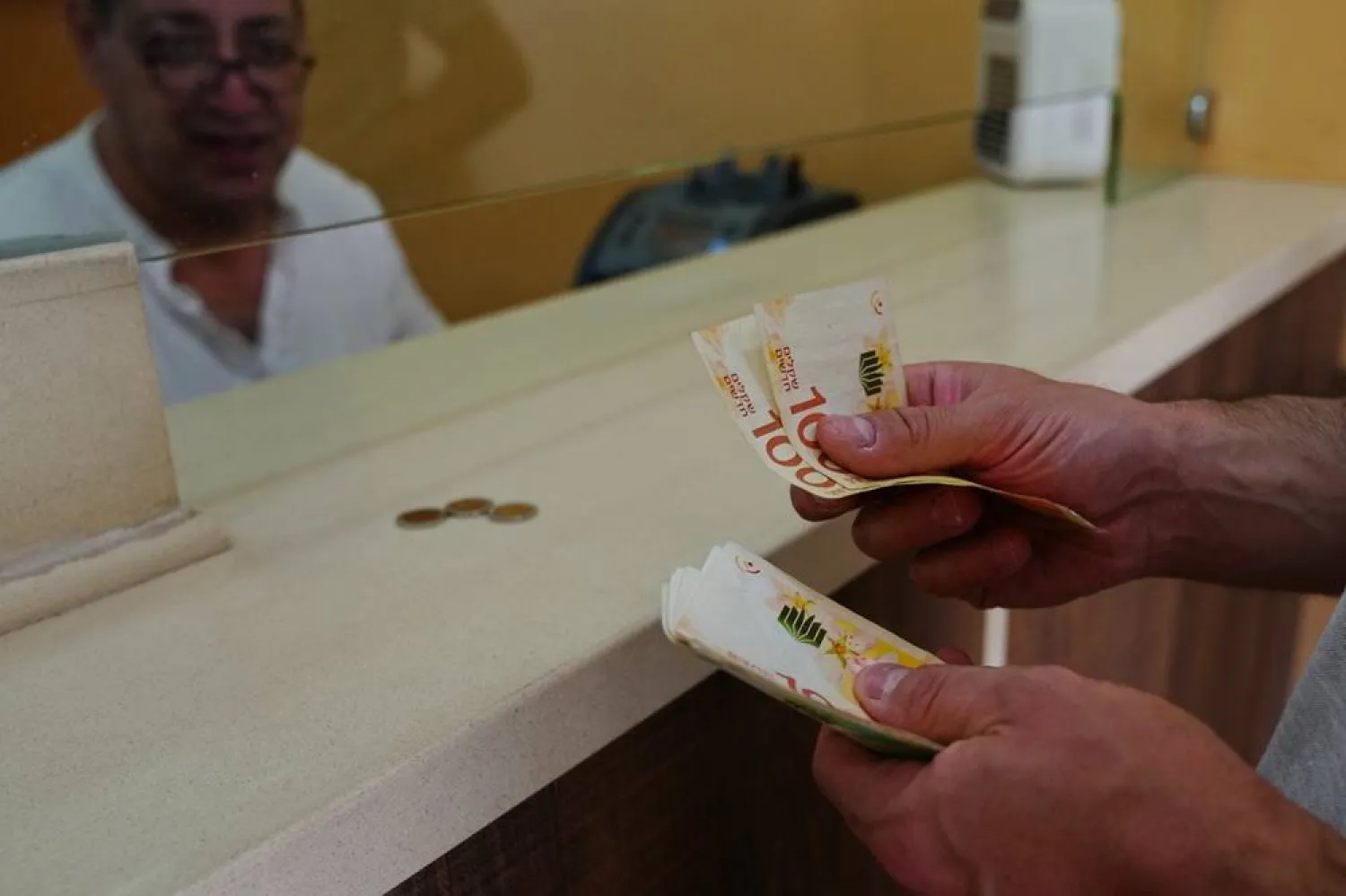
A customer counts Israeli shekels at a currency exchange bureau in the West Bank city of Bethlehem, Tuesday, July 7, 2026. (AP)
TT

In the Israeli-Occupied West Bank, Too Much Cash Is Breaking the Economy

A customer counts Israeli shekels at a currency exchange bureau in the West Bank city of Bethlehem, Tuesday, July 7, 2026. (AP)

Picture this: A gas station customer pulls out a wad of bills to pay for a fill-up. The cashier refuses the money, explaining that the station's bank has stopped accepting notes and coins as deposits because it already is drowning in cash.

In most places, cash is king. But in the Israeli-occupied West Bank, having too much is gumming up the machinery of daily life. The Palestinian banking system has more Israeli shekels than it can manage. As a result, paper money has gotten harder for residents to spend and for businesses to put into their accounts.

The excess liquidity stems from a conflict between the Bank of Israel and the Palestinian Monetary Authority, which oversees Palestinian banks and financial institutions. Israel limits the amount of physical currency it takes back from the West Bank. Palestinian officials say the cap has not kept pace with growth and is one mechanism used to keep the territory in a state of economic crisis.

Unlike in Gaza, where years of an almost total blockade have caused cash shortages, banks in the West Bank are running out of vault space to store stacks of shekels. With Bank of Israel refusing to accept more notes and coins, commercial banks can’t convert the money into electronic balances to pay suppliers or process transfers on behalf of their customers.

“The banks have been shackled” in their ability to deal with the crisis, Mohammad Manasra, the deputy governor of the Palestinian Monetary Authority, said in an interview with The Associated Press. “What is being practiced in the West Bank is economic warfare.”

More cash enters the West Bank than Israel allows out

Central banks in most countries take back cash from commercial banks and credit them electronically so they can settle payments and meet customers’ needs. But in the occupied West Bank — where Palestinians have no say over monetary policies guiding the shekel — the economy runs differently.

The territory has relied predominantly on the Israeli shekel for decades and depends on Israel to facilitate trade, collect taxes and process payments for imported goods under agreements dating to the 1990s. A surfeit of cash accumulates because the Palestinian economy runs almost exclusively on physical currency, and more enters from Israel than can exit.

Why? Employers in Israel and its settlements pay Palestinian laborers in cash, and Palestinian citizens of Israel often purchase goods like cigarettes and fuel in the West Bank, bringing in even more shekels. As more cash flows in, the surplus trapped inside Palestinian banks grows, neither earning interest nor getting turned into loans, investments and bill payments.

Israel's cash transfer limit from the West Bank's banking system is 18 billion shekels ($5.9 billion) a year. Banks now accumulate an estimated 30 billion shekels a year, said Moayad Afaneh, an economist who has advised the Palestinian Authority.

In the past, Israeli officials expressed reluctance to accept more, citing concerns that returned money could be linked to laundering, tax evasion or terrorism.

Bank of Israel said in a statement that it follows the current government's policy on how many shekels to accept but that fewer Palestinians have worked in Israel since the war in Gaza started, thereby reducing the cash entering the West Bank.

Israeli Finance Minister Bezalel Smotrich 's office did not respond to requests for comment but in September 2025 Smotrich threatened to “use all of the tools” at his disposal to prevent the creation of a Palestinian state, including “economic strangulation.”

Palestinians say Israel limits taking shekel as economic leverage

Israel has imposed a series of measures that have hobbled the West Bank’s economy since Hamas-led militants attacked in October 2023, starting the war in Gaza.

It revoked most work permits for Palestinians who used to work in Israel, cutting off a major source of income in the occupied territory. It has withheld tax and customs revenue collected on behalf of the Palestinian Authority, which in turn has been unable to fully pay public sector workers, including teachers and hospital staff, for more than a year.

With growing needs for vault space, banks are having to pay to store and insure cash they're unable to offload. They're accepting less from businesses and households, which in turn have to find alternative ways to store cash safely.

The excess shekel problem is “directly affecting the government’s ability and the private sector’s capacity to continue providing services to major industrial sectors and the Palestinian people,” Manasra said.

As an example, he noted most of the West Bank’s fuel and electricity is imported from Israel or purchased from Israeli utilities. When banks have too much of their assets tied up as physical cash, they don't have the funds when their clients — like the Palestinian Authority or West Bank cities — need to transfer payments to import fuel, water and electricity.

Fears of looting by Israeli soldiers conducting increasingly common home raids have made the problem worse, Afaneh, the economist, said. Palestinians are depositing more into banks because they fear soldiers will confiscate it, claiming suspiciously large sums could be used for illicit purposes or terrorism.

Having too much cash on hand also hurts the banks' bottom lines because they can't lend out money like most banks, which today do so electronically. A 2022 International Monetary Fund study estimated excess cash reduced Palestinian banks’ profits by about 20%, a figure Afaneh said is likely much higher today.

Cash-based businesses in the West Bank have money but can't pay suppliers

Inside the Ramallah headquarters of the Al-Huda Group, cigarette smoke and tea steam drift through an office where clerks feed banknotes into machines that spit out neat stacks of counted bills. The company operates filling stations, convenience, grocery and home improvement stores, car washes and other businesses that collect tens of millions of shekels each month.

Stockpiles of money that cash-based businesses can’t deposit because the banks are full has made routine operations and transactions more difficult and expensive, said Hussni Jaber, the executive manager of the Al-Huda Group.

To make electronic payments to Palestinian and foreign suppliers, for example, some businesses have resorted to taking out loans or buying other currencies while also paying more to keep their overabundance of cash on hand safely stored, Jaber said.

When they can't pay their suppliers, some gas stations have to stop filling their pumps. The Palestinian Authority in a statement pointed to the issue when gas stations temporarily closed on Saturday.

Last month, a number of gas station owners coordinated a 30-minute strike across the West Bank, including the 22 operated by Al-Huda, to draw attention to the cash crisis. It has done little to prompt a response.

With their earnings stuck outside the traditional banking system, business leaders fear the cash glut will eventually prevent West Bank companies from being able to import fuel, food and medical supplies from Israel or elsewhere abroad, Jaber said.

“All sectors will collapse if the cash problem is not resolved," he said.


Gaza’s Children Lose Simple Joy as Israel Warns Against Kite-Flying

Boys fly a kite against the backdrop of smoke rising from the Gath shelter, that houses displaced Palestinians, after an Israeli air strike in the west of Khan Younis, southern Gaza Strip on January 31, 2026. (AFP)
TT

Gaza’s Children Lose Simple Joy as Israel Warns Against Kite-Flying

Boys fly a kite against the backdrop of smoke rising from the Gath shelter, that houses displaced Palestinians, after an Israeli air strike in the west of Khan Younis, southern Gaza Strip on January 31, 2026. (AFP)

There are few joys left for 10-year-old Ahmed Hamdouna, whose childhood has already been scarred by years of war and displacement in Gaza.

Now, what little reprieve he found playing with scraps of plastic and sticks has also been torn away, as Israel warns it will step up military operations in the territory if kites continue to land on the Israeli side of the border.

"My father stopped me from flying my kites because of the occupation's threats," said Ahmed, who has been displaced to Deir el-Balah in the central Gaza Strip.

"I felt heartbroken after spending so much time collecting sticks and nylon, only for the occupation to prevent us from playing with them," he told AFP.

"We are just young children. They destroyed our home and our whole neighborhood -- what more do they want?"

Israel accuses Hamas of cynically using children and says the kites could pose a threat, years after a wave of incendiary kites and balloons sparked fires in Israeli farmland.

A series of kites have flown in recent days across the border into southern Israel, communities shaken by the Hamas-led attacks of October 7, 2023.

Hamas has denied responsibility. No explosives were detected, but at least one kite had a political message on it.

On Wednesday, an official of the US-led Board of Peace supervising the ceasefire plan in the territory said: "All militant activity in Gaza must stop, including the flying of kites."

"Israel, too, must comply with the ceasefire," a board official said.

Hamas spokesman Hazem Qassem said the popular committees in Gaza's displacement camps were trying to prevent children from flying kites, over fears they could be targeted by the Israeli military.

Ahmed said he was now scared of playing, but couldn't understand why the Israeli military was "afraid of kites when they are just paper and string".

"I don't want to hurt anyone. I just want to play like children everywhere else," he said.

- 'Sense of freedom' -

For Gaza's children, building kites was a simple way to find joy among the ruins of war.

"There are no toys here, no amusement parks, not even a football to play with. The kite is the only thing we can make with our own hands that makes us happy when we fly it in the sky," said 11-year-old Yamen al-Mubayyed, who has also been displaced to Deir el-Balah.

"My friends and I get together and make them using pieces of wood we collect from destroyed houses, along with paper and string. We glue them together using flour and water, then go to the sea to fly them," he told AFP.

Yamen said even the buzz of Israeli surveillance drones didn't put him off flying his kites.

"It is the only thing that makes us feel that we children are alive and gives us a sense of freedom," he said.

Israel has kept up attacks in Gaza, saying it is targeting gunmen, despite a US-backed ceasefire which came into effect in October.

Israeli army chief Lieutenant General Eyal Zamir on Tuesday vowed to push on with demilitarizing Gaza "using all necessary means".

- 'Kill the joy in their hearts' -

For parents in Gaza, the once-harmless activity now carries immense worries.

Akram Abu Shurkh, 30, said he had forbidden his children from making kites but felt he had "killed the joy in their eyes" in doing so.

"These are children who do not understand military calculations. They only see it as a game and a way to release their energy," he told AFP.

"But I see death in the touch of the string and the flying of the kite."

In southern Gaza, 34-year-old Umm Moaz Huwayla said her heart raced from worry every time her children went outside with their kites, but felt she couldn't stop them from playing.

"The occupation wants to kill the joy in their hearts," she told AFP.

"They are not asking for much, only to live their childhood, even with a piece of string and a sheet of paper."


From UNIFIL to Verification Committees... Will Int’l Force in Lebanon Have Expanded Powers?

UN peacekeepers (UNIFIL) vehicles drive in the Lebanese village of Wazzani near the border with Israel, southern Lebanon, July 6, 2023. (Reuters)
TT

From UNIFIL to Verification Committees... Will Int’l Force in Lebanon Have Expanded Powers?

UN peacekeepers (UNIFIL) vehicles drive in the Lebanese village of Wazzani near the border with Israel, southern Lebanon, July 6, 2023. (Reuters)

With UNIFIL’s departure now all but certain, the question is no longer whether the UN force will remain in southern Lebanon, but who will replace it, and with what powers.

A European-led force and verification committees are under discussion, potentially expanding the international role from monitoring UN Security Council resolution 1701 to verifying exclusive state control over weapons south of the Litani River.

European-led force

Abbas Daher, director of the Center for Media Foresight, told Asharq Al-Awsat that a decision not to renew the UN Interim Force in Lebanon’s (UNIFIL) mandate was now “virtually certain,” despite recent attempts involving Italy to revive efforts for an extension.

“However, President Joseph Aoun’s visit to Italy and the current visit by Lebanese army Commander Gen. Rodolphe Haykal to continue discussions on implementation have effectively opened debate over the force that could succeed UNIFIL, whether in the form of verification committees or a force with a predominantly European composition,” Daher said.

“Discussions are now underway, and European countries, led by Italy, France and Spain, and perhaps Germany, are considering establishing a primarily European force to continue the mission,” he added.

“Efforts are also being made to gain international support for this arrangement.”

As for the verification committees, Daher said there was a proposal for the United States to play a role, particularly in verifying that weapons were under the state’s exclusive control and monitoring implementation. Discussions with Washington remain open, he added.

Italian proposal

Separately, local media reported having reviewed a four-page Italian proposal for the post-UNIFIL phase. The plan calls for a smaller, but more effective international presence focused on supporting the Lebanese army, protecting civilians and backing the mechanism monitoring the ceasefire.

The force could play a role in the disarmament measures, conditional on political approval.

Force’s mission

The debate over the force’s composition is closely tied to questions about its jurisdiction, mission and powers.

Asked how the new force would differ from UNIFIL, Daher said: “UNIFIL’s duties were defined by an international mandate and resolution 1701.”

“Lebanon will insist on replicating the experience or substance of the resolution in defining the nature of its work. The question, however, is whether that will succeed or whether amendments will be imposed, because Washington, under Israeli pressure, wants any committee to have greater executive powers.”

Retired Brig. Gen. Fadi Daoud agreed that the most important issue in the next phase was not limited to which party would replace UNIFIL. Rather, he said, it concerned a change in the nature of the international mission itself and the potential redefinition of the relationship between the new force and the Lebanese army.

“The process of ending UNIFIL’s mission has effectively become a reality, despite Lebanese efforts to secure an extension,” Daoud told Asharq Al-Awsat.

“The central question has therefore become: Who will replace it? The alternative arrangement will be the one that receives US approval,” he added.

“We are moving from peacekeeping forces to verification committees — from a mission linked to resolution 1701 to a different mechanism suited to a post-1701 phase, at least in the form in which we have known it over the past years.”

“Lebanon has no problem with any mechanism for verifying exclusive state control over weapons south of the Litani because it is committed to this issue,” Daher said.

“But the fundamental question is whether Israel will withdraw or remain an occupying force. If verification committees carry out their work, the army reaches certain areas and confirms that they are free of weapons, will Israel uphold its end of the arrangement and withdraw?”

“There must be a clear framework for an Israeli withdrawal, just as there is a clear framework for ensuring exclusive state control over weapons in the south.”

Powers of the verification committees

From a military perspective, Daoud said the scope of the committees’ powers lay at the heart of the debate. The distinction between verifying that the army had completed its mission and helping oversee its implementation could determine whether any new arrangement was viable.

“Will the verification committees’ role be limited to confirming that the Lebanese army has completed the task required of it, or will they take part in overseeing how it is carried out? There is a very significant difference between the two,” he stressed.

“For example, if information is received about a weapons depot at a particular location and the Lebanese army raids the site, will the committee merely receive a report confirming that the mission was completed and verify its outcome? Or will it accompany the military force and monitor the search on the ground using personnel, cameras and communications equipment?” he added.

“This is not a technical detail. It could be the most dangerous issue in any new arrangement because the Lebanese army cannot easily accept a foreign party or an entity outside its military chain of command exercising such close oversight over how it performs its duties or directing it during search operations,” he continued.

“An international body can verify that a mission has been carried out and confirm its results. But moving toward direct supervision of its implementation could create serious and sensitive problems,” Daoud said.


Gaza’s Diabetes Patients Face a War Without Respite

Palestinian child Al-Baraa Abdel Aal, who has diabetes, was forced to use expired medication in Gaza (Asharq Al-Awsat)
TT

Gaza’s Diabetes Patients Face a War Without Respite

Palestinian child Al-Baraa Abdel Aal, who has diabetes, was forced to use expired medication in Gaza (Asharq Al-Awsat)

Diabetes patients in the Gaza Strip are fighting two battles without respite - the fallout from an Israeli offensive that began nearly three years ago despite a ceasefire announced almost a year ago, and a daily struggle to secure medication as Israel tightens restrictions on the entry of drugs and other medical supplies, despite appeals from UN and health organizations.

The war has forced people with chronic illnesses to use expired medication as access to safe treatment has dwindled.

Habib Abu Daqqa, 11, who was diagnosed with diabetes a year before the war, has spent more than three months at Nasser Medical Complex after falling into a coma following an injection of expired diabetes medication.

His mother, Maysaa Abu Daqqa, who also has diabetes, told Asharq Al-Awsat that her son has become severely distressed and needs regular, safe treatment before he can leave the hospital.

She resorted to the expired injection because of his condition, despite warnings from some doctors, while others had told her it could still be used. He subsequently developed diabetic ketoacidosis and was admitted to intensive care.

Before the war, she recalled, both had reliable access to medication and appropriate food and followed regular treatment and dietary plans. She attributed their deteriorating health partly to the period of famine in Gaza.

In 2024, the Palestinian Health Ministry estimated that around 350,000 people with chronic illnesses in Gaza lacked necessary healthcare, including about 71,000 diabetes patients, 225,000 people with hypertension and 45,000 with cardiovascular disease.

Al-Baraa Abdel Aal, 14, who has Type 1 diabetes, also required intensive care after medication shortages forced him to take expired drugs.

“Before the war, I had access to all kinds of medication, especially insulin,” Abdel Aal told Asharq Al-Awsat. Suitable food was also readily available.

“I spent eight days in intensive care. I saw death,” he recalled, adding that expired medication and substitutes left him severely fatigued.

Wafaa Washah, 36, a Jabalia refugee camp resident displaced to Khan Younis who has had diabetes for 13 years, explained that economic hardship and her husband’s unemployment had deprived her of suitable food and even clean drinking water.

She recounted that she nearly slipped into a coma several times after using expired medication because no alternatives were available. During the famine, shortages of food, particularly flour, left her suffering frequent dizziness and fever.

Farah Lafi, 19, noted that the crisis extends beyond insulin to glucose test strips needed for frequent blood-sugar monitoring. She estimated that expired medications retain only about 30% of their effectiveness, undermining patients’ daily activity and ability to function.

Ibrahim Dhair, a diabetes consultant at hospitals in southern Gaza, described diabetes patients as among those hardest hit by severe drug shortages. Much of the available medication is expired and can lead to complications including diabetic ketoacidosis and admission to intensive care.

Even when insulin is available, proper refrigeration poses another problem, he explained. Many residents live in tents without basic services, while extreme heat can spoil medicines that must be stored at specific temperatures.

Dhair added that doctors sometimes issue guidance on how to manage available medicines, but with stocks continuing to run out, he described the current situation as a crisis beyond the healthcare system’s capacity to handle.
