Sudan Rejects US Sanctions, Denies Chemical Weapons Allegations

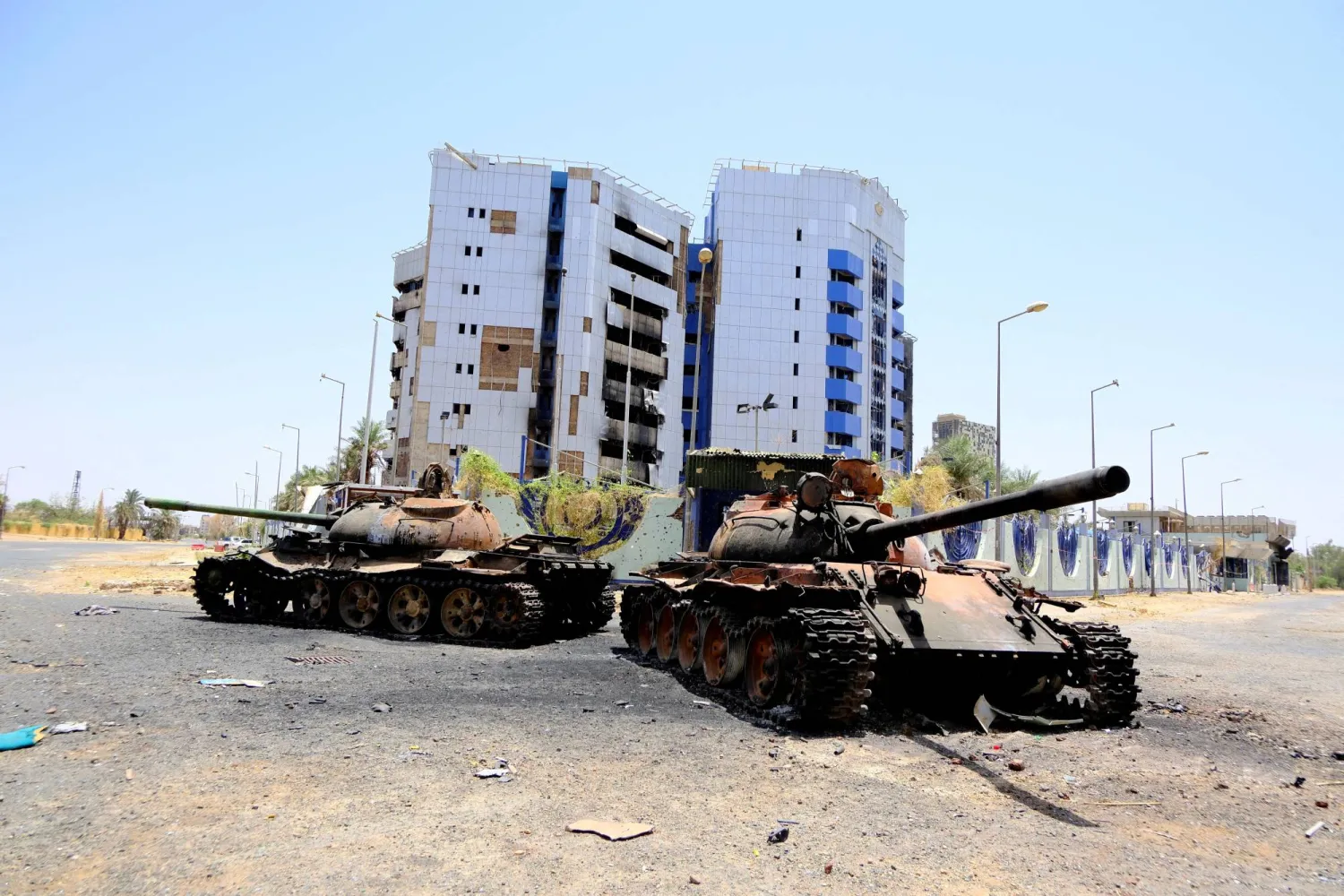
A view of damaged tanks in front of the Central Bank of Sudan building, after the Sudanese army deepened its control over Khartoum from the Rapid Support Forces (RSF), in Khartoum, Sudan April 27, 2025. (Reuters)
TT

Sudan Rejects US Sanctions, Denies Chemical Weapons Allegations

A view of damaged tanks in front of the Central Bank of Sudan building, after the Sudanese army deepened its control over Khartoum from the Rapid Support Forces (RSF), in Khartoum, Sudan April 27, 2025. (Reuters)

Sudan has strongly rejected US sanctions imposed over allegations that its military used chemical weapons during the country’s war, describing the measures as “unilateral and unlawful,” based on unsubstantiated claims and driven by “purely political motives.”

In a statement, the Foreign Ministry accused Washington of bypassing the relevant international mechanisms and disregarding procedures set out in the Chemical Weapons Convention by imposing sanctions based on “false allegations” that the Sudanese army had used prohibited weapons.

The response came on the eve of a second round of US sanctions taking effect on July 20, after Washington determined that Khartoum had failed to satisfy the requirements of the Chemical and Biological Weapons Control and Warfare Elimination Act of 1991.

The measures bar US support for loans and technical or financial assistance to Sudan through multilateral development banks, tighten export restrictions, and suspend the operating authority of Sudanese government-owned or government-controlled airlines to and from the US. Humanitarian assistance and certain goods and technologies remain exempt.

The ministry said Sudan had denied the allegations since they first surfaced in media reports citing anonymous sources. It reiterated that the country neither produces, possesses nor uses chemical weapons and remains committed to its obligations under the Chemical Weapons Convention.

It added that Sudan continues to submit the convention’s required periodic declarations and pointed to its membership on the Executive Council of the Organization for the Prohibition of Chemical Weapons (OPCW) as evidence of its cooperation with the body.

Khartoum also expressed its willingness to cooperate with the US in technically verifying the allegations and to engage in any procedures needed to resolve outstanding concerns.

It argued that Washington had neither presented credible evidence nor used the OPCW’s established verification mechanisms, saying this underscored the sanctions’ “purely political” nature.

Washington announced in May 2025 that it had concluded the Sudanese government used chemical weapons in 2024 during the conflict between the Sudanese army and the Rapid Support Forces.

A first round of sanctions followed in June 2025, including export restrictions and limits on US government credit, although Washington did not publicly identify the type of weapon allegedly used or specify where or when it was deployed.

US officials say Sudan failed to meet the conditions required to avoid additional sanctions, which were approved on June 23 and will remain in force for at least one year.

Sudanese authorities and the military continue to deny the allegations, saying they are unsupported by any independent investigation or OPCW report.

The US, however, maintains that its assessment shows Sudan violated international law and its obligations under the convention.


Iraqi PM Visited Iran Secretly to ‘Ease Tensions and Defuse War’

Iranian President Masoud Pezeshkian and Iraqi Prime Minister Ali al-Zaidi meet in Iran in July. (Iraqi PM's office)
TT

Iraqi PM Visited Iran Secretly to ‘Ease Tensions and Defuse War’

Iranian President Masoud Pezeshkian and Iraqi Prime Minister Ali al-Zaidi meet in Iran in July. (Iraqi PM's office)

Iraqi Ambassador to Iran Yasser Abdul-Zahra al-Hajjaj confirmed on Monday Iranian media reports regarding a "secret visit" by Iraqi Prime Minister Ali al-Zaidi to Iran last Friday. This marks al-Zaidi's second visit to the country, following an official visit on July 23.

In statements to the official Iraqi News Agency, al-Hajjaj said that al-Zaidi’s visit to Iran "was unannounced and aims to discuss ways to de-escalate tensions and defusing the threat of war in the region."

He added: “Iraq is not on the margins of regional developments, but is rather moving effectively in accordance with its supreme national interests, under the leadership of PM al-Zaidi, dedicating its diplomatic efforts to fostering de-escalation, preventing escalation, and strengthening regional stability.”

An informed source had previously confirmed to Iran's Fars News Agency that al-Zaidi carried out a visit lasting several hours to Tehran last Friday, during which he met with the head of the Iranian negotiating delegation, Mohammad Bagher Ghalibaf, with discussions focusing on Iraq's efforts to end the war between Iran and the United States.

Ghalibaf commended Iraq's initiatives and detailed a two-day Iranian proposal, stressing that Washington must respect Tehran's rights under the plan to advance the negotiations, source told the agency.

The talks did not address any other issues.

While no official statement has been issued by the Iraqi PM's office about the visit, the news of its confidential nature has raised eyebrows among some observers.

The surprise stems from the fact that "declared Iraqi diplomacy has not engaged in known de-escalation and mediation efforts between the United States and Iran, unlike the steps taken by countries such as Pakistan, Qatar, Oman, and others," according to a source close to the ruling Coordination Framework who spoke to Asharq Al-Awsat.

The source did not rule out that the visit may be connected to US President Donald Trump’s phone call with al-Zaidi last Thursday, followed by the PM’s meeting with US envoy Tom Barrack on the same day.

However, the source noted it remains unknown whether the trip was a personal initiative by al-Zaidi, a request from the Coordination Framework, or at the behest of the US or Iran.


Yemeni Army Launches Surprise Attack on Houthis in Al-Mudaribah, Killing and Wounding Dozens

Members of Yemen's Southern Giants Brigades near the Bab Al-Mandab Strait (AP)
TT

Yemeni Army Launches Surprise Attack on Houthis in Al-Mudaribah, Killing and Wounding Dozens

Members of Yemen's Southern Giants Brigades near the Bab Al-Mandab Strait (AP)

Fighting escalated across several fronts in Yemen on Monday as the government-aligned Nation Shield Forces announced a large-scale offensive against Houthi positions in Lahj province, while government troops and local resistance fighters continued to repel attacks in Taiz, where the Houthis reportedly targeted civilians and an ambulance.

The Nation Shield Forces said units from the Third, Fourth, Fifth and Sixth Brigades of the First Division launched a major surprise assault on Houthi positions and fortifications along the Al-Muhawalah front in Al-Mudaribah and Ras Al-Arah district.

According to a statement issued by the forces, dozens of Houthi militants were killed or wounded in the attack, while others fled their positions, leaving the bodies of their dead scattered across ravines and valleys.

Government forces also announced that the Nation Shield Forces had seized control of the Kahbub front near the Bab Al-Mandab Strait and released footage they said showed their troops deployed across mountainous positions in the area.

The Fourth Military Region separately released footage of a strike against a Houthi military vehicle on the Al-Maqatirah front in Lahj province, saying it had been carrying field supplies and equipment.

In Taiz province, government forces said they were continuing to engage and repel Houthi attacks with support from the Popular Resistance, targeting the group's movements and firing positions along several fronts.

Military sources reported clashes across multiple areas of the province, while civilians were killed or wounded by Houthi fire in separate incidents.

Civilians Targeted in Taiz

Two civilians were killed and a third wounded on Sunday when Houthi fire struck an ambulance transporting an injured man along a main road in the Al-Awat area, west of Al-Shaqab in Sabr Al-Mawadim district, southeast of Taiz city, according to Yemen's official SABA news agency.

The attack killed the wounded man being transported and his father, while injuring a member of the ambulance crew.

The Joint Medical Emergency Committee in Taiz condemned the targeting of ambulances and medical personnel, saying preliminary information indicated that another ambulance had also come under fire in the same area.

The incident marked the third attack on ambulances in Taiz since the latest round of fighting began.

The committee warned that repeated attacks threatened rescue and medical evacuation operations and endangered the lives of civilians and wounded people.

It called on the United Nations, the international community and the International Committee of the Red Cross to intervene to protect medical personnel and ensure the safe passage of ambulances.

Nine other civilians, including two children and two women, were wounded in shelling, gunfire and sniper attacks across several areas, including Al-Najadah in Sabr Al-Mawadim district; Al-Matar Al-Qadeem, Al-Arous, Wadi Al-Bir and Qahmah in Mishra and Hadnan district; and Qahfat Al-Saram in the Al-Aqrood area, southeast of the province.

According to SABA, the injuries were caused by gunfire and artillery shrapnel.

A civilian vehicle also came under fire from a Houthi sniper in Al-Najadah village, leaving two women wounded by shrapnel.

Meanwhile, local sources in Taiz's Al-Shamayatayn district reported the arrival of around 30 members of the Houthis' female security units, known as the Zainabiyat, in Al-Turbah and several surrounding villages and population centers.

The movement raised concerns among residents that the group was preparing to carry out raids on homes.

Observers linked the deployments to ongoing fighting in the neighboring Al-Maqatirah and Al-Mudaribah districts of Lahj province, amid Houthi fears of coordination between government forces and their supporters and Popular Resistance members in districts recently seized by the group.

According to the sources, residents exchanged warnings about the presence of Houthi female security personnel and expressed concerns over their money and valuables, fearing that possession of certain items could be used as a security pretext for abuses against them.

Developments in Al-Jawf and Marib

Government forces announced battlefield advances in the Al-Huwaishiyan and Al-Duhaydhah mountain ranges in Al-Jawf province as military operations continued across the area.

Reports also indicated that airstrikes had targeted Houthi gatherings and military vehicles east of Al-Hazm city.

Artillery fire reportedly struck Houthi positions and vehicles on the northern front in Marib province, where clashes continued along several axes.

On Sunday evening, Yemen's armed forces announced that they had carried out 992 strikes under Operation Fajr Yemen, including 19 airstrikes, 29 drone sorties and 944 artillery and missile attacks.

The military said preliminary figures showed that 267 Houthi militants and commanders had been killed, wounded or forced to flee, while 97 military vehicles and pieces of combat equipment had been destroyed or damaged.

The statement did not specify the period over which all the operations had been conducted.

For his part, Houthi military spokesman Yahya Saree said areas under the group's control had been hit by 91 airstrikes over the preceding 24 hours.

He said the strikes targeted several provinces, including Saada, Taiz, Hajjah, Hodeidah, Al-Jawf and Lahj.

Meanwhile, the Coalition to Support Legitimacy in Yemen had announced the destruction of three ballistic missile launchers in Houthi-controlled areas.

According to the coalition, two launchers in Saada had been used in attacks on Riyadh, while a third in Sanaa had been used in an attempted attack on Saudi Arabia's Eastern Province.


Four Killed in Gaza after Sand Embankment Collapses on to Tents

A Palestinian child sits beside a pool of rainwater at a camp for displaced people in Deir al-Balah in the central Gaza Strip, Saturday, Nov. 7, 2026. (AP Photo/Abdel Kareem Hana)
TT

Four Killed in Gaza after Sand Embankment Collapses on to Tents

A Palestinian child sits beside a pool of rainwater at a camp for displaced people in Deir al-Balah in the central Gaza Strip, Saturday, Nov. 7, 2026. (AP Photo/Abdel Kareem Hana)

Torrential rain in Gaza caused a sand embankment to collapse on to tents, killing a woman and three small children in an incident that highlighted the danger facing hundreds of thousands of displaced Palestinians as the rainy winter season sets in.

Medics said heavy rain late on Sunday washed away a rocky sand bank abutting a camp for displaced families south of Deir al-Balah, in central Gaza. A woman and two of her children, aged 8 and 6, were killed. A fourth child, aged 4, was also killed, and six others were injured.

Video verified by Reuters showed residents using hammers to break large sandy rocks and others removing sand with shovels searching for people trapped underneath using flashlights.

"What can one say about the situation in Gaza? Whoever did not die from bombs and missiles is dying from buildings collapsing on them, from the collapse of sand and mountains on them," said Amal Al-Zein, 35, a relative of the victims.

Sohaib Abu Darbali, a witness, said the collapse of the embankment sounded like an explosion.

"We found that three tents were covered completely after the mountain collapsed on top of them. People were under the rubble and we couldn't see them," he told Reuters.

'THE ONLY SOLUTION IS RECONSTRUCTION'

The vast majority of Gaza's 2 million population lives in tent encampments or the ruins of bombed-out buildings, with reconstruction yet to begin following Israel's two-year military assault, launched after the 2023 Hamas attacks on southern Israel.

For many of them, this is the fourth winter during which they will need to cope with flood water overtaking their tents and soaking their belongings when it rains.

Local authorities said at least 70,000 tents had been flooded in the first hours after heavy rain began on Saturday.

The UN Office for the Coordination of Humanitarian Affairs said humanitarian partners had received appeals from more than 26,000 households reporting damage to shelters or belongings following weekend rainstorms.

A US-brokered ceasefire last year called for the eventual reconstruction of Gaza, but little progress has been made. Negotiators have failed to agree on terms for Hamas to disarm or for Israel to withdraw its troops, which control about two-thirds of the territory and from which residents have been ordered to leave.

Mahmoud Basal, spokesman for Gaza's civil defence service, said people put up their tents next to sand banks believing they could protect them.

"Tents can't protect people, neither from rain nor of the heat, the only solution is reconstruction," Basal told Reuters.

Israel says no reconstruction can happen before Hamas is disarmed.