
Rebuilding War-Torn Syria Through Opaque Real Estate Development

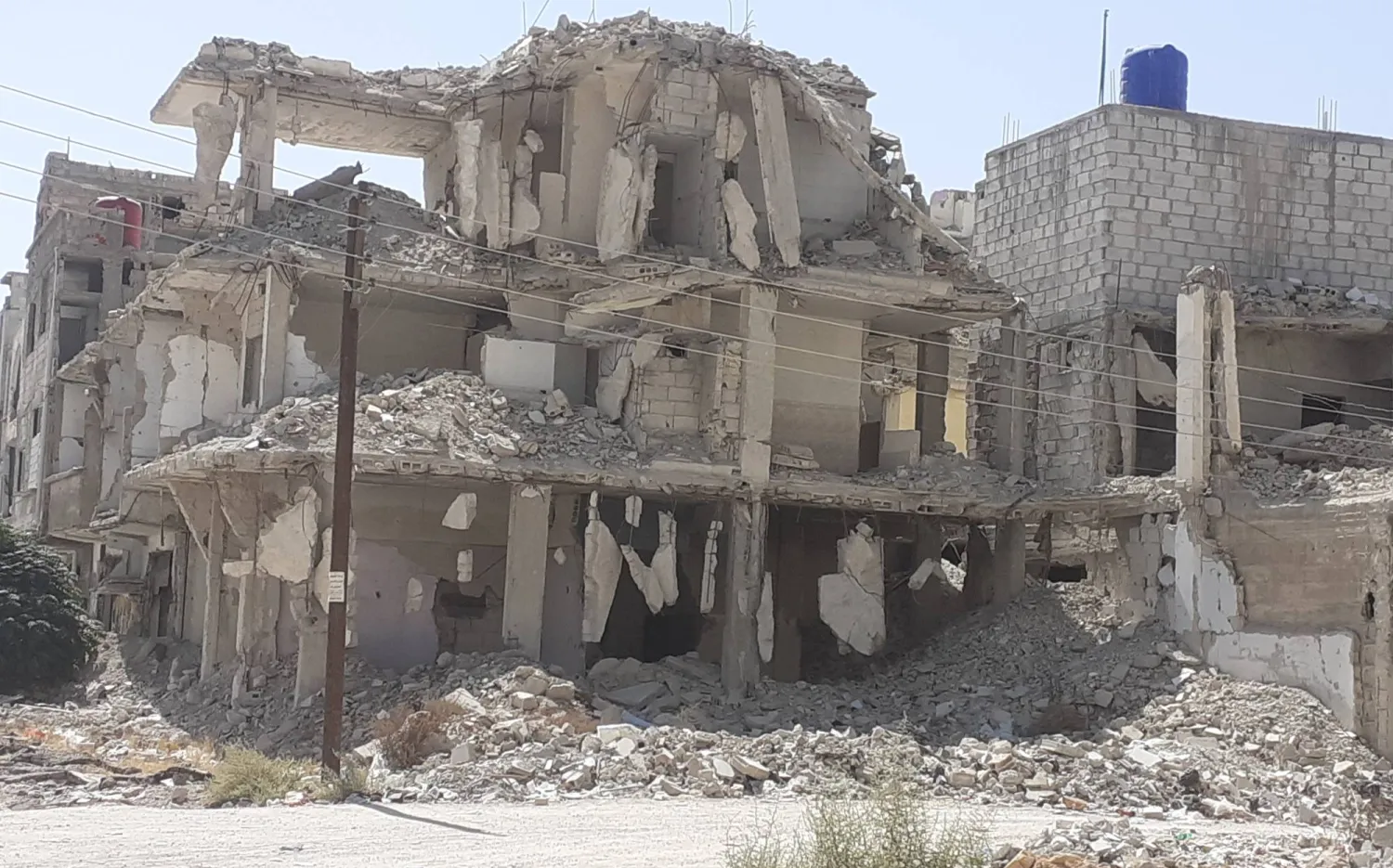
Widespread destruction in the Yarmouk Palestinian Camp in Damascus (Asharq Al-Awsat)
TT

Rebuilding War-Torn Syria Through Opaque Real Estate Development

Widespread destruction in the Yarmouk Palestinian Camp in Damascus (Asharq Al-Awsat)

On the Southern Ring Road in the Syrian capital, Damascus, Najah Hassan waves at passing cars, hoping one will take her to the turnoff for her hometown of Daraya, where large areas remain either completely or partially destroyed by the war. Once inside a car, she begins describing the hardships of displacement and her inability to repair her home in Daraya's Shamiyat neighborhood, which was damaged by shelling.

She says she is forced to move between her two daughters' homes because she cannot afford to rent even a single room in neighborhoods around the capital.

A striking contrast is visible on either side of the road dividing the area. To the south, the destruction of Daraya stretches across the horizon. To the north, the residential buildings of the Mezzeh district and the towers of the Marota City project rise into view. Syrian authorities have resumed work on the development, which was originally launched under the previous government.

Najah, who lost both her husband and son during the war, points toward the towers with regret.

"Building homes for displaced families is more important than building luxury towers for the wealthy who never lost their homes or their livelihoods."

The contrast is evident across Damascus, where two realities appear to belong to different countries. Billboards advertise modern residential compounds and luxury apartments, promoted as symbols of a new life with promises of comfort, investment opportunities, and a more prosperous future. Yet just a few yards away, entire neighborhoods still bear the scars of war, with widespread destruction and districts that have yet to see reconstruction projects or even basic infrastructure restored.

This gap between the image promoted by real estate development projects and the reality facing much of Syria's population raises questions that go beyond architecture and urban planning. It has prompted debate over the selective nature of these projects, their economic and social priorities, who stands to benefit from them, and whether they reflect the country's actual housing needs.

Following the fall of Bashar al-Assad's government, discussion of investment and development projects gained momentum. Many Syrian families hoped the new authorities would make addressing the country's severe housing crisis a priority by launching a genuine reconstruction plan that would help end years of displacement, homelessness, and the burden of rising rents.

That optimism quickly faded as the government's strategy came to rely on attracting domestic and foreign real estate investment companies. These firms have focused on building large new residential developments where only wealthy buyers can afford to purchase apartments, while families whose homes were destroyed have largely been left to face their circumstances on their own.
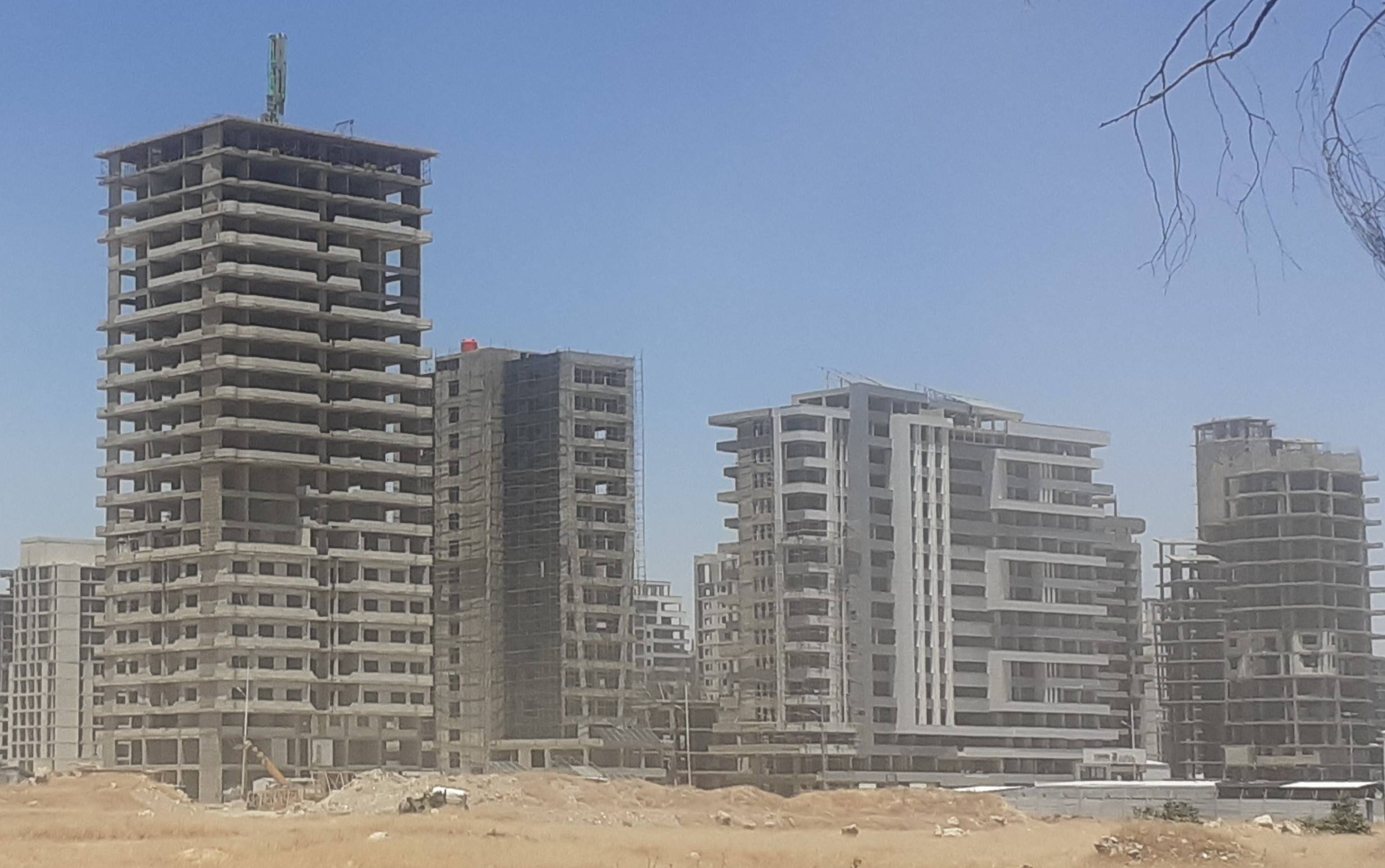
Modern buildings where construction has resumed within gated residential developments on the outskirts of the Syrian capital, Damascus (Asharq Al-Awsat)

"Yaafour 963"... A $300,000 Apartment

Among the real estate developments that have been promoted in recent months is Yaafour 963, located west of Damascus along the Damascus-Beirut highway. The project was launched by Invest Group Overseas, an investment firm headquartered in Dubai.

According to the real estate platform Al Masdar Al Aqari, the development spans nearly 144,000 square meters and consists of 13 buildings, including 12 residential buildings and a social club. More than 75 percent of the total area has been allocated to green spaces, open areas, and shared amenities.

The project's total investment value has not been disclosed. However, the platform said it includes 1,280 residential units, ranging from two, three, and four-bedroom apartments to penthouses.

Apartments in the development, which offers a wide range of facilities and services, start at $300,000 for a two-bedroom unit. Such apartment sizes do not meet the needs of the average Syrian family, while their prices are far beyond what most households can afford.

In a country where the monthly salary for most public sector employees does not exceed $150, while the basic monthly living expenses for even a small family are estimated at around $500, a price tag of $300,000 is far beyond reach.

With hopes fading for a government-led reconstruction effort or investment-backed projects aimed at rebuilding devastated areas, many families have found themselves with little choice but to return to damaged homes after carrying out limited repairs at their own expense, often financed through irregular money transfers from relatives abroad.

Questionable Investment Deals in Jobar

Residents and local officials in Jobar, a historic and economically significant suburb northeast of Damascus, say they have been presented with investment offers from unidentified companies in which the government acts as an intermediary rather than a guarantor.

Eymen al-Dasuqi, a senior researcher at the Omran Center for Strategic Studies who recently conducted a field visit to war-damaged areas, said one company has begun offering settlements to property owners in Jobar regarding their real estate. Under the proposed arrangements, owners of properties officially registered in the land registry would receive only 50 percent of the value of their holdings, while agricultural landowners would be offered 35 percent of the value of their land.

Al-Dasuqi said the mechanism has raised concerns that residents could lose ownership of their properties or see their real estate rights diminished through reconstruction projects. Some view the model as a way of consolidating privately owned properties while compensating owners for only a portion of their value.

It is widely rumored that businessmen with ties to the former government are behind these companies or hold significant stakes in them. As a result, many Jobar residents say their objections to the company's proposal go beyond legal and technical concerns and extend to the individuals involved.
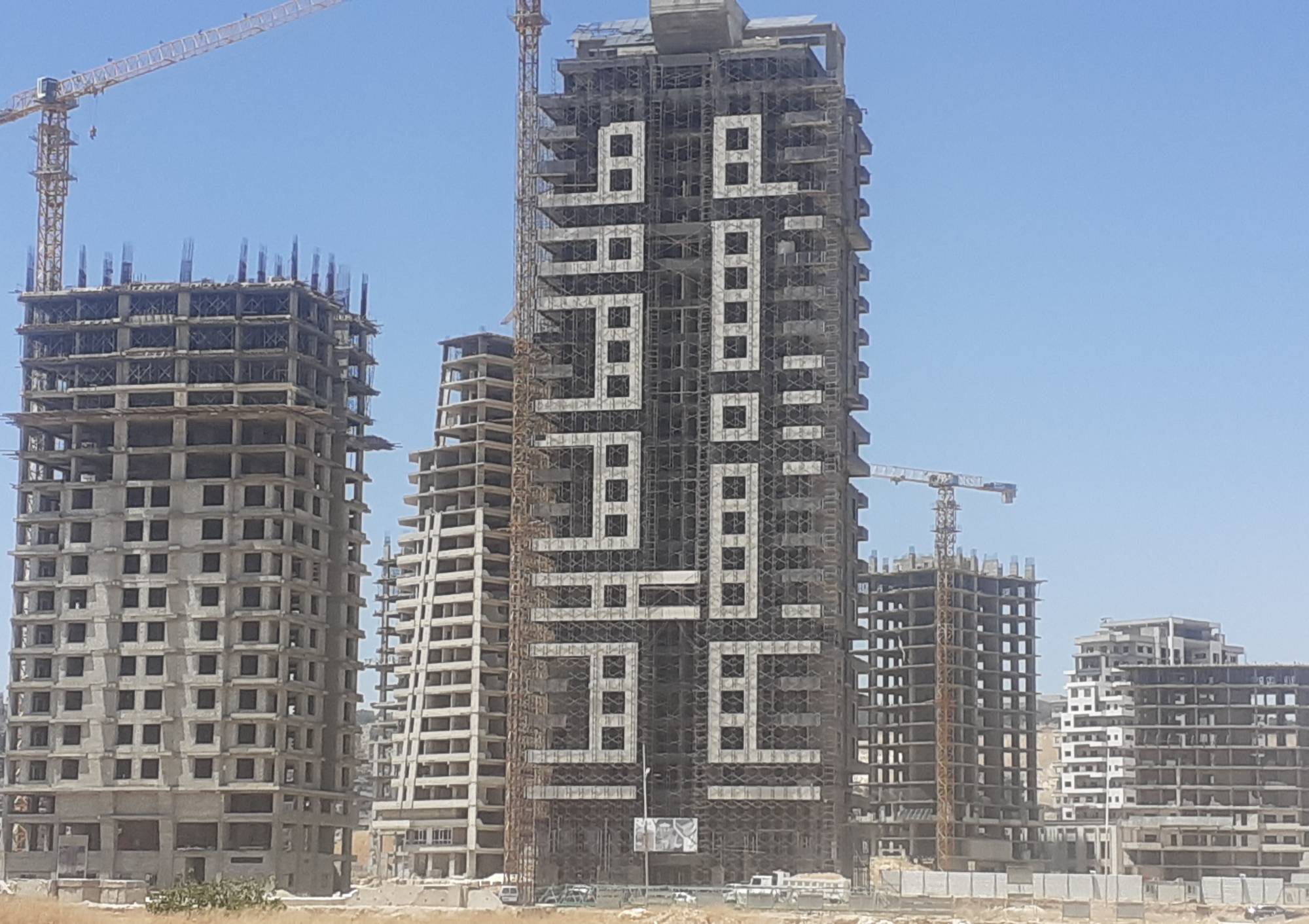
High-rise towers and luxury apartments await affluent buyers (Asharq Al-Awsat)

Al-Dasuqi added that, based on the company's market assessment, the proposed sale price for residential units is about $1,000 per square meter, well beyond the purchasing power of Jobar's residents, most of whom remain displaced.

He attributed the high price to the structure of real estate development projects in war-damaged areas. Under these arrangements, investment companies are expected to finance the restoration of basic services to compensate for the government's limited role. The cost is then passed on through higher housing prices and by acquiring stakes in land through partnership agreements with property owners.

Government as an Intermediary for Investors

The government is seeking to position itself as an intermediary that persuades investors to rebuild war-damaged areas while responding to pressure from communities that endured years of conflict and are seeking compensation. At the same time, it has announced a plan to close displacement camps, making investor-led construction in cleared areas its preferred approach.

However, what appears to be a pragmatic strategy has directed development projects toward higher-income buyers, while sidelining a large segment of rightful property owners with limited incomes.

Al-Dasuqi said this model is unlikely to achieve "social stability."

"The government genuinely wants to rebuild the destroyed areas and may encourage such projects, but it has no authority to compel investors to work there. Investors put forward proposals that align with their own economic interests," he said.

He added that the relevant government bodies, including the Damascus Governorate, the Ministry of Housing, and the Ministry of Local Administration, have been trying to persuade residents of war-damaged areas to accept the offers made by investment companies, arguing that they may represent the best available option.

According to al-Dasuqi, another explanation for the state's reluctance to take on reconstruction directly is the view that its role is limited to regulating the process by issuing laws and legislation and attracting investment proposals, rather than carrying out reconstruction itself or providing basic services. Under this approach, those responsibilities are left to the domestic and foreign private sector.

At the same time, luxury cities are being developed to serve what al-Dasuqi describes as a new social class in Syria, the "newly wealthy." He said this group accumulated substantial wealth during the war through large-scale real estate projects in parts of northern Syria and now represents an estimated 1 to 3 percent of the population. The target market also includes Syrians living abroad, the large Syrian diaspora in Europe that has become integrated into the European economy, and foreign investors seeking a foothold in Syria.

Al-Dasuqi said such large-scale developments meet the needs of only a limited segment of the population, which could be accommodated with the construction of around 100,000 housing units. Meanwhile, the housing crisis facing 3 million internally displaced people and 5 million refugees remains unresolved.

Marota City and Decree 66

The involvement of new companies in real estate development projects in war-damaged areas is not a new phenomenon in Syria. In 2012, the Assad government issued the controversial Decree 66, officially presented as a plan to redevelop informal settlements and unregulated housing areas.

Since the fall of the former government, debate over the decree has resurfaced, particularly in connection with the two redevelopment zones established under it. The first covers the southeastern Mezzeh and Kafr Sousa area, later renamed Marota City, including what is commonly known as the Mezzeh Orchards and parts of Kafr Sousa. The second is located south of the Southern Ring Road and was later named Basilia City.

Property owners in both areas who spoke to Asharq Al-Awsat, along with Syrian legal experts and international human rights organizations, said the former government's objective in issuing Decree 66 was to strip residents of their property, displace them, and alter the demographic composition of the two areas.

According to international reports published in 2018, "Decree 66 punishes displaced people and obstructs investigations into war crimes." The reports also said the former government "used the decree to confiscate property and displace residents."

In June 2020, the US Treasury Department imposed sanctions on former Damascus Governor Adel al-Olabi for his role in overseeing Damascus Cham Holding and the Marota City and Basilia City real estate developments. It described the project as "the largest real estate investment in Syria, worth millions of dollars," and said it was intended to reshape the area's demographics into "a wealthy population that is politically loyal to the regime."

Property Owners Seek Changes to Decree 66

Following the fall of the former government in 2024, original landowners in the Marota City and Basilia City development areas have expressed hope that the Syrian authorities will repeal or amend Decree 66 to restore the rights of the original owners after what they describe as years of injustice under the ousted government. Instead, Damascus Governorate has continued implementing the decree, prompting growing frustration among residents, who have staged protests demanding fair treatment.

Bashir Baalbaki, one of the original landowners in the Mezzeh Orchards area, told Asharq Al-Awsat that "under the former government, the governorate returned only 17 percent of our land to the original owners. That is the height of injustice."

Baalbaki added, "The replacement housing was supposed to be provided free of charge and within the same area. However, the governorate failed to honor that commitment, both in terms of location and compensation. Instead, property owners received a modest annual rental allowance that did not come close to compensating them for their property rights."

Following the change in government, the governorate increased the rental allowance by a factor of 35. However, Baalbaki said it "still does not reflect current rental and real estate market prices, especially given the enormous inflation. The governorate also promised to provide replacement housing in a neighboring area, but the units would be delivered unfinished and at a price that remains unknown to this day."
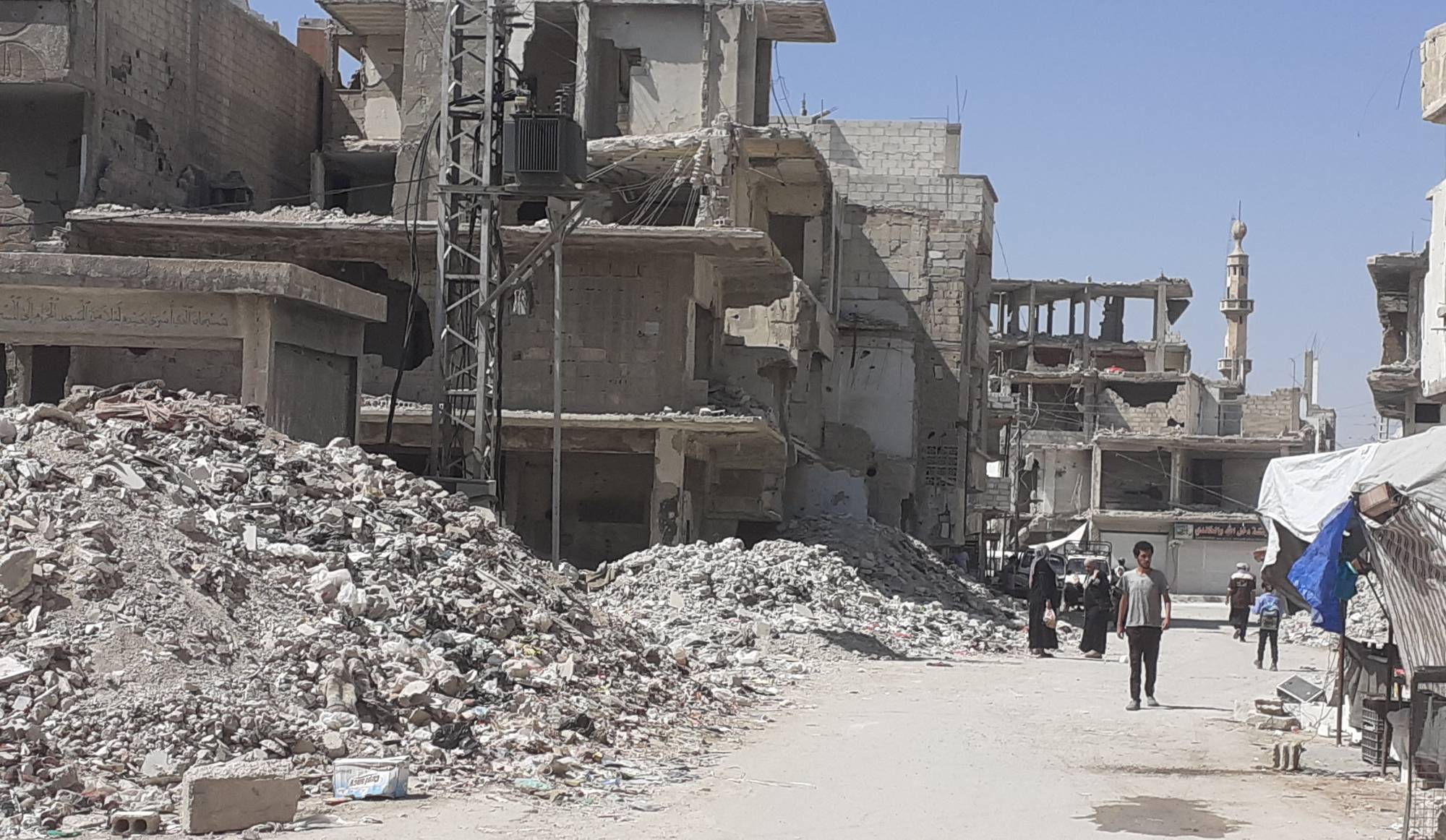
Residents return to their war-damaged homes, making whatever repairs they can to avoid soaring rents (Asharq Al-Awsat)

Targeting "Revolution Strongholds" Through the Law

Moatasim al-Sioufi, director of the Syria-based organization The Day After, which has conducted research on property rights and real estate development projects, said the core problem with Decree 66 and Law No. 10 of 2018 is that they "were issued under extraordinary circumstances during the years of the uprising , and were used by the former government against areas that had risen up against it. Those areas were strongholds of the uprising , and the laws were used to alter their identity and demographic character."

Al-Sioufi told Asharq Al-Awsat that property owners were subjected to "significant abuse," noting that many original owners were unable to prove ownership because of the circumstances at the time. He also said there were numerous cases of forced property sales. According to al-Sioufi, several prominent figures from the former government, including Asma al-Assad and businessmen Samer Foz and Hossam al-Qaterji, held major stakes in the Marota City towers, and those holdings have since been placed under the management of the Sovereign Fund.

Explaining what he describes as the mechanism behind the process, al-Sioufi said: "If you own a piece of agricultural land in Damascus today worth $1,000, its value can rise to $10,000 or even $100,000 once it is rezoned for construction. But under Decree 66, the land was assigned a fixed value, and owners were given shares in the new development in return. Meanwhile, property prices within the redevelopment zone rose so dramatically that the shares allocated to owners were no longer enough to buy even a single room, or even a bathroom, in one of the new towers, while individual apartments sell for around $1.5 million. In my view, this amounts to a form of fraud against property owners, or an indirect seizure of their property, and it continues to this day."

Al-Sioufi said that during the former government's rule, the Damascus Governorate took control of a large share of the residential and commercial plots within the project before offering them for investment through Damascus Cham Holding, claiming the proceeds would finance infrastructure projects. He said the arrangement raises many questions.

In his view, "the logical solution" would be to halt the implementation of Decree 66 at its current stage and then amend it in a way that guarantees fair compensation for the original property owners from the governorate's share.

Yarmouk Camp: A Double Catastrophe

In Yarmouk camp, south of Damascus, once known as the "capital of the Palestinian diaspora" before becoming one of the most prominent symbols of Syria's wartime destruction, signs of returning displaced families are becoming increasingly visible. Local markets have seen some activity resume, despite the continued devastation and the poor state of basic services, including electricity, water, sanitation, and telecommunications.

Along the main street and in several side alleys, buildings that have been rebuilt only to the structural frame stand out. Families are living in a single finished room with a minimally equipped kitchen and bathroom, while others have repaired their apartments despite the risk of collapse in severely damaged buildings.

Yassar al-Omar returned to his home in the camp about a year and a half ago. Speaking to Asharq Al-Awsat while sitting on a chair along the sidewalk, the man in his sixties blamed both the government and the UNRWA.

"Unfortunately, we haven't seen anyone."

He said soaring apartment rents, which have climbed to more than $400 a month in areas surrounding the camp, have forced displaced families to return to their homes after carrying out only limited repairs.

"The important thing is to escape the greed of landlords. We installed a front door for the apartment and used curtains and blankets to cover the interior doorways and windows. Some people are living on bread and onions just to save enough money for repairs."

Commenting on the new residential developments, he said, "These apartments and services are not for us. Even in informal neighborhoods, owning a small apartment has become an impossible dream for the overwhelming majority of people given current prices."
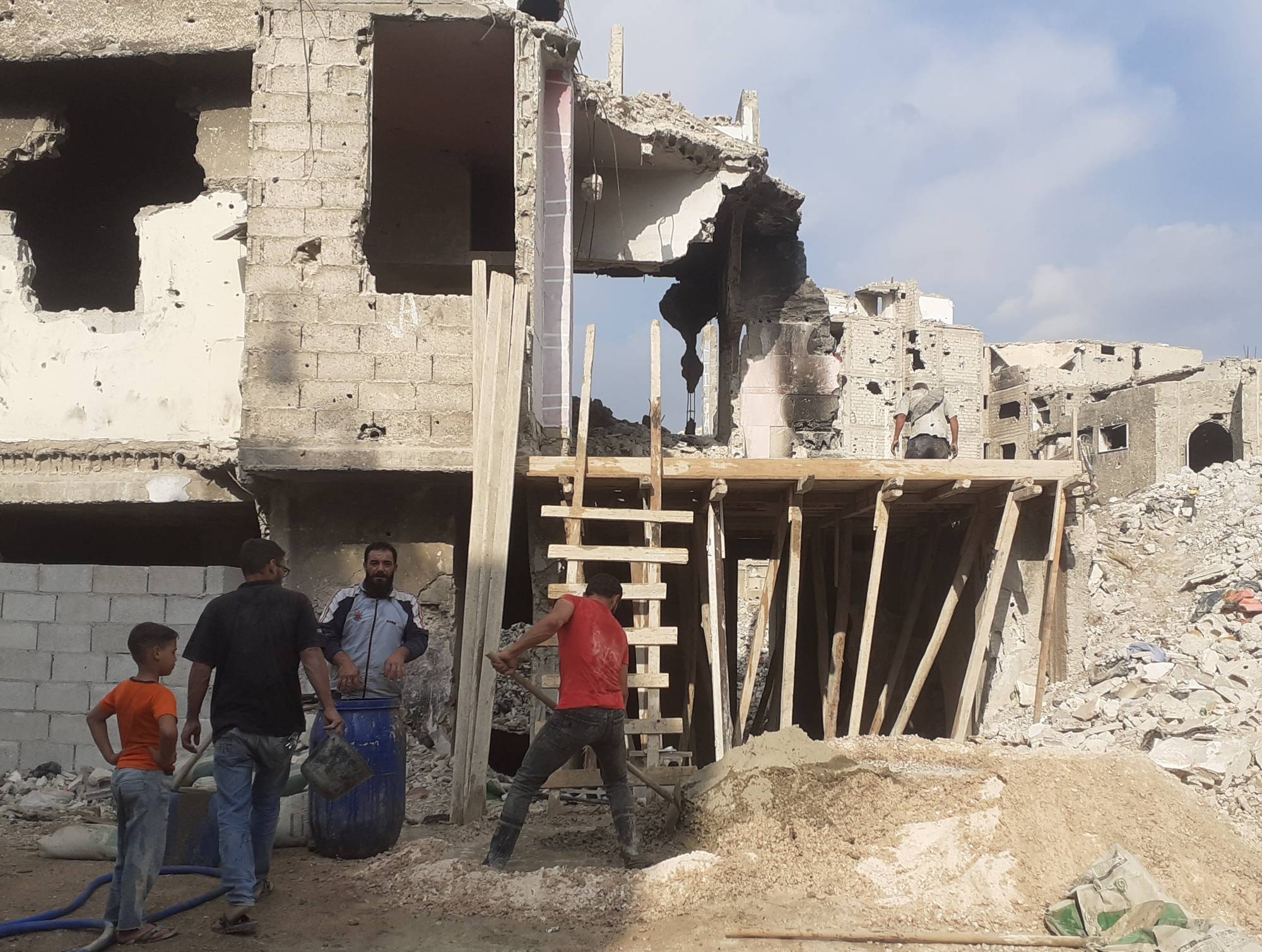
Residents rebuild and repair homes on their own as no government reconstruction plan is in place (Asharq Al-Awsat)

Government Largely Absent From Reconstruction

Al-Dasuqi pointed to local community initiatives to repair homes in the city of Deir ez-Zor, as well as projects by aid organizations to rehabilitate some markets. "But what is missing in all the war-damaged areas I visited, whether in Jobar in Damascus or the eastern countryside of Aleppo and Idlib, is the government's presence in the reconstruction process," he said.

According to al-Dasuqi, the government's absence stems from the enormous cost of reconstruction, which is typically financed by the state, the private sector, or external loans. As for the Syrian government, he said, "it is effectively outside this process because it faces major challenges and has not yet recovered financially in terms of public revenues and the state treasury. Taking on reconstruction could overwhelm the state's already strained finances.

That raises the question of why the government has not turned to foreign loans, especially since reconstruction efforts in many countries have relied on external financing.

Al-Dasuqi believes the government's reluctance to seek loans is driven by religious rulings on borrowing and interest, as well as concerns over sovereignty. Instead, it has sought to attract private capital by opening the door to investment in rebuilding war-damaged cities through agreements with local residents.

However, al-Dasuqi argued that the state is failing to fulfill its role as the guarantor of property rights. Instead, it functions more as an intermediary. When it presents residents with an offer from a real estate company to redevelop their area, it simply asks whether they accept it. In his view, the government should instead clearly determine whether the proposal adequately protects property rights and ownership interests.
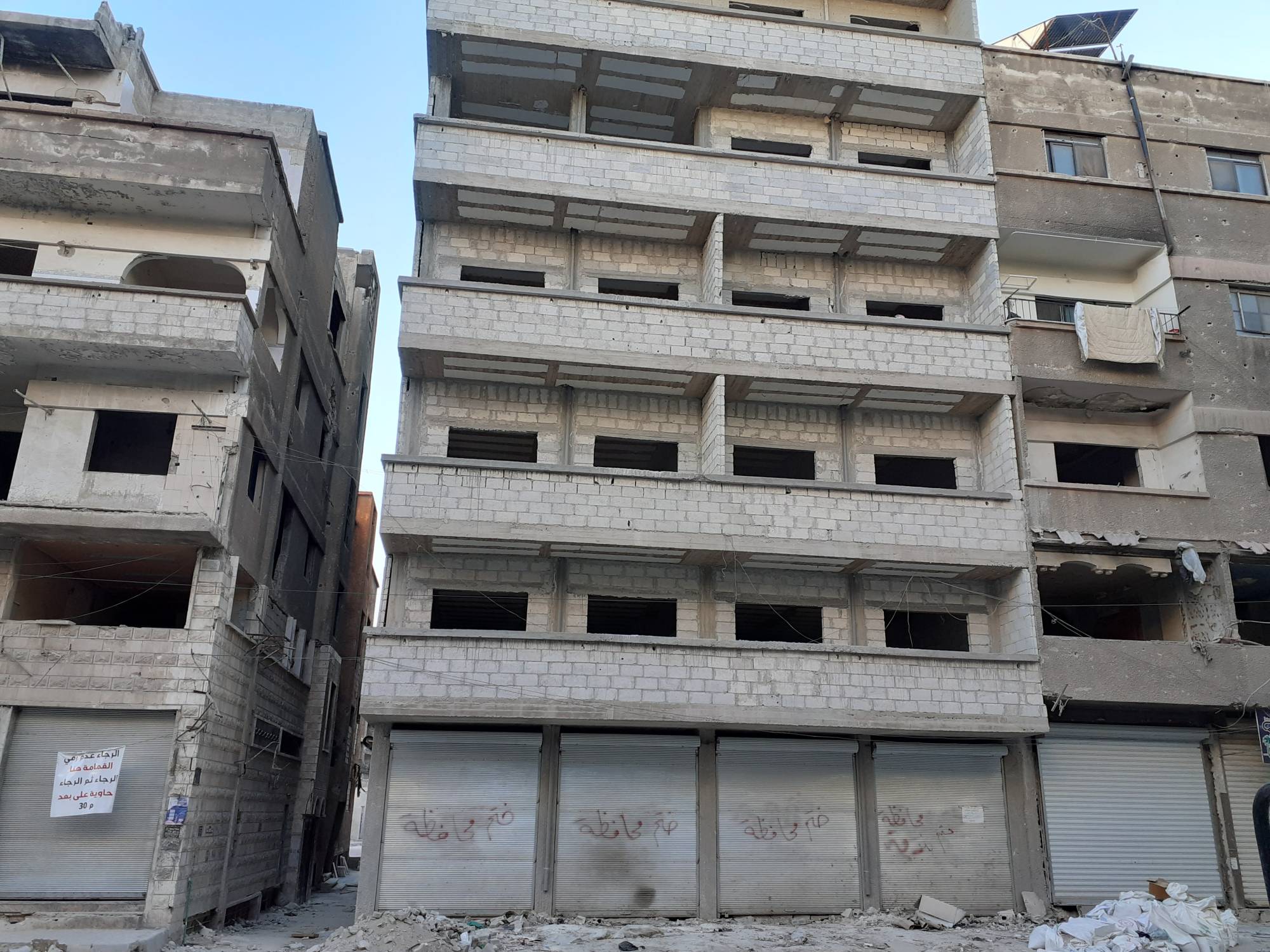
A rebuilt building, with the Damascus Governorate's seal visible on the doors of its ground-floor shops (Asharq Al-Awsat)

Possible Solutions Based on the Turkish Model

Al-Dasuqi believes one possible alternative would be for the government to strike land-for-development agreements with real estate companies by granting them state-owned land for investment in exchange for rebuilding a war-damaged neighborhood. He said the government needs to deliver tangible progress that helps narrow the gap between itself and residents of these areas before it widens further. This, he said, could be achieved by offering incentives and exemptions to encourage investors to undertake projects in devastated neighborhoods.

Al-Dasuqi noted that the government has the advantage of being able to draw on the experiences of other countries, particularly Turkish public-private housing models. He pointed to the Turkish state housing developer TOKİ, which builds homes and sells them at cost through affordable installment plans.

He added, "It is not unlikely that we will see a restructuring of Syria's Sovereign Fund through the creation of a real estate holding arm modeled on TOKİ. It could then begin providing housing at cost to citizens through installment plans, once settlement agreements with businessmen linked to the former government have been completed."

He said such a model would depend on two key factors: establishing effective governance for the Sovereign Fund to ensure a stable operating framework, and securing sufficient capital to finance the initiative. However, he does not expect such a project to be in place for at least another one to two years.

The Sovereign Fund was established by presidential decree in June 2025. It has since participated in several investment forums, and indications have emerged that it manages assets acquired through settlements reached by the Committee for Combating Illicit Gains with businessmen linked to the former government and some of its leading economic figures.

From Wells to Budget: Where Does Libya’s Oil Money Go?

Tugboat Al-Hani begins operations at Zueitina port (National Oil Corporation)
TT

From Wells to Budget: Where Does Libya’s Oil Money Go?

Tugboat Al-Hani begins operations at Zueitina port (National Oil Corporation)

Libya depends on oil for nearly 98% of its income. Yet a central question persists: How are those revenues collected and spent in a country divided between rival governments? And why do Libyans complain of poverty when their country holds Africa’s largest oil reserves and produces and exports about 1.4 million barrels a day?

The process starts with the National Oil Corporation, which collects proceeds from crude oil and gas sales in US dollars and deposits them in accounts at the Libyan Foreign Bank. The money is then transferred to the Central Bank of Libya's accounts in Tripoli, recorded as state budget sovereign revenue, and converted into Libyan dinars.

The dollar trades at 6.36 dinars at the official rate, compared with 9.12 on the parallel market.

The Finance Ministry in Tripoli then issues spending authorizations under approved financial arrangements, after which the central bank releases funds to ministries and other state bodies through the main budget chapters.

Libya’s oil export revenues have swung sharply in recent years, ranging between $18 billion and $22 billion. They rose to about $18 billion in the first half of this year, nearly double the level in the same period last year, according to the Economy Ministry in the interim Government of National Unity.

Libyan oil expert Mohamed al-Shahati attributed the increase during that period to the war involving Iran.

Where is the breakdown?

Economists say Libya’s dependence on oil as its near-exclusive source of income lies at the heart of the crisis.

Ayoub al-Farsi, an economics professor at the University of Benghazi, said Libya showed how excessive reliance on natural resources could turn into a complex financial crisis when combined with political fragmentation and a lack of economic diversification.

“The Libyan economy is a clear example of how excessive dependence on natural resources can become a complex financial crisis,” he said, adding that political fragmentation and the absence of diversification had created conditions that directly affected people’s lives.

Al-Farsi, a member of the Central Bank of Libya’s Monetary Policy Committee, said the economy was built around a rentier-state model that depended almost entirely on oil exports to fund the treasury and provide foreign currency.

That dependence, he told Asharq Al-Awsat, had created deep structural distortions.

Agriculture and industry had been marginalized, the state bureaucracy had expanded to absorb workers into unproductive public-sector jobs, and the country had grown heavily dependent on imports for most consumer goods, he said.

Industrial activity remains limited, largely confined to the private sector and small-scale production. Critics also point to a market dominated by a small number of traders and importers, helping imported goods crowd out local production.

At protests across Libyan cities, the question is often the same: Where is the oil money going? Why are people struggling in an energy-producing country?

Al-Shahati said part of the answer lies in the difference between the value of the oil Libya produces and the amount that actually reaches the state treasury.

“Not every barrel produced in Libya is converted directly into a dollar entering the public treasury, because foreign partners have a share,” he told Asharq Al-Awsat.

Foreign companies have become production partners under various contractual arrangements, he said.

He also pointed to a stark contradiction: Libya produces oil, yet depends heavily on imports of gasoline, diesel, and other petroleum products to meet domestic demand.

That means a growing share of the country’s resources is converted into foreign currency to pay for fuel imports.

Al-Shahati said another problem was the lack of a regularly published, unified, and easy-to-read account that answers basic questions, such as: What was the total value of the oil produced? How much went to foreign partners? How much was exported for the state? How much went to the domestic market? And how much net revenue was actually available for public spending?

“The figures in circulation provide parts of the picture,” he said, “but they do not always show the full flow of revenues from the wellhead to the state’s public accounts.”

Libya’s oil fields are concentrated mainly in the eastern Sirte Basin, which holds about 82% of its oil reserves, as well as in the Murzuq Basin in the southwest and offshore areas along the coast.

Fuel and power crises

Those weaknesses in the oil revenue chain are unfolding as Libya grapples with a severe electricity crisis.

The country has suffered several “blackouts” in recent days, with some areas going without electricity for more than 17 hours a day.

Researcher Ezzedine Mokhtar sees the power cuts as one part of a wider pattern of recurring financial failures, including fuel shortages.

He blamed the hardship facing many Libyans on “corruption” and “unlimited spending” by two rival governments competing for power in the country’s east and west.

He also cited “oil smuggling through Arkenu, whose revenues go to specific individuals rather than the state treasury.”

Mokhtar said Libya’s subsidy system was another core problem, with more than 60% of the country’s budget going to fuel subsidies.

He called on the Tripoli government to phase out those subsidies gradually and to draw up a national plan to develop the workforce.

“We have no industrial skills in anything,” he said. “We import everything — yogurt, dairy products, fruit, vegetables, frozen fish, and even underwear. Everything comes from abroad.”

Libya ranks 10th globally in proven oil reserves, with about 48.3 billion barrels, according to Worldometer.

The UN Panel of Experts said in its latest report on Libya, covering October 2024 to February 2026, that Arkenu had moved at least $3 billion in oil revenues to bank accounts outside Libya between January 2024 and November 2025.

According to the report, Arkenu was established in 2023 as a private company and is indirectly controlled by Saddam Haftar, deputy commander-in-chief of the Libyan National Army. It faces accusations of “oil smuggling.”

Reuters previously investigated the company and concluded, based on shipping documents, London Stock Exchange Group data, and information from Kpler, that some oil revenues were being diverted away from the Central Bank of Libya.

How are revenues distributed?

Oil revenues are distributed across the four main chapters of the state budget, according to experts and economists.

Chapter One, salaries and wages, takes the largest share. It covers public-sector employees across eastern, western, and southern Libya through the unified national identification number system.

Chapter Two covers operating expenses for ministries and public institutions.

Chapter Three covers subsidies, including fuel, water, and electricity.

Chapter Four covers development and projects, including infrastructure, as well as allocations to the National Oil Corporation to sustain and increase production.

Al-Shahati said 26% of oil revenues went toward importing fuel products, equivalent to about $7 billion if crude traded at $70 a barrel.

This year, he said, the figure could rise to between $8 billion and $9 billion because oil prices had climbed above $85 a barrel and the gap between crude prices and diesel and gasoline prices had widened amid shortages.

He also pointed to higher domestic consumption driven by economic growth and a rise in smuggling.

A second problem, al-Shahati said, is the absence of an approved national budget, which would make it possible to determine how spending should be allocated among population groups and regions.

“What is clear is that the main cities control most spending,” he said.

He also pointed to “a large and obvious imbalance” in salaries across Libya’s three regions, job grades, and types of employment.

Those gaps, he said, risk widening financial divisions between social groups.

Even an agreement to unify development spending did not appear to be properly implemented because there were no clear standards and no comprehensive budget.

“There are no criteria for distributing oil revenues,” al-Shahati said. “The distribution process is random and unsustainable.”

Libya fell to 177th out of 182 countries in the 2025 Corruption Perceptions Index, from 173rd out of 180 countries in 2024, reflecting worsening corruption and no tangible improvement over the past two years.

Pressure on the local economy

A report by UN Secretary-General Antonio Guterres on Libya highlighted deep structural strains in the economy, driven by high public spending, near-total dependence on oil and gas revenues, and mounting pressure from food, fuel, and electricity prices.

The report, submitted to the UN Security Council on Aug. 17, covers the period from April 1 to July 28.

Citing the International Monetary Fund, it said Libya’s fiscal deficit reached 30% of gross domestic product last year, while public debt climbed to 146% of GDP.

Inflation also rose into double digits, eroding purchasing power.

The UN report noted unjustified increases in fuel consumption by military and security agencies and the energy sector, as well as repeated double purchasing.

The cost of institutional division

Libya’s political and institutional split and the presence of multiple authorities have made the economic crisis worse, al-Farsi said.

The distortions, he said, were no longer merely structural.

They had created parallel public finances and pushed consumer spending higher to meet the demands of rival authorities, sending salaries and subsidies to unprecedented levels.

Repeated shutdowns of oil fields in previous years, combined with lower actual revenues, pushed financial authorities toward deficit financing and higher public debt, al-Farsi said.

That flooded the market with money without a corresponding rise in domestic production.

Oil revenues reached $21.9 billion in 2025, according to the National Oil Corporation, up from $18.6 billion in 2024, an increase of 15%.

Al-Farsi said the deterioration in public finances had left monetary authorities in a difficult position and forced them into emergency measures to protect reserves and contain the deficit.

The result, he said, was a weaker national currency, liquidity shortages and a collapse in confidence.

Development tools had also been paralyzed.

“Monetary policy shifted from an instrument for stimulating growth and investment into a tool for managing daily crises,” he said.

Why has the crisis not been solved?

Economists point to several reasons.

Al-Shahati put “corruption spreading on an unprecedented scale” near the top of the list.

“Corruption is no longer confined to the margins,” he said. “It has come to dominate the core of public finances in key sectors, obstructing any attempt at reform.”

He also blamed the absence of an institutional vision following the breakdown of middle management, which had once linked fiscal and monetary policy to economic realities and provided unified political backing.

Policies, he said, had become detached from the economy and lost their ability to restore balance.

Conventional reforms that had worked elsewhere would not work in Libya, al-Shahati said, because the country lacked a central political authority capable of building an institutional vision and curbing corruption that had spread through both the state and private sector.

Al-Farsi said Libya could not escape its fiscal and monetary crisis without addressing the roots of the problem.

That meant unifying the management of public finances, curbing government spending, and launching genuine structural reforms that would gradually shift Libya from consuming oil rents to building a diversified economy.

Mokhtar also called on the Tripoli government to develop a strategic plan to make better use of human resources and support small and medium-sized industries.

For him, breaking Libya’s dependence on oil revenues is part of the way out.

Masoud Suleiman, chairman of Libya’s National Oil Corporation, said in media remarks last week that the country needed between $30 billion and $40 billion in investment to develop untapped oil and gas resources.

The corporation, he said, aims to raise production to 2 million barrels a day by 2030.


Bandar Abbas, Iran’s Trade Hub on Hormuz Thrust to Frontline of US War

Fishermen check their nets and small boats on the seashore in the port city of Bandar Abbas, in southern Iran on August 10, 2026. (AFP)
TT

Bandar Abbas, Iran’s Trade Hub on Hormuz Thrust to Frontline of US War

Fishermen check their nets and small boats on the seashore in the port city of Bandar Abbas, in southern Iran on August 10, 2026. (AFP)

With a long shoreline on the Strait of Hormuz, Iran's southern trade hub of Bandar Abbas has found itself at the frontlines of the war with the United States, with residents struggling to revive livelihoods battered by months of fighting.

Like elsewhere in Iran, economic strain has squeezed households since US-Israeli strikes triggered the Middle East war on February 28. But unlike much of the country, the port city of around half a million people has remained exposed to fighting even after an April 8 ceasefire brought relief elsewhere.

But despite a lull in hostilities in July, residents still feel squeezed. Saeed Tajik, 42, used to work at a shipyard before losing his job and turning to driving a taxi.

"The prices of housing and food have become extremely high. Almost all the basics -- rice, yoghurt, and oil -- have doubled," said Tajik.

Fuel shortages have long been common in southern Iran, where authorities restrict supplies in an effort to curb widespread fuel smuggling.

But now, "the queues have become longer ... it happens that we wait in the long line for fuel only to get told 'there is none' upon arriving," Tajik said as he drove past a station where motorists waited under the punishing summer heat.

Hormuz has emerged as a central flashpoint after an April ceasefire and June framework deal failed to resolve disagreements between Washington and Tehran over the future management of the strait.

During the war, US strikes hit bridges, highways and railway infrastructure around Bandar Abbas until mid-July, in what analysts saw as attempts to cut off the city and disrupt Iranian military logistics in the south.

- 'Nothing left' -

Inside the city, under a towering concrete statue of two armed men with their arms trained towards Hormuz waters, economic strains play out in long queues snaking outside petrol stations and soaring prices squeezing shoppers in local markets.

The city's repeatedly hit airport remained largely closed until August 15, leaving travelers facing arduous road journeys, sometimes combined with flights and boat crossings.

Outside the city, construction crews still toil under the sweltering summer sun to repair the Gachin bridge, split by a US strike, as cars rumble along a dusty detour below.

Along the waterfront, traditional wooden vessels known as lenjes sit moored alongside fishing and commercial boats, part of a centuries-old trading network linking southern Iran with Arab states across the Gulf.

Arash Tondro, 45, used his lenj to carry Iranian fresh and dried fruit to the United Arab Emirates and return with household goods and other imports.

"My income dropped to zero at the beginning of the war," said Tondro, who later rerouted some trade through Oman's Khasab port as regional seaways were disrupted and "many of the lenjes were hit by drones".

After the UAE suspended trade with Iran on Tuesday following a missile attack on a ship that Tehran denied carrying out, Tondro said he was again unsure how his work would be impacted.

"People in the south mostly rely on trade or fishing. If you take the sea and trade away from them, there is practically nothing left. We don't have agriculture here; whatever there is comes from the sea," he said.

- 'No sales' -

As night falls and August's oppressive heat begins to ease, fish vendors set up along a busy street, laying out shark, tuna and shrimp as the smell of the day's catch hangs in the humid air.

Among them is 22-year-old Anoush Mallah, who recently moved onto the street after soaring rents forced him to close his shop in one of the city's bazaars.

"Business has been terrible since the war started. There are no sales, it's very weak," he told AFP.

"People are short of money. The fishermen aren't going fishing either."

Many fishermen around Bandar Abbas only began returning to sea in recent weeks, after months ashore for fear of being caught in the crossfire of US-Iran fighting.

Diplomatic efforts have so far failed to end the war. For Mallah, the uncertainty only adds to the strain.

"Let it (the war) start and get some result; right now, we're just left in limbo," he said.


The Ethiopian Dam Dispute and Egypt’s ‘Right to Self-Defense’

Egyptian Foreign Minister Badr Abdelatty. Photo: Foreign Ministry
TT

The Ethiopian Dam Dispute and Egypt’s ‘Right to Self-Defense’

Egyptian Foreign Minister Badr Abdelatty. Photo: Foreign Ministry

Over the past two weeks, Egypt has repeatedly stressed its right to prevent any actions by Addis Ababa on the Nile River that could harm its water interests, stressing that it possesses the “right to self-defense” over Ethiopia’s Grand Ethiopian Renaissance Dam (GERD).

According to experts who spoke to Asharq Al-Awsat, Egypt’s signaling means that it “will not hesitate to use all legitimate means to safeguard its water security.”

They explained that the message is a stern warning to Ethiopia and suggests that Cairo is seeking to shift from a policy of protesting Ethiopian measures to preventive deterrence, aimed at stopping the establishment of a new status quo on the Nile.

New Egyptian Warning

Egyptian Foreign Minister Badr Abdelatty said that “Egypt will not allow the construction of additional dams ... that affect its water interests,” stressing Cairo’s commitment to a legally binding agreement that guarantees its water rights.

In a television interview on Wednesday evening, Abdelatty said that Egypt does not oppose African countries’ right to development, noting Cairo’s participation in dam and infrastructure projects in several Nile Basin states. However, he stressed the need to balance the right to development with the rights of downstream countries.

He also underscored Egypt’s commitment to protecting its water interests. “We have the right to self-defense to protect our interests and water security,” said the minister. “We will not accept any agreement regarding the Nile River unless it is legally binding,” he reiterated.

Mohamed Hegazy, a member of the Egyptian Council for Foreign Affairs and a former assistant foreign minister, says the right of self-defense is protected under international law after all peaceful means have been exhausted.

According to Hegazy, the core message is that Cairo still prefers agreement and negotiation, but it no longer accepts using negotiations to impose a fait accompli.

He argued that the most significant aspect of Abdelatty’s statements is that they send three simultaneous messages - Rejection of unilateral measures, rejection of additional dams, and insistence on the right of self-defense to protect water security.

Hussein El-Behairy, an African affairs expert at the National Center for Middle East Studies, said the minister’s recent statements reaffirm Egypt’s right to defend its historical and water rights in the Nile by whatever means the Egyptian state deems appropriate to preserve what Egyptians view as a matter of life and death.

Ethiopia’s Grand Ethiopian Renaissance Dam (GERD). Reuters

Escalating Egyptian Position

This is the third time Egypt has signaled the possibility of using its “right to self-defense” and preventing dam construction on the Nile.

On August 16, Egypt’s state news agency quoted an unnamed Egyptian official as saying that Cairo “will neither accept nor allow any party to control the flow of Nile waters to downstream countries,” stressing that the Egyptian state possesses multiple tools capable of protecting its people’s interests in the Nile.

The statement came in response to remarks attributed to Ethiopian Minister of Water and Energy Habtamu Itefa concerning the construction of additional dams on the Nile and control over water flows to downstream states, namely Egypt and Sudan.

Earlier, on August 4, Egyptian Minister of Water Resources and Irrigation Hani Sewilam stated during a press conference that Egypt “will not allow the construction of new Ethiopian dams on the Nile River.”

He said: “It is well known that Ethiopia has plans to build additional dams, but will the Egyptian state allow this? No.”

According to Hegazy, the ball is now in Ethiopia’s court. If Addis Ababa agrees to resume serious negotiations leading to a legally binding agreement on GERD, the crisis can be contained.

However, if Ethiopia continues to create new realities on the Nile, the scope for a diplomatic solution will narrow, making risk management and deterrence a more prominent part of Egypt’s strategy.

El-Behairy does not expect the escalation to pave the way for new negotiations on GERD unless the Ethiopian government is willing to make concessions in response to Cairo’s demands. These demands include reaching a legally binding agreement that guarantees Egypt’s water rights during periods of drought and severe drought, and providing Egypt with information regarding the operation of the dam in a manner that does not harm its water interests.