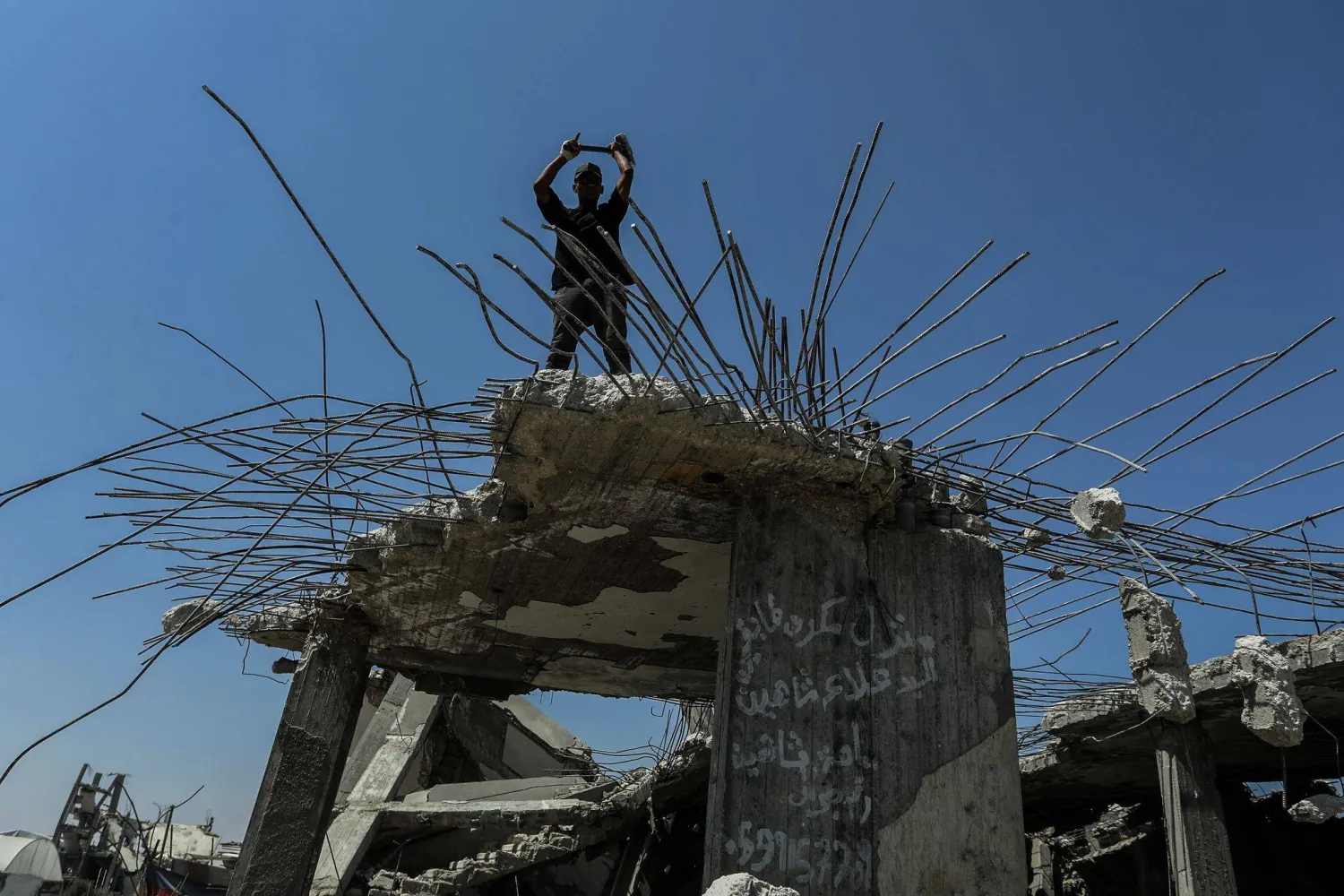
Israel Intensifies Assassinations of Hamas Police Officers in Gaza

25 July 2026, Palestinian Territories Photo: Abed Rahim Khatib/dpa
TT

Israel Intensifies Assassinations of Hamas Police Officers in Gaza

25 July 2026, Palestinian Territories Photo: Abed Rahim Khatib/dpa

The Israeli military intensified targeted killings over the weekend, with operations on Saturday and Sunday focusing primarily on security officers serving in the Hamas-run government in the Gaza Strip. Those targeted were responsible for various security portfolios, including pursuing armed gangs and individuals accused of collaborating with Israel.

Shortly before noon on Sunday, an Israeli drone fired three missiles at a vehicle in the Al-Baraka area of Deir al-Balah in central Gaza, well away from the "yellow line." The strike killed two men who were later identified as Col. Wael Al-Ladawi, 44, director of the Internal Security Service in central Gaza, and Maj. Ramez Abu Zureiq, 49.

Field sources told Asharq Al-Awsat that Al-Ladawi had recently led a security campaign, coordinated with several security agencies and Palestinian factions, to intensify efforts against armed gangs backed by Israel after they targeted members of the military wings of Palestinian factions. The sources said he was also responsible for handling the file of individuals accused of collaborating with Israel and had recently overseen the arrest of several suspects.

The attack came one day after a series of similar strikes targeting police officers and security personnel. One of those strikes killed Brig. Gen. Abdel Nasser Al-Maqadma, 54, director of police in North Gaza Governorate, as he was riding a bicycle in the Ard Al-Shanti area, north of the Sheikh Radwan neighborhood in northwestern Gaza City.

That attack, carried out on Saturday afternoon, coincided with another strike targeting the vehicle of the officer in charge of Jabalia police in northern Gaza, leaving him critically wounded. Medical teams in the territory are continuing efforts to save his life.

Meanwhile, Lt. Col. Yamen Obeid, 48, a police officer in Jabalia, died of wounds sustained in an Israeli strike on July 14 that targeted him along with a group of police officers and personnel west of the city. That attack killed one police officer and four security personnel at the time.

At least 49 police officers and security personnel have been killed since the ceasefire took effect on October 10, 2025.

Gaza's Interior Ministry accused Israel of "persistently targeting the foundations of police work" in an effort to spread chaos throughout the territory. The ministry called on the international community and the mediating countries to pressure Israel to stop targeting the police force.

Israeli strikes on Saturday killed seven Palestinians and wounded more than 20 others in a series of attacks across southern, central, and northern Gaza.

One of the strikes targeted the entrance to Al-Aqsa Martyrs Hospital in Deir al-Balah, where tents used by journalists are located nearby. Several journalists narrowly survived the attack.

The strike killed a Palestinian man who operated a small tobacco stand and wounded at least 14 people passing in front of the hospital entrance. Two other Palestinians were killed in a separate strike targeting them in the Al-Mawasi area of Khan Younis in southern Gaza.


Tunisia Says Recovered Eight Migrants' Bodies

African migrants rescued by the Tunisian coast guard in October (AFP)
TT

Tunisia Says Recovered Eight Migrants' Bodies

African migrants rescued by the Tunisian coast guard in October (AFP)

The Tunisian national guard said Sunday it recovered eight bodies from the sea after a boat carrying irregular migrants capsized off the country's southeastern coast, with six people still missing.

The boat was carrying 15 people, only one of whom was rescued after it sank some 14 nautical miles off the shore of Zarzis on Friday night, AFP reported.

"Search operations resulted in the recovery of three bodies yesterday and five bodies today, bringing the total to eight," the national guard said in a statement.

Searches for the remaining missing passengers were still ongoing, it added.

On Saturday night, residents in Ben Guerdane -- the city bordering Libya where 14 of the migrants were from -- staged protests, blocking roads and setting tires on fire.

Tunisia, whose coast is some 145 kilometres (90 miles) from the Italian island of Lampedusa, is a key departure point for migrants seeking to make the perilous journey across the Mediterranean in search of better lives in Europe.

The central Mediterranean crossing is the deadliest migration route in the world, according to the International Organization for Migration (IOM).

The IOM said earlier this month that the number of migrant deaths on the central Mediterranean route had more than doubled in the first four months of 2026 compared to the same period last year.

At least 914 migrants have died or gone missing along the route this year, according to the IOM.

In 2023, Tunisia signed a 255-million-euro ($290 million) deal with the European Union, nearly half of which was earmarked for tackling irregular migration.

The deal, strongly supported by Italy's hard-right government, aimed to bolster Tunisia's capacity to prevent boats leaving its shore.


The 'Ali al-Taher' Battle: A Test of Hezbollah’s Capabilities

A protester shouts slogans while holding a portrait of the late Hezbollah leader Hassan Nasrallah during a protest against the backdrop of Lebanon-Israel talks and the normalization of relations, in Beirut, Lebanon, Friday, Aug. 7, 2026. (AP Photo/Hussein Malla)
TT

The 'Ali al-Taher' Battle: A Test of Hezbollah’s Capabilities

A protester shouts slogans while holding a portrait of the late Hezbollah leader Hassan Nasrallah during a protest against the backdrop of Lebanon-Israel talks and the normalization of relations, in Beirut, Lebanon, Friday, Aug. 7, 2026. (AP Photo/Hussein Malla)

The battle for the “Ali al-Taher” heights is placing Hezbollah before a difficult test that goes beyond its ability to defend the hill and prevent its fall. It also tests the effectiveness of the military strategies it has recently developed after conventional strategies failed over the past two years to counter Israel’s military and technological superiority.

Can Israel, through firepower, air power and surveillance, suffocate the force deployed in the area and undermine the conditions needed for its survival? Or can the underground fortifications, tunnels, storage facilities and combat capabilities prepared by Hezbollah give it room to continue wearing down Israeli forces and prolong the confrontation?

Ability to Maneuver

Retired Brigadier General Bahaa Hallal says that, regarding Hezbollah’s military position, “the land still has strategic value for it, but its defensive value automatically declines if it shifts from a controlled area to an exposed area under surveillance.” He explains: “The party’s core strength is not simply holding the hilltop, but its ability to operate in depth and particularly in the surrounding area, while Israel seeks to turn its air and intelligence superiority into permanent ground superiority.”

Hallal told Asharq Al-Awsat that “the main challenge facing Hezbollah is maintaining its ability to maneuver. If Israel manages to establish a presence, impose a buffer zone around the hill and prevent the party from moving, the balance of power will gradually begin to shift in its favor.”

In this context, underground fortifications are among the most important tools available to the defender. They can reduce the impact of air superiority, preserve a degree of continuity and survivability, and prevent the battle from being decided simply by control of the ground surface. Hallal cautions, however, that fortifications that provide protection from bombardment can become a burden if the area around them becomes besieged or isolated.

Isolated Pockets?

According to Hallal, this raises the central question in the “Ali al-Taher” battle: “Do the underground facilities still constitute an integrated network for maneuvering and communication, or have they become isolated pockets?”

Hallal says the ability to make decisions, communicate and implement them, while maintaining communication channels under pressure, will be among the main challenges facing Hezbollah. However, Hezbollah’s model, historically based on a degree of decentralization and flexibility, may mean that targeting a local position or commander would not necessarily be enough to bring down the entire system.

Hallal says the party’s strengths include geographical knowledge, organizational depth, the ability to exploit the mountainous terrain, and the capacity to continue operating despite losing positions. By contrast, he identifies Israel’s superiority in surveillance and air power, as well as the risk of isolation, as its main weaknesses.

He says that if Israel succeeds in separating “Ali al-Taher” from Hezbollah’s broader operational theater, the force there will face a more difficult defensive situation. He also considers the destruction of villages, roads and homes to be a major strategic pressure because it strikes part of the social and geographical environment in which any local force operates.

A Network of Tunnels

Retired Brigadier General George Nader describes the “Ali al-Taher” hill as being of major tactical importance because it overlooks a wide area north of the Litani River and large parts of the area south of it. He also points to its historical significance, as it was previously under Israeli occupation.

Nader told Asharq Al-Awsat that, according to the information on which he relies, the hill is an important position for the command of the Radwan Forces. It contains underground facilities and a network of tunnels linked to ammunition, logistics, missiles, drones, fighters and operations rooms.

A Bargaining Chip in Negotiations

Nader believes that Israeli control of the hill would give Israel greater leverage and a greater ability to impose its terms in future rounds of negotiations, particularly if it manages to turn military control into an established reality on the ground.

He believes Israel’s destructive and technological capabilities make the targeting of these facilities and tunnels a possibility, warning that the presence of large quantities of ammunition and missiles in the area could mean that any large-scale destruction operation would have major repercussions.

Major Israeli Attack

Based on this, Nader expects a major Israeli attack to seize the hill, considering that the objective could have political implications for Israeli Prime Minister Benjamin Netanyahu, who seeks to use control of the site to demonstrate that he has succeeded in striking Hezbollah’s command center in the south, thereby enhancing the security of the northern settlements on the eve of Israeli electoral events.

As for Hezbollah’s options in response, Nader believes they appear limited given the difficulty of movement south of the Litani River. This, in his assessment, makes it difficult to divert Israeli forces or force them to disperse their efforts by opening other fronts of movement in the area.


Al-Maqtari to Asharq Al-Awsat: We Are Documenting Houthi Attacks...No Immunity for Perpetrators of Grave Crimes

Yemen needs a comprehensive legislative review to address the effects of war, the coup and division, according to Al-Maqtari (Saba).
TT

Al-Maqtari to Asharq Al-Awsat: We Are Documenting Houthi Attacks...No Immunity for Perpetrators of Grave Crimes

Yemen needs a comprehensive legislative review to address the effects of war, the coup and division, according to Al-Maqtari (Saba).

Yemen's Minister of Legal Affairs, Judge Ishraq Al-Maqtari, said that any future political settlement will not grant immunity to perpetrators of grave crimes, stressing that legal responsibility will not be limited to those who directly carried out the crimes, but will extend to the leaders who planned, issued orders, financed, and facilitated their execution.

In an interview with Asharq Al-Awsat, Al-Maqtari said that the relevant national authorities are working to document violations committed by the Iran-backed Houthi group and gather evidence related to its crimes against cities, ports, economic facilities, and infrastructure across the country.

She explained that Yemen needs a comprehensive legislative review to address the effects of war, the coup, and division, and to keep pace with economic, technological, and social changes. She said the legislative reform roadmap rests on three tracks: updating sovereign and institutional legislation, developing the economic and investment environment, and keeping pace with digital transformation and protecting rights.

Distortions Caused by the Coup

Al-Maqtari said the coup by the Houthi terrorist militias and their war against the state had caused deep distortions in the constitutional and institutional structure. These included the disruption of state institutions, undermining judicial independence, imposing parallel bodies, plundering public resources, issuing decisions outside the framework of the constitution and law, and the proliferation of weapons outside state institutions.

She added that restoring the rule of law begins with ending the coup, restoring state institutions, placing weapons exclusively in the state's hands, unifying the judiciary and law enforcement agencies, and enabling the legitimate government to exercise its powers throughout the national territory.

She continued: "A state governed by the rule of law cannot be established in the presence of armed sectarian militias that impose their will by force and treat state institutions and resources as tools to serve their project."

Responsibility Extends to Leaders

The minister described Houthi militia attacks on cities, ports, economic facilities, and infrastructure as crimes punishable under Yemeni law and grave violations of international humanitarian law, particularly when they target civilians and civilian objects or are carried out indiscriminately or inappropriately.

She stressed that responsibility "is not limited to those who directly carried out the crimes, but extends to the leaders who planned, issued orders, financed, and facilitated their execution."

She affirmed that any future political settlement will not grant immunity to perpetrators of grave crimes, nor erase victims' rights or prevent those responsible from being pursued and held accountable.

Documenting Houthi Crimes

Regarding the documentation of violations, Al-Maqtari said the relevant national authorities are gathering evidence related to crimes committed by the Houthi militias. She explained that the National Commission to Investigate Alleged Violations of Human Rights, as an independent and specialized national body accredited by the Human Rights Council, plays a central role in investigating and documenting violations in accordance with international legal standards.

She added that the Ministry of Legal Affairs, within the limits of its jurisdiction and in coordination with the relevant authorities, is working to strengthen the legal basis for these efforts, preserving the right of the state and victims to accountability and allowing the documented files to be used in the future before national courts and relevant international bodies and mechanisms.

Legislation in Need of Comprehensive Review

According to the minister, Yemen needs a comprehensive legislative review to address the effects of war, the coup, and division, and to keep pace with economic, technological, and social changes that some existing laws are no longer capable of addressing.

She explained that the Ministry of Legal Affairs has already begun exercising its powers in this area by reviewing laws that require updating or amendment and preparing a list of priority legislation.

She said technical legislative committees at the ministry are currently working on these laws in accordance with national priorities and the needs of state institutions and society.

Three Tracks for Reform

Regarding the legislative reform roadmap, Al-Maqtari said it rests on three tracks: updating sovereign and institutional legislation, developing the economic and investment environment, and keeping pace with digital transformation and protecting rights.

She explained that priorities include regulating the protection of personal data and information, combating cybercrime, drafting legislation governing the oil sector, human organ transplantation, the Cancer Patients Support Fund, and public-private partnerships, as well as reviewing press, media, and investment laws.

"We base this on identifying the actual legislative need, the extent to which the law can protect the public interest, and its ability to keep pace with the needs of the state, economy, and society," she said.

Protecting Public Funds

The minister described the law as the foundation that gives economic reforms their legitimacy and sustainability, stressing that public funds cannot be protected and corruption cannot be fought without effective oversight and genuine accountability.

She noted that the state has important legal frameworks governing oversight, tenders, and accounting, but said the main problem lies in weak implementation, overlapping jurisdictions, and slow accountability procedures.

She said that, as part of the government's approach under Prime Minister Dr. Shaya Al-Zindani, the Ministry of Legal Affairs is currently carrying out its core duties of legally reviewing new contracts that state institutions intend to conclude, in order to verify their validity, protect the rights of the state and public funds, and prevent unclear or unlawful financial or legal obligations from being created.

Justice Does Not Mean Impunity

Al-Maqtari stressed that Yemen urgently needs a comprehensive national transitional justice project that places victims and their rights at the heart of any political process and includes truth-seeking, accountability, reparations, restoration of rights, institutional reform, and guarantees against the recurrence of violations.

She affirmed that reconciliation does not mean erasing crimes or equating the state with coup militias that took up arms against it. Nor should a political settlement become a cover for granting immunity to perpetrators of grave crimes, she said.

"Lasting peace is not built on forgetting or escaping accountability, but on fairness, safeguarding victims' rights, and building a state that protects its citizens through the law," she said.

Postwar Files

The minister expected the most difficult issues to include addressing the effects of decisions issued by the Houthi militias in areas under their control, disarming and placing weapons exclusively under state institutions, recovering public funds and assets, resolving the status of employees and military personnel, and addressing issues involving property, confiscations, displaced people, missing persons, and detainees.

She concluded by stressing that transitional justice would be among the foremost of these challenges, because the success of any settlement will be measured by its ability to restore the state and its institutions, protect rights, and prevent impunity, rather than merely bringing military operations to an end.