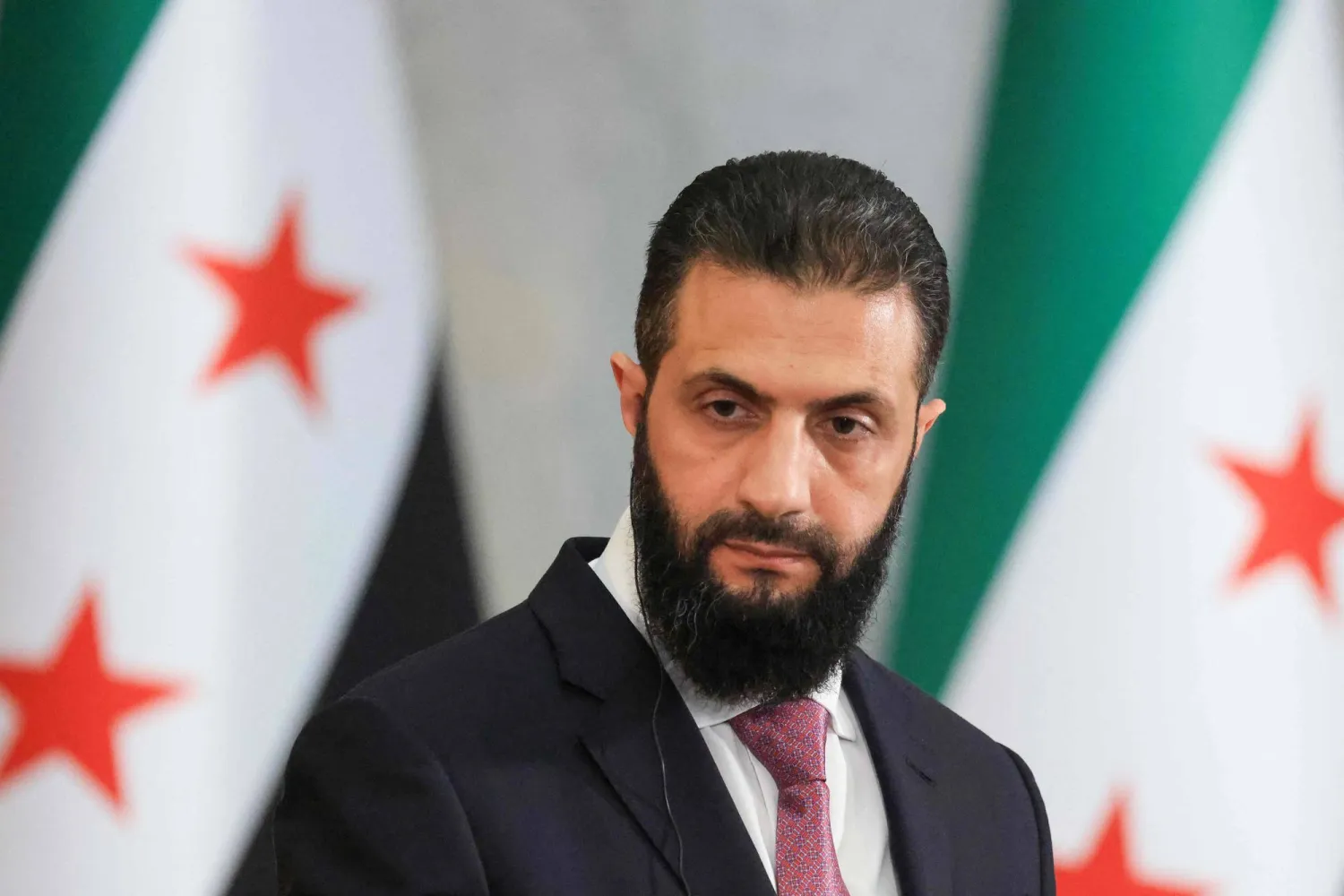
Sharaa: Syria Seeks Security Deal with Israel with Participation of Several Countries

Syrian President Ahmed al-Sharaa looks on during a joint press conference with France's President in Damascus on July 7, 2026.  (Photo by Ludovic MARIN / POOL / AFP)
Syrian President Ahmed al-Sharaa looks on during a joint press conference with France's President in Damascus on July 7, 2026. (Photo by Ludovic MARIN / POOL / AFP)
TT

Sharaa: Syria Seeks Security Deal with Israel with Participation of Several Countries

Syrian President Ahmed al-Sharaa looks on during a joint press conference with France's President in Damascus on July 7, 2026.  (Photo by Ludovic MARIN / POOL / AFP)
Syrian President Ahmed al-Sharaa looks on during a joint press conference with France's President in Damascus on July 7, 2026. (Photo by Ludovic MARIN / POOL / AFP)

Syria is seeking to reach a security agreement with Israel, Syrian President Ahmed al-Sharaa said in an interview with Al Jazeera on Sunday. He said a deal could pave the way for comprehensive peace between the two countries without compromising Syria's right to the Golan Heights, an area that Israel captured from Syria in the 1967 Six-Day War and annexed ‌in 1981.

Sharaa said ‌Syria was trying to involve a large group ‌of countries ⁠to pressure Israel ⁠to adopt a more balanced policy towards Syria.

"We are avoiding getting into confrontations," he added.

Soon after former Syrian President Bashar Al Assad fell to opposition forces in December 2024, Israeli troops pushed into Syria and seized strategic territories. Israeli troops moved into a demilitarized zone inside Syria, including the Syrian side of Mount Hermon, which overlooks the capital Damascus. Since then, ⁠the Israeli military has launched strikes on Syria and ‌detained individuals from within the country. Israel ‌has also intervened in what it calls missions to protect ethnic minority Druze in ‌southwestern Syria.

On Sunday, Israeli forces shelled areas in Syria and destroyed an ‌electrical transformer in the village of Maariyah, depriving homes of power, Syria's state news agency SANA said. Sharaa's comments coincided with UN Secretary-General Antonio Guterres visiting Syria, the first trip by a United Nations chief to the country since 2009.

In a statement ‌on X on Sunday, Guterres called for respect for Syria's sovereignty, independence, unity and territorial integrity.

"Violations by Israel of ⁠the 1974 ⁠Disengagement of Forces Agreement are unacceptable & must stop," Guterres said.

Last year, Sharaa, who is trying to rehabilitate Syria's image, became the first Syrian president since 1967 to take part in the UN General Assembly in New York. His government is seeking to rebuild international ties and the local economy after nearly 14 years of war and decades of isolation and death under Assad family rule. Sharaa also said his government is "not considering military interventions" in Lebanon.

Earlier this year, US President Donald Trump said he had spoken to Sharaa about combating Hezbollah, after criticizing Israel for killing too many civilians in Lebanon.


Yemeni Army Makes Battlefield Gains in Al-Jawf, Marib

Yemeni army forces advance in Al-Jawf governorate (government media)
TT

Yemeni Army Makes Battlefield Gains in Al-Jawf, Marib

Yemeni army forces advance in Al-Jawf governorate (government media)

Yemeni government forces expanded military operations against the Houthis on several fronts Wednesday, making battlefield gains east of Al-Hazm in Al-Jawf province and cutting Houthi supply lines toward the eastern fronts.

The advances coincided with the launch of a major operation south of Marib, intensified fighting in southern Taiz and along the western coast, and the thwarting of a Houthi boat attack in the Red Sea.

A military source told the Yemeni Armed Forces Media Center that government forces continued advancing east of Al-Hazm to the outskirts of Bir al-Maraziq and cut Houthi supply lines on the city’s eastern fronts.

Operations were continuing amid what the source described as heavy Houthi personnel and material losses. Several Houthi fighters were detained or neutralized and others wounded in the clashes, the source added.

The advance followed several days of government military moves in Al-Jawf, as forces sought to consolidate gains and pressure Houthi supply lines rather than merely retake frontline positions.

Marib and Taiz Developments

In Marib, the Yemeni army’s Third Military Region launched a major operation on the province’s southern fronts targeting Houthi positions and concentrations. Government forces said the operation aimed to secure Marib’s southern belt and push the group away from its defensive lines.

According to a statement from the Third Military Region, the operation, which began early Wednesday and was still underway, killed, wounded and captured a number of Houthis and destroyed vehicles and combat equipment. Army and Popular Resistance forces also seized several positions and brought Houthi supply lines under fire.

The operation coincided with military activity in Marib in recent days and fighting across the province’s northern, western and southern axes, as government forces sought to capitalize on battlefield pressure to prevent the Houthis from regrouping or sending reinforcements to other fronts.

In Taiz, clashes continued on southeastern fronts, alongside artillery fire and airstrikes targeting Houthi positions and concentrations in Al-Mamshat, Al-Ahkum, Ayrim, Al-Qubaytah, Al-Rahidah and Karsh.

A military source said the Houthis had sent reinforcements to several positions, including Al-Akboush School, Al-Zubayrah market, the Al-Ahkum junction, Hawd Hill, Al-Khazjah, Al-Aabous and Al-Manzarah Hill.

On the western coast, the National Resistance’s military media said its forces shot down a Houthi suicide drone over Al-Barh and reported the killing and capture of several commanders linked to a Houthi plan to attack toward Bab al-Mandab.

Among those reportedly captured by the Giants Brigades was Murtada al-Nuami, known as “Abdul Samad,” identified as head of the medical division of the Houthi reserve and rapid intervention forces.

Naval forces separately said they thwarted a Houthi boat attack in the Red Sea after detecting the vessels and engaging them, forcing them to retreat north toward Hodeidah port.

In Al-Dhale, Yemeni Defense Minister Lt. Gen. Taher al-Aqili inspected front lines to assess operations, readiness and deployments, urging troops to remain vigilant and prepared to counter any Houthi attempt to target government positions.


Israeli Strike in Gaza Kills Family of Four

Smoke and flames rise from a house during an Israeli strike, carried out after the Israeli military warned residents to evacuate the area, in Khan Younis, in the southern Gaza Strip, September 9, 2026. REUTERS/Ramadan Abed
TT

Israeli Strike in Gaza Kills Family of Four

Smoke and flames rise from a house during an Israeli strike, carried out after the Israeli military warned residents to evacuate the area, in Khan Younis, in the southern Gaza Strip, September 9, 2026. REUTERS/Ramadan Abed

An Israeli strike in Gaza on Thursday killed a family of four including two children, Palestinian hospital and security sources said.

"The bodies of four members of the Ahmad family were recovered in pieces after an Israeli strike hit a house in the Beit Lahia Project area in the northern Gaza Strip," an official at Al-Shifa hospital in Gaza City said, identifying the children as aged 12 and eight.

The Israeli military, contacted by AFP, said it was checking.

A Palestinian security source in Gaza, which is under the control of Hamas, said that Israeli warplanes struck after midnight in Beit Lahia and separately in the heart of the Jabalia refugee camp, with Israeli forces also firing on tents of displaced people and ambulances.

"Israel continues its violations in the Gaza Strip," the security source said.

Israel in October last year agreed to a ceasefire brokered by the United States but since then has advanced further into Gaza.

Israeli Prime Minister Benjamin Netanyahu has vowed no let-up in strikes targeting Hamas, which led the unprecedented October 7, 2023 attack against Israel, and no pullout from Gaza until Hamas gives up all of its weapons.

Israel often identifies its targets afterwards. The Israeli military said that on Sunday it killed Sabhi Hadr Al-Atham al-Batrihi, claiming he was planting explosive devices against Israeli troops in the Gaza Strip.

Israeli strikes have killed more than 1,300 people since the ceasefire was announced, according to the Gaza health ministry, which operates under Hamas and whose figures are considered generally reliable by the United Nations.

The Israeli army has identified five deaths in its ranks over the same period, as well as the death of one civilian contractor.


Yemeni Tribal Affairs Chief to Houthis: ‘Your Time Is Near’

Sheikh Bakil Naji al-Soufi, head of the Tribal Affairs Authority at Yemen’s Interior Ministry. (Asharq Al-Awsat)
TT

Yemeni Tribal Affairs Chief to Houthis: ‘Your Time Is Near’

Sheikh Bakil Naji al-Soufi, head of the Tribal Affairs Authority at Yemen’s Interior Ministry. (Asharq Al-Awsat)

Sheikh Bakil Naji al-Soufi, head of the Tribal Affairs Authority at Yemen’s Interior Ministry, has warned the Houthis that “your time is near, and you will leave Yemen because of your actions.”

Al-Soufi believes mounting anger in Houthi-controlled areas has moved beyond frustration over economic and living conditions and is nearing a point of action, with tribes awaiting “zero hour” and what he described as a “glimmer of hope” or support from the Yemeni government.

In a new episode of the Asharq Al-Awsat Podcast, recorded in the newspaper’s Riyadh newsroom, al-Soufi discussed the tribal practice of “nakaf,” the Al-Rayyan tribal encampments in Al-Jawf province and relations between the tribes and the Houthis. He also recalled his experience mediating with Houthi leaders more than a decade ago and outlined his view of the future confrontation, pointing to expected military “surprises.”

In the interview, filmed Aug. 20, 2026, al-Soufi described “nakaf” as a tradition under which tribes gather at encampments known as “matarah” when faced with a grievance or a situation requiring mobilization. He said developments in Al-Jawf reflected what tribes had experienced from Houthi conduct and attempts to subjugate and humiliate them.

Al-Soufi explained that tribes had historically been “an integral part of the state” and its supporting “backbone.” Where official institutions are absent, tribal customs and ties play a role in maintaining security and stability.

Deceptive slogans

Al-Soufi noted that the Houthis initially succeeded in appealing to public sentiment when they entered Sanaa by invoking poverty, high prices and corruption. The tribes later discovered, he argued, that those slogans were a means of reaching power.

He accused the group of imposing levies and taxes on various activities and using talk of a “blockade” to justify deteriorating living conditions.

The more significant shift, in his view, is occurring inside Houthi-controlled areas themselves. He stressed that tribes were not merely waiting to join the encampments but that there was broader readiness to move against the Houthis.

“People are only waiting for zero hour,” he stated, adding that he is personally in contact with figures inside Houthi-held areas whose names he declined to disclose. He described the situation as being “on the rim of a volcano.”

Al-Soufi recalled heading a mediation committee between the Houthis and Salafists in Kitaf in 2011 and 2012, when he dealt with Mahdi al-Mashat and met Abu Ali al-Hakim, Youssef al-Fishi and Saleh al-Sammad.

He said that experience led him at the time to conclude that the group was implementing an Iranian project. He described Abu Ali al-Hakim as one of the most important Houthi figures he had encountered because of the security and military portfolios he oversaw.

Failed negotiations

Al-Soufi recounted that years of negotiations had failed to demonstrate an ability to end the crisis. He argued that the Houthis maneuver when under pressure and were more willing to make concessions when in a weaker position.

On the delay in reaching a military resolution, he said the government acts as a state with domestic and international obligations and must weigh the economic and military consequences before and after any battle, unlike armed groups.

The Yemeni official concluded by saying that “strong preparations” were underway and that Yemenis would soon hear of “surprises.”

Asked whether those surprises would be “in the air or on the ground,” he replied briefly: “In the air and on the ground.”