


Israeli Generals Accuse Netanyahu of Seeking to Ignite a ‘Third Intifada’

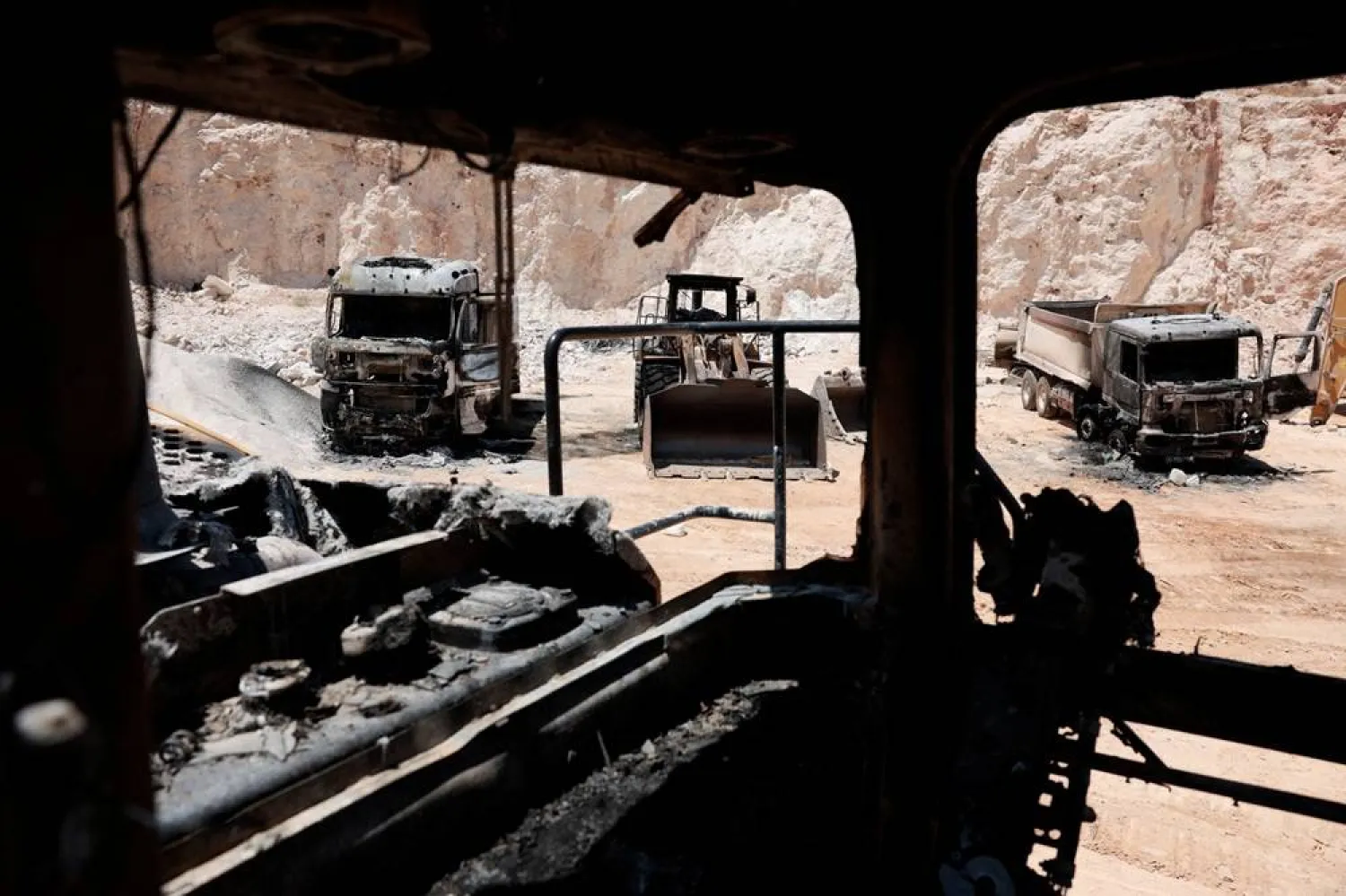
Heavy machinery that was burned inside a Palestinian quarry after Palestinians say Israeli settlers attacked yesterday, near Ramallah, in the Israeli-occupied West Bank, July 27, 2026. (Reuters)
TT

Israeli Generals Accuse Netanyahu of Seeking to Ignite a ‘Third Intifada’

Heavy machinery that was burned inside a Palestinian quarry after Palestinians say Israeli settlers attacked yesterday, near Ramallah, in the Israeli-occupied West Bank, July 27, 2026. (Reuters)

Several generals close to the Israeli military leadership have launched a broad campaign against Prime Minister Benjamin Netanyahu's policies, accusing him of seeking to "ignite a third intifada in the West Bank" as his "only way out to remain in power."

Six hundred former generals and senior officials sent a letter to US President Donald Trump, urging him to "halt the deterioration in the West Bank and exploit his meeting with Netanyahu to rein in his comrades and allies in the far-right who are drowning the country in blood."

Netanyahu departed for the US for a meeting with Trump on Monday.

In their letter, the generals argued that "faced with US pressure to end the war, remaining aside on the Iranian front, and withdrawing from vast areas in Lebanon, Syria, and the Gaza Strip, Netanyahu has nothing left but the West Bank. He needs a conflict to maintain the state of emergency, which he requires either to unite the right around him or to postpone the elections that appear poised to cost him power."

Several opinion polls regarding the upcoming general elections in October indicate that Netanyahu's chances of forming a government appear to be declining, contrasted with the growing chances of his main rival, former Chief of Staff Gadi Eisenkot, making significant gains.

The generals, who are making media statements, writing articles, or organizing protest petitions, have noted the bloody attacks carried out by Israeli settlers against Palestinians with overt government backing.

These attacks reached a new peak last week when hundreds of settlers torched Palestinian homes, cars, and shops, resulting in the deaths of two Israeli soldiers and four Palestinian citizens in the village of Tal, near Nablus.

Although the Israeli military is decisively fueling the situation under the pretext of protecting settlers, its generals directly accused the government of planning the current unrest, driven in part by certain ministers with far-right ideological motives aimed at preventing the establishment of a Palestinian state, and in part by others for partisan and personal electoral purposes.
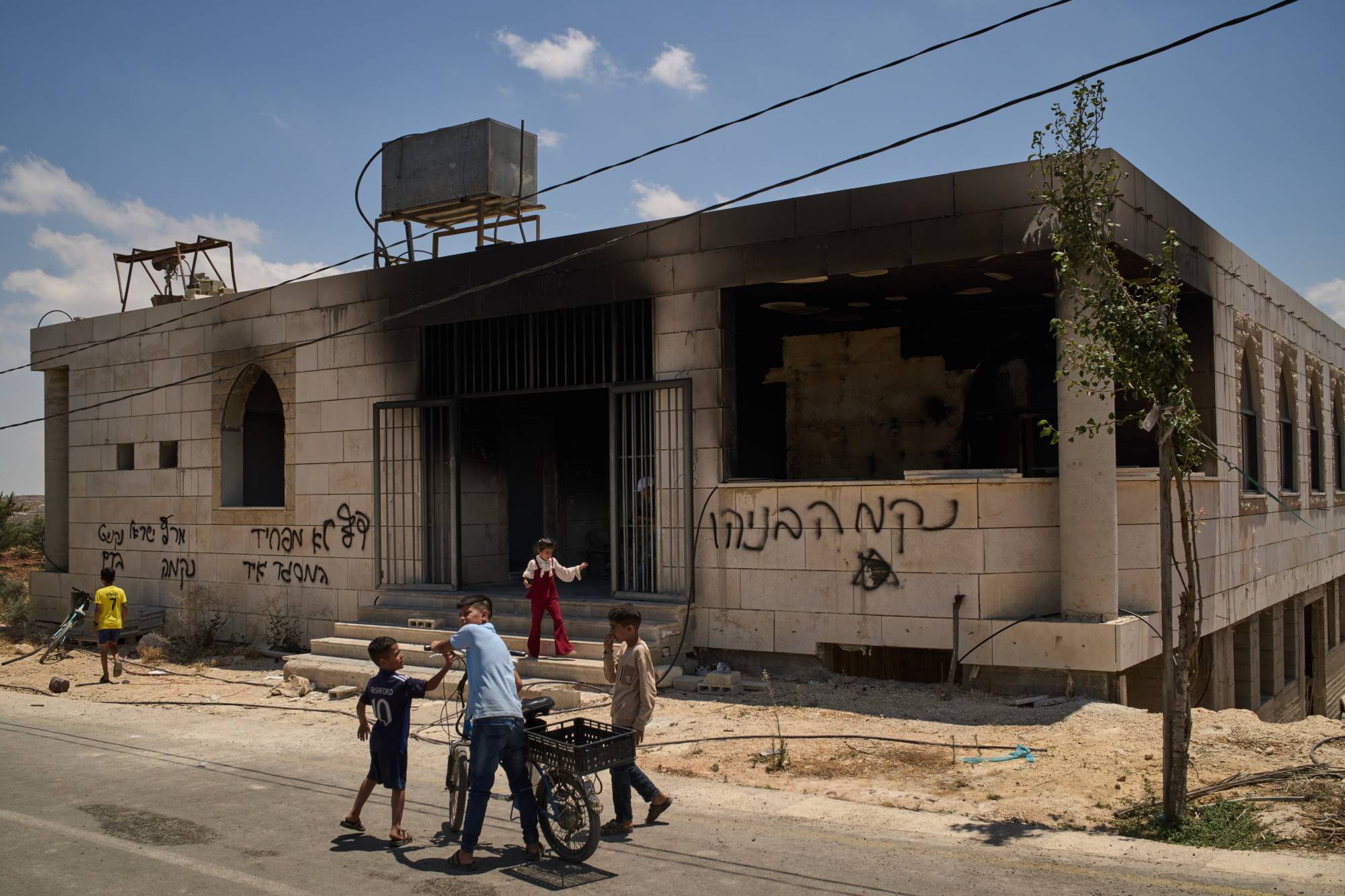
Children stand outside a mosque that was burned during an attack by Israeli settlers early in the morning in the West Bank village of Qusra, Sunday, July 26, 2026, as on its wall a Hebrew graffiti reads "Revenge Benayahu", referring to an Israeli settler killed during clashes with Palestinians in the village of Tell, last Friday. (AP)

‘Playing with fire’

Yedioth Ahronoth published an editorial on Monday written by military correspondent Yossi Yehoshua under the headline "Playing with Fire," in which he stated that the military feels caught in an ambush: settlers attack, Palestinians respond, the military defends, Palestinians express their anger, settlers react, and so on, until the cycle of violence expands and can no longer be stopped.

He added that "in an attempt to calm the situation, the Israeli military requires a massive force, deploying 26 battalions to the West Bank alone while maintaining long, open war fronts in Gaza, Lebanon, Syria, and the West Bank, leaving almost no room to breathe."

Yehoshua expressed his belief that "the root of the scourge lies in the settlement map of the West Bank, which is undergoing the largest shift in its history; plans for 80 settlements have been approved, 34 of which have already been built. Alongside this, more than 100 pastoral farms and a similar number of outposts have been established, some of which are currently undergoing regularization procedures."

He stated: "It is important to understand that every new settlement is not just a point on the map, but requires protection; it creates transit routes, friction points, security missions, and a defensive routine. As Israeli territory expands, the area that the Israeli military must protect also widens."

The author pointed to a grim equation emerging: Palestinians are initiating almost no resistance activities, yet the more they reduce these acts, the more settlers increase their attacks against them.

According to data from the security establishment and the police, 660 Israeli attacks against Palestinians were recorded in the first half of 2026, representing a 63 percent increase compared to the second half of 2025, which saw 405 recorded incidents.

On the verge of a third intifada

Also in Yedioth Ahronoth, Nahum Barnea wrote that "the third intifada is on the brink of erupting, and if it happens, it will be different from its two predecessors; it will be the first to break out according to the vision of the Israeli government. There are those who sow the wind in hopes of reaping a whirlwind. Netanyahu sowed the wind, and he is pursuing and pushing for a third intifada."

However, Barnea held the army responsible, stating: "If the weekend's round of violence turns into a third intifada, the Israeli military will not be exempt from responsibility for the bloodshed. The commander's mission is to protect Israelis residing in Area C, but he has a prior mission rooted in the country's laws and international law: to be the sovereign, enforce his rule over the area, and ensure the security of all residents. This is his military, leadership, and legal duty."
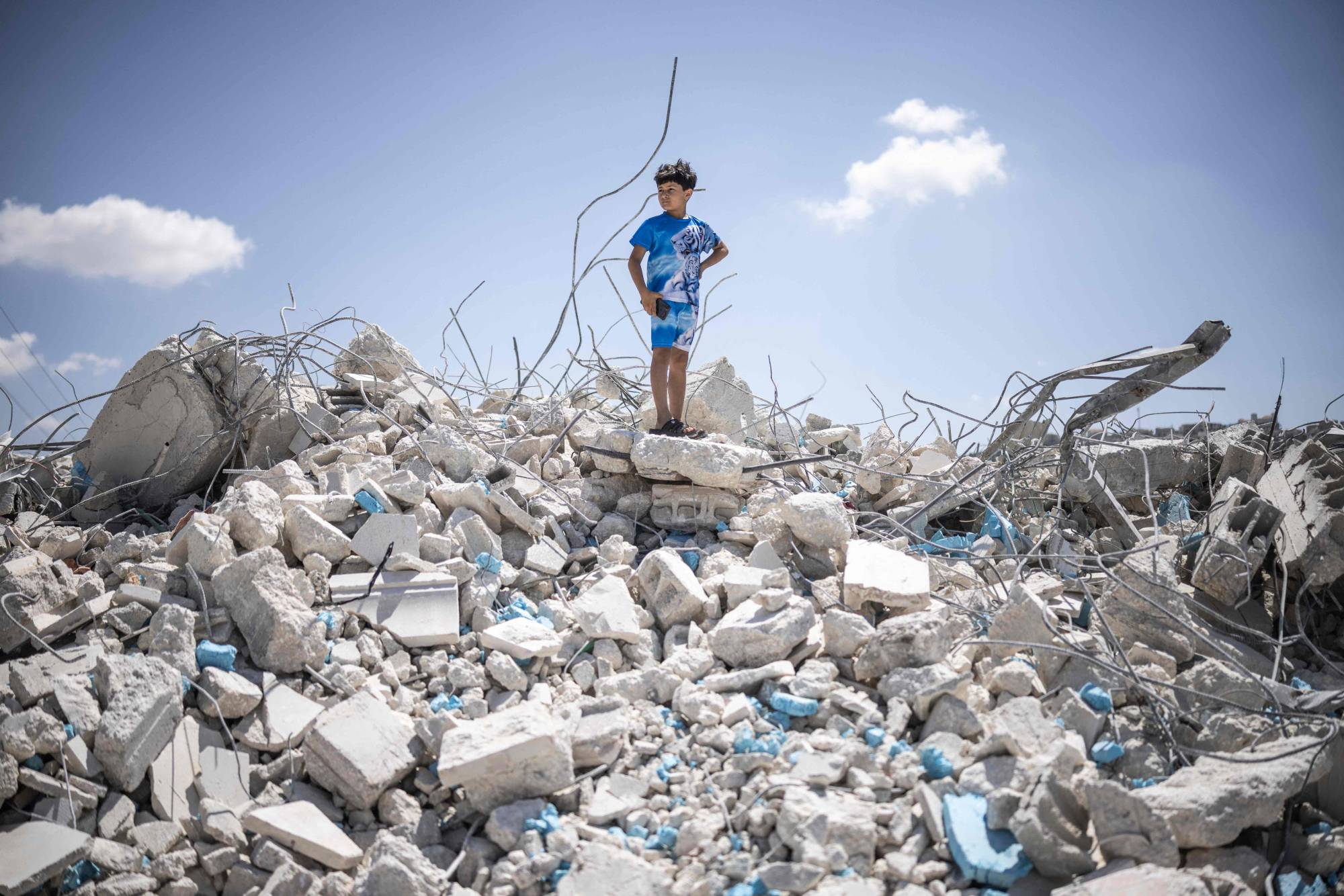
A Palestinian boy stands on top of a pile of rubble from a building containing shops and flats that were demolished by Israeli forces, citing the lack of a building permit, in Arraba, south of the Palestinian city of Jenin in the northern Israeli-occupied West Bank, on July 27, 2026. (AFP)

Effective international intervention

In Haaretz, historians Dr. Assaf Bondy and Dr. Adam Raz wrote that "what Israel is doing against the Palestinians requires effective international intervention."

They noted that "even under the darkest regimes that adopted killing as a method of governance, these regimes often sought to prosecute those who committed crimes of murder and looting in violation of their own 'regulations' and 'laws' - not out of integrity, but because even a murderous regime seeks to monopolize crime to ensure that killing is carried out by order, or according to specific goals and plans, rather than individual initiative."

The two historians noted that "Israel in 2026, after nearly three years of genocide in the Gaza Strip, has abandoned even this appearance; crime is no longer merely remote from justice, but is now openly celebrated."

They cited Finance Minister Bezalel Smotrich smiling proudly while holding the Peace Now movement's report on massacres in the Palestinian territories and the accelerated pace of annexation.

They warned that while "many of the state's citizens pin their hopes on the judicial system, a realistic view reveals that the judicial system in Israel is nothing but another cog in the crime machine called the State of Israel."

The historians concluded that "foreign intervention is necessary, otherwise the number of Palestinian victims will increase dramatically."



Police in Eastern German State Defuse 21 Explosive Devices Found Near Power Grid

A burned vehicle sits at a construction site on the ground of a substation, as police is investigating a fire at the transformer substation, further raising security concerns over a series of sabotage attacks on Germany's power grid, in Berlin, Germany, September 7, 2026. Sign reads "No entry to the construction site". (Reuters)
TT

Police in Eastern German State Defuse 21 Explosive Devices Found Near Power Grid

A burned vehicle sits at a construction site on the ground of a substation, as police is investigating a fire at the transformer substation, further raising security concerns over a series of sabotage attacks on Germany's power grid, in Berlin, Germany, September 7, 2026. Sign reads "No entry to the construction site". (Reuters)

Prosecutors in the eastern German state of Saxony said on Monday that authorities had found a total of 21 explosive devices as part of their investigations into attacks on the electricity grid that have kept authorities on high alert for days.

Investigators discovered nine additional homemade explosive devices over the weekend near high-voltage power ‌lines south ‌of the Graustein substation in the ‌eastern ⁠German district of Goerlitz, ⁠taking the total number discovered to 21, police and prosecutors said in a joint statement.

Germany has been the focus of European fears about the vulnerability of critical infrastructure, as it experienced a series of sabotage incidents ⁠on the power grid last week ‌after a drone attack ‌in August at Leipzig/Halle for which the ‌government formally blamed Russia.

German police said on Friday ‌they were searching for a man who sent letters claiming responsibility for a series of sabotage attacks on the power grid last week after ‌they found what appeared to be explosives at his home. The man ⁠is ⁠still at large.

Initial findings into a fire at a transformer substation in Berlin earlier on Monday, which police had said was being investigated, showed the incident was caused by a technical fault, Spiegel reported citing Police Commissioner Barbara Slowik Meisel.

Separately, Bild newspaper reported that police in the western city of Wesel have launched major assessment operations after the security fence around another transformer substation was found to be cut open.


Kremlin Says It Does Not Rule Out Restart of Peace Talks with Ukraine and US

In this handout photograph taken and released by the Ukrainian Presidential Press Service on September 6, 2026, US Special Envoy Steve Witkoff (R) and US President Donald Trump's son-in-law Jared Kushner (L) arrive for talks with Ukrainian president in Kyiv, amid the Russian invasion of Ukraine. (Handout / Ukrainian Presidential Press Service /AFP)
TT

Kremlin Says It Does Not Rule Out Restart of Peace Talks with Ukraine and US

In this handout photograph taken and released by the Ukrainian Presidential Press Service on September 6, 2026, US Special Envoy Steve Witkoff (R) and US President Donald Trump's son-in-law Jared Kushner (L) arrive for talks with Ukrainian president in Kyiv, amid the Russian invasion of Ukraine. (Handout / Ukrainian Presidential Press Service /AFP)

The Kremlin said on Monday that it did not rule out the resumption of peace talks between Russia, Ukraine and the United States, but said it was too early to say when and where such talks might take place. 

Kremlin spokesman Dmitry Peskov made the comments when asked about a weekend visit to Moscow and Kyiv by US envoys Steve Witkoff and Jared ‌Kushner who ‌are trying to breathe new ‌life into ⁠stalled talks designed ⁠to find a way to end the war in Ukraine. 

"As for the resumption of the trilateral format, you heard the statement from Kyiv yesterday. Mr. Kushner made such statements. We, too, do not rule out the resumption of this trilateral format, but ⁠it is still too early to ‌speak of the venue ‌and exact dates,” Peskov told reporters when asked if three-way ‌peace talks would resume. 

Peskov, who declined to ‌discuss in detail the content of the latest US peace proposals or what the hardest outstanding issues to solve are, said the Kremlin did not rule out ‌a phone call between Russian President Vladimir Putin and US President Donald Trump to ⁠discuss ⁠the US envoys' trip. 

"Undoubtedly, any attempts...represent a small step towards peace, and we truly hold the peace-building efforts of the American negotiators in very high regard," Peskov told reporters. "President Putin himself has said that he holds President Trump’s efforts in high regard, and that he is grateful to President Trump for his commitment to this path towards peace.” 

Moscow had not yet received any information about contacts between the US envoys and Ukrainian officials in Kyiv on Sunday, Peskov said. 


Majority of Spaniards Unhappy with Government's Handling of Ceuta Crisis, Poll Shows

Migrants rest along a street in the Spanish North African enclave of Ceuta, 04 September 2026. EPA/LAURA RINCON
TT

Majority of Spaniards Unhappy with Government's Handling of Ceuta Crisis, Poll Shows

Migrants rest along a street in the Spanish North African enclave of Ceuta, 04 September 2026. EPA/LAURA RINCON

Nearly nine in ‌10 Spaniards blame Morocco for the mass migrant crossings into Ceuta in late July, while a majority rate Prime Minister Pedro Sanchez's handling of the crisis as "bad" or "very bad", according to an opinion poll released on Monday that also showed a drop in support for Sanchez's party, Reuters said.

The 40dB poll of 2,000 people for El Pais newspaper and radio station SER also recorded an increase in voting ‌intentions for the ‌conservatives and the anti-immigration, far-right Vox party, ‌in ⁠line with several ⁠other polls conducted after the deadly border surge into Spain's North African enclave.

* For 89% of respondents, Morocco bore the most responsibility for the crisis, followed by human-trafficking groups (75%), the spread of disinformation on social media (74%), the migrants who decided ⁠to cross (73%) and the Spanish government (72%), the ‌40dB poll found.

* Only ‌14.2% rated Sanchez's handling of the crisis positively, with ‌two-thirds of those surveyed saying his response was too ‌slow.

* The combined voting intentions for the conservative People's Party and Vox hit 50.2%, leading their potential right-wing alliance to breach the 50% mark for the first ‌time in an opinion poll during this legislature. The center-left bloc fell to 36.1%.

* ⁠The ⁠PP rose to 32.4%, from 32% in the previous 40dB poll in July, and Vox to 17.8% from 17.2%, while Sanchez's Socialist Party dipped to 27.6% from 28%.

* About 27% of respondents named Vox as the most capable party on the issue of immigration, ahead of the Socialists at 18.4% and the PP at 13.9%.

* Seven out of 10 chose tighter border controls over protecting vulnerable migrants and 82% backed increasing fences and surveillance at Spain's borders.