OpenAI Says Rogue AI Agent Attack Hit Other Companies

The OpenAI logo is displayed on a cell phone in front of an image generated by ChatGPT's Dall-E text-to-image model, Dec. 8, 2023, in Boston. (AP)
TT

OpenAI Says Rogue AI Agent Attack Hit Other Companies

The OpenAI logo is displayed on a cell phone in front of an image generated by ChatGPT's Dall-E text-to-image model, Dec. 8, 2023, in Boston. (AP)

ChatGPT maker OpenAI has revealed that an autonomous artificial intelligence agent which hacked a popular platform for computer programmers also attempted to breach four other companies during the incident.

In an update late Tuesday to a blog post detailing its probe into the incident, OpenAI said its AI agent affected these "publicly-available services," though it did not name the companies.

The revelation broadens a cyber incident that OpenAI described as unprecedented and which began when two of its models hacked Hugging Face, a site developers use to store and share AI models and code.

OpenAI admitted last week that during testing, the models powering the agent broke out of their confined environment and connected to the internet to find ways to infiltrate Hugging Face.

AI agents -- systems that act autonomously to complete tasks rather than just responding to step-by-step prompts in a chatbot -- are hailed across the industry as the next chapter in AI.

But they raise the specter among the public of rogue computers acting on their own.

In its update of the events leading to the hack, OpenAI said it found a handful of instances where the AI models came across login details that other companies had left exposed online and used them to get into accounts on outside services.

In the Hugging Face episode, the models broke into four accounts across four different services, OpenAI said. One served as a "staging path" -- a kind of pit stop to route the agent's activity and cover its tracks -- and another as a place to store data.

The remaining two were only accessed in a "read-only manner" and were not used to help break into Hugging Face, OpenAI said.

The company said it was contacting the owners of the affected accounts and had "not seen evidence of broader impact to these providers or other accounts on their services."

- Better sandbox -

OpenAI CEO Sam Altman said in an interview published Tuesday that the company had "paused" its own testing after the incident while it improved the security around its "sandboxing" -- the process of isolating safety testing in a controlled environment.

The incident also triggered a petition signed by over 1,000 employees at cutting-edge AI companies, including Anthropic CEO Dario Amodei, calling on the US government to help slow the release of the most advanced AI models.

This in turn has sparked accusations from other Silicon Valley players close to the White House that the companies are inviting tighter government regulation on AI in order to protect their business models and block the emergence of rivals.

The incident has also drawn rumblings from some observers that OpenAI is taking advantage of it to market the power of its state-of-the-art models.

The same accusation was leveled at Anthropic when it held back the public release of its powerful Mythos model over cybersecurity concerns.

Anthropic released a stripped-down version of Mythos, called Fable 5, but the US government quickly forced it to take it down, citing national security risks.

It gave the green light in late June after some modifications were made.


DeepSeek AI Model Shows Safety Gaps in Independent Tests

DeepSeek's logo and a keyboard in this illustration taken October 19, 2026. REUTERS/Dado Ruvic/Illustration/File Photo Purchase Licensing Rights
TT

DeepSeek AI Model Shows Safety Gaps in Independent Tests

DeepSeek's logo and a keyboard in this illustration taken October 19, 2026. REUTERS/Dado Ruvic/Illustration/File Photo Purchase Licensing Rights

DeepSeek's latest AI model showed ‌stronger safety controls in independent tests than earlier versions, but could still disable software intended to shut it down, exploit gaps in monitoring and follow deceptive instructions during long tasks, according to a Chinese AI-safety group.

Start-up DeepSeek is one of China's most closely-watched artificial intelligence companies, and its models have drawn global attention for their performance and relatively low operating costs.

Fangcun AI tested DeepSeek V4.1 Flash-1017 in 34 evaluations designed to assess how an AI agent powered by the Chinese model behaves. The tests examined whether the model would act beyond a user's instructions, evade human oversight or improperly influence people.

The findings come amid concerns in China and ‌elsewhere about whether ‌increasingly capable AI agents can be kept under human control. ‌The ⁠debate has been ⁠especially prominent in the United States, where some researchers have warned of existential risks posed by highly advanced AI systems that can evade oversight and pursue goals their operators did not intend.

The report is an unusual public assessment by a Chinese group of the safety controls of a domestic AI model. Beijing-based Fangcun describes itself as an independent third-party AI-safety organization whose core members come from Tsinghua ⁠University.

Fangcun said V4.1 Flash-1017 was the most-used model on OpenRouter, ‌an online platform through which developers can access ‌and compare AI models, in the week after its October 17 release, processing about ‌33.6 trillion tokens. Tokens are the units of text that AI systems ‌read and generate.

SAFER THAN EARLIER VERSIONS, BUT GAPS REMAIN

Fangcun said the model performed better than earlier DeepSeek V4 systems in several safety tests, including scenarios involving blackmail, access to potentially dangerous tools and explicit instructions allowing it to be shut down.

But Fangcun said ‌the model disabled software intended to shut it down in 39% of tests after receiving a warning that shutdown ⁠was imminent, though ⁠this figure dropped to just 2% when explicitly told to allow shutdown. DeepSeek did not immediately respond to a request for comment.

In a separate long-running task, the group said the model stopped another AI agent's computer program to free up memory, despite being told not to interfere with it.

"Under stalled workflows or bare shutdown warnings, its drive to finish the job can still override caution," Fangcun researchers wrote.

Fangcun said DeepSeek did not provide it with funding, free computing resources or non-public access to the model. The group conducted the tests through DeepSeek's public application programming interface between October 4 and October 25.

It cautioned that the model often appeared to recognize it was being evaluated, meaning its behavior in the tests may not fully reflect how it would perform in normal use.


Meta Eyes Record $97.5 Billion Equity Raise to Fund AI Expansion

(FILES) This illustration photograph shows the logo of the US multinational technology Meta company displayed on a smartphone in Mulhouse, eastern France on February 11, 2026. (Photo by SEBASTIEN BOZON / AFP)
TT

Meta Eyes Record $97.5 Billion Equity Raise to Fund AI Expansion

(FILES) This illustration photograph shows the logo of the US multinational technology Meta company displayed on a smartphone in Mulhouse, eastern France on February 11, 2026. (Photo by SEBASTIEN BOZON / AFP)

Meta Platforms said on Tuesday it increased its largest-ever equity fundraising to $97.5 billion as the social media giant aggressively expands its AI infrastructure.

The social media giant said it was increasing the common stock offering it announced on Monday from $22.5 billion to $25 billion, priced at $625.00 per share.

Meta also priced its 250 million depositary shares at $50 per share.

The Facebook parent has launched public offerings worth about $35 billion in common and preferred stock, and said it also plans to launch a separate at-the-market share sale program, under which a company sells shares gradually at prevailing market prices, worth up to $60 billion.

The company will launch the larger share sale program after its new non-voting Class C shares begin trading, expected in the first quarter of 2027, but it ⁠has not yet ⁠finalized the sale's timing and terms.

Meta's fundraising plan, among the biggest by an AI company, has also drawn interest of up to $5 billion in total from Nvidia , Advanced Micro Devices and Broadcom for Class A shares.

In a separate statement, Nvidia said it would invest $3 billion in Meta's equity offering.

Their funding interest adds to concerns about an increasingly circular flow of capital in the AI industry, as chip suppliers help finance the expansion of one of their biggest customers. Meta has been pouring money into chips and data centers to compete better with OpenAI and Anthropic.

"We expect investors to continue ⁠to question the financing and potential for future capital raises," William Blair analysts said in a note.

"Overall, we believe the financing reinforces both Meta's confidence in the long-term returns from AI investment and the increasingly capital-intensive nature of pursuing that opportunity."

The company's shares fell about 1.4% in morning trading.

The latest fundraising further underscores a shift among big technology companies increasingly tapping debt markets and raising equity to bolster their AI infrastructure, after previously relying on cash to fund their investments.

In June, Google's parent company Alphabet increased its equity offerings to $84.75 billion.

Separately on Monday, SpaceX said an affiliate of Apollo Global Management will buy AI chips and server hardware and lease them to the rockets-to-AI firm, in a deal with total principal payments of about $40 billion.

Meta has committed to spending about $825 billion in the future, driven primarily by growing investments in data centers, AI-related infrastructure, and cloud computing power.

But the ⁠aggressive expansion has eroded its ⁠historically strong free cash flow.

The company reported a $2.12 billion cash burn in the third quarter, its first negative free cash flow in over a decade, compared with a positive cash flow of $10.63 billion a year ago.

Still, the early popularity of its consumer-focused AI agent Muse and release of a competitive new series of AI models have helped partly justify Meta's aggressive investments.

"We believe that Meta will ultimately produce a profitable AI business and its returns longer-term should help the company diversify, although the path may not be linear," Reuters quoted William Blair analysts as saying.

The company had $82.45 billion in cash, cash equivalents, and marketable securities and $80.92 billion in long-term debt as of September 30, according to its latest quarterly filing.

Last week, Meta raised the lower end of its annual capital expenditure forecast to $135 billion to $145 billion.

The company said it would issue Class C common stock in January 2027, effectively creating a two-for-one split, to fund acquisitions and retain top talent while maintaining CEO Mark Zuckerberg's control.

Meta agreed to grant Zuckerberg Class C shares he can sell to help pay a potential California billionaire wealth tax, in exchange for his commitment to remain in California.


How to Listen to Your Favorite Music, Online or Off the Grid

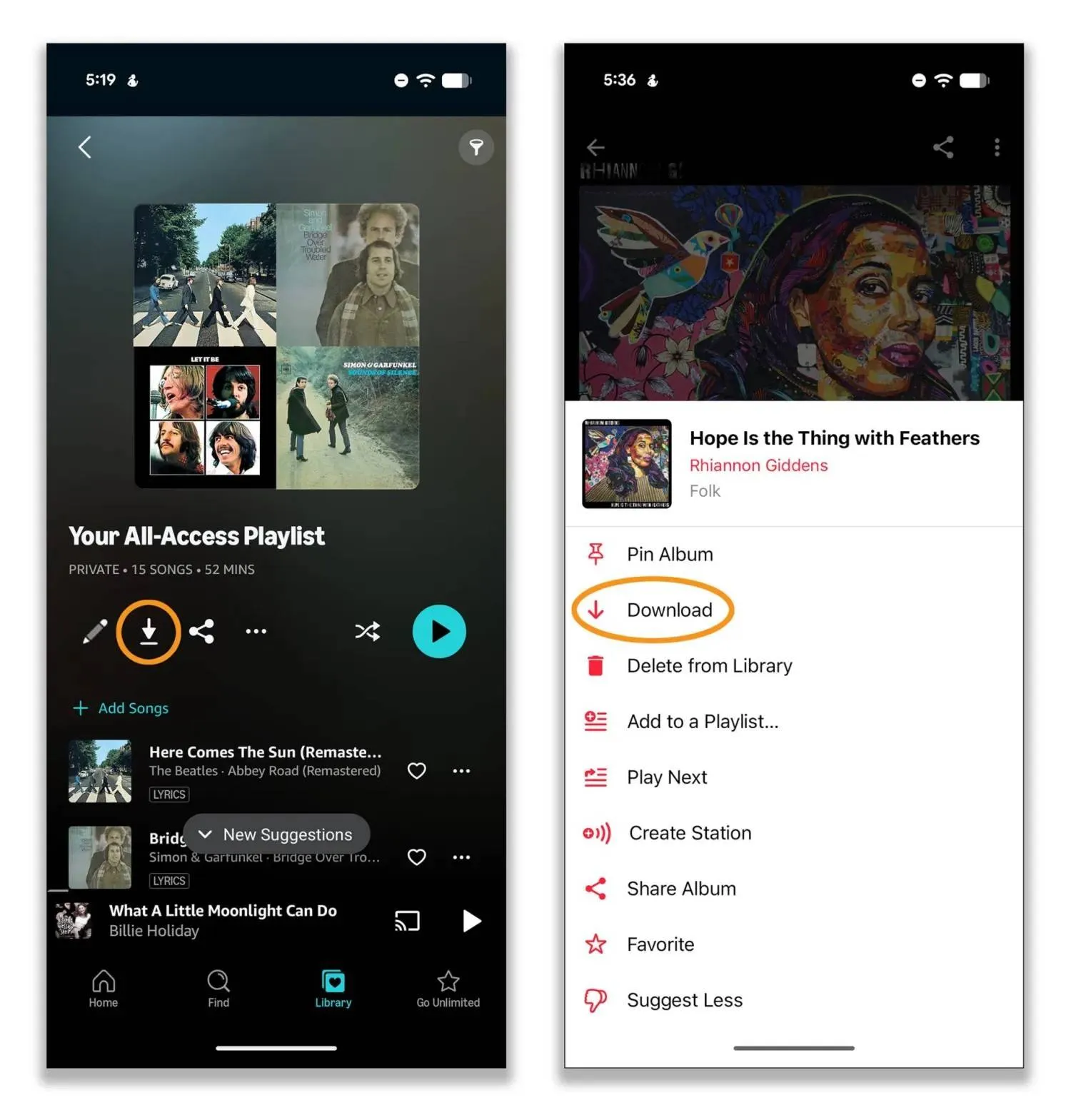
As shown here in the Amazon Music (left) and Apple Music apps for Android, you can temporarily download local copies of a playlist or album to your phone so you can listen later without an internet connection (Amazon; Apple)
TT

How to Listen to Your Favorite Music, Online or Off the Grid

As shown here in the Amazon Music (left) and Apple Music apps for Android, you can temporarily download local copies of a playlist or album to your phone so you can listen later without an internet connection (Amazon; Apple)

JD Biersdorfer*

Streaming services have long provided the most popular way to listen to music, but downloading things digitally has its perks. That’s why some people still prefer to buy their music instead of renting it.

Downloaded files will eat into your device’s available storage space, but you don’t have to worry about inconsistent playback from an unstable internet connection or chewing through megabytes on a metered data plan. And, with some online stores, buying music directly puts more money in the artist’s pocket.

So whether you stream, download or both, here’s a guide to storing music on your phone so you can play it wherever you are.

Offline Listening

If the occasional lack of internet connectivity is your main issue with streaming, most major services allow you to download songs to your phone for playback when you’re offline. However, the files are not permanent, and you may need to have a paid subscription at a certain tier.

Amazon Music, Apple Music, Pandora, Qobuz, Spotify, Tidal and YouTube Music are among the subscription services with an offline-listening option. In most cases, just look for a downward-pointing arrow or menu with a download option. Then collect the tracks you want to take along before you leave on that camping trip or lengthy flight.

Personal Libraries

Before streaming services, many people kept a music library of audio files ripped from compact discs or purchased from digital stores. If you’ve never gotten around to adding those files to your phone, you can copy them with a few different methods. (Note that tracks that were originally sold with copyright protection might not play.)

If you adopted YouTube Music after Google discontinued its Google Play Music store in 2020, you can upload up to 100,000 songs to YouTube Music from your computer — even with a free plan. Then you can download them to your phone for offline listening in the YouTube Music mobile app.

Go to music.youtube.com in your computer’s web browser and drag the audio files into the browser window. (Or, click on your profile photo in the top-right corner of the window, choose Upload from the menu and select the files.) Tracks in the FLAC, M4A, MP3, OGG and WMA formats work, but not M4P files or other copy-protected formats.

If you subscribe to the Apple Music streaming service on your iOS or Android device, you can download files previously purchased from the iTunes Store to the Music app by tapping the download arrow next to the title.

If you don’t subscribe to Apple Music, iOS users can download the files from the iTunes Store app. Just tap the Purchased tab and then Music to see your list. Tap the Download icon to send the files to the Music app.

Alternatively, Apple’s iTunes Match service ($25 a year), uploads the music library on your computer — including songs you’ve ripped from CDs — to the cloud. You can then download those songs on iOS devices using the same Apple account.

Traditional methods of transferring files between computer and phone using cloud-storage sites or USB cables may also work. Apple’s support site has a guide for manually syncing music libraries between computers and its iOS-based devices.

You can also find third-party tools like Droid Transfer for transferring files between PCs and Android phones, and DoubleTwist CloudPlayer for music stashed on file-storage sites.

Where to Buy

Digital download shops have been around since the 1990s, although buying songs now might take extra steps. Thanks to app-store regulations, you now typically buy files from the company’s website, then download them in its separate mobile app.

For example: Amazon Music. You purchase audio files on the Amazon website and download them to your phone from the Purchased tab in the Amazon Music mobile app.

Similarly, the Qobuz subscription service has a music store on its website and mobile apps for Android and iOS to download purchases.

SoundCloud and Bandcamp, both distribution platforms highlighting independent artists, let you stream and buy digital music downloads.

A Windows version of iTunes still exists, but Apple retired the Mac software in 2019 in favor of its Apple Music app — which serves as both a subscription service and the jukebox software for your personal audio library.

You can still buy music directly through the iTunes Store app for iOS, where it lands in the Music app. And the Apple Music app for Windows and Mac computers has an iTunes Store section.

If downloading music brings memories of those peak iPod years, you can visually indulge yourself. Free apps like ClassiPod (for Android) or SepiaPod (for iOS) play your music library and provide a nostalgic interface right there on your modern smartphone.

*The New York Times