
Western Sources Say Six Iranian Advisers Killed in Iraq Strikes

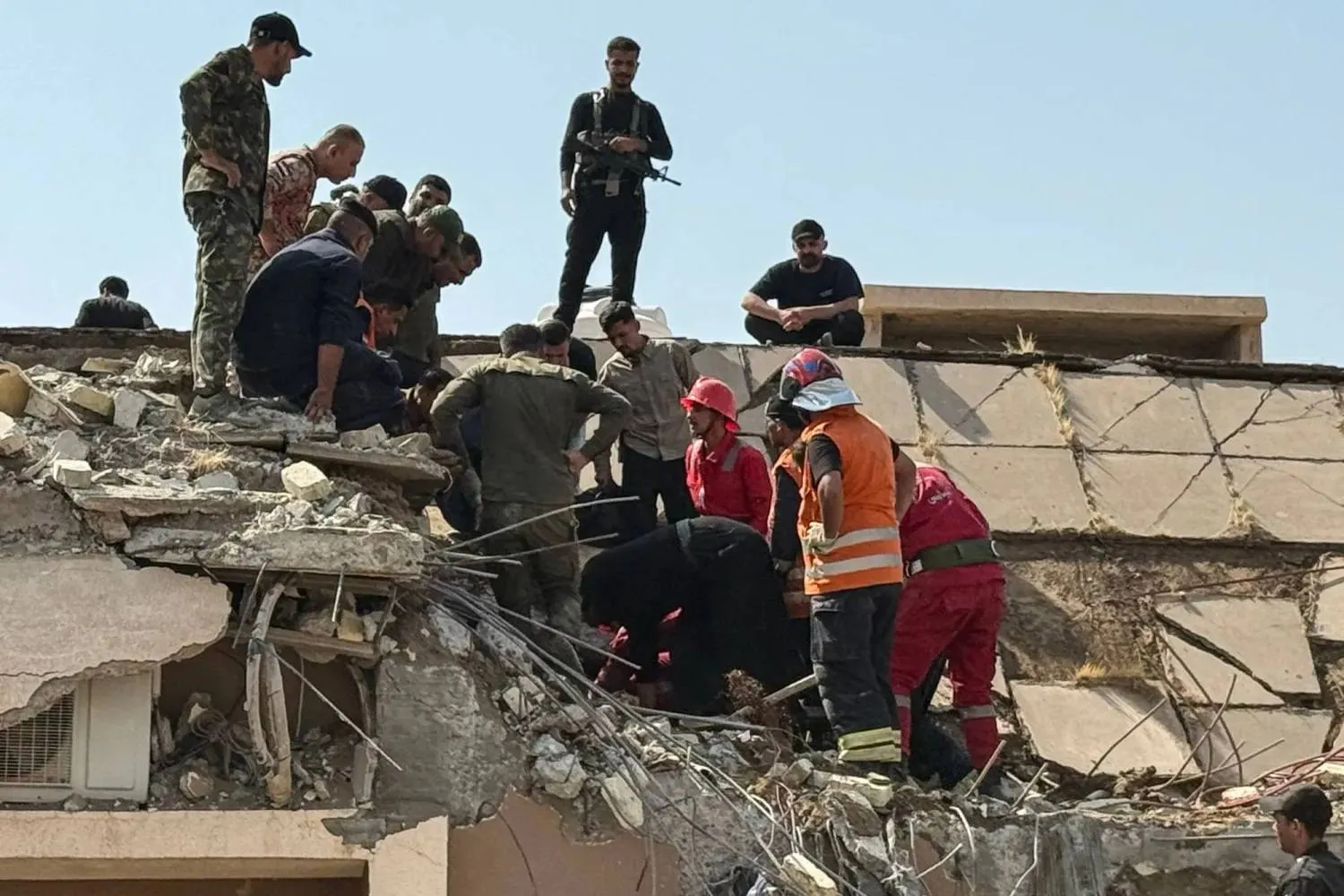
Rescuers search for dead or wounded people in Iraq's Miqdadiyah, Diyala province, on Wednesday. (AFP)
TT

Western Sources Say Six Iranian Advisers Killed in Iraq Strikes

Rescuers search for dead or wounded people in Iraq's Miqdadiyah, Diyala province, on Wednesday. (AFP)

Informed western sources told Asharq Al-Awsat on Wednesday that initial reports from Iraq indicated six Iranian military advisers and 20 members of the Popular Mobilization Forces were killed in an airstrike on the Amerli area of Salahuddin province. About 30 people were wounded.

The sources declined to confirm whether Iranian adviser Haj Ali Iqbalpour was among the dead.

They said Iraqi groups that launched missiles and drones toward Saudi Arabia, the United Arab Emirates, Kuwait, and Jordan were operating under the direct command of Quds Force officers from Iran’s Revolutionary Guards.

The officers, described as “advisers,” carry diplomatic passports, the sources said.

They identified the most prominent Iranian advisers directing Iraqi groups linked to what are described as “rogue factions” as:

Haj Hamed, also known as Abdollahi: Head of the Quds Force Esmail Qaani’s deputy for Iraqi affairs, who plays a leading role in that capacity.

Javad Ghaffari: A Quds Force official previously responsible for Syria and Palestine who was transferred to Iraq after recent developments. Many regard him as the most dangerous of the advisers because of his past experience and connections.

Haj Ali Iqbalpour: The official responsible for northern operations, including attacks targeting the Kurdistan region, oil and gas fields and US forces. He oversees groups from several factions, including Iraq’s Harakat al-Nujaba and Kataib Hezbollah, particularly units experienced in launching drones.

Dr. Amir: An economic expert considered one of the senior officials behind attempts to smuggle weapons from Iraq to Lebanon through Syria. He controls several Revolutionary Guards-linked companies tasked with evading US and international sanctions. He is also responsible for transferring cash to Iran and previously oversaw oil-smuggling operations.

The Iranian advisers are deployed across Iraq’s southern and central provinces and maintain key bases near Karbala, Najaf, and Kadhimiya.

They also operate a command center that manages attacks once targets have been selected. Haj Hamed is the most senior among them, alongside Ghaffari.

Citing reports from informed Iraqi sources, the western sources said the advisers use the Iranian Embassy’s cultural attaché building in Baghdad and other bases in neighborhoods around the Green Zone.

The reports said Tehran decided, after the fall of Bashar al-Assad’s government and developments in southern Lebanon, to place allied groups in Iraq and Lebanon under “reliable management.”

It sent Quds Force officers to have the final say on any escalation or on decisions to activate the fronts.

The reports said Iran was unwilling to make even symbolic concessions or take steps suggesting its control over its allies in Iraq and Lebanon had weakened because of US strikes.

They said Hezbollah’s sharper rhetoric against Lebanese President Joseph Aoun and Prime Minister Nawaf Salam came at Iran’s prompting.

The same applied to the tougher position taken by Iraqi factions toward the government of Prime Minister Ali al-Zaidi, although some of those groups had spoken of restricting weapons to the state and preventing arms from remaining outside the control of the legitimate authorities.

On Wednesday afternoon, Iran’s Hamshahri newspaper said four Revolutionary Guards military advisers were killed in overnight strikes on Iraq.


Iraq Closes Three Iran Crossings, Pursues Those Behind Attacks on Saudi Arabia

Travelers at the Shalamsheh border crossing between Iraq and Iran after Iraqi authorities ordered its closure as a precautionary measure following the latest drone attacks on Saudi Arabia on September 12, 2026 (Reuters)
TT

Iraq Closes Three Iran Crossings, Pursues Those Behind Attacks on Saudi Arabia

Travelers at the Shalamsheh border crossing between Iraq and Iran after Iraqi authorities ordered its closure as a precautionary measure following the latest drone attacks on Saudi Arabia on September 12, 2026 (Reuters)

Iraq closed three border crossings with Iran on Saturday, officials told AFP, after a drone attack on a Saudi Arabian pipeline that both Riyadh and Baghdad said was launched from Iraq.

An Iraqi security source and a government official told AFP that authorities ordered the closing of three border crossings with Iran.

The security source said the decision was "part of an intelligence effort to track down the perpetrators and prevent their escape... and to hinder the smuggling of drones through these crossings".

Both sources, who spoke on condition of anonymity because they were not allowed to speak to the media, could not specify when the crossings would reopen.

The closed crossings are Shalamsheh in Basra province, al-Shib in Missan and al-Mandali in the central province of Diyala.

Other border crossings with Iran are still open.

A security official said that "security forces found drone launchers near the Iraq-Iran border in the al-Tib" region, a remote part of Missan, close to the al-Shib crossing. A second security source gave the same account.

Military spokesperson Sabah al-Numan said the prime minister had approved "Iran's request to conduct a joint investigation into finding drone launch platforms near the Iraq-Iran border".

The government's security media cell said earlier that authorities "have started administrative and security reorganization operations at several border crossings".

It added that they had stepped up "intelligence activities" to determine "the breaches and violations that took place at these crossings".

It later announced that passengers stranded for hours at two crossings were permitted to pass.


Al-Halbousi Condemns Attacks on Saudi Arabia

Iraqi Speaker of parliament Mohammed al-Halbousi speaks with the news media as he departs the Department of State after meeting with Secretary of State Mike Pompeo, in Washington, on March 28, 2019. (AP)
TT

Al-Halbousi Condemns Attacks on Saudi Arabia

Iraqi Speaker of parliament Mohammed al-Halbousi speaks with the news media as he departs the Department of State after meeting with Secretary of State Mike Pompeo, in Washington, on March 28, 2019. (AP)

Speaker of the Iraqi Council of Representatives Haibat Al-Halbousi strongly condemned the attacks targeting the Kingdom of Saudi Arabia that originated from within Iraqi territory.

In a statement issued on Saturday, Al-Halbousi rejected the use of Iraq's territory or airspace to threaten Saudi Arabia's security or that of any neighboring state, describing such actions as unacceptable violations that contradict Iraq's national interests, stated foreign policy, and regional relations.

Al-Halbousi emphasized the critical need to restrict weapons exclusively to the state and its constitutional institutions under the authority of the commander-in-chief of the Armed Forces.

He stressed that enforcing state control over arms is vital to reinforcing national sovereignty, preserving domestic stability, and preventing Iraq from being drawn into wider regional conflicts.


Lebanese Army Detains Bashar Assad’s Relative on Weapons and Drugs Charges

Ousted Syrian President Bashar Assad - File Photo
TT

Lebanese Army Detains Bashar Assad’s Relative on Weapons and Drugs Charges

Ousted Syrian President Bashar Assad - File Photo

Lebanese authorities have detained a relative of ousted Syrian President Bashar Assad along with the son of a notorious drug dealer in northeast Lebanon on charges of carrying weapons and drugs, officials and the Lebanese army said Saturday.

Suleiman Assad and Ali Zeiter, son of Noah Zeiter, the suspected drug trafficker arrested last year, were detained Friday near the northeastern city of Baalbek, said the two judicial officials, who spoke on condition of anonymity because they were not authorized to speak to the media. Suleiman Assad is the son of Hilal Assad, a cousin of the ousted president, The AP news reported.

A number of Syrian officials and relatives of Assad have fled from Syria to other countries including Lebanon, after the five-decade Assad family rule came to an end in December 2024, when the opposition seized power. Bashar Assad and his younger brother, Maher, have been living in Russia.

The Lebanese army said in a statement that it detained three people, including a Syrian citizen who did not have documents proving that he is staying legally in Lebanon.

The army said they had weapons with them along with hashish, a drug that is processed from cannabis that are widely planted in northeast Lebanon. The army did not release the names but the initials of their first and family names matched those of Assad and Zeiter. The army said they were questioned under the supervision of judicial officials.

The arrest of Suleiman Assad comes weeks after Lebanon handed over to Syrian authorities a retired major general who commanded a division in Bashar Assad’s army.