


Pakistani Rescuers Recover 3 Bodies of 10 Climbers Missing on Broad Peak after Avalanche

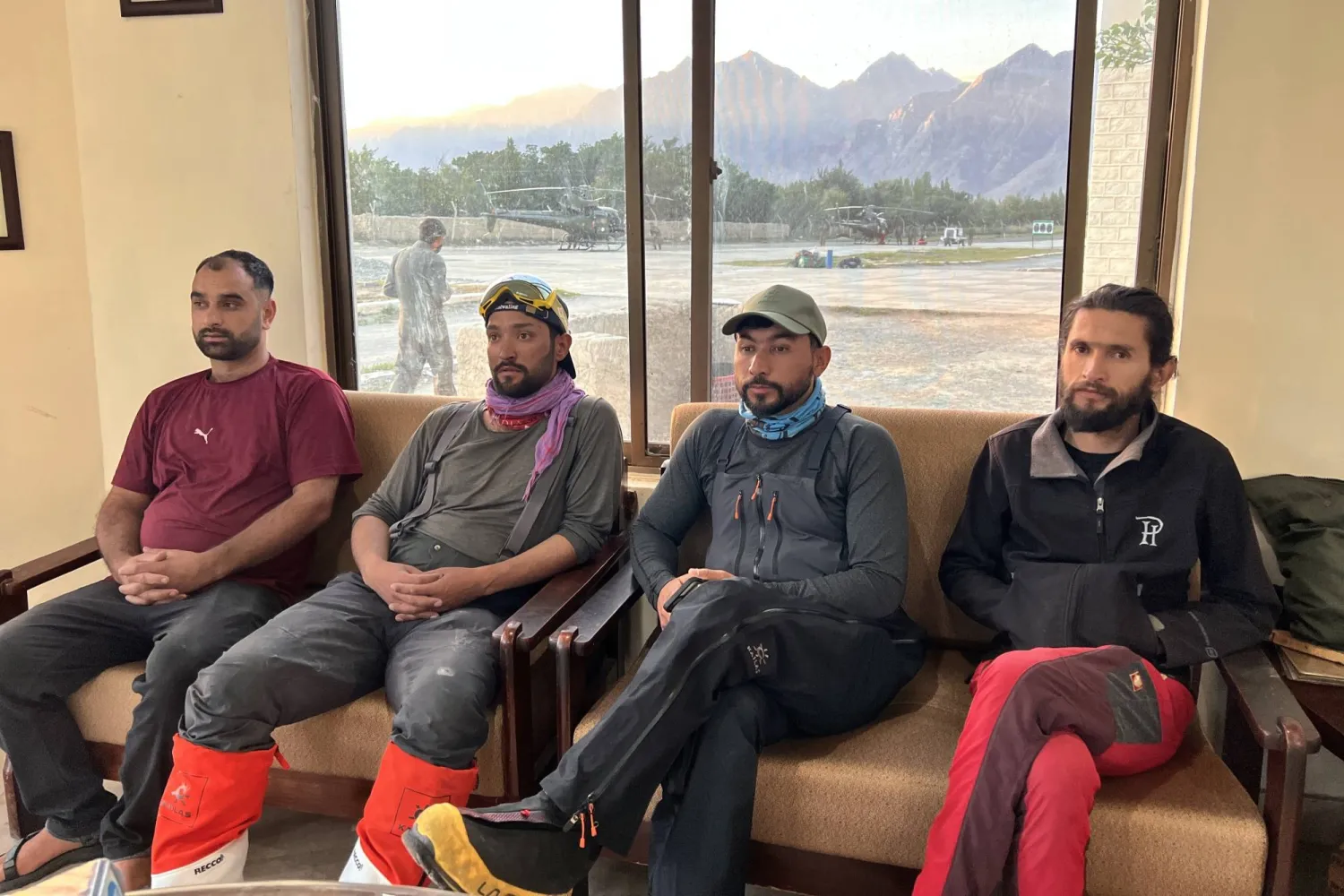
In this photo released by the Alpine Club of Pakistan on Friday, July 31, 2026, members of a mountaineers rescue team prepare to depart from an airbase on a search operation for climbers missing after an avalanche on Pakistan's Broad Peak, in Skardu, in Gilgit-Baltistan's region, in northern Pakistan. (Alpine Club of Pakistan via AP)
TT

Pakistani Rescuers Recover 3 Bodies of 10 Climbers Missing on Broad Peak after Avalanche

In this photo released by the Alpine Club of Pakistan on Friday, July 31, 2026, members of a mountaineers rescue team prepare to depart from an airbase on a search operation for climbers missing after an avalanche on Pakistan's Broad Peak, in Skardu, in Gilgit-Baltistan's region, in northern Pakistan. (Alpine Club of Pakistan via AP)

Rescuers searching for 10 climbers missing after an avalanche on Pakistan's Broad Peak found four bodies and recovered three of them Friday in harsh weather that hampered flights by search and rescue helicopters, officials said.

The regional Gilgt-Baltistan government identified the three recovered bodies as Nepalese climber Pur Bahadur Gurung, Omani climber Nathira Ahmed and American climber Mallory Geis. According to The Associated Press, it said the bodies had been transported to a hospital.

The announcement came hours after officials said search teams had located the remains of four climbers. They did not immediately identify the fourth body that was spotted. The officials spoke on condition of anonymity because they were not authorized to speak to the media.

Bad weather continued to hinder the rescue effort Friday, Gilgit-Baltistan region Chief Minister Amjad Hussain said in a statement.

The climbers lost contact with their base camp after an avalanche struck Broad Peak while they were attempting to scale the mountain, said Karrar Haidri, vice president of the Alpine Club of Pakistan.

“The team has been out of communication since Thursday,” said Haidri, adding that army helicopters were part of the search-and-rescue operation.

The search for the missing climbers continued until Friday evening and would resume Saturday, authorities said.

Broad Peak, at 8,047 meters (26,401 feet), is the world’s 12th-highest mountain. It lies in Pakistan’s Karakoram range, home to five of the world’s 14 peaks above 8,000 meters, attracting climbers from around the globe.

Accidents are common during climbing expeditions in northern Pakistan because of avalanches and rapidly changing weather.

The expedition comprised five Nepali climbers in addition to the Omani and American climbers, Pakistani climber Sohail Sakhi, a Chinese climber identified only as Wang and one other foreign climber, according to the Alpine Club.

China said it was trying to verify whether any of its nationals were among the 10 climbers missing.

“We will provide assistance to Chinese citizens in need and are also willing to offer help in accordance with the needs of the Pakistani side,” Chinese Foreign Ministry spokesperson Mao Ning said Friday in Beijing.

The expedition leader was the renowned mountaineer Nirmal Purja, a Nepal-born former soldier in the British army widely known as Nims Dai. He climbed the world’s 14 highest peaks in a record 189 days in 2019, an achievement featured in the Netflix documentary, “14 Peaks: Nothing is Impossible.” His record was surpassed in 2023.

Moving Mountains, a travel company based in Pakistan, announced late last month that the expedition team was on its way to the small town of Askole and wished them a safe journey climbing Broad Peak.

The expedition was Geis’ first try at an 8,000-meter peak in Pakistan, while it was expected to be the final one for Sakhi, who is a guide for the company, as well as a geographer and high-altitude photographer who has climbed some of the world’s major peaks, according to the Moving Mountains website.

Geis, 39, lived in San Antonio. She announced on social media earlier this year that she was closing her Pilates studio to take “a giant leap of faith into the unknown to see where life goes. I have a sneaking suspicion there will be lots of helmets, harnesses, and crampons involved.”

Kimberly Hardman, a climber based in Alaska, met Geis at a Colorado women’s ice climbing weekend in January and they instantly connected and talked about climbing all over the world.

Geis was relatively new to ice climbing but was a natural athlete with experience mountaineering after climbing in Nepal, according to Hardman, who said Geis respected the mountains and understood the risks of climbing.

She didn’t go into it blindly, Hardman said.

“She was wanting to learn and grow,” Hardman said. “That’s what brought her to her happy place.”



Iran Nominates ‘Aerospace and Missile Official’ For Defense Minister Post

Mehrdad Akhlaghi Ketabchi (Mehr news agency)
TT

Iran Nominates ‘Aerospace and Missile Official’ For Defense Minister Post

Mehrdad Akhlaghi Ketabchi (Mehr news agency)

Iranian President Masoud Pezeshkian has nominated Mehrdad Akhlaghi Ketabchi, a senior official linked to the country’s missile industry, for the position of defense minister, an official said Monday.

Pezeshkian “in a letter, introduced Mehrdad Akhlaghi Ketabchi to Parliament to take up the post of defense minister and armed forces logistics,” Sasan Valizadeh, a presidential advisor, said, as cited by semi-official Mehr News Agency.

The nomination was sent to Parliament, requiring a confidence vote after lawmakers review Akhlaghi Ketabchi’s program.

In Iran, parliamentary approval of nominees for sensitive security positions is generally regarded as a formality, as the nomination and public announcement of a candidate typically indicate that he or she has already secured the Supreme Leader’s approval.

However, Iranian media outlets say the nomination of Akhlaghi Ketabchi has raised questions about how the appointment received approval at the highest levels of Iran’s political establishment, given the Supreme Leader’s continued absence from public view.

The nomination came to fill a post vacant since Defense Minister Aziz Nasirzadeh was killed in US-Israeli strikes in February.

The ministry has been run by acting minister Majid Ebn-e-Reza since March 2. A former deputy defense minister, Ebn-e-Reza has represented Iran domestically and abroad but was not put forward for the permanent role.

A Longtime Defense Official

Akhlaghi Ketabchi is a longtime Defense Ministry official with deep ties to Iran’s missile and aerospace sectors.

The UN Security Council listed him in 2007 as head of the Shahid Bagheri Industrial Group, linked to Iran’s ballistic missile program; his name reappeared on UN sanctions lists when earlier measures were re-imposed in September 2025.

In 2014 he was appointed head of the Aerospace Industries Organization. He was also sanctioned by the US in 2020 over his alleged links to Iran’s arms-related activities, while the UK sanctioned him in 2023 over his alleged involvement in Iran’s nuclear and ballistic missile activities.


Trump Says Nobody Knows Who Is Running Iran

Iranians walk next to a wall painting of late Iranian Supreme Leader Ali Khamenei on a street in Tehran, Iran, 06 October 2026. (EPA)
TT

Trump Says Nobody Knows Who Is Running Iran

Iranians walk next to a wall painting of late Iranian Supreme Leader Ali Khamenei on a street in Tehran, Iran, 06 October 2026. (EPA)

US President Donald Trump said on Tuesday that nobody knew who was running Iran during the US-Israeli war with Iran, now in its eighth month.

"Their leaders are gone, their second group of leaders are gone, and the biggest problem I have is nobody knows who the hell is running the country," ‌Trump said.

Iran's foreign ministry spokesman said on ‌Sunday Washington ⁠knows very well ⁠who their counterpart is in Iran and how the decision-making system in Iran works.

"The problem is actually the opposite: it lies in the contradictory positions and mixed messaging from US officials," Esmaeil Baghaei said in a news conference.

Iran's Supreme ⁠Leader Ali Khamenei was killed ‌on the first day of ‌the US-Israeli war on Iran, which began on February ‌28. His son, Mojtaba Khamenei, succeeded him but ‌has not been seen in public since he was injured in the same strike that killed his father.

Iran responded with its own strikes on Israel and ‌Gulf states. US-Israeli strikes on Iran and Israeli attacks ⁠on ⁠Lebanon have killed thousands and displaced millions.

Fuel prices that have risen in response to the war are also a risk to Trump's Republican Party ahead of the November US midterm elections in which control of Congress is at stake.

Trump, whose approval rating has held at a record low amid concerns of high cost of living spurred by soaring gasoline and diesel prices, has offered shifting timelines and goals for the war.


Vance Says Iran Must Cut Enrichment to End War

US Vice President JD Vance speaks at a campaign rally at Fairbanks International Airport in Fairbanks, Alaska, US, October 5, 2026. (Jacquelyn Martin/Pool via Reuters)
TT

Vance Says Iran Must Cut Enrichment to End War

US Vice President JD Vance speaks at a campaign rally at Fairbanks International Airport in Fairbanks, Alaska, US, October 5, 2026. (Jacquelyn Martin/Pool via Reuters)

US Vice President JD Vance said in an exclusive interview with Reuters that Iran must make a “meaningful” reduction in its nuclear enrichment capacity to satisfy US demands and end the countries’ seven-month war, even as Washington was unsure how Tehran makes decisions in negotiations.

Vance, a longtime skeptic of US involvement in foreign wars, has taken a leading role in negotiating a settlement to the conflict and brokered a provisional peace agreement in September that quickly fell apart. The war has jolted global energy markets and become a political liability for President Donald Trump and fellow Republicans ahead of November midterm elections.

Speaking on Monday after a campaign trip in Alaska, Vance said any agreement would require Iran to reduce its nuclear enrichment capacity, rather than offer assurances of future nuclear drawdowns.

"If you don't want a nuclear weapon, then why do you need 60% enriched ‌fuel? And if ‌you want to show commitment to not building a nuclear weapon, don't build highly ‌enriched ⁠fuel. That's a very ⁠basic threshold issue," Vance said.

"I think if they want to show a commitment to not building a nuclear weapon, they would do something meaningful on their enrichment capacity."

Iran and the US have exchanged proposals in recent weeks aimed at ending the war and reopening the Strait of Hormuz, a vital global energy shipping route. Trump rejected Tehran's latest offer and has warned that military operations could intensify after the midterms.

Vance said the US remained open to an agreement but would require concrete Iranian nuclear concessions.

"We're not going to trade words for actions," Vance said.

UNCLEAR HOW IRAN MAKES DECISIONS, SAYS VANCE

Complicating matters, Vance said Washington is uncertain ⁠who makes decisions in Tehran.

Vance said the US was in talks with Iranian President ‌Masoud Pezeshkian and Foreign Minister Abbas Araghchi. But it was unclear how much authority ‌they wield within Iran's power structure, he said, after joint US-Israeli strikes at the start of the war killed Supreme Leader ‌Ali Khamenei.

"One of the things we picked up on is it's not totally clear how their country makes decisions," ‌Vance said. Separately, Trump said on Tuesday his "biggest problem" is no one knows who is running Iran.

Iran's Foreign Ministry spokesperson said on Sunday that US officials are well aware of who their Iranian counterparts are and how Iran's decision-making system works.

"The problem is actually the opposite: it lies in the contradictory positions and mixed messaging from US officials," Esmaeil Baghaei told a weekly press conference.

Vance told Reuters he ‌has held personal conversations with field commanders to gauge battlefield conditions. He dismissed concerns over critical munitions shortages and added that while Iranian troops are periodically able to strike ⁠commercial ships in the Strait ⁠of Hormuz, they are largely unable to prevent energy exports through the waterway.

The war — and its $3 billion monthly price tag — has become a key issue on the campaign trail. Higher energy prices have put Trump and Republicans on the defensive in competitive states that will decide control of Congress.

Vance has sought to temper criticism of Trump’s handling of the conflict, telling voters they should not let that issue keep them from backing Republicans in next month's elections.

In Alaska, Vance rallied for Republican Senator Dan Sullivan, who is locked in a tight reelection battle with Democratic challenger Mary Peltola. Trump carried Alaska by 13 percentage points in 2024, but rising everyday costs have put the state in play.

Before speaking with Reuters, Vance focused much of his speech on affordability concerns, especially around energy. Alaska's remote locale makes consumer goods more expensive, and energy production is a key industry.

Rally attendees roared when Sullivan nearly introduced Vance as the president of the US, rather than the vice president. Vance is seen as a leading Republican contender to succeed Trump in the White House.

Vance told Reuters afterward that he had not decided whether to seek the presidency in 2028.

"I'm inherently a procrastinator," he said. "I really haven't thought about it much."