

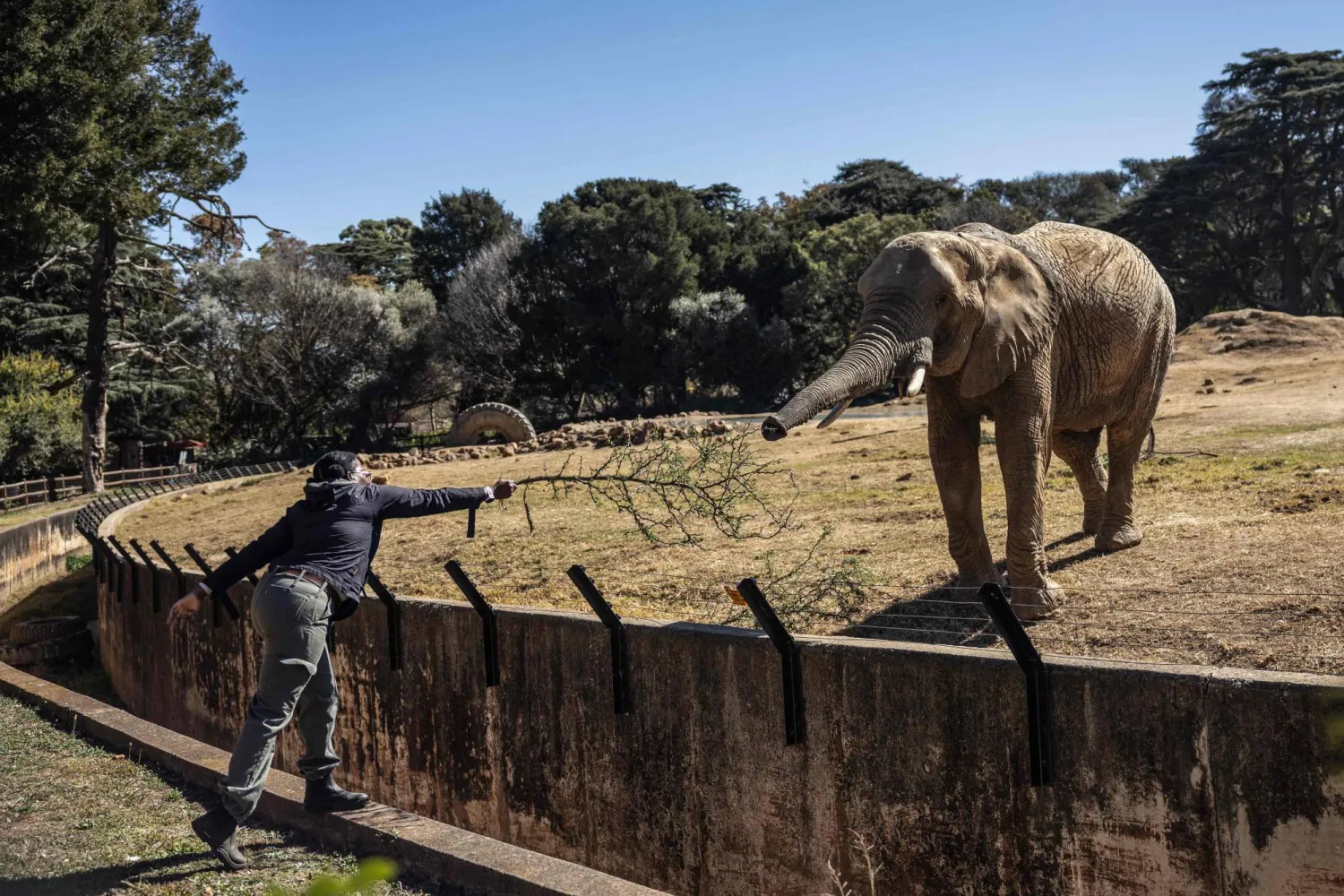

The Last Trio: S.Africa's Zoo Elephants Await their Fate

Pinky Modina, Pachydermist at the Johannesburg Zoo, feeds Ramadiba one of the three remaining elephants in Johannesburg on July 24, 2026. (Photo by Phill MAGAKOE / AFP)
TT

The Last Trio: S.Africa's Zoo Elephants Await their Fate

Pinky Modina, Pachydermist at the Johannesburg Zoo, feeds Ramadiba one of the three remaining elephants in Johannesburg on July 24, 2026. (Photo by Phill MAGAKOE / AFP)

The last three elephants still in a traditional South African zoo entered their enclosure in single file, fruit and vegetables scattered on the ground to encourage natural foraging.

For visitors to the popular Johannesburg Zoo, it was a chance to see Africa's largest land animal in real life.

But for animal welfare campaigners, it is a scene of cruelty that they have petitioned the courts to end by ordering the trio's release into a rewilding sanctuary.

In a case supported by international elephant experts, the campaigners told a court in May that observation showed that Lammie, aged 47, Ramadiba, 28, and Mopane, 26, were distressed and depressed.

"These elephants are highly intelligent, socially complex and sentient beings who are living in conditions that are damaging to their well-being, and who are, as a result, in a state of distress," said the three parties behind the case.

The court should "authorize their immediate release to a suitable sanctuary... where they can rehabilitate", they argued.

Judgment is expected in the coming weeks, said Megan Carr, senior researcher at the EMS Foundation that is part of the application.

Carr told AFP the three elephants were the only ones remaining in an urban zoo environment on the entire continent.

"They are the last three elephants showcased within an exhibition in a traditional zoo-type setting in South Africa and Africa," she said.

The legal bid for their freedom follows campaigners' success in having a 42-year-old elephant released from the national zoo in Pretoria and into a private reserve in 2024, after years of negotiation with the South African government.

The animal had spent 40 years at the facility.

When an AFP team visited Johannesburg Zoo, a group of small children pressed towards a viewing area shouting, "Elephant! Elephant!" as the three animals shuffled around their enclosure.

Lammie, focused only on the food, was born at the zoo, one of a handful in South Africa and among a plethora of state-run and private animal sanctuaries or game reserves. Ramadiba and Mopane arrived in 2019.

The trio are well cared for and had recently been given a clean bill of health, said Johannesburg city parks spokeswoman Jenny Moodley.

The facility could accommodate up to five elephants, and two keepers were dedicated to each animal, with food hidden around the enclosure to encourage foraging and walking, said an official not authorized to speak to the media.

Johannesburg City Parks and Zoo does not want the trio freed, saying they are suited to captive life, especially Lammie, who has never lived elsewhere.

Should they be relocated, the zoo would not be able to offer important research and education possibilities to the public, managing director Thanduxolo Mendrew said in papers for the court case, which was launched after negotiations failed.

Having the animals among the zoo's offerings allowed school children, especially from poorer backgrounds, to see them live, he said.

Carr responded: "Why would you show your child a compromised elephant when it is much easier for them to look at elephants on a video or a TV program?"

"They need a vast amount of space in order to remain healthy and fit, and no enclosure is able to offer that to an elephant."

The elephants share two holding bomas or enclosures at night, each measuring 160 square meters (1,700 square feet), smaller than an average tennis court, according to campaigners.

During the day, they are allowed to roam in an unshaded enclosure several times larger, around the size of a football pitch.

South Africa is home to about 44,000 African savannah elephants, about 6,000 owned privately or by communities, the government said in August last year.



New NASA Telescope to Probe Dark Energy, Dark Matter and Exoplanets

NASA's Nancy Grace Roman Space Telescope stands after engineers and technicians working inside the Payload Hazardous Servicing Facility mated the observatory to its payload adapter and a strut payload attach fitting, a specialized piece of hardware designed for large, heavy loads at NASA's Kennedy Space Center in Cape, Canaveral, Florida, US August 7, 2026 NASA/Jolearra Tshiteya via REUTERS
TT

New NASA Telescope to Probe Dark Energy, Dark Matter and Exoplanets

NASA's Nancy Grace Roman Space Telescope stands after engineers and technicians working inside the Payload Hazardous Servicing Facility mated the observatory to its payload adapter and a strut payload attach fitting, a specialized piece of hardware designed for large, heavy loads at NASA's Kennedy Space Center in Cape, Canaveral, Florida, US August 7, 2026 NASA/Jolearra Tshiteya via REUTERS

NASA is preparing to launch its next flagship space observatory, one that scientists plan to use to investigate some of the universe's biggest mysteries including dark energy and dark matter, while also testing gravity at vast scales and hunting for planets beyond our solar system.

The launch of the Nancy Grace Roman Space Telescope, a roughly $4 billion project, is planned for Sunday at NASA's Kennedy Space Center in Florida, with the observatory to be lofted into orbit aboard a SpaceX Falcon Heavy rocket. The launch comes nine months ahead of schedule, according to US space agency officials.

Roman is a follow-on to the Hubble Space Telescope, launched in 1990, and the James Webb Space Telescope, launched in 2021, and has capabilities that can expand on the knowledge gained by those pioneering observatories, both of which continue to operate.

The new telescope's panoramic view of space and its rapid survey speeds offer the opportunity for scientists to study the cosmos as never before, with wide-field surveys examining its structure, composition and evolution.

"Roman's vast reach will allow us to find the weird, the rare and the unusual," Julie McEnery, Roman's senior project scientist ⁠at NASA's Goddard ⁠Space Flight Center in Maryland, told reporters.

"Roman's primary instrument combines exquisite performance and sensitivity with the ability to quickly and efficiently survey the large regions of the sky," Reuters quoted McEnery as saying.

The telescope's main survey will take more than a year, McEnery said.

"The survey will contain over two billion galaxies and enable us to study how the structures in our universe — the stars, the galaxies, the clusters of galaxies — grew and evolved. We'll also measure how our universe has expanded over time. And these are the keys that will allow us to unlock the fundamental nature of dark matter and dark energy and the fabric of the universe itself," McEnery said.

The Big Bang event roughly 13.8 billion years ago initiated the universe, and ⁠it has been expanding ever since. Scientists in 1998 disclosed that this expansion was actually accelerating, with an invisible force called dark energy as the hypothesized reason.

The universe's contents include ordinary matter — stars, planets, gas, dust and all the familiar stuff on Earth — as well as dark matter and dark energy, whose physical nature remains unknown. Ordinary matter represents perhaps 5% of the contents. Dark matter, known through its gravitational influences on galaxies and stars, may represent about 27%. Dark energy may represent about 68%.

"The key questions are: Is dark energy simply a property of empty space that remains constant over time, or does it evolve in time?" cosmologist Mustapha Ishak of the University of Texas at Dallas, a member of Roman's scientific collaboration, told Reuters.

"The recent results from the DESI — Dark Energy Spectroscopic Instrument — collaboration indicate tantalizing hints of a time evolution of dark energy.

Could the observed acceleration instead indicate that our theory of gravity needs modification on the largest scales? Answering these questions is one of the most important goals of modern cosmology," Ishak said.

Physicist Albert Einstein in 1915 presented his theory of general ⁠relativity explaining gravity, and it ⁠remains foundational.

Roman will map how galaxies cluster and how matter bends light through a phenomenon called gravitational lensing.

"These measurements allow us to test whether Einstein's theory remains valid across billions of light-years or whether modifications to gravity (theory) are required," said Ishak. "This is important because it addresses one of the most fundamental questions in physics: What law governs the universe on its largest scales?"

To date, more than 6,350 exoplanets — planets outside our solar system — have been discovered, as scientists search for evidence of potential life beyond Earth.

Roman will conduct one of the most comprehensive searches ever for exoplanets. It is expected to discover thousands of new ones and provide the first statistical census of planetary systems similar to our own. It also will demonstrate new technology to directly image some relatively nearby exoplanets.

After launch and separation from the rocket, the telescope will travel toward a location called Lagrange Point 2, situated about a million miles (1.6 million km) from Earth, about four times the distance to the moon. Webb also resides at this orbital location. Hubble is in low-Earth orbit.

Roman's mission is planned for five years, though NASA said the telescope may have enough fuel for five additional years. US President Donald Trump's administration tried during both his first and second terms to reduce or eliminate funding for Roman, but Congress preserved it.

The telescope is named after Nancy Grace Roman, NASA's first chief astronomer. Roman died in 2018 at age 93.


Nepal PM Allowed to Wear Signature Sunglasses in Parliament

Newly appointed Prime Minister Balendra Shah, popularly known as "Balen," looks on during his oath ceremony at "Shital Niwas," presidential building in Kathmandu, Nepal, March 27, 2026. REUTERS/Navesh Chitrakar/File Photo
TT

Nepal PM Allowed to Wear Signature Sunglasses in Parliament

Newly appointed Prime Minister Balendra Shah, popularly known as "Balen," looks on during his oath ceremony at "Shital Niwas," presidential building in Kathmandu, Nepal, March 27, 2026. REUTERS/Navesh Chitrakar/File Photo

Nepal's Prime Minister Balendra Shah may keep his signature dark sunglasses on in the legislature due to medical reasons, an official said Tuesday, after the parliament speaker had advised against it.

The rapper-turned-politician better known as "Balen" has rarely been seen in public without his trademark rectangular shades.

The 36-year-old premier has been seen wearing them everywhere from campaign rallies to official engagements and even in his formal portrait after taking office in March.

Earlier this month, Speaker Dol Prasad Aryal advised against wearing dark glasses in the chamber, citing criticism by the public that such eyewear is out of place in the national legislature.

But Shah appears to have won an exemption.

"A report has been submitted to the secretariat pointing to medical reasons for the respected prime minister to need sunglasses," the parliament secretariat's deputy spokesman Ananta Prasad Koirala told AFP.

Koirala said Shah would be allowed to wear the glasses in parliament if they were medically necessary in bright light.

Shah, who has kept a low profile since taking office, is expected to appear for a parliament session on Wednesday.

The dark glasses, often paired with an all-black outfit, have become a defining feature of Shah's public persona since his successful campaign to become the mayor of Kathmandu in 2022.

Their popularity has surged, with shops selling lookalike eyewear as "Balen sunglasses" to customers keen to emulate Shah's style.


Indonesians Brave Choking Smoke to Pray for Rain as Country Battles Wildfires

Firetrucks parked near a wildfire burning through a peatland field in Sampit, Central Kalimantan, Indonesia, Monday, Aug. 24, 2026. (AP Photo/Andri Rizky Agustian)
TT

Indonesians Brave Choking Smoke to Pray for Rain as Country Battles Wildfires

Firetrucks parked near a wildfire burning through a peatland field in Sampit, Central Kalimantan, Indonesia, Monday, Aug. 24, 2026. (AP Photo/Andri Rizky Agustian)

Authorities in Indonesia’s South Sumatra province turned to spiritual measures on Tuesday as huge blazes in central and western regions scorched wide areas of forests and peatland, creating a choking haze that blanketed some cities in the world’s most populous Muslim-majority country.

The prayer gathering in one of the regions hardest hit by this year’s wildfire season comes as the province faces prolonged dry weather that has heightened the risk of forest and peatland fires.

The latest satellite data from the Environment Ministry showed West Kalimantan recorded the highest number of hot spots with 3,120, followed by Central Kalimantan on 2,314 and South Sumatra at 1,500. Forestry Ministry data showed that nearly 940 square kilometers (363 square miles) were burned in July alone, including over 20 square kilometers (8 square miles) in South Sumatra province.

About 3,000 residents gathered in Palembang, the capital of South Sumatra province, to take part in a special Islamic prayer for rain, known as “salat istisqa.” They prayed shoulder to shoulder in the courtyard of the governor’s office as thick smoke shrouded roads, buildings and public facilities, reducing visibility and forcing motorists to drive with their headlights on during the day.

“We have done everything we can and worked closely with all relevant parties,” The Associated Press quoted Gov. Herman Deru as saying before the prayer. “As people of faith, we are also praying to God to send rain so that life can return to normal.”

He also said the public prayer would complement ongoing firefighting and drought-mitigation measures and serve as a moment for residents to unite in confronting the environmental challenges facing the province.

A woman prays during a prayer requesting for rain following wildfires that burn through peatlands in several regions in Sumatra and Kalimantan Island, in Palembang, South Sumatra, Indonesia, Tuesday, Aug. 25, 2026. (AP Photo/Muhammad Fajri)

Emergency services have been battling wildfires driven by an intensifying El Nino pattern and a prolonged dry season, generating dense smoke that crossed into Malaysia and Brunei, according to the National Disaster Management Agency.

Indonesia is intensifying weather-modification operations to help more than 24,000 firefighters, who were deployed on Sumatra and Borneo islands to combat wildfires, by inducing rainfall through the dispersal of salt particles into suitable clouds, with 30 aircraft for cloud-seeding and water-bombing operations over Kalimantan, and another 22 helicopters covering Sumatra.

As fires continued to spread, the Forestry Ministry announced Tuesday it had sanctioned six forestry concession holders after finding that more than 15 square kilometers (5.8 square miles) of forest and land had burned within areas under their management in West, Central and East Kalimantan provinces on Borneo island.

Five companies were ordered to strengthen fire-control measures and rehabilitate burned land, while a sixth company had its permit suspended because fires on its concession were widespread and recurrent.

Forestry law enforcement director general Dwi Januanto Nugroho said the authorities could pursue criminal charges if investigations uncover evidence that companies or individuals deliberately caused fires or failed to meet their obligations to prevent them.

Indonesian police have arrested 72 people suspected of starting some of the forest and peatland fires.

Plantation owners and traditional farmers often start fires to clear land for farming at low cost, triggering hazardous haze that reduces visibility, disrupts land and air transportation and threatens public health.

Fires are a regular problem during the dry season in Indonesia, the vast archipelago of more than 17,000 islands, and the haze they generate has periodically drawn diplomatic complaints from neighboring countries in Southeast Asia.