

Japan’s Ambassador to Yemen Yoichi Nakashima affirmed that Tokyo stands with Saudi Arabia in confronting threats to Red Sea security, freedom of navigation, and international trade, describing attacks on commercial vessels as “unacceptable.”
In an interview with Asharq Al-Awsat, Nakashima revealed that Japan is considering joining the Saudi-led Red Sea security initiative, with consultations still underway within the Japanese government.
He added that Tokyo continues to engage regional actors, including Iran, whose government was urged by Japan’s foreign minister to deliver a clear message to the Houthis to avoid further escalation.
The ambassador also announced the imminent inauguration of a project to rehabilitate the Port of Aden’s facilities, enhancing its capacity to service vessels and handle cargo.
Red Sea security is a top priority for Japanese policymakers because of the country’s reliance on overseas trade and energy supplies from the Middle East, he stressed.
Nakashima attributed the relative stability he observed during his recent visit to Aden, along with the Yemeni government’s focus on implementing priority policies, to “substantial Saudi support.”
He hoped that the government would manage the current phase effectively and establish a sustainable path toward stability and development.
‘Deep concern’ in Tokyo
Nakashima described developments in the Red Sea as “a pressing issue,” noting that the Middle East’s location between Asia, Europe, and the United States makes it a vital route for global trade and a key source of energy.
“These developments are a matter of deep concern for Japan. Attacks on commercial vessels and the imposition of a maritime blockade on Saudi Arabia are unacceptable,” he said, stressing that such actions run counter to the principles Japan upholds, foremost among them freedom of navigation and the rule of law.
“Japan depends heavily on international trade. That is why it places special importance on maritime security in both the Indo-Pacific and the Red Sea,” he added, emphasizing the need to stand alongside Saudi Arabia in confronting current threats.
Saudi initiative
Regarding the Saudi initiative to establish an international coalition in the Red Sea, Nakashima said Japan is familiar with and respects the proposal, while the nature of its participation remains under consideration.
“It is still too early to determine how Japan might participate, but the matter is under discussion within our government,” he remarked.
He stressed that addressing the root causes of regional tensions requires a comprehensive political settlement to Yemen’s conflict in line with UN Security Council resolutions, particularly Resolution 2216, and continued support for the UN special envoy’s efforts.
Tokyo also remains engaged with regional actors, including Iran, he underlined, noting that Japan’s foreign minister urged his Iranian counterpart to exercise maximum restraint and convey a clear message to the Houthis to avoid further escalation.
Nakashima added that Japan does not communicate directly with the Houthis except in exceptional circumstances, such as after the hijacking of the Galaxy Leader in late 2023.
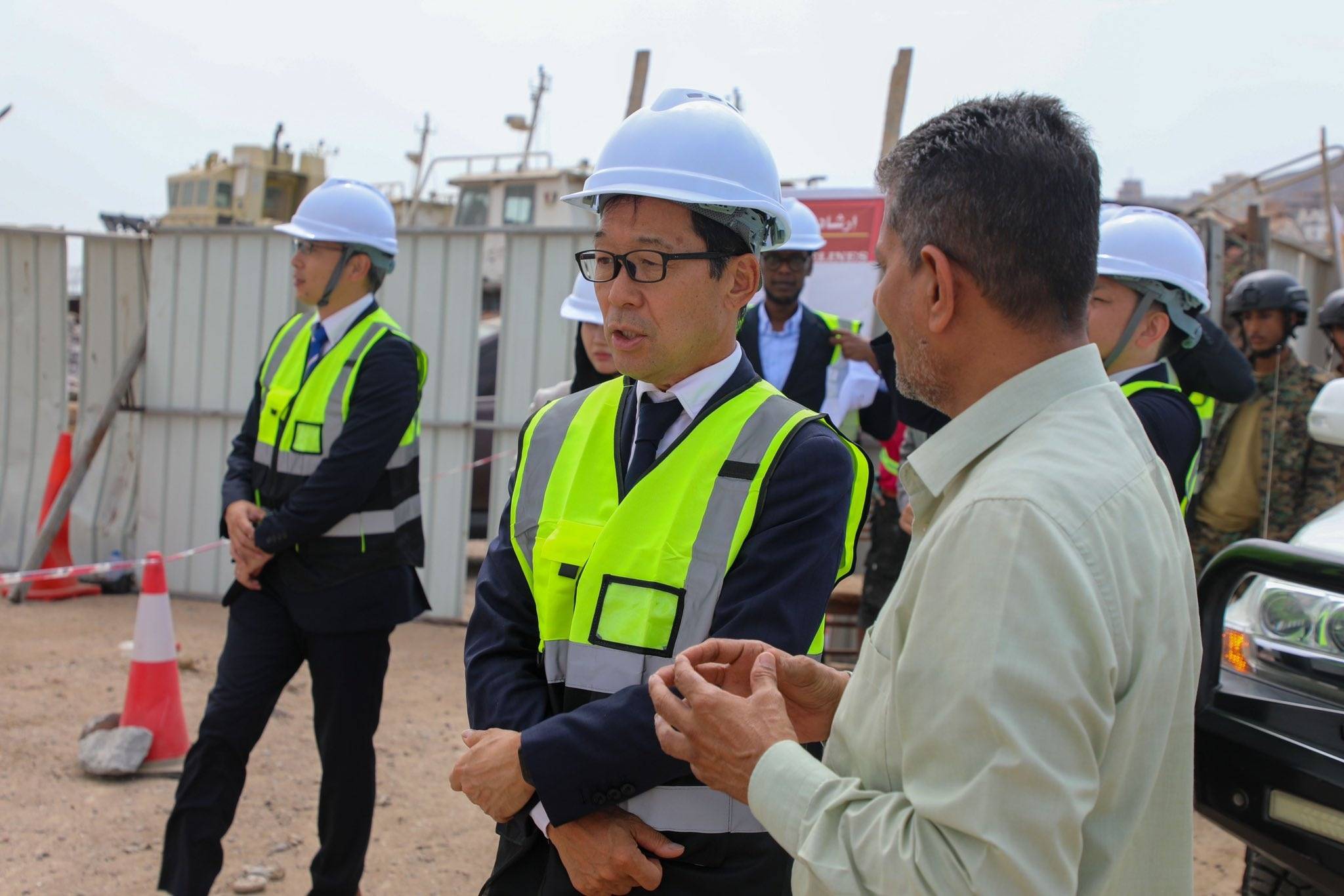
Rehabilitating the Port of Aden
The ambassador revealed that a Japanese project to rehabilitate the Port of Aden is nearing completion. It includes facilities for ship maintenance, warehouses, and infrastructure for cargo handling and ship-to-ship transfers.
The project is in its final stages and is expected to be inaugurated soon as part of broader efforts to strengthen infrastructure and boost economic activity and logistics services in Yemen’s interim capital.
Nakashima noted that no Japanese companies currently operate directly in Yemen, although several Japanese firms are represented by local agents, particularly in the automotive sector.
It is still premature to discuss the return of the Japan International Cooperation Agency (JICA) because of current conditions, he revealed.
From relief to development
Nakashima said the clearest message he received during meetings with Yemeni officials in Aden and Riyadh was the need to gradually shift from humanitarian assistance to development support.
He added that Japan and the broader international community had taken note of that message and would study how best to align future assistance with the Yemeni government’s development plan, expected to be launched early next year.
He highlighted several ongoing Japanese initiatives, including $5.2 million to support displaced people and host communities in Marib, $4.7 million for the customs sector, and nearly $3 million to rehabilitate technical education and vocational training centers.
He also noted that five vocational and technical training centers in Aden, Taiz, and Lahj have been equipped to receive students, including one in Aden’s Al-Mualla district that he visited during his trip.
‘Substantial’ Saudi support
Nakashima said the relative stability he witnessed in Aden and the government’s focus on implementing priority policies were made possible by “substantial Saudi support.”
He described Saudi Arabia as an influential voice in the international community, playing a pivotal role in coordinating efforts between the Yemeni government and donor countries while implementing humanitarian, development, and infrastructure projects.
Aden and government cohesion
Reflecting on his recent visit to Aden, Nakashima said the effects of war and regional developments were evident throughout the city, particularly in the deterioration of electricity and other basic services after more than a decade of conflict.
At the same time, he observed greater cohesion within the government, a growing presence of technocrats in key positions, and a stronger determination among officials to advance priority policies.
Nakashima noted that Yemen is at a critical juncture and that regional developments should not distract from improving public services and implementing agreed reforms.
He hoped that the government would lead the country through this phase effectively while laying the foundations for lasting stability and sustainable development.