
Gazans Bury Nearly a Whole Clan Found in Rubble in Mass Funeral for 112

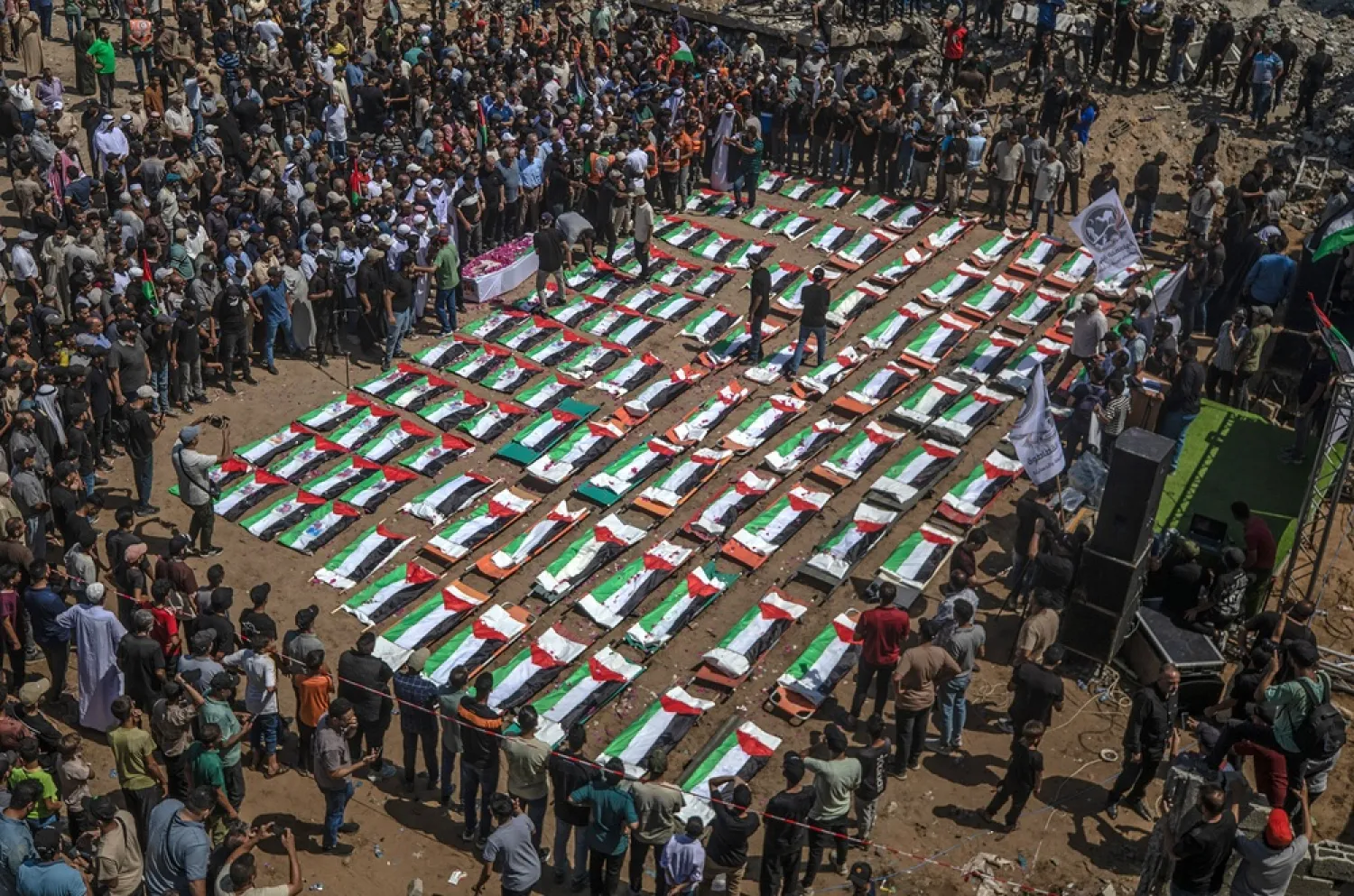
Palestinians gather during a mass funeral for 112 members of the Abu Sharia and Al-Hassayna families in the eastern Gaza City, 04 August 2026. (EPA)
TT

Gazans Bury Nearly a Whole Clan Found in Rubble in Mass Funeral for 112

Palestinians gather during a mass funeral for 112 members of the Abu Sharia and Al-Hassayna families in the eastern Gaza City, 04 August 2026. (EPA)

The decomposed remains of 112 bodies lay on stretchers shrouded ‌in flags in the sun's heat: all that could be found of the Al-Hassaynas of Sabra, a Palestinian clan of proud Bedouin stock all but wiped out by Israel nearly three years ago. 

According to Palestinian authorities, 308 members of the extended Al-Hassayna family, also known as the Abu Sharia, were killed on November 22, 2023, when Israeli airstrikes brought down a cluster of apartment buildings as residents slept in Sabra, one of the old neighborhoods of Gaza City. 

Around half of the dead were previously recovered and buried, but 153 bodies had remained under the rubble until now. 

Nearly three years later, a recovery team of 40 workers spent 17 days painstakingly combing the wreckage, and brought out remains identified as belonging to 112 of those missing victims. 

A cluster of neighbors and surviving members of the clan gathered on Tuesday on a flattened lot of demolished ruins, where the remains were laid out for what Palestinian authorities described as the largest mass funeral of the Gaza war. 

Men lifted the stretchers and carried them through the streets. A sign was adorned with portraits of the dead — men, women and children. 

"This day is mixed with grief, and it has reopened our wounds three years after this massacre," said ‌Taysir Al-Hassayna, a surviving member ‌of the clan. 

"It has brought sorrow back to our children and women. But our consolation is ‌that ⁠we believe they ⁠are martyrs with God." 

Reuters was unable to locate an Israeli military statement from November 2023 giving Israel's account of the strike, which took place in the early weeks of the war launched after Hamas-led fighters stormed out of Gaza killing 1,200 Israelis. The military did not immediately respond to a request for comment on its account of the incident. 

According to Palestinian health authorities, more than 73,000 Palestinians are confirmed to have died in the Israeli war in Gaza. Most of the deaths were documented when bodies were brought to morgues and buried, but around 8,000 more are believed to lie beneath the rubble. 

'THEY ARE PIECES OF ME' 

Omar Al-Hassayna, 65, a survivor of the Sabra bombing who escaped Gaza for Egypt days after the strike, wept as he watched footage from Tuesday's ⁠funeral of his kin on satellite TV in Cairo. 

His wife was killed in the bombing, along with ‌four of his adult sons, Abdallah, Abdel-Rahman, Ahmed and Osama. So were his four grandchildren: two ‌little boys and two little girls, the oldest just 4, the youngest only a few months old. 

"They are pieces of me. I have thought about ‌them every single day. I have seen them in my thoughts and in my dreams," he said. 

"The funeral today is the least that ‌could be done for those martyrs. It is time for those bodies, those little bodies, to rest in peace, and for their souls to hover in the skies around us." 

Most of the population of Gaza are descendants of refugees who arrived from territory now located in Israel, so it was common for entire extended families to settle together in clusters of residential buildings. But this meant that one Israeli airstrike could effectively wipe out an entire clan. 

The Hassaynas, who lived in the Sabra ‌neighborhood for decades, were a branch of a prominent clan known throughout the enclave for their generosity and humility. 

Omar said the Israeli strikes hit three residential buildings where members of the extended family had ⁠gathered for shelter, seeking safety in ⁠one place as the early days of the war unfolded. 

Two of the buildings were completely destroyed, killing almost everyone inside. He was in the third, which was only partially destroyed, and survived with minor injuries from flying debris. Two daughters and a son of his also survived. 

RECOVERY ONLY POSSIBLE OUTSIDE ISRAELI CONTROL 

An October ceasefire that ended major fighting left Israeli forces in control of over half of Gaza, since expanded to around two-thirds. There, they have bulldozed remaining buildings and ordered people out. 

The recovery of bodies can only take place in the remaining third of the territory, where nearly all of Gaza's more than two million people now live, mostly displaced in makeshift tents or shelters in the damaged buildings. 

Mahmoud Basal, spokesperson for Gaza's Civil Defense, said identifying the remains of the Al-Hassaynas required a mixture of forensic evidence and memories gathered from survivors. 

"The bodies were decomposed. Relatives identified some through their clothes, injuries and distinguishing marks. Some victims had bone fixation plates on some organs, while some women were identified through jewellery they had on or necklaces bearing their names," Basal said. 

With this recovery operation now over, the team would move on to other accessible areas of Gaza. 

"If we had at least 10 excavators, bulldozers, excavators, and cranes needed for the work, the job could be completed in three months," he told Reuters. 

When Tuesday's funeral procession reached a vast graveyard amid the ruins of Gaza, men passed the small shrouded bodies over their shoulders and laid the Hassayna clan to rest in fresh graves. 


2 Killed Near Israeli-Occupied Zone in South Lebanon

A Lebanese flag placed on a damaged olive tree in the southern Lebanese village of Zawtar al-Gharbiyeh, near the neighboring village of Zawtar al-Sharqiyeh, where Israeli forces are stationed, in southern Lebanon, 10 October 2026. (EPA)
TT

2 Killed Near Israeli-Occupied Zone in South Lebanon

A Lebanese flag placed on a damaged olive tree in the southern Lebanese village of Zawtar al-Gharbiyeh, near the neighboring village of Zawtar al-Sharqiyeh, where Israeli forces are stationed, in southern Lebanon, 10 October 2026. (EPA)

Two men were killed in south Lebanon on Sunday, one by Israeli fire and the other by an explosive remnant of war, as they took part in the annual olive harvest, according to state media and local officials.

South Lebanon has been the scene of two wars since 2023 between Israel and Iran-backed Hezbollah, and Israeli troops still occupy a band of territory 10 kilometers (six miles) wide running along the border.

The official National News Agency (NNA) said one of the men was killed in Yater, in Bint Jbeil district, when Israeli "shelling targeted the outskirts of the town while he was inspecting his land and olive harvest".

The Lebanese army blamed Israeli tank fire and called the ongoing attacks "a flagrant breach of existing agreements".

Afterwards, the Yater municipality urged residents "to avoid the outskirts of the town and refrain from crossing the earthen barrier separating some unsafe neighborhoods" for fear of Israeli attacks.

In the village of Froun, in the same district, the NNA reported that "a foreign object" left over from previous Israeli operations exploded and killed an engineer as he and others tended their trees.

The engineer had come down from Beirut, where he lives, for the harvest, Froun mayor Hassan Bazzi told AFP.

The incident prompted local residents to call off the harvest and wait for "the Lebanese army to complete the decontamination of the village", Bazzi said.

Since a framework agreement between Lebanon and Israel was struck in June, the violence in the south has diminished but not stopped.

Israel continues to carry out sporadic strikes and demolitions in and around the territory it occupies, while Hezbollah refuses to submit to government plans to disarm it.

About eight kilometers (five miles) away, in Jibshit, volunteers from the north came to help locals with the harvest in a show of solidarity.

"From north to south, one people and one land," said organizer Ahmad Chahhal.

As workers swatted at branches to make the olives fall, an AFP photographer saw drones and heard fighter jets overhead, and explosions could be heard in the distance.

Hezbollah drew Lebanon into the Middle East war in early March by launching attacks against Israel in support of its backer Iran. Israel responded with an intense bombing campaign and a ground invasion.

The framework deal between Lebanon and Israel involves Hezbollah's disarmament, a gradual Israeli withdrawal and the deployment of the Lebanese army to the region.


Saddam Haftar Assures Shaibani of General Command’s Readiness to Support Syrian People

General Saddam Haftar, deputy commander-in-chief of the Libyan National Army, and Syrian Foreign Minister Asaad al-Shaibani in Benghazi. (LNA General Command)
TT

Saddam Haftar Assures Shaibani of General Command’s Readiness to Support Syrian People

General Saddam Haftar, deputy commander-in-chief of the Libyan National Army, and Syrian Foreign Minister Asaad al-Shaibani in Benghazi. (LNA General Command)

General Saddam Haftar, deputy commander-in-chief of the Libyan National Army, discussed with Syrian Foreign Minister Asaad al-Shaibani several issues of common interest during the minister’s first visit to Benghazi.

They also underlined the depth of the fraternal and historical relations uniting the Libyan and Syrian people.

Libya and Syria restored diplomatic ties after nearly 14 years after Shaibani visited Tripoli in August. Talks discussions aimed to strengthen bilateral relations and expand joint cooperation between the two countries, culminating in the reopening of the Syrian embassy in Libya.

The LNA General Command said on Sunday that Saddam praised the role of the Syrian leadership "in achieving security and stability in Syria, overcoming the challenges faced during the transition phase, and working to restore normalcy and open up to the international community."

He underscored the General Command's support for the Syrian leadership, and “its readiness to provide everything within its power to support the brotherly Syrian people to help Syria regain its position in the Arab and international arenas.”

For his part, Shaibani expressed the Syrian leadership's keenness to support everything that would achieve permanent stability in Libya.


139 Migrants, Including Children, Die After Boat Capsizes off Djibouti

 A portion of the vessel floats after it capsized while carrying about 305 people from Djibouti to Yemen. (Kennedy Omondi Okoth/International Organization for Migration/Handout via Reuters)
A portion of the vessel floats after it capsized while carrying about 305 people from Djibouti to Yemen. (Kennedy Omondi Okoth/International Organization for Migration/Handout via Reuters)
TT

139 Migrants, Including Children, Die After Boat Capsizes off Djibouti

 A portion of the vessel floats after it capsized while carrying about 305 people from Djibouti to Yemen. (Kennedy Omondi Okoth/International Organization for Migration/Handout via Reuters)
A portion of the vessel floats after it capsized while carrying about 305 people from Djibouti to Yemen. (Kennedy Omondi Okoth/International Organization for Migration/Handout via Reuters)

At least 139 people, including children, have died after a boat carrying more than 300 migrants capsized off the coast of Djibouti in east Africa, the International Organization for Migration said Sunday.

That number only includes those buried by authorities in Djibouti. Others have been buried by the migrants themselves, but they won't be added to the official count until authorities can verify the bodies, Alexandre Coissac, IOM Chief of Mission in Djibouti, told the AP via the phone.

“What is terrible is that they were buried with no names, in a common grave, like in a war situation,” Coissac said. “They all have a mother, a father, and we may never learn what happened.”

Coissac said the migrants boarded the ship in the evening of Oct. 8 and that it sank very soon after, close to the shore, “mainly because it was overcrowded.”

“The local authorities did their best,” Coissac said, “but they were overwhelmed with all the bodies that kept coming at once towards the shore.”

He said authorities were bringing the surviving migrants to the IOM rescue center in Obock where they received medical assistance after swallowing sea water, and psychological support.

“They're all in a state of shock,” Coissac, who visited the area of the shipwreck Saturday, said. “I tried to talk to some of them but it's very difficult.”

Some of the migrants in the IOM center are already aware that their family members died during the shipwreck. Others were given access to phones to call loved ones back home to notify them they are alive.

At least 84 people remained missing in one of the deadliest shipwrecks yet on the popular but perilous crossing from the Horn of Africa to the Arabian Peninsula, where many migrants seek work in Gulf nations.

The boat was traveling from Djibouti to Yemen when it capsized on Thursday night or Friday morning, according to the IOM. More than 80 people survived, all of them Ethiopian nationals, it said.

The Geneva-based UN migration agency said the vessel had 305 people on board and warned that the death toll could still rise.

Personal items likely belonging to the migrants, including shoes, were seen on a beach in a video shared by IOM. Rescue work continued as fears grew for the missing.

Tens of thousands of migrants from the Horn of Africa travel every year through Djibouti and across the Bab al-Mandeb Strait towards Gulf countries in search of safety and economic opportunities, the IOM said in its statement.

That movement has continued despite newly escalating fighting in Yemen, on the other side of the strait.

“This is a devastating loss of life,” said Coissac. “This tragedy is a stark reminder of the dangers faced by migrants along this migration corridor as they seek economic opportunities.”

In recent weeks, at least 2,000 Yemenis have received aid in Djibouti as the fighting has escalated in Yemen between the legitimate government and Iranian-backed Houthi militia.

That's the opposite direction from the movement of the migrants who died in the shipwreck and the typical migration patterns of recent years: The tens of thousands who cross from eastern Africa toward Yemen each year have typically been looking for work in the Gulf.

Over 900 migrants died or went missing along the route last year, according to IOM’s Missing Migrants Project.

“No one gets into a boat like that unless they believe there is no other safe way,” IOM Director-General Amy Pope said. “We cannot keep treating these deaths as normal. Safe and legal pathways save lives. I am asking governments and donors to act before the next boat goes down.”