



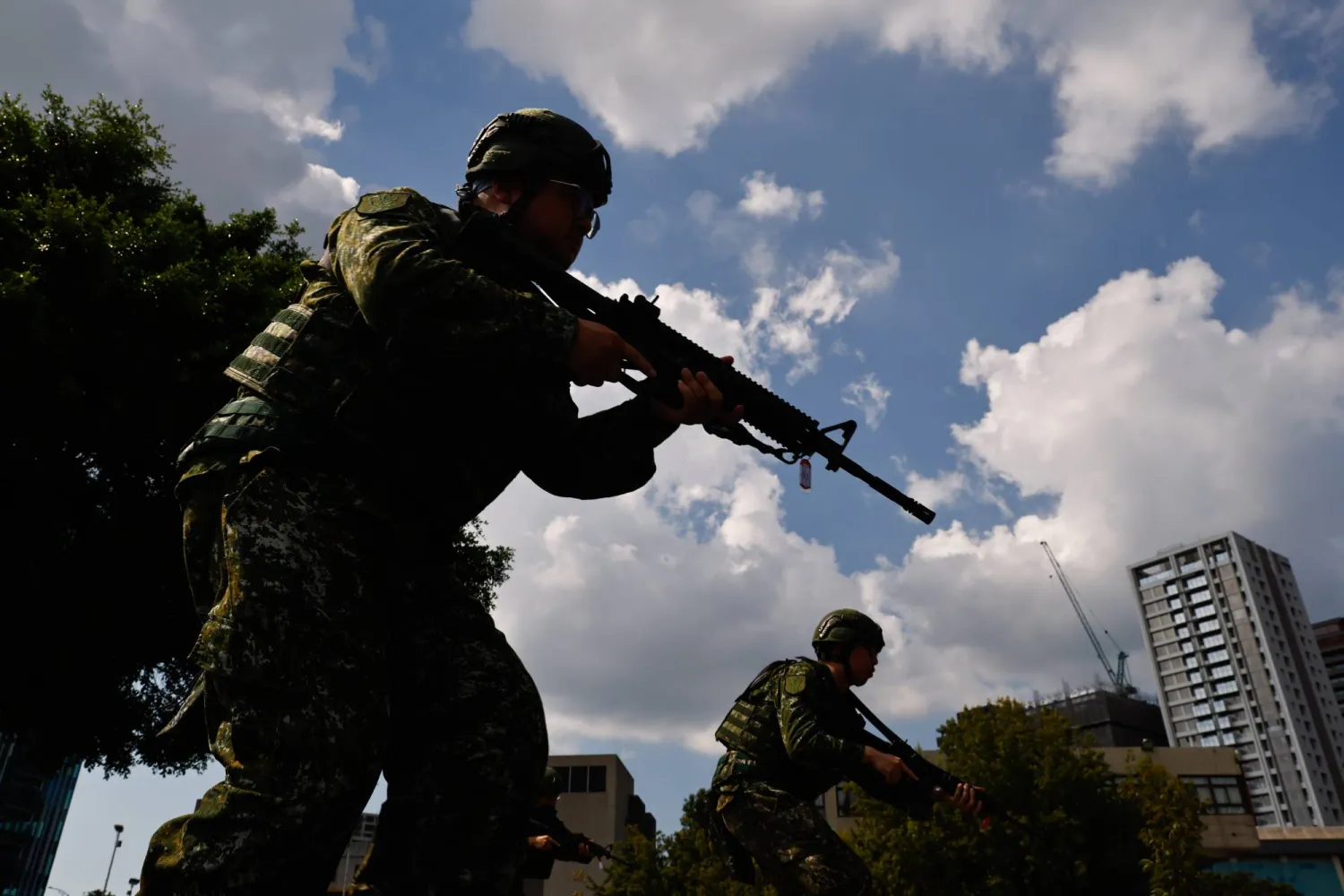

Taiwan's largest military drills of the year began Wednesday as the island democracy attempts to prepare its population for a potential Chinese invasion.
The annual "Han Kuang" exercise, which runs from August 5-14, stages combat scenarios for troops and reservists to practice responding to an attack on the island, defense officials say.
Civilians will also be put through their paces during exercises that include a temporary slowdown of mobile internet speeds, as well as air raid drills.
China claims Taiwan is part of its territory and has threatened to use force to seize the island of 23 million people.
Beijing has ramped up military pressure on Taiwan in recent years, deploying fighter jets and warships around the island on an almost daily basis and carrying out large-scale drills.
The Chinese coast guard has also stepped up its grey zone activities -- actions that fall short of war -- around Taiwan and its outer islands.
On Wednesday, dozens of reservists spread out along a beach facing the Taiwan Strait and fired Taiwanese-made assault rifles at targets on a shore where Chinese forces could land during an invasion.
At a school playground in Taipei, reservists practiced loading mortars and handling M4A1 rifles.
Navy vessels, including a submarine, were deployed in southern Taiwan, while tanks and other armored vehicles conducted pre-dawn maneuvers on the streets of the central city of Taichung.
Black Hawk helicopters were also seen flying in the sky above Kaohsiung.
"In recent years, we've constantly emphasized that the Han Kuang exercise must be closer to real combat scenarios, so that even without actually experiencing war our units can test their real operational capabilities," a senior defense official said on the eve of the drills, on the condition of anonymity in order to speak to the media.
- 'Whole-of-society defense' -
A key part of this year's exercise is decentralizing command and control to enable commanders and officers on the battlefield to make operational decisions without waiting for orders.
Another focus is drone "kill chain" operations involving "reconnaissance drones and attack drones operating together with other means of attack", the defense official said.
Taiwan has boosted defense spending and acquired smaller and more nimble weaponry, including drones, to enable its military to wage asymmetric warfare against China.
Under intense US pressure to cough up more on security, Lai's government has vowed to increase defense spending to five percent of GDP by 2030.
But his government has been at loggerheads with the opposition parties, which control the parliament, over how much to spend on boosting the island's defense capabilities.
In May, the KMT and the Taiwan People's Party passed a $25 billion special defense budget, slashing by a third the amount sought by Lai's Democratic Progressive Party.
The opposition stripped out around $15 billion that the government had wanted to use for domestic drone procurement and other efforts to boost defenses.
Lawmakers are now considering rival proposals for drone investment worth billions of dollars.
"As the CCP's (Chinese Communist Party's) authoritarianism continues to expand, red terror is also spreading into every corner of the world," President Lai Ching-te told a security forum on Tuesday.
"We will continue to upgrade our national defense and build whole-of-society defense and resilience," he said.
Urban resilience drills will be held at the same time as part of the government's efforts to prepare the entire island for a war or natural disaster.
Mobile internet speeds will be slowed for 30 minutes during air raid drills in central and northern regions, as the government seeks to expose ordinary people to communications disruptions.
Taiwan will also deploy naval and coast guard ships to escort supplies during a simulation of a Chinese blockade in waters east of the island.
And it will assess "the capacity of mobilized factories to support wartime production" and test the "wartime relocation" of military and civilian factories, defense officials said previously.
"Training can always be better," Defense Minister Wellington Koo said Wednesday.
"We will therefore continue to train diligently and intensively, so that we are fully prepared in peacetime and able to carry out our missions in wartime."


