

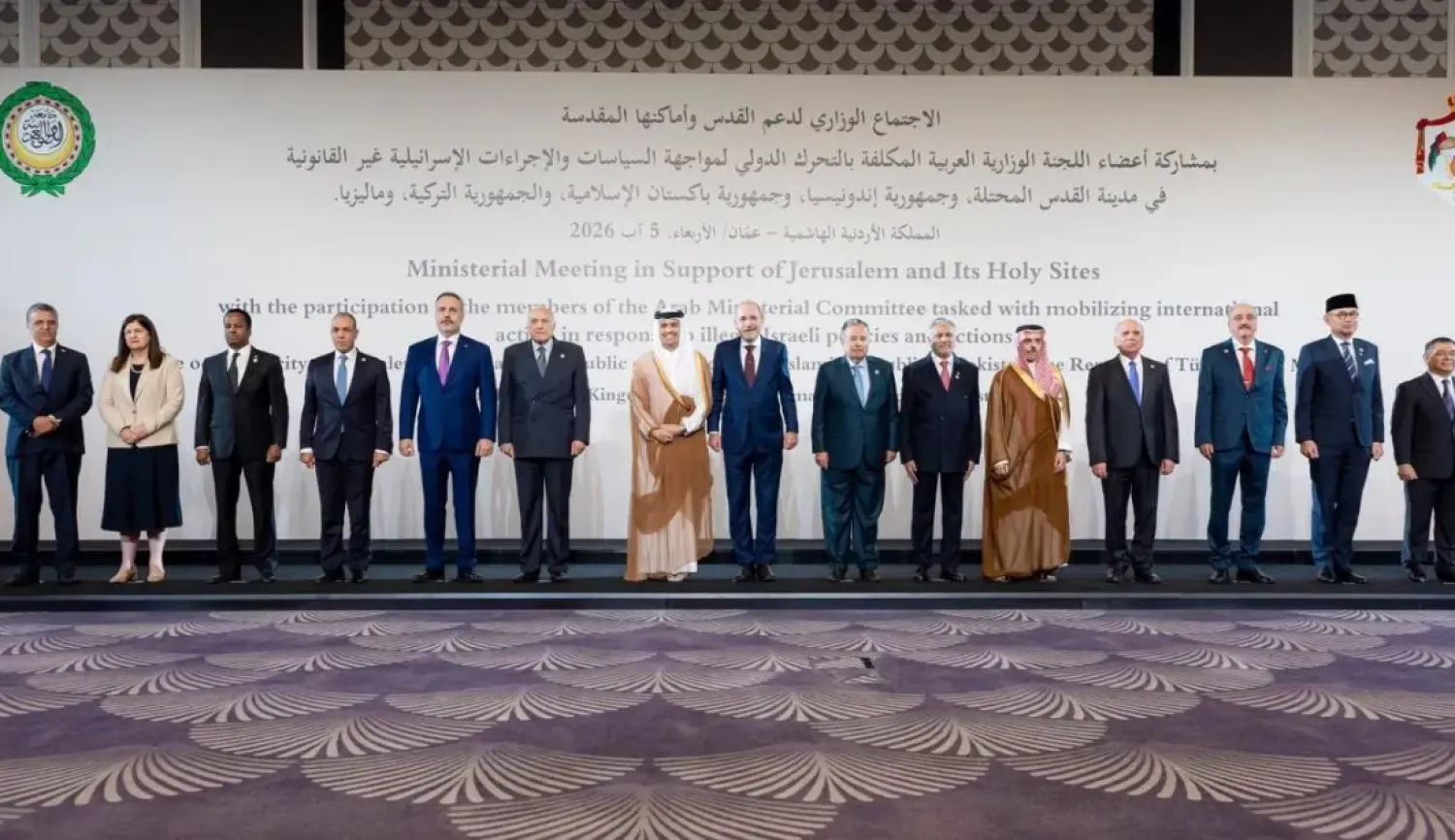

Saudi Arabia Calls for International Action to Protect Jerusalem, End Gaza Violations at Jordan Ministerial Meeting

The meeting was attended by Saudi Ambassador to Jordan Prince Mansour bin Khalid bin Farhan, and Minister Plenipotentiary at the Foreign Ministry Dr. Manal Radwan - SPA
TT

Saudi Arabia Calls for International Action to Protect Jerusalem, End Gaza Violations at Jordan Ministerial Meeting

The meeting was attended by Saudi Ambassador to Jordan Prince Mansour bin Khalid bin Farhan, and Minister Plenipotentiary at the Foreign Ministry Dr. Manal Radwan - SPA

Saudi Minister of Foreign Affairs Prince Faisal bin Farhan bin Abdullah participated on Wednesday in the Ministerial Meeting in Support of Jerusalem and its Holy Sites, hosted by Jordan.

During the meeting, Prince Faisal delivered a speech in which he expressed the Kingdom of Saudi Arabia’s appreciation to Jordan for convening and hosting the important gathering. He also commended Jordan’s historic role in safeguarding the Islamic and Christian holy sites in Jerusalem and preserving the city’s historical identity.

Prince Faisal reaffirmed the Kingdom’s position that East Jerusalem is the capital of the State of Palestine, stressing that all unilateral measures, including settlement activities and land confiscation, are null and void and cannot create any legal rights or alter the city’s legal status.

He reiterated the Kingdom’s rejection of all violations aimed at changing Jerusalem’s legal and historical status or altering its Islamic and Christian identity and character. He also rejected any attempts to misuse the principle of freedom of worship to justify measures intended to entrench a new political and occupation-driven reality in the city.

The foreign minister emphasized that protecting Jerusalem is a fundamental pillar of any just peace, adding that justifying or inciting violence based on religious or ideological claims represents a dangerous deviation from the shared values of the Abrahamic faiths and is incompatible with the principles of equality and human dignity.

Prince Faisal stated: “While the Kingdom welcomed President Donald J. Trump’s announcement to move forward with the implementation of the second phase of the Comprehensive Peace Plan, we strongly condemn the Israeli military violations in the Gaza Strip, which constitute a direct challenge to the agreement, undermine the momentum it has generated, and serve the agenda of those seeking to obstruct and derail the peace process.”

He renewed the Kingdom’s call on the international community to assume its responsibilities by taking practical steps to halt violations in the Gaza Strip and the West Bank, protect the holy sites, support the steadfastness of the Palestinian people, reject hate speech and religious and racial supremacist rhetoric, hold accountable all forms of incitement that fuel violence and settler terrorism, and put an end to practices that undermine the prospects for coexistence and peace.

Prince Faisal also reaffirmed the Kingdom’s commitment to working with its regional partners and the international community, including through the Global Alliance for the Implementation of the Two-State Solution, which launched the Interfaith Dialogue Track as part of implementing the Comprehensive Peace Plan.

He underscored the Kingdom’s belief that fostering mutual respect and coexistence among followers of the three Abrahamic religions is a cornerstone for supporting political efforts and achieving lasting peace.

Concluding his remarks, Prince Faisal said that Jerusalem, toward which the hearts of millions of followers of the Abrahamic faiths turn, must remain a city of peace and coexistence and a symbol of humanity’s shared values, rather than a battleground or a place where faits accomplis are imposed.

He stressed that safeguarding the city and preserving its historical and legal status are essential to achieving a just and lasting peace and building a future of security, stability, and prosperity for all the peoples of the region.

Saudi Arabia Lifts Early Warning Alerts Issued in Ten Cities

Saudi Civil Defense (Asharq Al-Awsat)
TT

Saudi Arabia Lifts Early Warning Alerts Issued in Ten Cities

Saudi Civil Defense (Asharq Al-Awsat)

The Saudi Civil Defense sent an all clear on Saturday after issuing alerts for potential ⁠danger in several cities of the kingdom as part of emergency procedures to alert residents.

The alerts included Riyadh, al-Kharj, Khamis Mushait, Jeddah, Taif, Yanbu, AlUla, Jazan, Farasan and Abha.

The sirens had been activated in those cities and governorates as part of the emergency early warning system before the Civil Defense later declared that the danger had passed.

The Civil Defense stressed the importance of refraining from circulating rumors and videos from unknown sources, emphasizing that information related to emergency situations should be obtained from official sources. Residents should comply with instructions and guidance issued by the relevant authorities, it added.


Saudi Electronic University Renamed after Prince Musaid bin Abdulrahman

Prince Musaid bin Abdulrahman (King Abdulaziz Foundation)
TT

Saudi Electronic University Renamed after Prince Musaid bin Abdulrahman

Prince Musaid bin Abdulrahman (King Abdulaziz Foundation)

Saudi Arabia’s King Salman has ordered the Saudi Electronic University in Riyadh renamed after Prince Musaid bin Abdulrahman, following a recommendation by Crown Prince and Prime Minister Mohammed bin Salman.

The directive honors Prince Musaid bin Abdulrahman for his distinguished service and contributions as one of the Kingdom’s prominent statesmen.

Prince Musaid, a brother of Saudi Arabia’s founder King Abdulaziz bin Abdulrahman, was born at Al-Hukm Palace in Riyadh in 1918. He studied at one of the capital’s leading traditional Quranic schools before attending lessons in Islamic studies and Arabic under several prominent scholars.

He held a series of senior government positions, serving as an adviser to King Saud bin Abdulaziz, president of the Board of Grievances in 1954, state auditor before the establishment of the General Auditing Bureau, royal adviser and Cabinet member in 1957, interior minister in 1960, and minister of finance and national economy in 1962. He died in Riyadh on Dec. 9, 1986.

Commitment to knowledge

Prince Musaid was known from an early age for his interest in education, knowledge and culture. In 1944, he established Riyadh’s first public library inside his palace, assembling a collection of valuable books and manuscripts and opening it to students and visitors.

Renaming the university, established in Riyadh in 2011, is intended to carry forward that intellectual legacy and preserve the memory of a national figure closely associated with education and public service.

Crown Prince Mohammed bin Salman referred to Prince Musaid’s forward-looking ideas in a 2021 television interview, recalling a real estate development proposal he had put forward more than five decades earlier.

The Crown Prince said the proposal, raised during the reign of King Faisal and the beginning of King Khalid’s reign, faced opposition from ministers and officials who resisted allowing greater private-sector involvement.

He said the rejection contributed to poor urban planning and services in Saudi housing developments, adding that had the proposal been implemented at the time, Saudi Arabia could have developed some of the world’s largest real estate companies. He cited ROSHN as a company now seeking to help meet housing demand in the Kingdom.

Honoring his legacy

Prince Musaid’s public service has previously been commemorated. In 2017, the General Auditing Bureau named the main hall at its new Riyadh headquarters after him, honoring his role as the bureau’s first president and his contribution to establishing its administrative and professional foundations.

At the hall’s inauguration in early 2018, Riyadh Governor Prince Faisal bin Bandar bin Abdulaziz paid tribute to Prince Musaid’s work and his role in laying the foundations for the institution’s approach.

Dr. Mohammed bin Yahya Mardi, president of the newly renamed university, said the name carries national and academic significance and reflects the leadership’s recognition of Prince Musaid’s contributions to the Kingdom.

Mardi noted that the prince’s longstanding interest in education, culture, and knowledge aligns with the university’s mission to build capabilities and expand access to learning.

He said the university would continue pursuing excellence and innovation while strengthening its national impact, drawing inspiration from the intellectual and national legacy associated with Prince Musaid’s name.

Mardi added that continued government support has helped drive significant advances in Saudi higher education, enabling universities to develop human capital, advance knowledge, serve society and contribute to the goals of Saudi Vision 2030.


Arab, Regional Officials Condemn Houthi Attacks on Taif

Arab, Regional Officials Condemn Houthi Attacks on Taif
TT

Arab, Regional Officials Condemn Houthi Attacks on Taif

Arab, Regional Officials Condemn Houthi Attacks on Taif

Arab and regional officials and organizations condemned on Friday the recent Houthi attacks targeting Taif, expressing solidarity with those affected and stressing the need to respect international law and protect civilians, the Saudi Press Agency reported.

Condemnations poured in from the GCC secretary-general, Arab interior ministers, the Arab League, the Muslim World League and several countries, including Syria, Mauritania, Jordan, Bahrain, Qatar, Kuwait and Kenya, over the Houthi attacks.

Gulf Cooperation Council Secretary-General Jasem Mohamed Albudaiwi strongly condemned the drone attack describing it as a heinous assault.

Falling debris from the drone killed one person and injured others, while also causing material damage, SPA said.

The condemnations emphasized that Houthi attacks on civilian areas represented a dangerous escalation and violation of international law, calling for firm international action to halt the attacks, hold those responsible accountable and protect civilians.

They reiterated their firm solidarity with Saudi Arabia in confronting threats to its security and territorial integrity, affirming support for all measures taken by the Kingdom to protect its sovereignty, citizens and residents.
