Farmers in Kenya Dispute That Cyanide Poisoning Could Have Killed 15 Elephants

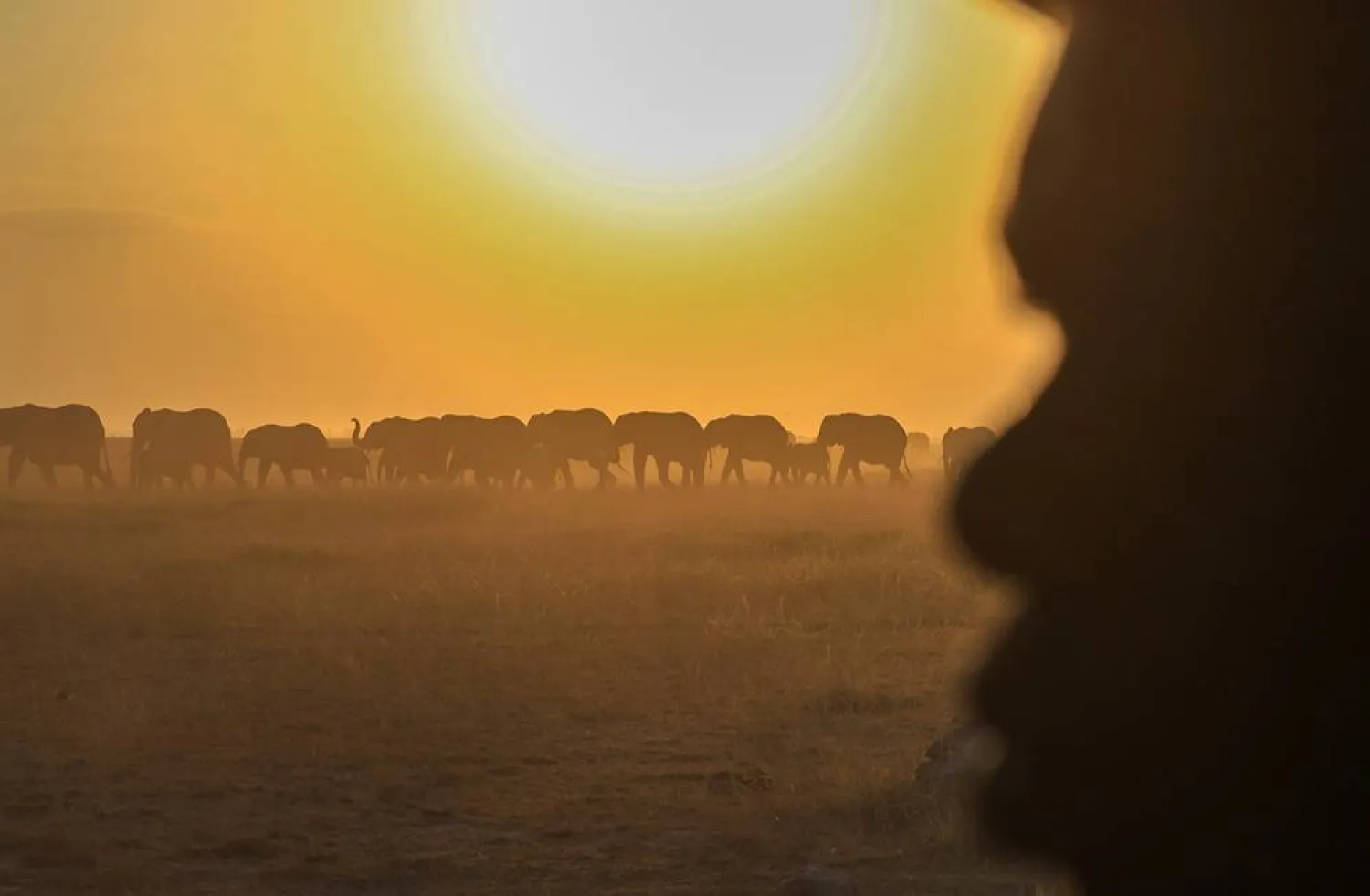
 A herd of elephants walks across Amboseli National Park in Kajiado County, Kenya, Wednesday, Aug. 5, 2026. (AP)
A herd of elephants walks across Amboseli National Park in Kajiado County, Kenya, Wednesday, Aug. 5, 2026. (AP)
TT

Farmers in Kenya Dispute That Cyanide Poisoning Could Have Killed 15 Elephants

 A herd of elephants walks across Amboseli National Park in Kajiado County, Kenya, Wednesday, Aug. 5, 2026. (AP)
A herd of elephants walks across Amboseli National Park in Kajiado County, Kenya, Wednesday, Aug. 5, 2026. (AP)

The carcass of one elephant lies on a dusty road, while another has been almost completely eaten by scavengers, leaving just the skull. They are among 15 elephants that died of suspected cyanide poisoning in Kenya’s Amboseli National Park after eating tomatoes in nearby farms.

Investigations are ongoing into how cyanide found its way to an ecosystem where wild and domestic animals coexist and farms grow tomatoes and onions, but growers are disputing claims that cyanide from their tomatoes killed the elephants.

The elephant deaths and disputes about the cause have intensified concerns over growing human-wildlife conflict in the region due to expanding agricultural activities near Amboseli park. Kenya has until recently been widely recognized for rebuilding its elephant population from historic lows to more than 36,000 individuals by reducing poaching and protecting elephants.

Elvis Muchai has farmed on the edge of Amboseli for two decades. In all that time, he said, he has never heard of farmers poisoning wildlife.

That is why he was skeptical of reports last month that the 15 elephants had died from suspected cyanide poisoning after consuming tomatoes believed to have been contaminated with the chemical.

Muchai, who farms tomatoes in Kimana area, said local communities have long coexisted with elephants despite suffering repeated crop losses when the animals cross the park’s electric fence and raid farms, particularly during the dry season.

“We are used to the animals eating from our farms,” he said.

Fifteen elephants died in one month

Last month, the Kenya Wildlife Service announced that 15 elephants had died in the Amboseli ecosystem in a span of a month. Preliminary laboratory tests detected cyanide, while postmortem examinations found tomatoes in the animals’ stomachs.

The head of veterinary services at Kenya's wildlife agency, Dr. Isaac Lekolool, said the elephants had shown signs of “paralysis and difficulty breathing” before they died. Initial tests pointed to cyanide poisoning, although further laboratory tests are being done to determine the concentration of cyanide.

“We are yet to find out where this cyanide came from,” Lekolool said, adding that the elephants had also consumed watermelons. He urged caution over the handling and use of pesticides on farms.

One of Kenya's most productive farming regions Kimana, which borders Amboseli, is one of Kenya’s most productive agricultural areas, growing tomatoes, onions and French beans that are transported to markets to the capital, Nairobi.

The samples tested for toxic chemicals were obtained from the elephants' stomach contents and the analysis of blood samples is ongoing, Dr. Lekolool said. He disputed earlier claims that cyanide, which is regulated by the government for use in mining, may have been present in the park due to illegal mining.

Farms have expanded near the park and conflict between people and elephants remains the second leading cause of deaths after poaching, according to Kenya’s National Elephant Plan. Between 2000 and 2020, at least 1,160 elephants died in incidents linked to self-defense or retaliatory killings as communities sought to protect their crops, property and lives, the Plan notes.

But Duncan Juma, communications director of Kenya’s wildlife service, ruled out human-wildlife conflict in the death of the elephants, saying “the community loves these animals.”

Urgent need to tackle human-wildlife contact

The International Fund for Animal Welfare, or IFAW, said the recent suspected cyanide poisoning highlights the urgent need to tackle the underlying causes of human-wildlife conflict.

“As people and elephants increasingly share space, protecting wildlife and safeguarding communities’ livelihoods must go hand in hand,” IFAW wrote in a statement.

IFAW’S East Africa Director Ben Wandago said the reported cyanide poisoning must be “urgently and thoroughly investigated” and recommended that coexistence solutions to protect communities living near the park be implemented.

“This tragedy also underscores the urgent need for the strict control and responsible handling of highly toxic substances to prevent them from entering the natural environment,” he said.

Farmers are doubtful that the cyanide could have originated from commonly used agricultural inputs.

Muchai said he has never encountered cyanide among the pesticides or chemicals sold to farmers in the area and insisted that products available on the market are regulated by the Kenyan government.

“The chemical they are talking about, we’ve never seen it or heard of it here,” he said.

Last season alone, Muchai said elephants destroyed about half an acre of his tomato crop, costing him an estimated 500,000 Kenya shillings ($3,800).

“We have lived with these animals for years. They eat our crops, and many of us have never received compensation,” he said.

Another farmer, Rymondy Mrosso, also questioned whether pesticides used by local farmers could explain the deaths and wondered why only elephants appeared to have been affected.

“We have goats, cows and other wildlife such as gazelles that also feed in these areas,” he said. “If the crops were poisoned, why were only the elephants affected?”


British Embassy Quashes Winnie-the-Pooh Return Rumors, Keeping the Bear in New York

FILE - A photograph of author A. A. Milne with his son Christopher Robin is displayed beside Milne's son Christopher Robin's beloved teddy bear, the inspiration for "Winne-the-Pooh," at the New York Public Library, Monday, Sept. 30, 2013, in New York. (AP Photo/Kathy Willens,File)
TT

British Embassy Quashes Winnie-the-Pooh Return Rumors, Keeping the Bear in New York

FILE - A photograph of author A. A. Milne with his son Christopher Robin is displayed beside Milne's son Christopher Robin's beloved teddy bear, the inspiration for "Winne-the-Pooh," at the New York Public Library, Monday, Sept. 30, 2013, in New York. (AP Photo/Kathy Willens,File)

It turns out Winnie-the-Pooh and his fluffy friends aren't getting bear-napped from their longtime home at the New York Public Library.

The British Embassy in Washington dispelled rumors Thursday about a campaign to return the collection of stuffed animals including the “willy nilly silly old bear" to the United Kingdom.

The toys were owned by English author A.A. Milne's son — the real-life Christopher Robin — in the 1920s and served as the inspiration for the characters in the writer's beloved children’s books.

“There’s an open invite if Pooh ever wants to make a temporary visit to the UK, but we have no doubt that Pooh and his pals are in excellent hands with the New York Public Library," the embassy said in a post on social media.

Rumors began swirling about a change of scenery for Pooh after The Washington Post reported last week about a push to bring the teddy bear back home as the famed character turns 100 this year.

Milne bought Pooh for his son's first birthday in 1921 from Harrods department store in London. Decades later, the collection of dolls came to the U.S. for a national tour before publisher Dutton Children’s Books donated them to the library in 1987.

When asked about the British Embassy’s statement, Melissa Grace, director of communications at the library, said they’re excited to celebrate Winnie-the-Pooh’s anniversary and invite the public to their exhibit for free.

“Christopher Robin’s childhood toys are a cornerstone of our renowned children’s literature collection,” she said in a statement, adding that the library has plenty planned for the anniversary, including giving away 3,000 copies of the books.

Last week's Post story reported that Gyles Brandreth, an author and friend of the late Christopher Robin Milne, went to New York two years ago for Queen Camilla to try to bring Pooh to Buckingham Palace. But, he said, the library wasn't interested.

Camilla visited the library herself in April, and rather than try to make off with the plump bear, she delivered a new Roo doll to add to the library’s collection that also includes Piglet, Tigger, Eeyore and Kanga. Roo, in the books, was a small brown kangaroo and the son of Kanga.

This is far from the first time there has been talk of relocation.

In the late 1990s, then Labour Party lawmaker Gwyneth Dunwoody introduced a question in Parliament to ask what plans Britain’s culture secretary had to arrange for the collection's return.

“Just like the Greeks want their Elgin Marbles back — so we want our Winnie-the-Pooh back, along with all his splendid friends,” she had told a reporter.

A New York congresswoman introduced a resolution condemning the attempt to remove the bear.

“The Brits have their head in a honey jar if they think they are taking Pooh out of New York City,” then US Rep. Nita Lowey said, according to The Associated Press.

And unlike plundered antiquities, there's no doubt that Pooh and his friends were freely given to the library. So it would seem once again that children looking to catch a glimpse of the honey-loving bear who inspired such fantastical stories have nothing to worry about.

Besides, New Yorkers would never give up their stuffed friend without a fight. As Manhattan Borough President Brad Hoylman-Sigal said when he reposted the embassy’s statement Friday: “You come at the bear, you best not miss.”


Need a Smile? This Livestream Features 6 Puppies All Day Long

In this image taken from video puppies of the Lagotto Romagnolo dog Hilkka sleep in Finland, Thursday, Oct. 15, 2026. (Breeder's album, Julia Kiiskinen/Yle - The Finnish Broadcasting Company via AP)
TT

Need a Smile? This Livestream Features 6 Puppies All Day Long

In this image taken from video puppies of the Lagotto Romagnolo dog Hilkka sleep in Finland, Thursday, Oct. 15, 2026. (Breeder's album, Julia Kiiskinen/Yle - The Finnish Broadcasting Company via AP)

Every wiggle and wobble, every snuffle and squeak of six newborn puppies snuggling together in Finland is captured by cameras monitoring their development in the first weeks of their lives. For science, of course.

Even though the puppies mostly nap and nurse — no fetching yet — they've entranced millions of Finnish viewers and others around the world through " Pentulive," a 24/7 slow TV livestream from Finland’s national public broadcaster, Yle. "Pentu” means puppy in Finnish.

The puppies' mother, a 5-year-old Lagotto Romagnolo dog named Hilkka, gave birth to four males and two females on Oct. 10. The puppies have brown and white fur and weighed roughly 1 kilogram (2.2 pounds) each Thursday.

“They are just opening their eyes and their ears,” Pirjo Koskinen, a Yle science journalist who came up with the idea for “Pentulive,” told The Associated Press on Thursday. “They are taking their first clumsy steps.”

The slow TV show is in its sixth season and expected to break viewership records again. In less than two weeks, the livestream had more than 6 million views on social media alone in the country of 5.7 million people. A naming ceremony is set for Saturday.

The programming incorporates science through chat sessions with viewers three times a week, as well as a podcast and online articles detailing the dogs' development. The audience can watch the puppies grow day by day and track their milestones alongside Yle's science journalists and the breeder.

The scientific benefits extend to humans, too.

Seeing the puppies attempt to make a mad dash to their mother for milk, for example, can trigger an increase in levels of a hormone called oxytocin in a human brain, Koskinen said. Also known as the love hormone, it can help create social bonding as well as reduce anxiety.

The show is also an escape from the stresses of the rest of the world for viewers and Yle's journalists alike. One look at those wagging tails and little pink noses and it's hard not to smile, said Jyri Loikkanen, Yle’s producer of “Pentulive.”

Loikkanen, who often watches the livestream to decompress from his workday, said a commenter wrote on social media comparing the US considering livestreaming the firing squad execution of Fort Hood shooter Nidal Malik Hasan to Finland streaming puppies.

“I think it’s pretty much a sign of the times that people crave for this kind of small escape,” Loikkanen said, from the “doom and gloomy news what we are experiencing at the moment: The politics, the economics, war and strife et cetera.”

The puppies will be adopted mid-December by people chosen by the breeder. Yle keeps the breeder's name and location anonymous for their privacy and so that they can focus on the dogs' well-being. The puppies' new families are selected before the livestream begins each year.

The slow TV style of programming began in 2009 with Norwegian public broadcaster NRK’s minute-by-minute airing of a seven-hour train trip across the southern part of the country. It has since spread with productions in the United Kingdom, China and elsewhere.

In Sweden, for example, remote cameras for “The Great Moose Migration” capture dozens of moose as they swim across the Ångerman River, some 300 kilometers (187 miles) northwest of Stockholm, in the annual spring migration toward summer grazing pastures.


Prince William, Wannabe DJ and Film-Lover, Appears on UK Chat Show

Britain's Prince William meets with the public on a street during a royal visit to the Aberfan Disaster Memorial Garden to mark the 60th anniversary of the 1966 disaster, in which 109 children and five teachers were killed at Pantglas Junior School when a coal spoil tip collapsed onto the Welsh village, Britain, October 21, 2026. (Reuters)
TT

Prince William, Wannabe DJ and Film-Lover, Appears on UK Chat Show

Britain's Prince William meets with the public on a street during a royal visit to the Aberfan Disaster Memorial Garden to mark the 60th anniversary of the 1966 disaster, in which 109 children and five teachers were killed at Pantglas Junior School when a coal spoil tip collapsed onto the Welsh village, Britain, October 21, 2026. (Reuters)

Prince William talked about his ‌love of Christopher Nolan films and how he once wanted to be a DJ as he appeared on a British television chat show on Friday to promote his annual award for climate change innovation.

The heir to the throne, 44, has in recent years regularly appeared in less formal settings in a bid to connect with younger audiences, including Radio One, one of UK's biggest stations for under 30s, and sports podcasts.

William surprised celebrity guests including actors Cate Blanchett and Hannah Waddingham when he joined them ‌on the ‌sofa for an episode of the BBC's Graham ‌Norton ⁠Show, which is ⁠due to air later on Friday.

Asked about how he relaxes, he said he and his family together enjoy reality show The Celebrity Traitors, while he personally turns to music and films.

"I'm a big fan of everything Christopher Nolan does. His films are fantastic – The Dark Knight series is psychologically dark and deep and I ⁠absolutely love that," William said.

"He takes concepts that ‌are completely out there and ‌makes them incredibly entertaining."

Before accepting that his future job would be that ‌of king, he said he had wanted to be a ‌policeman.

"Then I went through a phase of wanting to be a DJ – I wasn’t very good," he said.

William has in recent years sought to provide insights into his personal life, without creating waves by ‌giving too much away about the challenges of life in the public eye.

Two years ago, both ⁠his father, ⁠King Charles, and his wife Kate began treatment for cancer. His wife is now in remission, while Charles's treatment continues.

He has also been estranged from his brother Prince Harry for about six years, after Harry published a book detailing the breakdown of their relationship and repeatedly criticized the royal family.

Talking about The Earthshot Prize, which he set up six years ago to award five winners £1 million each to fund their ideas to save the environment, William said the aim was to bring optimism into an issue which can otherwise feel depressing.

"There are some amazing people out there doing things to protect the world," he said.