


Trump Administration to Invest $3 Billion in Minerals Projects to Boost US Defense Supply Chains

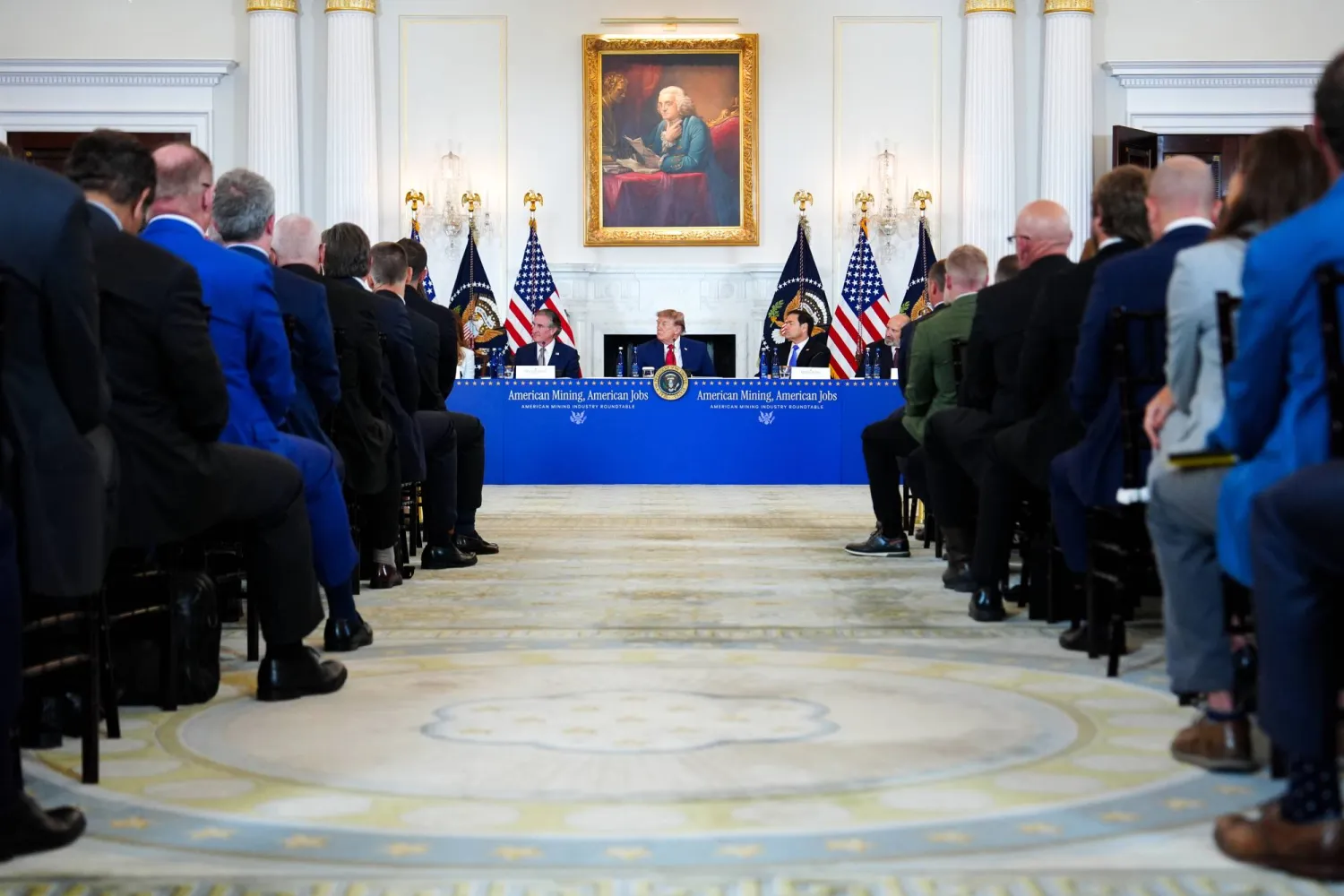
 President Donald Trump speaks during a roundtable on the American mining industry, Friday, Aug. 7, 2026, at the State Department in Washington. (AP)
President Donald Trump speaks during a roundtable on the American mining industry, Friday, Aug. 7, 2026, at the State Department in Washington. (AP)
TT

Trump Administration to Invest $3 Billion in Minerals Projects to Boost US Defense Supply Chains

 President Donald Trump speaks during a roundtable on the American mining industry, Friday, Aug. 7, 2026, at the State Department in Washington. (AP)
President Donald Trump speaks during a roundtable on the American mining industry, Friday, Aug. 7, 2026, at the State Department in Washington. (AP)

The US government will invest $3 billion in critical minerals and battery projects as part of a push to increase domestic production and boost national security and industrial policy, President Donald Trump said on Friday.

"We're reclaiming America's rightful place as the minerals superpower of the world," Trump told more than 200 mining executives, educators, investors and fellow politicians at a roundtable at the State Department aimed at supporting the industry, which he said had not received enough attention from Washington in recent years.

He announced a slew of investments during his speech, including a $1.4 billion conditional loan from the Defense Department's Office of Strategic Capital for Sila Nanotechnologies, which makes lithium-ion battery parts.

The OSC also extended a $400 million conditional loan to scandium miner Sunrise Energy Metals and a $150 million conditional loan to magnet developer Niron Magnetics.

The US Export-Import Bank will lend $58 million to Westwater Resources, Global Advanced Metals and 5E ‌Advanced Materials, which Reuters ‌reported earlier on Friday.

"Critical minerals are the raw materials of American strength that power everything ‌from ⁠advanced weaponry to automobiles, ⁠and we want these essential products to be mined, refined and made right here in the USA," Trump said.

Interior Secretary Doug Burgum, Secretary of State Marco Rubio, Commerce Secretary Howard Lutnick and National Security Council official David Copley attended the announcement.

WEAPONS STOCKPILES DRIVE MINERAL DEMAND

The White House needs critical minerals to replenish weapons stockpiles depleted during the Iran conflict and reduce US dependence on Chinese supply chains.

Several executives came with gifts for Trump. Tom Albanese, chairman of deep-sea mining firm American Ocean Minerals, gave Trump a gold replica of a nodule that the company hopes to mine from the Pacific seabed. Trump last year said he may bypass the UN-backed International Seabed ⁠Authority and issue international seabed mining licenses.

Jim Litinsky, CEO of rare earths firm MP Materials, which ‌is financially supported by the Pentagon, gave Trump magnets that had been produced ‌for General Motors in the company's Texas plant.

Other attendees included executives from Lithium Americas, which is building the largest US lithium mine, NioCorp, ‌which is building a scandium mine to supply defense contractor Lockheed Martin, and Energy Fuels , which received a $725 million ‌OSC conditional loan in June.

US forces have burned through large numbers of precision-guided missiles and air-defense interceptors during the five-month-old Iran war. Defense officials and lawmakers have warned that replenishing some inventories could take years given existing production constraints. The Trump administration has disputed reports of significant shortages.

Supplies of minerals including rare earths, tungsten, germanium and scandium are essential for manufacturing precision-guided missiles, fighter aircraft, armored vehicles, infrared sensors and other advanced weapons systems, according to ‌Pentagon officials and defense companies.

MINING SCHOOLS RECEIVE FUNDING BOOST

The Department of Energy on Friday hosted representatives from all 14 accredited US mining schools to promote mining careers and encourage ⁠more students to enter the ⁠field.

The department announced $100 million in grants to help boost educational programs and set a goal of doubling the number of mining-related graduates at the nation's universities within two years.

"We need to work on some systemic changes to how we as a nation want to offer our brightest students an opportunity to participate in this industry," said Assistant Energy Secretary Audrey Robertson.

The Pentagon also said it would fund $80 million in projects at three US mining schools.

Officials have pointed to China's extensive network of mining universities as a key advantage in its dominance of global mineral production.

Since returning to office, Trump has launched a $12 billion strategic minerals stockpile, backed equity investments in companies developing US mines and processing facilities, and sought to limit defense contractors' reliance on supplies from China.

The administration says government support is needed to counter decades of Chinese investment that left Beijing dominant in the mining and processing of many strategic minerals.

Australia's government on Saturday welcomed the Trump administration's loan to Sunrise Energy Metals, which is developing a scandium mine in the country's New South Wales state.

"The Sunrise Scandium Project hosts the world's largest and highest-grade known scandium resource, which has a range of vital aerospace, defense and clean energy applications," Resources Minister Madeleine King said in a statement.



OPEC+ Countries Reaffirm Commitment to Market Stability

FILE PHOTO: OPEC logo is seen in this illustration taken, October 8, 2023. REUTERS/Dado Ruvic/Illustration/File Photo
TT

OPEC+ Countries Reaffirm Commitment to Market Stability

FILE PHOTO: OPEC logo is seen in this illustration taken, October 8, 2023. REUTERS/Dado Ruvic/Illustration/File Photo

The seven OPEC+ countries, which previously announced additional voluntary adjustments in April and November 2023, namely Saudi Arabia, Russia, Iraq, Kuwait, Kazakhstan, Algeria, and Oman met virtually on November 29, 2026, to review global market conditions and outlook.

The seven countries reviewed current market conditions and emphasized the essential role of the Declaration of Cooperation (DoC) in supporting the stability of global energy markets. In this context, the seven countries highlighted the critical importance of safeguarding international maritime routes to ensure the uninterrupted flow of energy.

The countries also expressed concern regarding attacks on energy infrastructure, noting that restoring damaged energy assets to full capacity is both costly and takes a long time, thereby affecting overall supply availability.

Accordingly, the seven countries stressed that any actions undermining energy supply security, whether through attacks on infrastructure or disruption of international maritime routes, increase market volatility and weaken the collective efforts under the DoC to support market stability for the benefit of producers, consumers, and the global economy.

The seven countries will continue consultations and review market conditions through the Joint Ministerial Monitoring Committee (JMMC).


Syria’s Finance Ministry: 2026 Budget Deficit Estimated at $1.8 Billion, Not $2.8 Billion

Syrian Finance Minister Mohammed Yisr Barnieh meets with a World Bank mission for the Public Financial Management Modernization Project on November 28 (Finance Ministry).
TT

Syria’s Finance Ministry: 2026 Budget Deficit Estimated at $1.8 Billion, Not $2.8 Billion

Syrian Finance Minister Mohammed Yisr Barnieh meets with a World Bank mission for the Public Financial Management Modernization Project on November 28 (Finance Ministry).

Syria’s Ministry of Finance has dismissed reports that the country’s 2026 budget deficit is expected to reach $2.8 billion, clarifying that the estimated shortfall stands at approximately $1.8 billion based on conservative projections.

The ministry also said that figures circulating about salaries, pensions and development loans were not all based on official announcements or sources.

In a statement, the ministry stressed that the deficit outlined in the published 2026 budget was based on conservative estimates and did not represent the final fiscal outcome, which would depend on actual budget execution through the end of the financial year.

The budget projected revenues of approximately $8.716 billion and expenditures of $10.516 billion, resulting in an estimated deficit of $1.8 billion.

The ministry explained that its published financial performance report for the first half of 2026 showed a deficit of around $1 billion. However, it noted that government revenues are not evenly distributed between the two halves of the year.

Based on revenue collection patterns in previous years, approximately 30% to 35% of annual revenues are typically collected in the first half, compared with 65% to 70% in the second half.

The ministry attributed its expectation that the year-end deficit would be lower than initially budgeted to improving revenues and government measures to control and rationalize spending.

It emphasized that these projections remain estimates based on specific assumptions and sources and should not be treated as official or final fiscal results.

Regarding reports of salary and pension increases and a new minimum wage, the ministry said the figures and percentages being circulated had not been officially announced by either the ministry or the government.

It confirmed, however, that options for improving salaries and pensions remain under review in coordination with the Ministry of Administrative Development and other relevant authorities, taking into account the direct impact of these measures on the living conditions of employees and retirees.

Ministry Denies Annual Interest on Development Fund Loans

Regarding loans signed with the Saudi Fund for Development, the ministry denied reports circulating on some platforms that the agreements carry annual interest of 3%.

It clarified that the financing consists of concessional development loans that bear no interest and are subject only to modest administrative fees.

The ministry described the arrangements as similar to qard hasan, or interest-free loans, because they do not impose interest charges.

It stressed that the government's policy focuses on controlling public debt, avoiding unjustified borrowing and limiting loans to development purposes under highly concessional terms.

The ministry added that the loan agreements would be submitted to the People's Assembly for approval in accordance with established procedures.


Saudi Stock Market Closes 0.9% Higher, Above 10,000 Points

A man monitors stock prices in Saudi Arabia (AFP)
TT

Saudi Stock Market Closes 0.9% Higher, Above 10,000 Points

A man monitors stock prices in Saudi Arabia (AFP)

The Saudi stock market ended Sunday's session higher, with the Tadawul All Share Index (TASI) rising 0.9% to close at 10,009 points, gaining 86 points. This marked its first close above the 10,000-point threshold since falling below it last week.

The gains came amid improved performance by heavyweight stocks, while trading liquidity fell to its lowest level since January 2026, with turnover reaching approximately SAR 2 billion ($533 million), indicating continued investor caution despite the market's advance.

Al Rajhi Bank shares rose 1.1%, Saudi National Bank gained 1%, and Saudi Aramco advanced 0.4%.

Amana Insurance topped the gainers with a 7.8% increase, followed by Wataniya Insurance at 7.6% and Gulf Insurance Group (GIG) at 6.3%.

Shares of Petro Rabigh, Al Jouf, BCI, Banan, Salama and Gulf General Insurance also rose between 5% and 6%.

Conversely, Budget Saudi, Jahez, SACO and Saudi Ceramics declined between 2% and 4%.