


As AI Grips World, the Thrill of Collecting Vintage Computers Is Growing

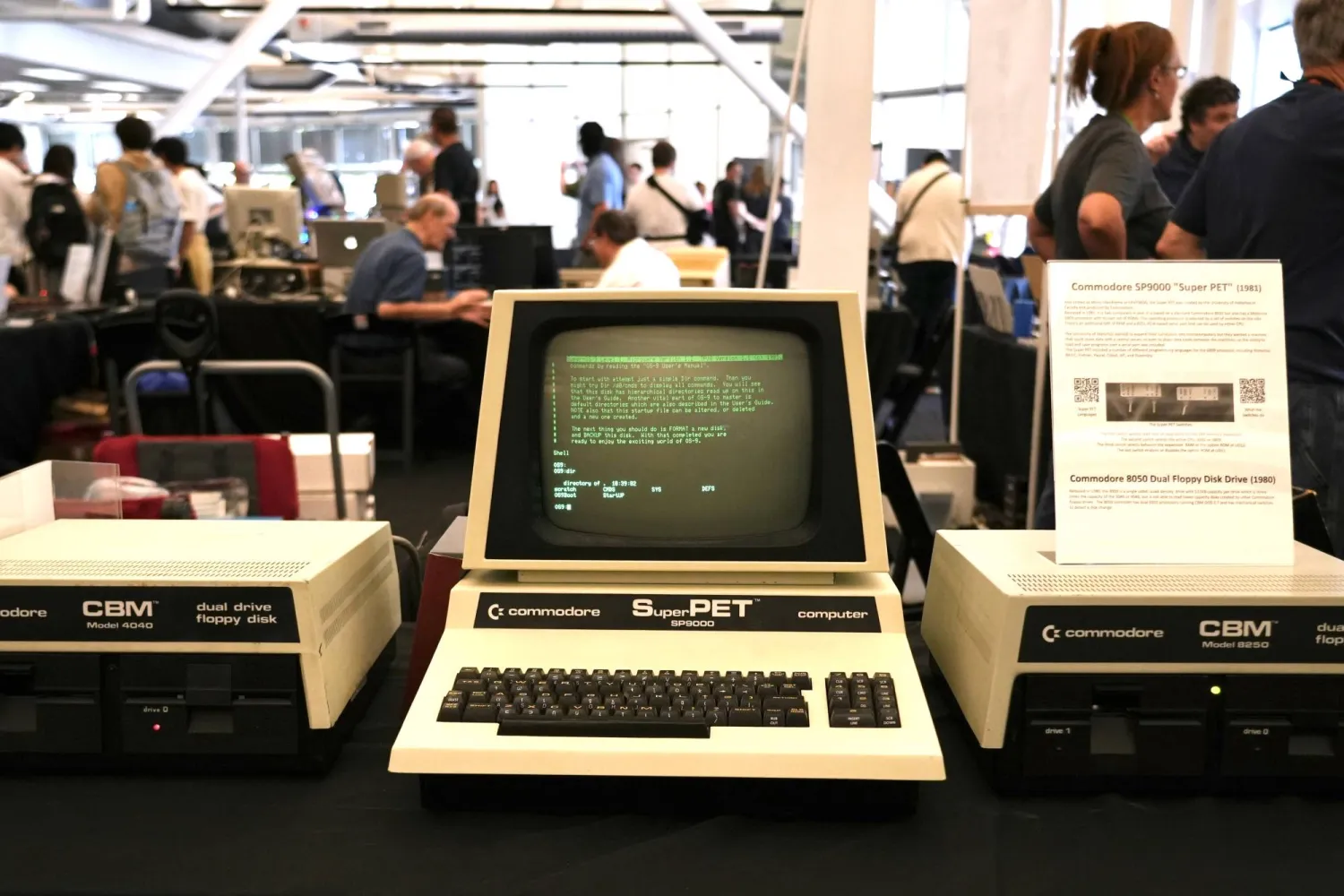
 A 1981 Commodore SP9000 “Super PET” computer and floppy disk drives are displayed at the Vintage Computer Festival in Mountain View, Calif., Sunday, Aug. 2, 2026. (AP)
A 1981 Commodore SP9000 “Super PET” computer and floppy disk drives are displayed at the Vintage Computer Festival in Mountain View, Calif., Sunday, Aug. 2, 2026. (AP)
TT

As AI Grips World, the Thrill of Collecting Vintage Computers Is Growing

 A 1981 Commodore SP9000 “Super PET” computer and floppy disk drives are displayed at the Vintage Computer Festival in Mountain View, Calif., Sunday, Aug. 2, 2026. (AP)
A 1981 Commodore SP9000 “Super PET” computer and floppy disk drives are displayed at the Vintage Computer Festival in Mountain View, Calif., Sunday, Aug. 2, 2026. (AP)

Software engineer Josh Dersch loves old computers. He spends countless hours tinkering in his garage, trying to coax decades-old machines back to life. He estimates he owns more than 200 vintage computers and devices in his Seattle home.

“It’s always been fascinating to me to see the origins of things,” Dersch said. “It’s a fun challenge to debug and repair. You can understand the entire system from top to bottom.”

Dersch is part of a growing community of vintage computer collectors who are preserving the classic machines that helped launch the digital revolution. While Silicon Valley has since moved on to shaping the future of artificial intelligence, these hardware enthusiasts are intent on saving the Atari, Commodore and IBM machines that are ancestors to today’s laptops, wearable devices and smart phones.

Where others see junk, people like Dersch see artifacts of computer history that are worthy of attention and respect. They delight in hearing the beeps and chimes of their childhood and firing up a low-def game of “Pong” or “Space Invaders.”

“The enthusiasm for the history of computers and all the stuff around it is growing,” said Erik Klein, president of the Vintage Computer Federation, which organizes an annual festival at the Computer History Museum in Mountain View in the heart of Silicon Valley.

Vintage computer festivals bring collectors together

This year more than 3,500 people attended the two-day Vintage Computer Festival in early August that celebrated the 50th anniversary of Apple, founded in 1976 in nearby Cupertino, Calif. It featured a panel with co-founders Steve Wozniak and Ronald Wayne reminiscing about the company’s early days as a scrappy startup led by the late Steve Jobs.

More than a dozen such gatherings have since sprung up in cities across North America, South America and Europe.

Growing interest is reflected in more demand for vintage computers in online marketplaces, Klein said. Rare, iconic computers like the Apple-1 — the company’s first product — can fetch hundreds of thousands of dollars.

Collectors exhibited the computer systems that they have painstakingly restored to their original working condition, allowing attendees to play with the computers built long before the internet, social media and AI transformed the world.

Restoring the ‘grandfather of the modern computer’

Dersch drove down from Seattle to showcase the pride of his collection: the Xerox Alto. He spent years restoring what's considered “the grandfather of the modern computer,” which was developed at the pioneering Xerox Palo Alto Research Center in the 1970s.

The Alto was one of the earliest computers to move beyond text on screen and use the mouse and graphical user interface, such as windows, icons and cursors, that became the industry standard. The model famously inspired Jobs and Bill Gates to incorporate the technologies in their early products.

Dersch’s exhibit featured a fully functioning Xerox Alto workstation with its boxy vertical monitor, chunky keyboard and mouse, as well as pizza-sized spinning disks that store tiny amounts of data by modern standards.

“It’s fun to share what I’ve done with people. It’s fun to share in what other people have done,” Dersch said. “Also, there’s a consignment area where I can buy more junk to take home with me, so that’s always fun.”

Klein, a Silicon Valley software engineering manager, was a passionate collector until his hobby overwhelmed his home and family life. He had as many as 150 computer systems — complete with accessories, documents and packaging — crammed into his closets and garage.

He said his beloved collection had become an “albatross” and he worried about burdening his family. So he started selling and giving away his machines until he only had a few favorites left at home.

Similar events for collectors spread around the world

Now Klein channels his passion for vintage computers into organizing festivals, repair workshops, swap meets and other events as president of the Vintage Computer Federation.

“So it’s really about evangelizing that history and evangelizing this hobby of maintaining, collecting and enjoying this vintage technology,” Klein said.

Sellam Ismail is thrilled to see the collector community develop and mature since he organized the first festival in 1997, drawing about 150 hobbyists to a venue east of San Francisco. He ran the events for a decade.

He later co-founded the Vintage Computer Federation, which runs festivals in the US and Canada. He’s helped other groups launch similar festivals in Argentina, Germany and Switzerland.

“The community grew up. More and more people started getting old computers, started collecting them,” said Ismail, who once had a massive collection he stored in a warehouse. “Next year is the 30th anniversary. And I expect this to continue and grow even bigger.”



Dutch Peanut Butter Artwork Proves a Sticky Attraction

The peanut butter had to be spread as smoothly as possible, without lumps. AFP
TT

Dutch Peanut Butter Artwork Proves a Sticky Attraction

The peanut butter had to be spread as smoothly as possible, without lumps. AFP

An artwork consisting of 390 kilograms of peanut butter spread on the floor of a Dutch museum attracted 48,000 visitors, 48 accidental footprints, five phones and one "licking incident" during its run, the institution said Tuesday.

The unusual work, a tribute to artist Wim T Schippers who died this year, was on display for two months at the Boijmans van Beuningen museum in Rotterdam.

Peanut butter was spread on a hexagonal floor measuring 25 square meters "as smoothly as possible, without any lumps", according to the artist's instructions.

"Forty-eight visitors made a fatal misstep into the floor," said the museum in a statement summing up the exhibition. "Five phones were fished out."

"There was one licking incident," the statement added, with a spokesperson telling AFP that a young child was thought to be the culprit.

The museum also received 80 complaints in writing or by telephone.

The big question now the exhibition is over: what to do with the hundreds of kilograms of used peanut butter?

"We looked into whether the peanut butter could be reused, for example by zoos, animal shelters or sustainable initiatives," museum spokesman Rene Timmermans told AFP.

"However, after being part of the tribute... for eight weeks, we could no longer guarantee its quality, hygiene or food safety."

The peanut butter is therefore destined for the compost heap, he said.

The Dutch are a huge fan of peanut butter, often combining it with "Hagelslag" chocolate sprinkles for a calorie-rich breakfast.

The museum said more than 400 peanut butter sandwiches were served in its cafe.

"The combination with Hagelslag was the most popular."


Macron Urges EU Ban on Social Media for Under-15s in Letter to Von der Leyen

France's President Emmanuel Macron addresses the audience during the opening plenary session of the "Lumière Summit" meeting on the future of cinema and the moving-image industry at the Maeght Foundation in Saint-Paul-de-Vence, southeastern France, Monday, Sept. 7, 2026. (Valery Hache/Pool Photo via AP)
TT

Macron Urges EU Ban on Social Media for Under-15s in Letter to Von der Leyen

France's President Emmanuel Macron addresses the audience during the opening plenary session of the "Lumière Summit" meeting on the future of cinema and the moving-image industry at the Maeght Foundation in Saint-Paul-de-Vence, southeastern France, Monday, Sept. 7, 2026. (Valery Hache/Pool Photo via AP)

French President Emmanuel Macron has urged the European Commission to back a European Union-wide ban on social media for children under 15 after France failed to enact its own legislation, his office said on Tuesday.

In a letter to European Commission President Ursula von der Leyen dated Aug. 29 and seen by Reuters and other media, Macron said it had become urgent to introduce a bloc-wide ban through new EU legislation after France's Constitutional Council struck down a national bill this summer before it was due to take effect in September.

"I believe it has now become ⁠essential to go ⁠further and, through a new European legislative text, harmonize a ban on access to social media platforms for children under the age of 15, in order to protect all children across the Union," Macron wrote.

Following Australia's landmark social media ban for children adopted last year, several European countries are considering their own ⁠curbs amid growing concern over the impact of social media on young people's mental health and safety. But some countries, especially in Scandinavia, believe it is best left for parents to decide.

Macron, now in his final year as French president, has taken up the cause as a priority before the next French presidential election in 2027, and has been lobbying other EU governments to back restrictions. He said France would separately rework the legislation struck down by the Constitutional Council, though political fragmentation in ⁠parliament and ⁠difficult budget negotiations could complicate efforts to pass a new law.

Von der Leyen said in July that the European Union would move to limit young children's access to social media across the 27-member bloc, citing proposals from two experts recommending a tiered system. Under that approach, children under 13 would only be allowed limited, supervised access, with restrictions eased gradually as they get older.

Macron is seeking a tougher approach, pushing for a blanket ban on social media access until the age of 15, ahead of Von der Leyen's flagship State of the Union speech to the EU parliament later this month.


Eiffel Tower Reopens after Row over Removing Women Staff

Pedestrians walk past the Eiffel Tower in Paris on September 8, 2026. (Photo by Lou BENOIST / AFP)
TT

Eiffel Tower Reopens after Row over Removing Women Staff

Pedestrians walk past the Eiffel Tower in Paris on September 8, 2026. (Photo by Lou BENOIST / AFP)

The Eiffel Tower reopened on Tuesday after staff walked out over the removal of women colleagues during a visit by a Hindu religious group which later apologized.

The operating company that runs the Paris landmark, SETE, acknowledged that the Hindu delegation had requested the visit on Saturday be organized so as to limit "interactions with women" and said that "these conditions should not have been accepted.”

The Eiffel Tower, which says it receives nearly seven million people a year, reopened on Tuesday morning, with visitors making their way through security checkpoints at the base.

The monument was closed on Monday, when SETE said it held a meeting between staff and management, AFP reported.

The Bochasanwasi Akshar Purushottam Swaminarayan Sanstha (BAPS) spiritual movement apologized for "any pain or inconvenience caused" by the incident.

"To the best of our knowledge, at no point was anyone prevented access to the Eiffel Tower," the organization wrote on X.

"Due to the size of our delegation, the visit was arranged in conjunction with the Eiffel Tower team at the start of normal operating hours to avoid disrupting or inconveniencing others."

Eiffel Tower staff condemned "professional instructions that led to female employees being sidelined, replaced and made invisible because of their sex" during the visit by the delegation.

"Instructions were given to female employees of the Eiffel Tower and to female employees of contractors to make themselves invisible in order to welcome this delegation," the staff said in a statement, adding they were shocked to have been put in such a situation.

"Some were asked to leave their posts and withdraw to other areas. In some posts they were replaced by men. And all female employees were instructed not to go through or cross certain areas while the delegation was present."

BAPS, which is close to Indian Prime Minister Narendra Modi's ruling conservative Hindu nationalist party, opened its first major temple in France on Sunday, near Paris.

BAPS spiritual leader Mahant Swami Maharaj, 93, consecrated it himself.

The BAPS organization claims a worldwide network of more than 1,300 temples, some of which have been inaugurated by Modi himself.

France's gender equality minister Aurore Berge voiced indignation after the Eiffel Tower incident.

"In France, we do not ask women to erase themselves," she said.

Candidates in next year's presidential election also weighed in.

Far-right presidential candidate Marine Le Pen also criticized the incident, saying France would "never accept that women's presence be 'limited'".

Gabriel Attal, a centrist rival to become head of state, said: "In France, no culture, no belief, no religion, nothing and no one can come and dictate to women what their place should be."
