
Taiwan Building Drones to Repel Any Future Chinese Invasion

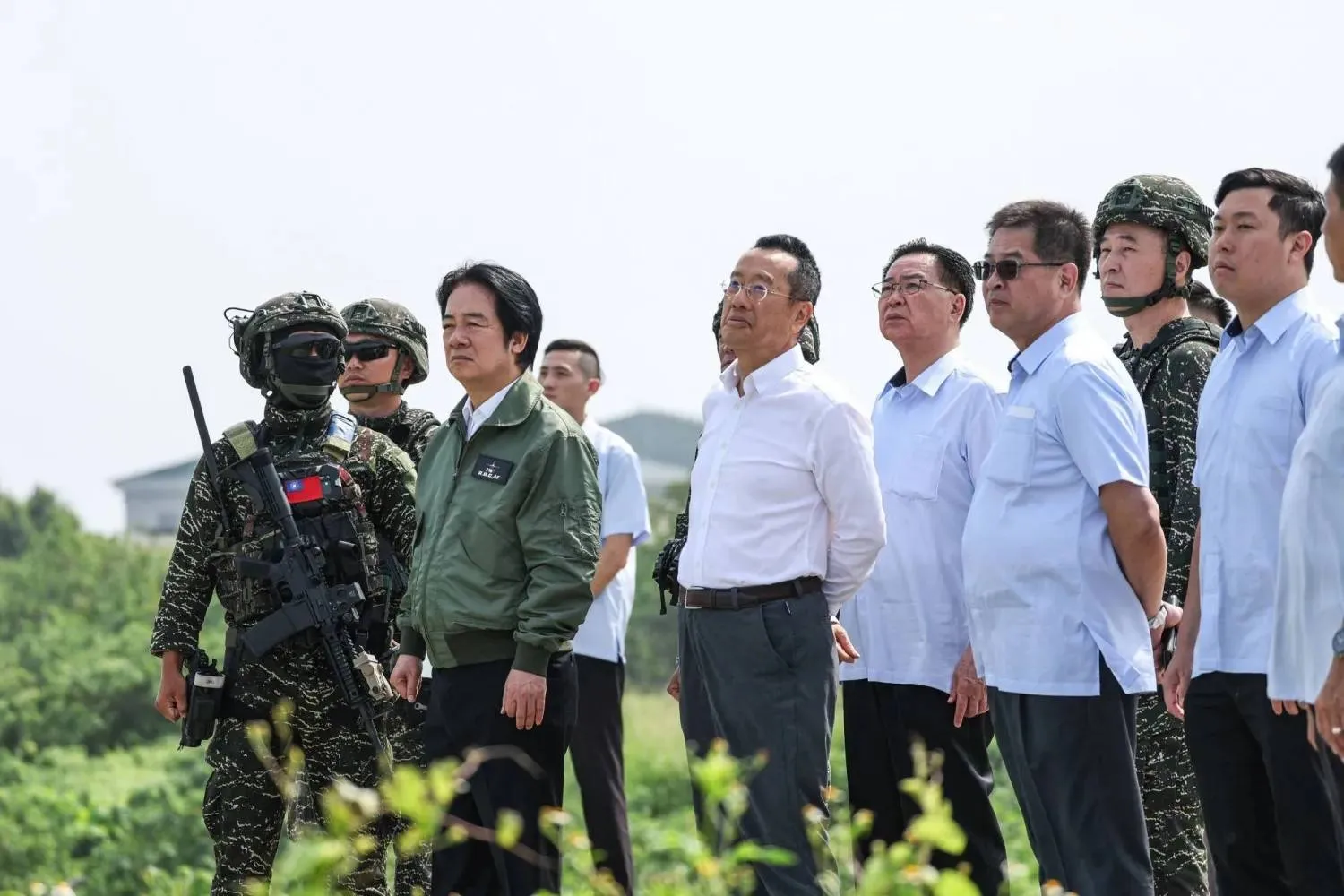
Taiwan's President Lai Ching-te (2nd-L) and Defense Minister Wellington Koo (3rd-L) inspect a drone operation at a navy base during annual Han Kuang military exercise in Kaohsiung, August 8, 2026. (AFP Photo)
TT

Taiwan Building Drones to Repel Any Future Chinese Invasion

Taiwan's President Lai Ching-te (2nd-L) and Defense Minister Wellington Koo (3rd-L) inspect a drone operation at a navy base during annual Han Kuang military exercise in Kaohsiung, August 8, 2026. (AFP Photo)

Taipei: Chris Buckley and Amy Chang Chien

To repel any future Chinese invasion, Taiwan is building fleets of flying drones and unmanned attack boats.

The goal is to use them to help locate and attack Chinese forces approaching the island, relying on Taiwanese soldiers trained to move quickly before China can strike them.

US commanders who developed this strategy call it a “hellscape”: overwhelming an invading force with waves of drones, missiles and artillery, and making an amphibious assault so risky that China’s leaders are deterred from trying.

Inspired by lessons from Ukraine and other recent war zones, Taiwan is now accelerating efforts to put that strategy into practice.

“Our drone and counter-drone efforts started relatively late, and initially we were trying things out as we went along,” Lt General Huang Wen-chi, the director general of strategic planning for the Taiwanese Defense Ministry, told a committee of lawmakers on Wednesday. That has begun to change over the past two years, he added.

On Thursday, Taiwan’s military allowed reporters to watch as troops in central Taiwan practiced using drones for reconnaissance, as part of the island’s annual Han Kuang military exercises, which began on Wednesday and will run for 10 days.

Major General Lu Wen-yuan, who helped plan the exercises, said earlier that they would also train troops to take out enemy drones.

Many militaries across the world are embracing the drone revolution, but Taiwan faces a particularly urgent threat: China, which is roughly 110 miles away, claims the self-governed island as its territory.

Chinese leaders say they want to absorb Taiwan peacefully but will not rule out using force. They are backing that threat with expanding fleets of warships, planes, missiles and drones, as well as more frequent coast guard patrols and landing exercises.

Taiwanese officials have noted Ukraine’s drone-driven gains on the battelfield, and they are trying to emulate Ukraine’s David-versus-Goliath approach: using relatively cheap and nimble drones to level the playing field against a much larger adversary.

“Drones are entering a new chapter,” said Max Lo, the chairman of the Taiwan National Drone Industry Association. “Taiwan, for its own survival and national defense, is in urgent need of these drones. But it’s the same everywhere in the world right now — that’s an opportunity for Taiwan.”

Aiming to make the island a drone industry superpower, the government says it wants Taiwan to make 100,000 drones a month by 2030, with around half exported. It also wants the military to acquire over 210,000 flying and seaborne drones.

Taiwan has “realized that drones will be important in all the domains, in all the phases,” in a potential war with China, said Mick Ryan, a retired Australian major general who has studied Ukraine and Taiwan.

Ukraine’s recent success at longer-range drone strikes suggests that Taiwan could also attack ships leaving Chinese ports if Beijing launched an amphibious assault, said Ryan, now a senior fellow at the Lowy Institute in Sydney.

China’s army is not yet strong enough to easily invade Taiwan, many experts believe, and recent purges in the People’s Liberation Army’s high command have undermined its readiness.

But like Taiwan’s military, it has been building up fleets of crewless planes and boats, and is investing heavily in technology to detect and jam drones.

“Remember, the Chinese are also watching everything the Ukrainians are doing,” Ryan added.

A Long Road to Mastering Drones

For Taiwan, acquiring the drones may be the straightforward part. To master drone warfare, Taiwan must also retool its military organization, training and doctrine.

It must learn to operate swarms of drones, rapidly assess and share the intelligence they provide and prevent an enemy from disabling them, according to experts. This will require troops to be more mobile and self-sustaining.

“The army’s frontline military operations must undergo a total change from the past,” said Shu Hsiao-Huang, an associate research fellow at the Institute for National Defense and Security Research in Taipei, which is supported by Taiwan’s Defense Ministry.

“In the Russia-Ukraine War, if you fire one round, you won’t have a chance to fire a second, if you just stay lined up there without moving on,” he said.

Unlike Ukraine, though, Taiwan lacks the pressure of an actual invasion to mobilize resources and force changes. “It’s very difficult, because they haven’t experienced the crucible of war,” Shu said.

But military units have been working to learn drone tactics, which are a focus of the continuing Han Kuang exercises.

The Taiwanese army also released pictures from a drill last month in which a unit scrambled to defend islands off Taiwan’s east coast by using drones to hunt for enemy forces.

On Saturday, Taiwan’s president, Lai Ching-te, watched an exercise in the island’s south where troops tested two types of prototype drones designed to strike invading forces.

Taiwan also recently created a Littoral Combat Command, integrating drones, mobile missiles and artillery into a coastal shield against potential Chinese invasion.

Still, Taiwan is a long way from meeting the complex demands of 21st-century warfare, many experts said.

It risks becoming “focused on the technology more than the equally essential organizational and doctrinal changes that are needed to implement a hellscape concept,” said Stacie Pettyjohn, a senior fellow at the Center for a New American Security and an author of a recent study of Taiwan’s drone warfare strategy.

Building an Indispensable Drone Industry

In the event of an invasion, China is likely to try to seal off Taiwan from external support. To survive a blockade, Taiwan needs to build stockpiles and expand homegrown drone production, especially “cheaper, shorter-range one-way attack drones,” Pettyjohn said.

Both sides of Taiwan’s polarized political landscape agree on building more drones, even if they disagree on the details.

Taiwan’s government has proposed spending $6.5 billion over five years to buy drones. But two opposition parties that hold the majority in its legislature rejected the plan, arguing that it could attract graft and create waste. The main opposition Nationalist Party has proposed spending $7.4 billion over six years, with requirements for growing levels of domestic production.

As lawmakers debate spending, Taiwanese and US drone makers are competing for potential orders.

Thunder Tiger, a Taiwanese manufacturer, and Shield AI, an American defense technology company, last month staged a trial run for two models of sea drones that could scout for enemy vessels and blow them up. But Chen Kwan-ju, the chairman of Thunder Tiger, said the company is seeking more policy certainty before it expands production partnerships.

At the same time, Taiwan is rapidly increasing its rate of drone exports, seeking to make itself an indispensable supplier of components for other democratic states that want to reduce their reliance on Chinese parts, which raise concerns about supply disruptions, or espionage.

In the first three months of 2026, Taiwan exported drones worth $115 million, exceeding its total drone exports for all of 2025, according to the island’s Ministry of Economic Affairs. The top destination is the Czech Republic, though many of the drones find their way to nearby Ukraine, research shows.

Taiwan’s exports of drone components are probably even higher. Demand for these parts, such as motors and optical equipment, is likely to grow, according to representatives of US drone companies.

“Taiwan sits at the center of one of the most important industrial and strategic competitions of our time,” Michael Robbins, the president of the Association for Uncrewed Vehicle Systems International, wrote in an email. “It is one of the few places positioned to produce trusted drone components at scale.”

The New York Times


Iran Supreme Leader Calls for Unity Among Muslim Countries

Motorbikes drive past a billboard depicting Iran's late Supreme Leader Ali Khamenei, center, handing the country's flag to his son and successor, Mojtaba Khamenei, right, as the late revolutionary founder Khomeini stands at left, in a square in downtown Tehran, Iran, March 10, 2026. (AP)
TT

Iran Supreme Leader Calls for Unity Among Muslim Countries

Motorbikes drive past a billboard depicting Iran's late Supreme Leader Ali Khamenei, center, handing the country's flag to his son and successor, Mojtaba Khamenei, right, as the late revolutionary founder Khomeini stands at left, in a square in downtown Tehran, Iran, March 10, 2026. (AP)

Iran's supreme leader Mojtaba Khamenei on Sunday called on Muslim countries in the region to unite against the United States and Israel, in a written message issued six months on from the start of the Middle East war.

Khamenei, in power since shortly after his father Ali Khamenei was killed at the start of the war on February 28, has yet to be seen in public since his appointment, and authorities have not released any video or audio of him.

"The solution to the problems of the Islamic nations is unity of words, friendship, and cooperation on the path of goodness," he said Sunday.

"Anyone, in any position, who does anything that leads to division among Muslims and creates conflict in the Muslim community, knowingly or unknowingly, intentionally or unintentionally, has served the purpose of the enemies of Islam," he added, according to his official website.

During the war, Iran struck countries across the Middle East, claiming it was targeting US military bases, while the attacks struck civilian and energy facilities.

Relations with those nations have since soured.

Khamenei, who has the final say on major state policies, also called on Iranian officials and citizens to put aside differences and come together against Israel and the United States.

"Again, this servant's advice to the Iranian people is to not allow any differences to arise among themselves in any way," he said, echoing remarks made in another statement on Friday.

"I firmly declare that doing anything detrimental to social cohesion is prohibited," he had said in Friday's message.

He also called Friday for the gradual de-dollarization of the Iranian economy and for boosting economic production to support growth following months of a US naval blockade and years of crippling sanctions that have hit livelihoods.


Pakistan Suspends Eight Officials After Deadly Infant Ward Fire

A woman walks out from the Mother and Child Health ward at the Pakistan Institute of Medical Sciences (PIMS) Hospital in Islamabad on August 27, 2026. (AFP)
TT

Pakistan Suspends Eight Officials After Deadly Infant Ward Fire

A woman walks out from the Mother and Child Health ward at the Pakistan Institute of Medical Sciences (PIMS) Hospital in Islamabad on August 27, 2026. (AFP)

Pakistan's prime minister said eight officials were suspended and called for criminal proceedings against them, after 14 infants were killed in a fire in the maternity ward of a hospital in the country's capital.

A preliminary report conducted by a four-person committee formed by Prime Minister Shehbaz Sharif found the deadly blaze had engulfed the unit "within approximately two minutes" just after 6:30am (0130 GMT) on Wednesday, with a nurse only able to save one of the 15 infants in the hospital's care.

Among those suspended were hospital staff including its executive director and the head of the neonatal department, as well as the director-general of Islamabad's emergency services.

Sharif said late Saturday "those responsible for criminal negligence do not deserve any concession" and that they will be "brought to justice".

He also approved taking action against the company responsible for the hospital's security, without naming them.

Emergency services were called within six minutes of the fire breaking out, with the first rescue services arriving at the scene 15 minutes later, the report said.

Parents and other witnesses told AFP the response had been slow and guards had reportedly prevented people from leaving the building.

The hospital did not have detailed operating procedures or fire and emergency training, according to the preliminary report.

Two nurses, a woman security guard and another officer were in the ward when the fire started, but there were no supervising staff, the report stated.

Earlier Health Minister Mustafa Kamal said that a spark from an air conditioner is believed to have caused the fire. The report clarified an ignition source is yet to be determined as the investigation continues.

Health Secretary Aslam Ghori, the country's top civil servant for the department, was sacked on Wednesday following the devastating incident.

Fires in large buildings are frequent in Pakistan, often due to poor safety laws and building codes as well as lax enforcement.

In January, more than 65 people were killed in a shopping center fire in the port city of Karachi.

At least 11 people were killed in another shopping mall fire in Karachi in 2023.

In 2012, at least 250 laborers died at a garment factory in Karachi.


Russia Says Preparing ‘Massive Strikes’ on Ukraine’s Energy Sector

A view of the destruction after a Russian attack struck a warehouse, followed by an explosion, in the village of Myla, Kyiv region, Ukraine, Saturday, Aug. 29, 2026. (AP)
TT

Russia Says Preparing ‘Massive Strikes’ on Ukraine’s Energy Sector

A view of the destruction after a Russian attack struck a warehouse, followed by an explosion, in the village of Myla, Kyiv region, Ukraine, Saturday, Aug. 29, 2026. (AP)

Russia's defense ministry on Sunday said it was gearing up for large-scale attacks on Ukraine's energy infrastructure in a tit-for-tat response to strikes by Kyiv.

"Russian forces have begun preparations for massive strikes against facilities in Ukraine's energy sector in response to the ongoing attacks by the Kyiv regime on civilian infrastructure and on Russia's oil and energy complex," it said on Telegram.

Last winter, Moscow repeatedly hit Ukrainian power plants, devastating the country's energy sector and plunging millions of people into cold and darkness in sub-zero temperatures.

Both sides have for several months escalated long-range strikes, targeting infrastructure such as warehouses, businesses, oil and port facilities, as well as ships, increasing civilian casualties.

On Sunday, the Russian army claimed to have struck a plant in Kyiv producing asbestos and cement whose warehouses, it said, were used to store explosives, as well as a manufacturer of drones and munitions.

On Saturday, a Russian strike on an ammunition depot in the suburbs of the Ukrainian capital triggered a huge explosion and killed at least 37 people.

Ukraine for its part attacked an oil refinery with drones in northwestern Russia, causing a fire, according to the local authorities.