


Lebanon Passes Sweeping Amnesty Law for Prisoners, Wanted People

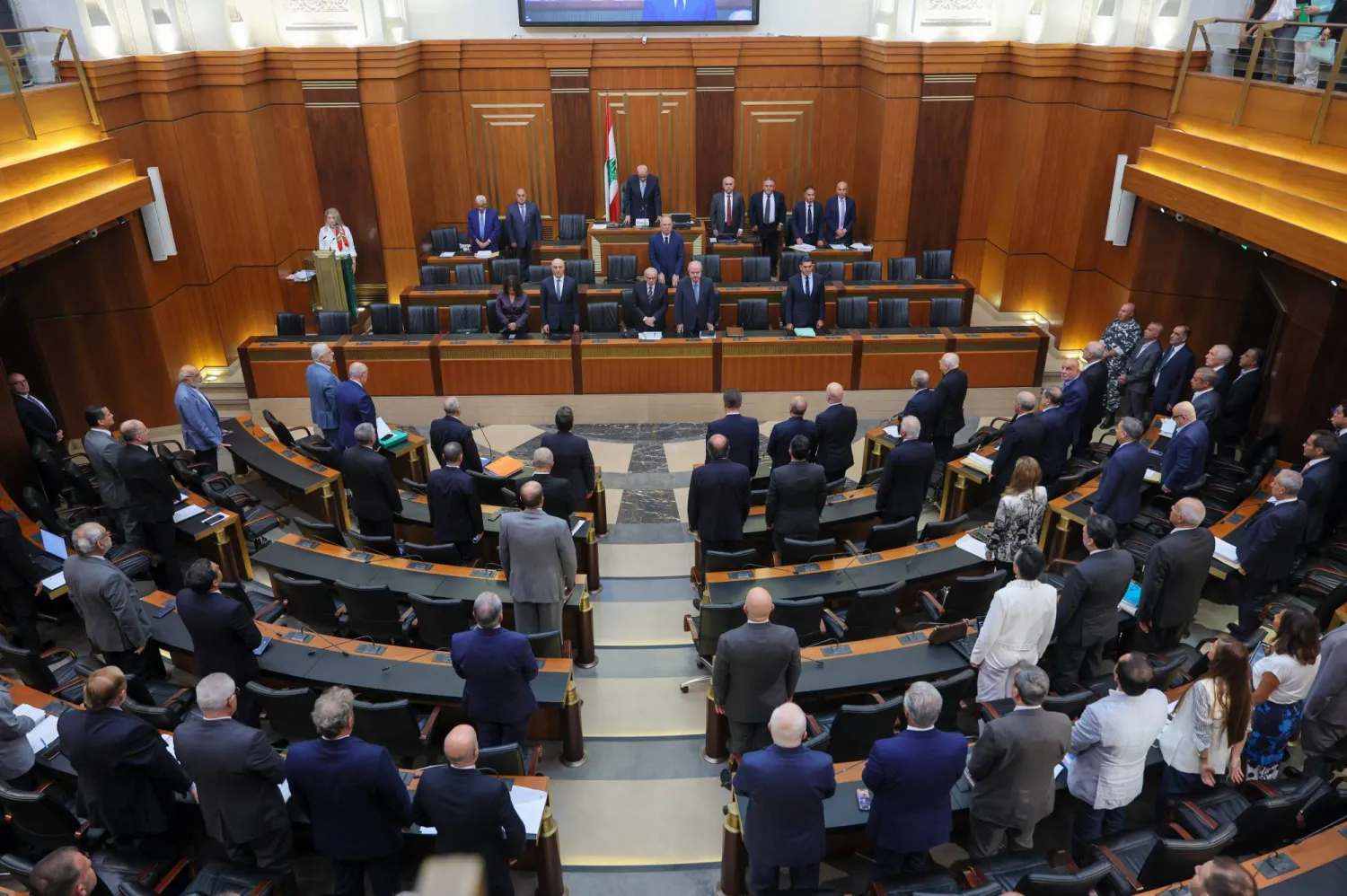
Lebanese lawmakers attend a parliamentary session to discuss a proposed general amnesty law, the abolition of the death penalty and the salaries of retired members of Lebanon's security forces in Beirut, Lebanon, 11 August 2026. (EPA)
TT

Lebanon Passes Sweeping Amnesty Law for Prisoners, Wanted People

Lebanese lawmakers attend a parliamentary session to discuss a proposed general amnesty law, the abolition of the death penalty and the salaries of retired members of Lebanon's security forces in Beirut, Lebanon, 11 August 2026. (EPA)

Lebanon's parliament on Wednesday passed a sweeping and long-awaited amnesty law that should benefit thousands of prisoners and wanted people, in the first legislation of its kind since 1991.

The law, which had been a demand of various political factions and a topic of debate for years, aims to reduce prison overcrowding with many inmates awaiting trial for years.

The office of the country's parliament speaker announced the "approval of a draft law aimed at granting a general amnesty and exceptionally reducing the terms of certain sentences".

Authorities did not immediately announce the number of people that would benefit from the law.

According to Imad al-Hout, one of the lawmakers in favor of the bill, the law reduced the sentences of those facing death and life imprisonment to 17 prison years.

That is equivalent to 12 years and nine months of actual imprisonment in Lebanon, where a prison year is calculated as nine months.

The law also calls for the release of inmates detained for more than 12 prison years without charges as their trial continues.

In its 2025 report, the country's National Human Rights Commission said that prisons had an overcrowding rate of 300 percent, with prison authorities reporting at least 6,268 inmates by the end of March.

But general amnesty was brought back into the limelight after the 2024 fall of longtime Syrian president Bashar al-Assad, as many extremist prisoners in Lebanon were jailed over events linked to the Syrian civil war.

Most of them are accused of crimes that include attacking the Lebanese army, participating in clashes and planning bombings.

Other political forces, including Iran-backed Hezbollah, have been demanding amnesty for their communities.

Thousands of families from the eastern Baalbek and Hermel regions, bastions of Hezbollah and its ally Amal where illicit cannabis cultivation is widespread, have been demanding amnesty for drug-related offenses and car theft for years.

Christian parties meanwhile have pushed for the law to include the families of those who joined an Israeli-backed proxy and fled to Israel after its withdrawal from southern Lebanon in 2000, fearing reprisals, particularly from Hezbollah and its supporters.

Lebanon previously passed a general amnesty law in the wake of its 1975-90 civil war, allowing former warlords to transition into politics without facing trial for crimes committed during the conflict.



Leadership Crisis in Hezbollah After Nasrallah's Assassination

A woman carries a picture of the late Hezbollah leader Nasrallah as supporters of Hezbollah protest outside the Lebanese Government Palace in Beirut, Lebanon, 18 August 2026, rallying against direct Lebanese-Israeli talks.  EPA/WAEL HAMZEH
A woman carries a picture of the late Hezbollah leader Nasrallah as supporters of Hezbollah protest outside the Lebanese Government Palace in Beirut, Lebanon, 18 August 2026, rallying against direct Lebanese-Israeli talks. EPA/WAEL HAMZEH
TT

Leadership Crisis in Hezbollah After Nasrallah's Assassination

A woman carries a picture of the late Hezbollah leader Nasrallah as supporters of Hezbollah protest outside the Lebanese Government Palace in Beirut, Lebanon, 18 August 2026, rallying against direct Lebanese-Israeli talks.  EPA/WAEL HAMZEH
A woman carries a picture of the late Hezbollah leader Nasrallah as supporters of Hezbollah protest outside the Lebanese Government Palace in Beirut, Lebanon, 18 August 2026, rallying against direct Lebanese-Israeli talks. EPA/WAEL HAMZEH

Two years after the assassination of former Hezbollah Secretary-General Hassan Nasrallah, the group has not fully overcome the absence of the man who led it for more than three decades and transformed the secretary-general's office into a center of political, organizational, military, and popular influence that is difficult to replace.

Hezbollah will mark the second anniversary of the assassinations of Nasrallah and his successor, Hashem Safieddine, on Sunday with a public rally at Nasrallah's shrine in Beirut's southern suburbs. Its new Secretary-General, Naim Qassem, will speak at the event. Security measures will include closing roads leading to the shrine from the direction of the old airport road and Ziad Rahbani Highway and diverting traffic to other routes.

According to people close to the group and its opponents, current Secretary-General Naim Qassem does not appear to have succeeded in filling the vacuum left by his predecessor. At the same time, there has been an increasing shift in the center of decision-making within the group, with the room for internal initiative narrowing in favor of decisions coming directly from Iran.

The group's opponents say the issue is not simply a matter of the difference in charisma and popular presence between the two men, but also the nature of the role Nasrallah played within Hezbollah. He combined political, organizational, and military leadership, and served as the principal link with the group's supporters and its Iranian ally. Hezbollah today, by contrast, appears to have a more collective and structured leadership, but with a more direct Iranian role in shaping its choices and decisions.

While people close to Hezbollah believe that, despite the blows it has suffered, the group has managed to reorganize its ranks and maintain its cohesion under Naim Qassem, its opponents argue that the period following Nasrallah has exposed a leadership crisis and a decline in its ability to mobilize supporters, as well as internal divisions resulting from Qassem's performance.

A New Approach to Confronting the Challenges

Political writer Dr. Qassem Qassir, who is closely familiar with Hezbollah's position, acknowledges that after Nasrallah, the group "faced many internal and external obstacles" following a long period of centralized leadership during which Nasrallah held the reins of the organization for about 33 years, from 1992 until 2024, before his assassination under extremely difficult circumstances.

He notes that despite losing both of its secretaries-general, Nasrallah and Hashem Safieddine, along with a number of its cadres and leaders, Hezbollah succeeded in reorganizing its ranks and putting its security and organizational affairs in order under Sheikh Naim Qassem.

In remarks to Asharq Al-Awsat, Qassir says Hezbollah now faces new challenges, which has prompted it to adopt a different approach at both the domestic and external levels. He adds that while Hezbollah was previously a major regional player, it is now focusing to a much greater degree on its internal situation, southern Lebanon, and confronting Israel.

He continues that while Hezbollah is no longer the strongest political player on the domestic scene as it once was, it remains a major political force, and domestic and external actors continue to treat it as a key party in the Lebanese equation.

Asked about the charisma Nasrallah possessed, which many believe Qassem lacks, Qassir says there is no doubt that Nasrallah's charisma was distinctive. However, he describes Sheikh Naim as a highly important organizational and administrative figure who succeeded in reorganizing the group's ranks and preserving its cohesion during an extremely difficult period, given that Hezbollah is entering a new phase that requires a new approach at the political, military, and militant levels.

A Missing Leadership

Jad Al-Akhawi, head of the Lebanese Democrats Coalition and a Shiite opponent of Hezbollah, takes a different view. He says it is difficult to argue that Naim Qassem has so far succeeded in filling the vacuum left by Hassan Nasrallah.

The issue, he says, is not solely about charisma, but about the nature of the leadership Nasrallah built over more than three decades and his ability to combine organizational, political, and military leadership while maintaining direct communication with the group's supporters. Qassem, by contrast, came from a more organizational and ideological background than a popular one and spent decades serving as deputy secretary-general rather than as the group's primary center of gravity.

In remarks to Asharq Al-Awsat, Al-Akhawi says what stands out about Qassem's appearances is their format. He appears on screen, but without the direct interaction with supporters that was an essential part of Nasrallah's public image. Some of Qassem's appearances, he adds, appear to be so tightly controlled and produced that they can at times give the visual impression of an image or persona generated by artificial intelligence rather than that of a political leader interacting directly with his supporters.

He adds that Nasrallah was not merely a secretary-general, but for Hezbollah's supporters he was part of the mechanism for mobilization, persuasion, and decision-making. Naim Qassem, by contrast, has not yet demonstrated that he can inherit all of these functions collectively.

The question, therefore, is no longer simply whether Qassem can fill the vacuum left by Nasrallah, but whether Hezbollah itself can produce a comparable leadership after the collapse of a significant part of its former leadership structure.

The Decision-Making in Iran

Political activist and Lebanese University psychology professor Dr. Mona Fayad, for her part, focuses on Hezbollah's ability to mobilize people. She considers that ability to have declined significantly under Qassem's leadership, pointing to internal divisions within the group between those who support Qassem and those who oppose him, which she says have affected the way decisions are made and the current phase is managed.

Fayad believes Qassem's current performance "serves Israel," making it not in Israel's interest to target him. She also believes that decisions within Hezbollah now come directly from Iran, with the scope for Lebanese decision-making reduced to a minimum.

In this context, Fayad speaks of an Iranian "determination" to keep the Iranian ambassador in Beirut, saying his role goes beyond diplomatic work to include security responsibilities. She describes him as an "intelligence operative" whom Tehran seeks to keep in place to complete his missions.


Iraq Seeks Exemption from US Ban on Iran Airlines

People walk near a giant billboard depicting portrayals of Iran's slain supreme leader Ali Khamenei through various periods in his life, in Baghdad's central Tahrir Square on September 22, 2026. (Photo by AHMAD AL-RUBAYE / AFP)
TT

Iraq Seeks Exemption from US Ban on Iran Airlines

People walk near a giant billboard depicting portrayals of Iran's slain supreme leader Ali Khamenei through various periods in his life, in Baghdad's central Tahrir Square on September 22, 2026. (Photo by AHMAD AL-RUBAYE / AFP)

The Iraqi government said Saturday it was holding talks with the United States to secure exemptions from sanctions on Iranian airlines, which has disrupted travel for patients, students and pilgrims.

All Iraqi airports enforced the ban this week, resulting in major disruption at the airport of the holy city of Najaf, the main destination for Iranian flights to Iraq.

"The Iraqi government is holding direct talks with the American side to exempt certain Iraqi airports from these measures," the prime minister's media office said.

An exemption would allow flights to resume "for humanitarian reasons, including medical treatment, education, religious visits, and for the interest of civilians," it added.

Iranian airlines mainly carry Iraqi Shiite pilgrims to Iran's holy cities or Iranians visiting sacred sites in Iraq. The flights also serve Iraqi students studying in Iran and patients seeking medical treatment there.

Iraq has joined several countries in enforcing the US ban, after Treasury Secretary Scott Bessent said Iranian airlines would be "shut down" on Wednesday.


Golan Spat Exposes One Reason Israel-Syria Talks Stalled

A lake near the Druze village of Majdal Shams in the Israeli-occupied Golan Heights, with Mount Hermon in the background (AFP)
TT

Golan Spat Exposes One Reason Israel-Syria Talks Stalled

A lake near the Druze village of Majdal Shams in the Israeli-occupied Golan Heights, with Mount Hermon in the background (AFP)

The exchange over the Golan Heights between Israeli Prime Minister Benjamin Netanyahu and Syrian President Ahmed al-Sharaa at the UN General Assembly exposed part of what has stalled talks between Israel and Syria.

The negotiations began two years ago but stopped after an Israeli attack on Abu al-Duhur airport in Idlib province a few weeks ago.

To Netanyahu’s critics, his hard-line stance at the United Nations revealed how wary Israel’s current leadership is of peace with Damascus.

Al-Sharaa told the General Assembly in New York that Syria wants peace, but at a price: the return of the Golan Heights, which Israel has occupied since 1967.

Knowing Israel is not ready to pay that price today, he pressed instead for security agreements that would pull Israeli forces out of areas they occupied after Bashar al-Assad’s fall in December 2024 and restore the framework of the 1974 disengagement agreement.

Israel knows Syria’s position from the talks held so far. Al-Sharaa’s government has signaled its willingness to keep negotiating, rebuild trust and eventually reach a full peace agreement, with embassies, good-neighborly relations, trade and cooperation across various fields, according to accounts circulating in Tel Aviv.

Israel’s leadership, unwilling to pay a price for peace, responded sharply. Defense Minister Israel Katz said that the Golan under Israeli sovereignty is an inseparable part of the State of Israel forever.”

Israel, he added, will not withdraw from Mount Hermon or the security zone. He also warned: “Any territory we take this time will remain ours forever, in accordance with the laws of war.”

Netanyahu followed from the UN podium with what appeared to be a history lesson for al-Sharaa, according to his own reading of that history.

“Mr. al-Sharaa, you should know the Jews have been on the Golan Heights since the days of Moses,” he said. “You can read it in the Bible.”

But the region’s history does not establish the claim Netanyahu sought to make. His remarks gave a religious and historical cast to Katz’s statements about occupation. Archaeological sites show that people inhabited the Golan long before the time of Moses and the Israelites.

Evidence of settlement dates to the Copper and Bronze Ages, alongside stone structures, burial sites and other remains left by communities that lived there thousands of years ago.

Critics of Netanyahu’s account say that even if Jews lived in the Golan, they did not live there alone; others may have outnumbered them.

Those critics also accuse Israeli governments of hiding a central fact about the Golan’s occupation: Israel displaced as much as 90% of the Syrian plateau’s population in 1967.

They say 140,000 people lived there at the time, compared with just 8,000 today. Israel still prevents disclosure of the reasons for their displacement, while people from the Golan recount crimes and massacres that drove them out, the critics say.

Under Assad, the Syrian government agreed to lease the Golan to Israel for 15 years, with an option to extend the lease.

Netanyahu now rejects even proposals he once accepted. He wants to use what he sees as a new balance of power and what Katz calls the laws governing the outcome of war. Yet al-Sharaa’s Syria did not start a war with Israel.

The Israeli military, instead, took advantage of Assad’s fall to launch thousands of strikes on Syria, destroy 85% of the Syrian military’s defensive capabilities and occupy new areas in the south.

Israelis confirm al-Sharaa’s assertion that the two sides had agreed on 90% of the issues in a proposed security arrangement.

They explain Israel’s retreat from the talks by claiming that Syria is becoming a sphere of Turkish influence and that Syrian territory could be used to attack Israeli settlements in the Golan, as Hamas attacked communities around Gaza on Oct. 7, 2023.

Syrians offered far-reaching security guarantees in the negotiations: demilitarization in southern Syria and a secure trade corridor that would allow Druze communities in Israel and the Golan to send aid to Sweida province.

They also agreed to joint security coordination under US supervision, including intelligence sharing and Jordanian participation in monitoring the entire border area.

Israel wanted more: to keep Mount Hermon’s peaks and parts of a security belt, and to retain the freedom to enter Syria in pursuit of armed cells.

The prevailing sense is that Israel has little interest in successful talks and entered them only because US President Donald Trump wanted it to. Trump alone is seen as stopping Netanyahu from using the situation in Syria to launch further military attacks.

The US president appears to be waiting for the Israeli election results before deciding where he stands on the government’s policies.

Trump issued a presidential proclamation in March 2019 recognizing Israeli sovereignty over the Golan Heights.

UN resolutions, however, affirm that the Golan is occupied territory and reject Israel’s declaration that it has imposed its laws and administration on the Syrian plateau.