


New Space Object ‘Black Hole Star’ Discovered by Astronomers

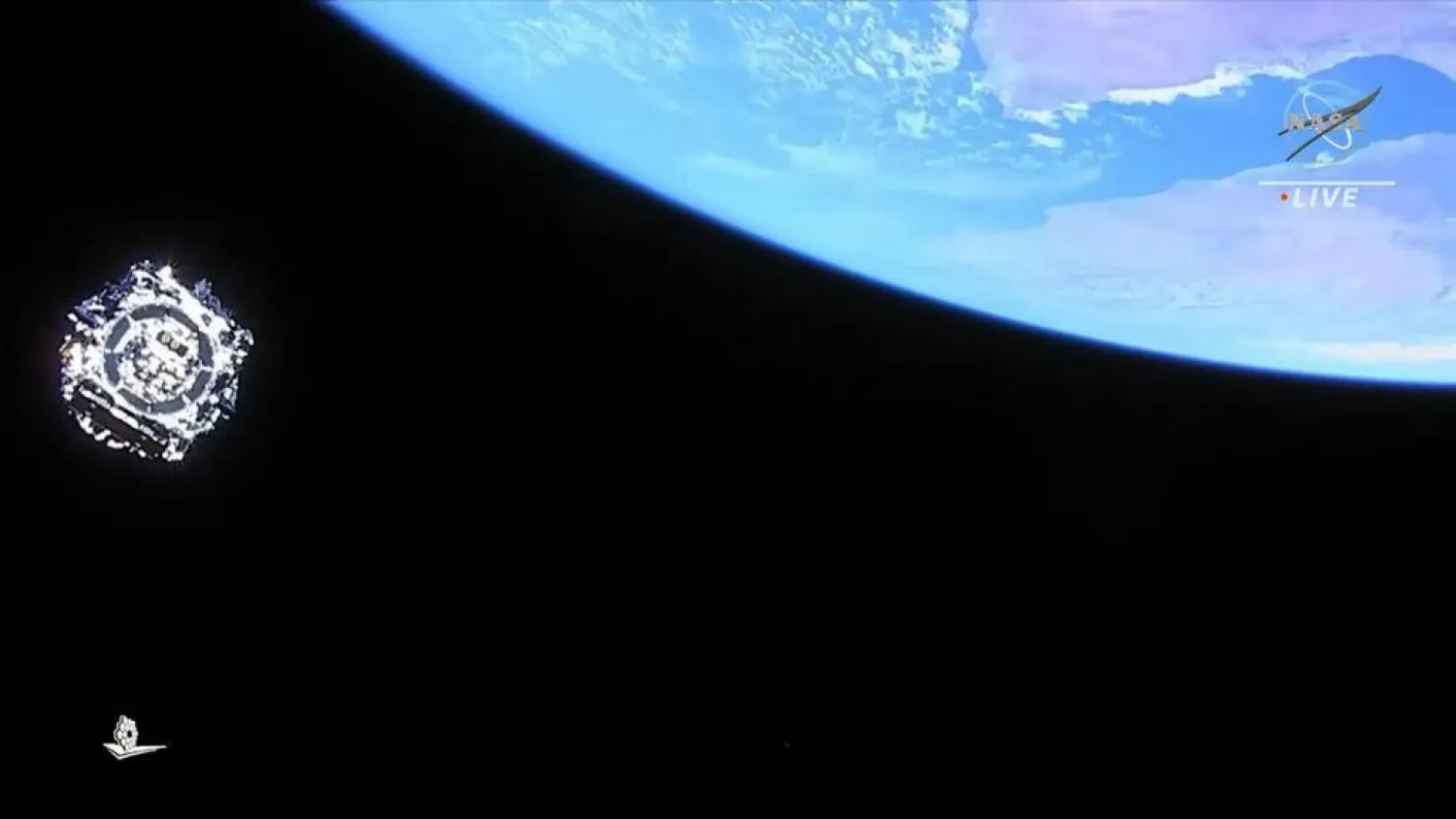
 The James Webb Space Telescope, which spotted the new astronomical object called a "black hole star". (NASA TV/AFP file)
The James Webb Space Telescope, which spotted the new astronomical object called a "black hole star". (NASA TV/AFP file)
TT

New Space Object ‘Black Hole Star’ Discovered by Astronomers

 The James Webb Space Telescope, which spotted the new astronomical object called a "black hole star". (NASA TV/AFP file)
The James Webb Space Telescope, which spotted the new astronomical object called a "black hole star". (NASA TV/AFP file)

Astronomers announced Wednesday they had discovered a new type of astronomical object called a "black hole star", potentially solving a mystery involving strange red dots spotted in the early universe.

The object looks like a star the size of our solar system, but produces 100 billion times more energy than any star -- a mighty blast of power closer to what is produced by a black hole.

The black hole star, which dates from 660 million years after the Big Bang, was spotted by a US-led team of astronomers using the James Webb Space Telescope, according to a study published in the journal Nature.

Since history's most powerful telescope went online in 2022, it has been spotting many extremely bright cosmic objects dubbed "little red dots" in the early universe that have baffled scientists.

"What exactly these objects are has been one of the most debated topics of the JWST era," lead study author Rohan Naidu of Hawaii University said in a statement.

The team had been trying to find clues for a different mystery: why JWST keeps finding bright galaxies in the universe's infancy, when it was thought to have been too early for them to have become so huge.

But while looking through the images, they spotted a little red dot.

- 'Pure black hole star light' -

"When we see something very red in the universe, we often assume that it is surrounded by dust, like soot or ash," said Robert Simcoe, a study co-author from the Massachusetts Institute of Technology.

"The same way that the wildfire smoke from Canada recently made the sky in Boston look bright red, astronomical objects can also appear redder than their intrinsic color when you see them through a veil of dust," he added.

However, when the team sifted through their data, they found that at certain wavelengths, the object's light simply disappeared.

To their surprise, this suggested that it is not dust making this object appear red -- it is hydrogen gas.

This explained the object's color, but not how it could be pumping out so much energy.

"You can't be powering this by nuclear fusion, which is the energy source that sits at the heart of all the stars," Naidu explained.

Using modelling simulations, they determined the most likely scenario was that the object is powered by a central black hole surrounded by a cocoon of gas that makes it resemble a star.

The team named the object MoM-BH*-1. The BH and asterix is for black hole star -- and the number one suggests they believe there are more out there.

"Every little red dot is consistent with being a black hole star," Naidu said.

"What is special about MoM-BH*-1 is, the black hole star is essentially completely outshining its surrounding host galaxy, such that we're seeing pure black hole star light."



MWL Launches First Interactive Scientific Encyclopedia on Scientific Miracles in the Quran

Muslim World League (MWL) Secretary-General and Chairman of the Organization of Muslim Scholars Sheikh Dr. Mohammed Al-Issa speaks at the launch event on Monday. (MWL on X)
TT

MWL Launches First Interactive Scientific Encyclopedia on Scientific Miracles in the Quran

Muslim World League (MWL) Secretary-General and Chairman of the Organization of Muslim Scholars Sheikh Dr. Mohammed Al-Issa speaks at the launch event on Monday. (MWL on X)

Muslim World League (MWL) Secretary-General and Chairman of the Organization of Muslim Scholars Sheikh Dr. Mohammed Al-Issa inaugurated the "International Forum on Scientific Miracles in the Quran and Sunnah" at the MWL's headquarters in Makkah.

The event was attended by prominent Muslim scholars specializing in studies and research on scientific miracles.

Al-Issa launched the "MWL Encyclopedia of Scientific Miracles in the Quran and Sunnah," the first interactive digital scientific encyclopedia of its kind, available in 10 languages.

The encyclopedia includes 500 peer-reviewed scientific research papers spanning 7,500 pages across 15 volumes. It features 2,000 high-resolution scientific images, 2,000 high-quality short scientific videos, and 4,000 links to reputable scientific websites and peer-reviewed scientific journals.

Al-Issa also honored several scholars who had made significant scientific contributions to research and studies on scientific miracles.


Don’t Ban Children from Social Media, Estonia Tells EU

The TikTok app icon on a smartphone in this illustration taken October 27, 2025. (Reuters)
TT

Don’t Ban Children from Social Media, Estonia Tells EU

The TikTok app icon on a smartphone in this illustration taken October 27, 2025. (Reuters)

The European Union should make social media platforms change instead of banning children from using the apps, Estonia's digital minister told AFP Monday, just over a week before the EU is due to announce an age limit.

Estonia has been a lone voice in opposing the EU's plans to restrict children's access to social media, instead calling for online platforms to change.

EU chief Ursula von der Leyen is expected to announce a social media ban on September 16, with officials saying an age limit of 13 or 15 is under discussion.

But IT-savvy Estonia argues the tech giants have prime responsibility for making their popular platforms safer for minors.

"As children are members of the information society, it's actually the platforms who should change," Estonian Justice and Digital Affairs Minister Liisa-Ly Pakosta said.

"The best interests and rights of the child must guide platforms' design, and that is useful for the whole society," she said in a video interview.

Pakosta pointed to the EU's content law known as the Digital Services Act (DSA) as one way for the bloc to demand platforms change.

She argues for instance that the EU's recommendations for platforms under the DSA to protect children online should be made legally binding.

The EU has already deployed the law to probe Meta's Facebook and Instagram as well as TikTok, and told the platforms to change their "addictive" designs.


‘Slumping’ South Korean Corals Worry Divers, Scientists Studying Climate Change

Kang Do-hyung, principal research scientist at Korea Institute of Ocean Science and Technology and former Oceans and Fisheries Minister, checks corals with researchers at a lab called Jeju Tropica, in Jeju, on Jeju Island, South Korea, August 20, 2026. (Reuters)
TT

‘Slumping’ South Korean Corals Worry Divers, Scientists Studying Climate Change

Kang Do-hyung, principal research scientist at Korea Institute of Ocean Science and Technology and former Oceans and Fisheries Minister, checks corals with researchers at a lab called Jeju Tropica, in Jeju, on Jeju Island, South Korea, August 20, 2026. (Reuters)

Ko Myeong-hyo loved the vibrant color and thriving life of South Korea's soft corals when she first began diving off the coast of Jeju island six years ago, looking to harvest seafood for sale.

"Watching the coral garden collapse and turn white, it was so disorienting," Ko says now, after two years of rising temperatures and harsher weather brought by climate change have led to many corals slumping over and dying.

"I was afraid the whole sea might be collapsing."

The "slumping" phenomenon is showing up again this year, says the Paran Ocean Citizen Science Center, a group of divers who monitor the island's UNESCO-listed soft corals, mostly around uninhabited islets south of Jeju.

Roughly half of one cluster off the islet of Beomseom has been struggling in past months, the group says.

Unlike hard corals supported by rigid calcium carbonate skeletons, soft corals rely on internal fluid pressure to keep upright. Environmental changes can disrupt that pressure, leading them to sag or collapse.

"If another large-scale 'slumping' happens, corals partially recover and ‌then a lot ‌break off and deteriorate again, and that keeps repeating, their capacity to recover just keeps declining," ‌said ⁠researcher Kim Taihun.

Kim ⁠and Anna Beate Jöst, a colleague at the Korea Institute of Ocean Science and Technology (KIOST), documented Jeju's 2024 soft coral slumping event for the first time in a May article in the journal Scientific Reports.

In an email, Korea Heritage Service, which manages the soft coral colonies designated a national monument, said it has monitored the situation this year and will keep up long-term research to identify the reasons for the changes.

The Oceans Ministry, which oversees marine protected species and areas such as soft corals, added that it plans detailed investigation to gauge the scale of damage.

EL NINO COULD WORSEN THIS YEAR'S EVENT

Kim said this year's event looked similar to that of 2024, but could worsen should high water temperatures persist ⁠through September, and the El Nino weather phenomenon may trigger typhoons and heavy rains.

But he called for ‌consistent and quantitative monitoring of the loss of soft corals through slumping, citing a ‌lack of research support.

Climate change has hit corals globally, with perhaps the world's most famous colonies on Australia's Great Barrier Reef getting the most attention.

A record ‌heatwave has parched the Korean peninsula this year while heavy rains have pelted the south.

Coral researchers say such weather conditions, as ‌well as water flowing down from China's Yangtze River to affect the area's salinity, are potential triggers for "slumping".

Jeju's waters have given safe harbor to soft coral communities, sensitive to environmental conditions and living on the edge of tolerable conditions in the northernmost limit of coral distribution in the East China Sea.

Soft coral functions as the nursery underpinning Jeju's marine ecosystem, and soft coral communities reside in the UNESCO-listed Jeju Island Biosphere Reserve.

"The seaweed sea, the coral ‌sea, is the foundational ecosystem underlying Jeju's marine ecology," said Yoon Sanghoon, an environmental expert at Paran.

"So if this base ecosystem collapses, there's a real possibility the entire marine ecosystem could collapse."

Over the ⁠past decade, marine heatwaves around ⁠Korea have extended almost four times longer, at 83.3 days, weather authorities say.

RIPPLING IMPACT

Paran, formed in 2023 by Jeju residents concerned by marine changes, brings together office workers, traditional divers and documentary filmmakers who flock there for monthly dives.

They plunge to the coral bed to take photograph and document changes they provide to scientists.

While Ko, a third-generation Jeju "haenyeo" or "sea woman", can dive to a depth of as much as 8 m (26 ft) relying on her own breath, she carries an oxygen tank on coral dives to greater depths.

The warming waters have affected the seabed in other ways, said her mother, 70-year-old Son Choon-sook, who began diving 45 years ago, when species such as turban shells, abalone and sea cucumber were abundant and thick seaweed festooned the rocks.

"I've worked at the sea for about 45 years, earned money, and sent my children to school on it," she said. "Now the catch has run dry, and it makes me very sad."

The thinning catch of the past few years follows summers that make the water too hot for species to spawn, she added, and her workday has shrunk to three hours from five formerly, as there is less to gather, but partly also for reasons of health.

Ko said her most recent dives in the summer have worried her again. "Rather than the beautiful coral shapes, I feel like I'm seeing more sick coral now," she added.