Israel Defense Minister Vows Troops to Stay in Lebanon, Syria, Gaza

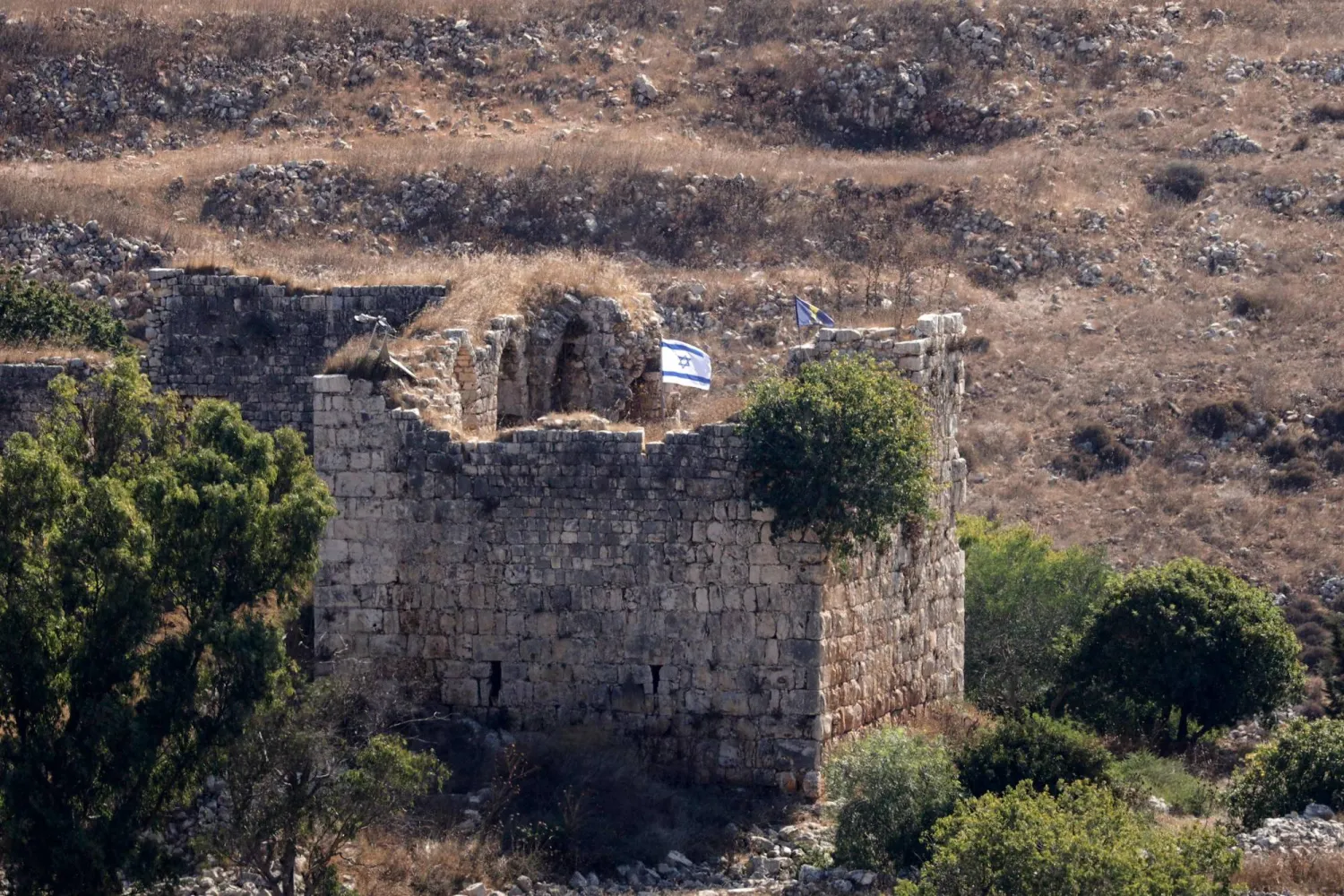
A photograph taken from the southern Lebanese village of Chaqra shows the Israeli flag as it flutters on top of the nearby Crusaders Cital of Doubieh on August 11, 2026. (AFP)
TT

Israel Defense Minister Vows Troops to Stay in Lebanon, Syria, Gaza

A photograph taken from the southern Lebanese village of Chaqra shows the Israeli flag as it flutters on top of the nearby Crusaders Cital of Doubieh on August 11, 2026. (AFP)

Israel's Defense Minister Israel Katz visited southern Lebanon on Wednesday, vowing to destroy infrastructure and keep troops in a so-called "security zone" as well as in Syria and Gaza.

The comments came almost two months after Israel and Lebanon agreed to a US-sponsored framework deal that involves the disarmament of the Iran-backed Hezbollah, a gradual withdrawal of Israeli forces from Lebanon's south and the deployment of the Lebanese army to the region, starting in test areas known as "pilot zones".

The United States plans new talks in early September in Rome between Israel and Lebanon.

Katz and Prime Minister Benjamin Netanyahu have repeatedly vowed not to withdraw from the occupied "security zone" in southern Lebanon -- a strip of territory where Israeli forces operate that reaches around 10 kilometers (six miles) into Lebanon.

"As the prime minister and I have clearly stated, we are not withdrawing from this security zone," Katz said during a visit to troops, according to a statement from his office.

The Israeli military "is here to protect the northern communities and its own forces. We will clear this area and guarantee the security of the residents of the north. We will in no way withdraw from the security zones: not in Lebanon, not in Syria, and not in Gaza," he added.

In southern Lebanon, Katz said the military was "destroying the underground infrastructure" in the area and "destroying all the houses".

Hezbollah drew Lebanon into the Middle East war in early March with rocket fire aimed at Israel to avenge the killing of Iran's supreme leader in US-Israeli strikes.

Israel responded with massive airstrikes and a ground invasion of southern Lebanon.

Israel has also carried out repeated incursions and bombings in Syria since the overthrow of longtime ruler Bashar al-Assad, saying it sought to establish a demilitarized zone in the country's south.

In Gaza, Israeli forces occupy more than 60 percent of the war-battered territory.

Last week, Netanyahu rejected a US-led plan for Gaza endorsed by Hamas, saying the Israeli military "will not carry out any withdrawal until Hamas is genuinely disarmed, and will continue to thwart threats against our forces and our citizens".


Hamas Shocked by Al-Arabeed’s Abduction as Israel Eyes ‘Intelligence Trove’

A Palestinian bids farewell to her sister, Israa al-Hassi, 7, after she was killed by Israeli military fire in central Gaza on Tuesday (AFP)
TT

Hamas Shocked by Al-Arabeed’s Abduction as Israel Eyes ‘Intelligence Trove’

A Palestinian bids farewell to her sister, Israa al-Hassi, 7, after she was killed by Israeli military fire in central Gaza on Tuesday (AFP)

Hamas security bodies were reeling after a swift Israeli operation shortly before noon on Tuesday seized Moin Al-Arabeed, a senior security official in the movement and its government, and took him into Israel.

Israeli reports said interrogating Al-Arabeed could yield an “intelligence trove.”

A day after the raid, Israeli Prime Minister Benjamin Netanyahu visited Israeli troops in Gaza and said Israel would not withdraw from the Palestinian enclave.

“We control the area. We will not retreat. We will remain on this line,” Netanyahu said from the “Yellow Line,” which separates areas held by Israeli forces from those administered by Hamas.

The raid, carried out by a Shin Bet force, nearly unraveled when Al-Arabeed, members of his family — including his wife and daughter — and his bodyguards exchanged fire with the Israelis in an attempt to thwart it.

The operation took place in a residential block known as the Villas in Gaza City’s Al-Katiba district, an area considered safe. Sources told Asharq Al-Awsat that the headquarters of Gaza’s Internal Security Service, which Al-Arabeed headed, was no more than 250 meters from the scene.

The neighborhood also houses many displaced people and armed Palestinian families. Some of those weapons were used days earlier in a major dispute in which gunfire continued for hours and at least one person was killed.

Hamas sources in Gaza told Asharq Al-Awsat that a broad committee had been formed to investigate the raid and determine how the Israeli force entered the area.

Investigators collected videos recorded by residents and displaced people nearby, as well as security-camera footage from homes and apartment buildings, to reconstruct each stage of the operation, the sources said.

What happened during the raid?

Two security sources told Asharq Al-Awsat that Al-Arabeed was leaving his home with a bodyguard when the Israeli special force opened fire on them. His wife then spotted the raiders.

“His wife, who was killed in the attack, opened fire at the Israeli force,” one source said. “Two of her sons then joined the exchange of fire and tried to give their father a chance to withdraw despite his leg injury. Both were seriously wounded.”

A second security source said surveillance footage and witness accounts showed the force pursuing and wounding Al-Arabeed before seizing him and taking him out of Gaza City toward Israeli-controlled territory.

Warplanes and drones flew intensively overhead to cover the force’s withdrawal, the source said.

A source from a Palestinian faction said one of Al-Arabeed’s sons, who married four months ago, had an eye removed after being struck directly in it. His other son, who had been due to sign his marriage contract on Tuesday, was seriously wounded.

Their sister suffered moderate injuries, while their mother was shot directly in the head during the exchange of fire, the source said.

At least two bodyguards who were in the house’s rear courtyard also were wounded after engaging the Israeli force.

Drones fired more than five missiles, while small quadcopters dropped more than 14 bombs in and around the area to create a diversion and protect the force, the source said.

A video recorded by residents showed a wounded Al-Arabeed crawling and apparently trying to escape. The vehicle carrying the special force reached him, and he opened fire toward it. The Israelis returned fire and threw a bomb toward him before seizing him.

Israel hails an ‘intelligence trove’

Israeli officials celebrated the raid, with Netanyahu praising it on Tuesday evening and alleging that Al-Arabeed was behind the holding of Israeli hostages and efforts to rebuild Hamas’s capabilities in Gaza.

A senior Hamas source denied to Asharq Al-Awsat that Al-Arabeed had played any role in matters involving the Israelis held by the movement during the war.

Nitzan Shapira, military correspondent for Israel’s Channel 12, said information Al-Arabeed might disclose during questioning could be an “intelligence trove” for Israel.

Channel 12 said Al-Arabeed was in good condition after receiving treatment at an Israeli hospital and had begun undergoing questioning. Israeli security officials believe his senior Hamas role could make him a valuable source of information, it said.

The channel said the Shin Bet carried out the operation alone and that none of the armed gangs in Gaza took part.

The Shin Bet had tracked Al-Arabeed for a long time before obtaining what the channel called “golden intelligence” and finding the right opportunity to arrest him.

The operation was conducted under intense secrecy, and officials planned to conceal its details. But reports from Palestinian sources about the nature of the attack forced the security agencies to disclose them, Channel 12 said.

Field sources told Asharq Al-Awsat on Tuesday that the Israeli force may have been in the area for at least two days before the raid.

Israel’s Kan public broadcaster said the Shin Bet had located Al-Arabeed several weeks earlier. Israel considered killing him in an airstrike but concluded that a special operation could bring him to Israel for questioning.

The raid was planned over several months and directed from the Shin Bet’s special operations room, Kan said.

Citing sources, the broadcaster said Israel decided to take Al-Arabeed alive because of his role in rebuilding Hamas and because he was among those obstructing efforts to dismantle and disarm the movement.

The operation was coordinated with the Americans and approved by Netanyahu and Israeli Defense Minister Israel Katz, according to the report.

Intelligence was not the only objective

Israeli sources told Channel 12 that the raid was intended not only to gather intelligence but also to make senior Hamas leaders feel hunted, even during a period of relative calm in Gaza.

Israel’s Maariv newspaper said the operation had made Hamas realize that its leaders were exposed to Israeli intelligence and that Israel could reach every home and tunnel.

An Israeli security official told the newspaper that Al-Arabeed’s position was comparable to that of brothers Mohammed and Yahya Sinwar, who controlled Hamas’s military wing.

An informed Hamas source rejected that account but told Asharq Al-Awsat that Al-Arabeed was not merely an ordinary officer or security official.

Maariv cited sources describing the raid as strategic. Israel could have killed Al-Arabeed from the air, as it had done with others, but chose to seize him for the information he could provide.

The operation was likely to produce results depending on that information, the newspaper said.

Haaretz said Al-Arabeed’s capture was highly valuable from Israel’s perspective. His interrogation could reveal, for example, what Hamas knows about the network of agents Israel currently operates in Gaza.

The newspaper linked the issue to lessons from the Oct. 7, 2023, attacks, saying investigations found that agents had conducted very little operational activity before the war.

Haaretz said Hamas was likely to take steps to limit the intelligence damage caused by Al-Arabeed’s capture.

Hamas sources told Asharq Al-Awsat on Tuesday that Al-Arabeed was responsible for files involving suspected collaborators with Israel.

He also handled several sensitive security matters, including the arrest of ISIS loyalists and others, and oversaw investigations into armed gangs.


Lebanon Dismantles Security Network Linked to Hezbollah, Assad Remnants

Syrian army patrols the Lebanese border near Qusayr and searches tunnels used by Hezbollah in April 2026 (AFP)
TT

Lebanon Dismantles Security Network Linked to Hezbollah, Assad Remnants

Syrian army patrols the Lebanese border near Qusayr and searches tunnels used by Hezbollah in April 2026 (AFP)

Lebanese authorities have foiled a plot threatening security in Lebanon and Syria, dismantling a dangerous cross-border network linked to Hezbollah and remnants of the former Syrian regime.

Judicial and security sources told Asharq Al-Awsat that five network members, three Syrians and two Lebanese, had been arrested.

The group brought fighters from Syria into Lebanon across the northern border, moved them to Beirut’s southern suburbs and then sent them to a training camp in the Baalbek-Hermel region.

The detainees held both Lebanese and Syrian citizenships, the sources said. The most prominent was Syrian Colonel Manaf Ali Safi, who had been in charge of a security branch under the former Syrian regime.

Authorities seized weapons and ammunition from the network, including hand grenades, machine guns, and sniper rifles. The arsenal raised fears about what the group was preparing to do, particularly as investigators examine whether its objectives went beyond military training.

Possible attack on the Bekaa

Preliminary investigations showed that the detainees admitted receiving training from Hezbollah fighters and operatives led by a man known as “Hajj Alaa,” according to the sources.

The network was run by Major General Mohammed Jaber, the former commander of the Desert Brigade in the Syrian army, the sources revealed.

Jaber is now in Moscow and is known to have been close to ousted Syrian President Bashar al-Assad.

The case poses a major security challenge for Lebanon, given the network’s ability to move across the Lebanese-Syrian border at a highly sensitive time in relations between Beirut and Damascus.

The detainees claimed the stated purpose of the training was to prepare for a possible attack by Syria’s current forces on Lebanon’s Bekaa region, the judicial and security sources said.

Initial findings also pointed to a broader network inside Syria involving more than 50 remnants of the former regime. They arranged the transfer of fighters from Syria into Lebanon and monitored Syrian forces’ movements inside Syria.

Sowing unrest and security chaos

Initial information also implicated three Hezbollah-linked individuals in bringing in and training the fighters. Several other names remain under scrutiny as investigators seek to establish their roles.

The sources said the network’s mission likely went beyond preparing to repel a possible Syrian incursion. They said it may have sought to sow unrest and security chaos in Lebanon, carry out assassinations and, most importantly, conduct operations in Syria’s coastal region.

That assessment was based on the weapons seized, including explosives, military-grade machine guns, sniper rifles and hand grenades.

Bodyguard to Christian bloc leader arrested

In a significant development, the sources said a member of Lebanon’s State Security agency who was part of the group had been arrested at dawn on Wednesday after more than a week in hiding. The man worked as a bodyguard for the head of a Christian parliamentary bloc.

He is the brother of one of the detainees and helped another person move and conceal a cache of weapons hidden in Talbira, an Akkar town near the Syrian border, the sources said.

The town served as an assembly point for fighters arriving from Syria before they were moved to Beirut’s southern suburbs. That adds a more sensitive dimension to the case, pointing to organized routes for moving people and weapons across the border.

Lebanese security agencies are working to uncover the network’s full structure and identify everyone involved, particularly those suspected of handling financing, recruitment, transportation and training.

Investigators are also seeking to determine what operations the group was preparing and whether it has other cells in Lebanon or Syria.


Lebanon Central Bank Says New Audit to Scrutinize Transactions for Graft

A view shows Lebanon's Central Bank building in Beirut, Lebanon August 25, 2023. (Reuters)
TT

Lebanon Central Bank Says New Audit to Scrutinize Transactions for Graft

A view shows Lebanon's Central Bank building in Beirut, Lebanon August 25, 2023. (Reuters)

Lebanon's central bank said Wednesday that an outside firm had begun a forensic audit into past transactions linked to its foreign assets, scrutinizing them for evidence of graft in the wake of the country's economic collapse.

The move is part of measures the institution has taken to improve oversight, steps that have also resulted in the arrest of the body's former governor, Riad Salameh.

A forensic audit has also been a key demand of the international community and the International Monetary Fund as Lebanon seeks bailout funds after the economic crash, which began in 2019.

The central bank said Wednesday that on August 17, the New York-based Alvarez & Marsal began the forensic audit of "selected transactions", covering the period from October 2019 to the end of 2023.

The audit includes "transactions related to the central bank's foreign assets, including subsidy programs for essential goods and materials" as well as other transfers, it said.

In May, the central bank had said that the audit aimed to verify that payments and transfers "were executed pursuant to proper authorizations and approvals", and that funds "were used for their intended purposes, without any violation, misuse, or misappropriation".

In 2020, Alvarez & Marsal had launched an audit of the central bank but later halted work after the body failed to hand over necessary data.

The firm resumed that audit the following year, and its preliminary report in 2023 painted a damning picture of the institution under long-serving former governor Salameh.

Salameh, who headed the bank from 1993 to July 2023, is widely viewed as a key culprit in the country's dramatic economic crash and is accused of having amassed a fortune during his time in the job.

He has faced numerous accusations including embezzlement and tax evasion in probes in Lebanon and abroad but has consistently denied any wrongdoing, insisting he is being made a "scapegoat" for the economic collapse.

He was arrested in September 2024 and charged with offenses including the alleged embezzlement of $44 million from the central bank, but was released a year later after posting record bail of more than $14 million.

He was placed in custody again in July over accusations including embezzlement and illegal enrichment after a complaint lodged by the new central bank authorities.