
Syria Forms Committee to Seek Interpol Handover of Assad-Era Figures

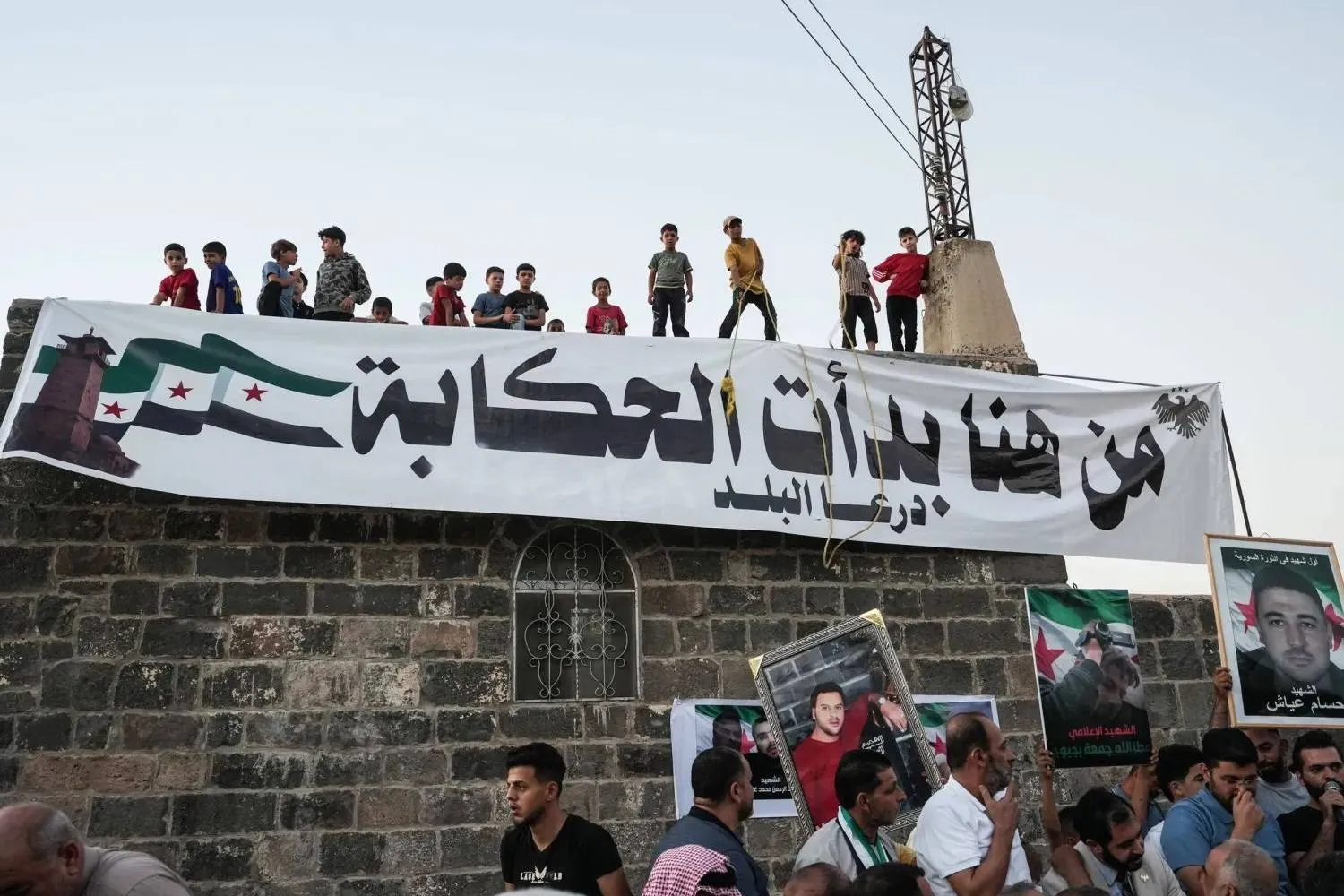
Syrians celebrate outside the Omari Mosque in Daraa, where the Syrian uprising began in 2011, after a Syrian court sentenced Atef Najib, the official responsible for the crackdown in the city, to death (dpa)
TT

Syria Forms Committee to Seek Interpol Handover of Assad-Era Figures

Syrians celebrate outside the Omari Mosque in Daraa, where the Syrian uprising began in 2011, after a Syrian court sentenced Atef Najib, the official responsible for the crackdown in the city, to death (dpa)

Syria has formed a committee to seek the extradition of criminals sentenced to death in absentia, Deputy Justice Minister Mustafa al-Qassem said on Wednesday, as the government defended the rulings against criticism from Amnesty International.

Al-Qassem said the committee would coordinate with Interpol to secure the handover of those convicted to Syria.

A Syrian court on Tuesday sentenced ousted President Bashar al-Assad and several senior figures from his rule to death, including former security official Atef Najib, in the first rulings of their kind since the former government was overthrown in late 2024.

Cheers and chants erupted inside the courtroom, through the corridors of the Palace of Justice and outside the building as the verdicts were announced.

“We have established offices to receive complaints related to transitional justice crimes, and we are seeking to recover Syrians’ stolen funds and pursue those who invested them abroad,” al-Qassem told Syria’s Al-Ikhbariya television.

He said international cooperation, particularly in the handover of fugitives, would help accelerate Syria’s transitional justice process.

Al-Qassem said the Justice Ministry was also seeking the closest possible alignment between Syrian judicial procedures and international trial standards, while stressing Syria’s national sovereignty in matters of transitional justice.

The Justice Ministry, meanwhile, pushed back against Amnesty International’s criticism of Tuesday’s rulings, saying the group’s statement “does not accurately reflect the nature of the judicial procedures followed in these cases or the safeguards guaranteed to litigants under Syrian law.”

Amnesty said the government, if it wanted to “truly turn the page on the horrors of the past,” should end trials in absentia and the death penalty, criminalize core crimes under international law in domestic legislation and undertake comprehensive judicial reform.

It said prosecutions should take place before ordinary civilian courts, with victims participating and without resorting to capital punishment, as part of a nationwide, victim-centered strategy aimed at establishing truth, delivering justice and providing reparations.

The ministry said the cases were heard before a competent civilian criminal court by qualified judges, with victims and their representatives taking part in accordance with legal procedures.

It said constitutional and legal safeguards were observed, along with relevant principles of international humanitarian law and international human rights law.

The trials, it added, were based on facts, evidence and judicial case files, with defendants guaranteed rights of defense, appeal and objection under applicable procedures.

The ministry said Syria’s current circumstances, after years of crimes and violations, placed a legal and moral duty on the state to deliver justice and hold those responsible to account.

That responsibility, it said, did not justify bypassing constitutional or legal safeguards or diminishing the rights of any party to a case.

Justice was being pursued through state institutions and within their jurisdiction, the ministry said, “in a manner that preserves victims’ right to redress and defendants’ right to a trial under the law, away from revenge or politicization.”

On capital punishment, the ministry said the death penalty remained part of Syrian law and could only be imposed by a court ruling based on law, evidence and facts.

Any execution, it said, would be subject to prescribed legal safeguards and could take place only after all stages and procedures required by law and the competent authorities had been completed.

The ministry also defended trials in absentia, saying that when permitted by law and conducted under the required conditions, they did not, in themselves, undermine fair-trial guarantees or the legality of the proceedings.

It reiterated its willingness to engage with international rights groups and consider observations that could help improve Syria’s justice system.

But it said evaluating judicial procedures, ruling on cases and determining responsibility and punishment remained the jurisdiction of the Syrian judiciary, operating under the constitution and the law while safeguarding the rights of all parties and victims’ right to justice.

Justice Minister Mazhar al-Wais told Al-Ikhbariya on Tuesday that the ruling against Atef Najib had been issued in the name of the entire Syrian people.

He said the verdict showed that no one was above the law, regardless of status or position, and that rights would ultimately be restored to those entitled to them, however long it took.


Houthi Escalation Backfires in Taiz, on Yemen’s Western Coast

Yemeni government forces launch counteroffensive in Taiz, Hodeidah — military media
TT

Houthi Escalation Backfires in Taiz, on Yemen’s Western Coast

Yemeni government forces launch counteroffensive in Taiz, Hodeidah — military media

A large-scale Houthi ground offensive launched on Thursday across Yemen’s western coast, southern Hodeidah, and western Taiz was faltering on Saturday as government forces counterattacked on several fronts, backed by intensified air strikes and efforts to cut the group’s supply lines.

In the most significant battlefield development on Saturday morning, national resistance forces, backed by units from the Giants Brigades, launched a counterattack south of al-Jarrahi district in Hodeidah province.

National resistance drones simultaneously struck Houthi reinforcements in the area, according to its military media office.

The operation came as government forces advanced from Hays towards al-Jarrahi in southeastern Hodeidah, seeking to regain the initiative on one of the fronts where the Houthis had carried out major attacks in recent days.

Military sources said the group had suffered heavy losses in personnel and equipment during the fighting.

In southeastern Taiz, government forces made further gains on the Hayfan front and seized al-Wathra hill and Saeed Taha hill in the al-Mafalis area, as well as the Dheiban, al-Khudaira and al-Najdain hills, according to a military source.

The recaptured positions are militarily significant because they overlook al-Khazja market and Houthi supply routes towards fronts in northwestern Lahj and southern Taiz, the source said. The source added that the group had suffered losses in personnel and equipment and that some of its fighters had fled their positions.

Counteroffensive

In western Taiz, government forces recaptured al-Khazan hill in Jabal Habashi district on Friday after fierce clashes with the Houthis, as fighting intensified on the Maqbanah and al-Kadaha fronts and government reinforcements arrived.

The rapidly unfolding developments on these fronts indicate that the initiative is gradually shifting from the Houthis to government forces after three days of fighting in which the group sought to break through in southern Hodeidah and western Taiz, particularly in Jabal Habashi.

On the Saqam front, the national resistance’s military media office said on Saturday that Second Division forces were inflicting heavy losses on the Houthis in the al-Muharraq mountains.

The national resistance’s naval forces said they destroyed two Houthi explosive-laden boats that had attempted to target the al-Fajra area south of al-Khokha and the port of Mokha.

Military sources also said a Houthi infiltration attempt from the eastern entrance to Taiz city had been thwarted and several members of the group killed, while fighting continued in various sectors of the front.

At the same time, Houthi shelling struck the Hayjat al-Abd road linking Taiz and Aden, killing four civilians and wounding nine others, according to local and medical sources. The attack also caused property damage at the site.

The incidents reflect the widening scope of the Houthi escalation to include roads and civilian areas alongside the group’s ground operations on the front lines.

Air strikes enter the battle

For the first time, the Yemeni army said it had used combat aircraft to strike Houthi positions on the Taiz and Hodeidah fronts, marking a notable development in the course of the current fighting.

The armed forces’ media center said on Friday evening that combat aircraft had carried out more than 15 strikes on Houthi positions, gatherings and vehicles on the western coast fronts in Taiz and Hodeidah provinces, as artillery fire and ground clashes continued.

Military sources said Yemeni aircraft continued to strike Houthi positions in Taiz and Hodeidah, targeting supply lines and weapons depots. Houthi positions in the city of al-Hazm in al-Jawf province were also hit by air strikes, according to military sources.

Field sources said the Houthis had suffered heavy losses during three days of fighting, with hundreds of the group’s fighters killed or wounded. Hospitals under Houthi control in Hodeidah were facing mounting pressure as casualties arrived from the battlefronts, they said.

The group transferred another group of fighters killed or wounded in the clashes to hospitals in al-Jarrahi and Zabid, according to local media sources, indicating the scale of its losses during the offensive and subsequent efforts to repel the counterattacks.

The Houthis, meanwhile, continued to send reinforcements to the battle zones to hold positions they had initially advanced to and contain the government forces’ counteroffensive.

Protecting Bab al-Mandab

As the fighting widened, Rashad al-Alimi, chairman of Yemen’s Presidential Leadership Council, and other council members monitored developments in the military operations and contacted military and field commanders to review the course of the battles, readiness levels, and operational and logistical needs, according to a statement from the office of the supreme commander of the armed forces.

Al-Alimi warned on Friday evening of the consequences of the Houthi escalation, holding the group responsible for the resulting humanitarian impact, including the displacement of hundreds of families from areas affected by the fighting.

He said government forces would not allow what he described as Iran’s objective of controlling the Bab al-Mandab Strait to be achieved, adding that any advance towards those areas would severely drain the Houthis.

The Ministry of Planning and International Cooperation called on international organizations and donors to intervene urgently to help displaced and affected families in Taiz and Hodeidah.

It warned of growing needs for shelter, food, medicine, water and medical services, and called for field hospitals to be established to receive the wounded.

Mokha and its port were hit by a series of Houthi ballistic missile and drone attacks last August, in an escalation that struck civilian facilities and sites, disrupted port traffic, and put its facilities out of service.

Government forces responded with military operations and strikes targeting the group’s movements and offensive capabilities.


Iraq’s Coordination Framework, Armed Factions Hit Deadlock in Talks

Iraqi police manage a queue of vehicles outside a fuel station in Baghdad, Sept. 5, 2026. (AFP)
TT

Iraq’s Coordination Framework, Armed Factions Hit Deadlock in Talks

Iraqi police manage a queue of vehicles outside a fuel station in Baghdad, Sept. 5, 2026. (AFP)

Iraq’s Shiite Coordination Framework has hit a deadlock with armed factions refusing to surrender their weapons as the Sept. 30 deadline for the final US withdrawal approaches, casting a shadow over government plans to celebrate the date as “Sovereignty Day.”

A three-member committee formed by the Framework has so far failed to secure a breakthrough with the factions, which reject demands to hand over their arsenals by the withdrawal date.

Prime Minister Ali al-Zaidi’s government had initially hoped Sept. 30 would mark both the departure of US forces and the transfer of factional weapons to government control. But negotiations between the Framework and the armed groups now appear to have reached an impasse.

According to the latest position expressed by the armed factions, articulated by Harakat al-Nujaba, as well as statements by former Prime Minister Nouri al-Maliki and Badr Organization leader Hadi al-Amiri, there is no final or fixed deadline for handing over, restricting, disarming or freezing weapons held outside state control.

Several armed groups, foremost among them Kataib Hezbollah and Harakat al-Nujaba, have previously rejected demands to surrender their arsenals, saying they would not abide by any timetable because their weapons are ideological and not confined within national borders.

Ali al-Asadi, head of Harakat al-Nujaba’s Political Council, said the movement remained committed to its right to safeguard what he called the “sanctity” of the resistance’s weapons in the face of regional risks and threats.

In a post on X on Friday, Asadi said he had concluded a visit to leading figures in the Coordination Framework’s political process, during which he reaffirmed the movement’s position on the importance of “preserving the Popular Mobilization Forces as a national body that cannot be compromised.”

He also stressed the need to preserve the “resistance” and the “sanctity of its weapons” in light of what he described as the “real and serious risks and threats” facing Iraq and the wider region.

Asadi also reiterated Nujaba’s policy of not participating in the political process, saying: “This approach is what keeps us alongside our people, experiencing what they experience, carrying their concerns and working to fulfill their demands.”

“This responsibility will remain on our shoulders until comprehensive change is achieved, ensuring sovereignty, security and prosperity, freeing our economy from American domination and stabilizing the domestic situation,” he said.

The Iraqi government, for its part, says through Sabah al-Numan, spokesperson for the commander-in-chief of the armed forces, that “no force in the world and no regional circumstances can break a state whose people, in all their components and communities, rally around its institutions.”

In a briefing, Numan warned of what he called “a flood of alarmism led by platforms financed with suspicious funds to peddle fear and exploit Iraqis’ emotions as the Sept. 30 deadline approaches.”

“The military and security establishment, which stood firm through the darkest and most difficult circumstances and sacrificed its most precious blood to protect this land, fully understands the scale of the challenges and is working around the clock in the field, away from the clamor of political posturing,” Numan said.

“The next phase requires wisdom, steadfastness and solidarity,” he added.

Asked about efforts to bring weapons under state control and the armed factions’ demands regarding the announced timetable for surrendering them, military and strategic expert Mukhlad Hazem told Asharq Al-Awsat that political blocs often made ill-considered statements that did not reflect what they were actually thinking behind closed doors.

“Everyone knows that their options are limited and that they could lose these gains, spoils, prestige and power at any moment,” Hazem said.

“Everyone agrees that the issue of bringing weapons under state control must be resolved because it is no longer a matter of domestic will alone, but also of external will. It is a trade-off between remaining in power and heading into the unknown,” he added.

Hazem said some politicians addressed their supporters merely to provide political cover while trying to appease the factions.

“The reality has been imposed not only on Iraq, but also on Syria, Lebanon and Yemen: No weapons can remain outside the authority of the state, and armed groups cannot be allowed to control decisions of war and peace,” he said.

“Everyone now has few options left in this regard. A decision on bringing weapons under state control has been made conclusively and finally.”

Maliki and Amiri

The three-member committee formed by the Coordination Framework — comprising former prime ministers Mohammed Shia al-Sudani and Nouri al-Maliki, as well as Badr Organization leader Hadi al-Amiri — is continuing negotiations with armed factions that refuse to surrender their weapons.

However, recent statements by al-Maliki and al-Amiri have raised questions among political groups and the Iraqi public about the timetable agreed upon for bringing all weapons under state control.

Al-Maliki said there would be “no disarmament of the factions,” but rather a process to regulate their weapons. He gave no timeframe for doing so, which some sources said meant the process would be postponed until after the US withdrawal.

Al-Amiri went further, saying in a speech that the armed factions would remain in place. He said they had protected the political system by confronting what he called the “October sedition,” a reference to the mass uprising that erupted in 2019 and was violently suppressed.

Academic and political activist Faris Harram told Asharq Al-Awsat that “the first striking aspect of al-Amiri’s statement is that it is consistent with allegations made in several Western reports during the October protest movement that armed factions in Iraq were responsible for killing demonstrators.”

“Some reports at the time named leaders alleged to have been involved in liquidations, assassinations and the unjustified attacks carried out against the young participants in the October uprising,” Harram said.

“Such consistency should immediately draw the attention of Iraq’s public prosecutor,” he added. “I ask: Where has the public prosecutor’s office been in monitoring such statements since 2003? To this day, the public prosecution service has not fulfilled its role in pursuing cases that require judicial intervention.”

Harram said an investigation should have been opened into the statements about the factions’ role in suppressing the October protest movement, given their connection to reports that both the Iraqi government and the armed factions had denied at the time.

“We are therefore facing a connection that must be kept in mind,” he said.

“Al-Amiri must explain what he meant by the statement, which can be understood as saying that the factions were responsible” for suppressing the protests, Harram added.

He said this was also connected to remarks by then-Prime Minister Adel Abdul-Mahdi, who said the killings of demonstrators had been carried out by a “third party.”

“Unfortunately, we have grown accustomed in Iraq to everything passing without investigation as part of a broader pattern of impunity,” Harram said.


Hezbollah Throws Blame on Lebanese State for Israeli Escalation

TOPSHOT - Residents inspect the destruction the morning after a night airstrike by the Israeli military that targeted the southern Lebanese village of Mayfadoun on September 5, 2026. (Photo by ammar ammar / AFP)
TT

Hezbollah Throws Blame on Lebanese State for Israeli Escalation

TOPSHOT - Residents inspect the destruction the morning after a night airstrike by the Israeli military that targeted the southern Lebanese village of Mayfadoun on September 5, 2026. (Photo by ammar ammar / AFP)

Lebanon’s Hezbollah party continues to throw the blame on Lebanese authorities for Israel’s military escalations in the South, as a ministerial source questions the party’s silence over the fall of the strategic Ali al-Taher hill following reports of an Iranian-US deal.

“It is unfortunate that this rhetoric of holding the authorities responsible continues, while everyone knows who dragged the country into this war and whose interests they served by doing so”, the source told Asharq Al-Awsat on condition of anonymity on Sunday.

Hezbollah didn’t issue any clear position after the downfall of Ali al-Taher into Israel’s control.

The source questioned why the group had not defended it or explained to its supporters what had actually happened there. “Why did they not defend Ali al-Taher? Why don’t they tell their supporters the truth about what actually happened there, instead of maintaining this complete silence?” said the source.

The source also pointed to a shift in Hezbollah’s rhetoric, from portraying Ali al-Taher as strategic and issuing threats over it, to downplaying its significance following its downfall.

Israeli Escalation in the South and Bekaa

Israeli strikes on southern and eastern Lebanon on Friday killed four people and wounded 32, according to Lebanon’s Health Ministry. The strikes hit seven villages mainly striking Nabtieh. In Mayfadoun, an 18-year-old woman was killed.

Israel said it targeted Hezbollah personnel and weapons infrastructure in response to a drone launch toward its forces.

Also, Israeli drones flew at low altitude over Beirut and its southern suburbs on Saturday, while Israeli aircraft struck homes in Mansouri and carried out several explosions in the area. Large explosions were also reported in Bani Hayyan, with footage showing extensive smoke.

Hezbollah Steps Up Rhetoric against the Government

Hezbollah escalated its rhetoric against the Lebanese authority, considering Israel’s continued aggression against Lebanon showed the failure of the state’s approach toward Israel.

In a statement it issued on Saturday, Hezbollah said: “The Israeli enemy continues to escalate its aggression and crimes against Lebanon, through killings, bombardment, destruction and the systematic demolition of homes and villages, amid complete international silence, blatant US complicity and the total absence of the Lebanese authorities from assuming their responsibilities”.

It added that the authorities’ continued pursuit of “wrong choices and a concessionary and submissive approach” had only served to entrench the occupation and allow the enemy to continue its aggression and crimes against the Lebanese people.

Hezbollah said the Israeli aggression was putting pressure on the Lebanese authorities to carry out what it described as “agendas” with known objectives, warning that continuing along the negotiating path “gives the enemy cover to continue its aggression and more time to achieve its goals and impose its conditions and dictates on Lebanon.”

Hezbollah also criticized the direct US-sponsored Lebanese-Israel talks and the “framework agreement,” arguing that the continued occupation and Israeli attacks undermined any claims of progress achieved through the process.