Israel Rejects Lebanon Withdrawal, Presses on With Destruction in South

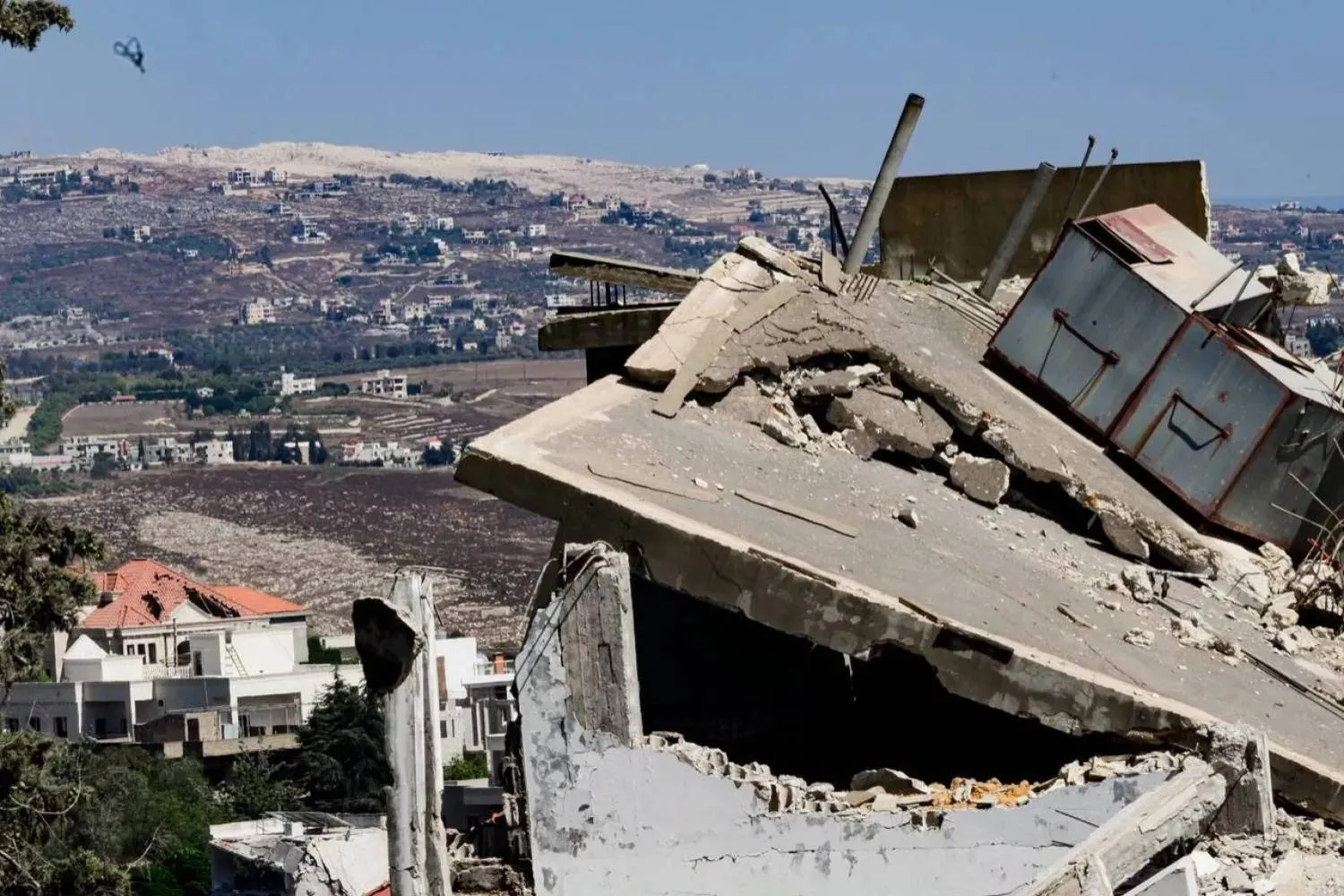
Rubble of homes in the town of Mayfadoun, with traces of a large explosion that struck in southern Lebanon seen in the background (Asharq Al-Awsat)
TT

Israel Rejects Lebanon Withdrawal, Presses on With Destruction in South

Rubble of homes in the town of Mayfadoun, with traces of a large explosion that struck in southern Lebanon seen in the background (Asharq Al-Awsat)

Israel has hardened its stance against Lebanese demands for a withdrawal, insisting it will remain in a “security zone” it has carved out inside Lebanon covering about 700 square kilometers.

Israeli Defense Minister Israel Katz summed up the policy bluntly: “We destroy there and build here,” referring to Lebanon and Israel.

The position poses a major challenge to Lebanon and to US-led mediation aimed at securing an Israeli withdrawal and placing all weapons across Lebanese territory exclusively under state control.

US General Joseph Clearfield, head of the Military Coordination Group for Lebanon (MCG4L), is visiting Tel Aviv with Lebanese proposals for a mechanism to inspect designated pilot zones and plans to expand them.

He is due back on Friday to discuss with the Lebanese army the proposed arrangements and missions for implementing the “framework agreement.”

Lebanese President Joseph Aoun and Prime Minister Nawaf Salam discussed developments in the south, particularly continued Israeli attacks and the destruction and demolition of homes and property in several villages and towns.

They also discussed Clearfield’s visit and reviewed items on the cabinet meeting agenda, the Lebanese presidency said.

Three-pronged destruction plan

Israel is pressing ahead in the border area with a three-pronged destruction campaign: bulldozing homes and civilian structures, burning buildings still standing, and blowing up tunnels, homes and other civilian facilities.

Security sources in southern Lebanon told Asharq Al-Awsat that what Lebanese observers could see in the occupied area was “the destruction of all urban infrastructure and the obliteration of the manifestations of life.”

They said Israel was also building military positions and raising mounds over the ruins of homes and villages.

The work was advancing “at a rapid pace,” the sources said, with explosions intensifying over the past two weeks alongside military measures, deployments across towns along the Yellow Line and incursions toward nearby villages.

Ministerial sources told Asharq Al-Awsat that the most dangerous Israeli action in the south was the reshaping of border towns and villages.

The villages no longer resemble what they once were, the sources said, citing changes to the geography of towns and neighborhoods, the opening of new roads and the razing of homes and orchards.

Some villages had not originally been fully surveyed topographically, they added, deepening the impact of the changes underway.

Salam on Wednesday condemned the Israeli bulldozing and demolitions.

“Attempts to justify the razing and destruction on the grounds that military facilities are being targeted are contradicted by the nature of what is actually being struck on the ground,” he said.

“Lebanon’s sovereignty, the security of its people and the right of southerners to return to their land and rebuild their villages are not matters open to compromise.”

After the post was published, Salam’s account on X was hacked and the statement deleted. He later reposted it.

Bulldozing reaches Bani Hayyan

After carrying out hundreds of explosions and bulldozing operations in the border area, the Israeli army on Thursday began razing homes in Bani Hayyan, about 10 kilometers from the border.

The move came two days after a large explosion in the town and marked the first incursion by Israeli bulldozers there.

Local media reported Israeli sweeping operations in Bani Hayyan alongside shelling and the burning of several homes. Israeli military vehicles were also seen moving around the town.

An Israeli infantry force was also reported moving between Aita al-Jabal and Beit Yahoun in the Bint Jbeil district.

Systematic destruction

The repeated explosions and bulldozing point to a systematic Israeli strategy of destruction, one Katz described openly on Thursday after touring southern Lebanon a day earlier and highlighting the scale of the damage caused by Israeli forces.

He said he had seen “the homes of dozens of villages, the Lebanese border villages, that were destroyed, demolished and turned into ruins,” claiming they had been “Hezbollah positions in every sense of the word.”

“Here we build, and there is ruin,” Katz said, adding that Israel had “removed once and for all” the threat he said those areas had posed.

Katz said the Israeli army now controls about 700 square kilometers of what Israel calls a “security zone” inside Lebanon, stretching “from the sea area in the west to al-Shaqif and the outskirts of the summit of Mount Hermon in the east.”

He described the area as “empty of residents” and said Israeli troops were deployed there while what he called Hezbollah infrastructure above and below ground was being destroyed.

Long-term occupation

Katz said Israel would not withdraw from the territory it occupies in southern Lebanon until Hezbollah was disarmed and what he called its “threat” eliminated across the country.

He said he had ordered the military to prepare for a “long-term presence” there.

“This position is clear and we stand behind it, the prime minister and I, whether in direct talks with the US leadership or in practice and everywhere,” Katz said.

He said he had instructed the army “to prepare for a prolonged presence in the area in order to protect the fighting forces and the communities until this goal is fully achieved.”

“We promised the residents of the north security, and that is exactly what we have done and what we will do,” he added.

Katz also said on Thursday that Israel’s position on remaining in Lebanon had been raised “in direct talks with the US leadership,” underscoring the continuing dispute over how the framework agreement should be interpreted and the conditions for withdrawal.

A senior US State Department official had said that “a permanent Israeli military presence in southern Lebanon is inconsistent with the commitments made under the framework agreement and is not compatible with long-term peace and security for both countries.”

The official said Washington remained committed to the agreed path for the gradual redeployment of Israeli forces, alongside steps to verify Hezbollah’s disarmament and the destruction of its military infrastructure.


Lebanon’s EDL Begins Cutting Power to Ministries, Municipalities and Public Institutions over Unpaid Dues

The offices of Electricite du Liban in Beirut on August 17, 2024. (EPA)
TT

Lebanon’s EDL Begins Cutting Power to Ministries, Municipalities and Public Institutions over Unpaid Dues

The offices of Electricite du Liban in Beirut on August 17, 2024. (EPA)

Lebanon’s public power utility, "Electricite du Liban" (EDL), began on Monday implementing measures to disconnect electricity supply to public administrations, public institutions, and municipalities that have failed to settle their financial dues.

This unprecedented move, in terms of its sweeping scope, targets ministries, official bodies, water authorities, and municipalities. It comes amid a severe financial crisis confronting the state utility due to the accumulation of public sector debts.

An initial list obtained by Asharq Al-Awsat revealed the names of institutions and administrations covered by the measures. They include the Council for Development and Reconstruction, Ministry of Public Works and Transport, Directorate General of Urban Planning, Directorate General of Education at the Ministry of Education and Higher Education, the Land Registry Directorates, and the Directorate General of Customs, in addition to subscriptions belonging to the Ministry of Telecommunications across various regions.

An informed source confirmed to Asharq Al-Awsat that "the decision to cut electricity to public institutions and administrations that fail to settle their dues does not aim to punish them or disrupt their work, but rather to enforce respect for the law and establish permanent financial regularity in paying electricity bills, thereby ensuring that EDL secures its rights and the continuity of its operations."

The source explained that "the primary objective is not the power disconnection itself, but rather to push public institutions to assume their financial responsibilities and settle their accumulated obligations on a regular basis, instead of continuing to pile up debts and resorting to temporary fixes whenever the crisis intensifies."

Rafik Hariri International Airport in Beirut successfully avoided a power disconnection after the Civil Aviation Authority reached an understanding with EDL. The agreement stipulates the payment of a portion of the accumulated dues and the rescheduling of the remaining amounts, alongside a commitment to settle incoming bills on a regular basis.

The accumulated dues owed by the Directorate General of Civil Aviation reached around $22.8 million, according to figures circulated regarding public sector debts.

These measures come in light of EDL’s need to collect regular revenues to finance fuel purchases and operate power plants. Its dues from public administrations and institutions reached around a quarter of a billion dollars.

The problem of arrears dates back to years of irregular electricity bill payments and has worsened with the tariff increase and the lack of sufficient credit availability among some administrations. This presents a dual challenge related to settling past debts and ensuring the payment of new consumption.


Lebanese, Syrian Talks in Damascus Tackle Border Security, Refugees

Syrian Foreign Minister Asaad Al-Shaibani and Lebanon's Deputy Prime Minister Tarek Mitri meet in Damascus. (Syrian Foreign Ministry)
TT

Lebanese, Syrian Talks in Damascus Tackle Border Security, Refugees

Syrian Foreign Minister Asaad Al-Shaibani and Lebanon's Deputy Prime Minister Tarek Mitri meet in Damascus. (Syrian Foreign Ministry)

Syrian Foreign Minister Asaad Al-Shaibani received on Monday a high-level Lebanese delegation led by Deputy Prime Minister Tarek Mitri in the Syrian capital, Damascus, for talks on outstanding issues between the neighboring countries.

Informed sources in Damascus told Asharq Al-Awsat that the Syrian side focused heavily on border control and joint security cooperation and coordination, while the Lebanese side focused primarily on the file of Syrian refugees in Lebanon.

A Syrian Foreign Ministry statement said: "The meeting discussed ways to strengthen bilateral relations between the two brotherly nations and develop joint coordination across various fields, primarily security cooperation and border control. This is in addition to expanding the horizons of partnership in the sectors of education, higher education, social affairs, and labor, as well as following up on the work of joint technical committees to serve mutual interests."

The Lebanese delegation's visit to Damascus comes within the context of strengthening bilateral relations, serving as a continuation of previous talks and a follow-up on the work of the joint committees established between the two sides to address shared files.

This follows an agreement reached by both countries last July to establish a joint higher committee to serve as an institutional framework for coordinating the work of the relevant ministries, developing economic, investment, and trade cooperation, and reinforcing security understandings.

According to informed sources in Damascus, the management of the Syrian–Lebanese border, traffic at border crossings, and security coordination to combat smuggling and infiltration topped the agenda of the talks.

The file of Syrian refugees and the status of residents in Lebanon, particularly those who entered covertly, was brought forward. The discussions sought to address the refugee issue from multiple dimensions, including social, security, and legal aspects. The situation of Syrian students in Lebanese schools was also raised.


Yemen Urges Int’l Pressure to Dry Sources of Houthi Funding, Weapons

Houthi supporters holding weapons during a protest in Sanaa, Yemen. (EPA file)
TT

Yemen Urges Int’l Pressure to Dry Sources of Houthi Funding, Weapons

Houthi supporters holding weapons during a protest in Sanaa, Yemen. (EPA file)

The Yemeni government is seeking to elevate its coordination with the United Kingdom beyond political and diplomatic support, pushing for more impactful measures to confront the terrorist Houthi militia.

These proposed actions include designating the group as a terrorist organization, choking off its financial and armament supply lines, and tightening restrictions on the dual-use technologies and components used to develop its military capabilities. This diplomatic push coincides with anticipated international efforts to mobilize economic and humanitarian assistance for Yemen.

These issues were at the forefront of a meeting between Chairman of the Presidential Leadership Council Dr. Rashad Al-Alim and British Minister of State for the Middle East Stephen Doughty. The two officials reviewed the latest developments in Yemen and examined the threats posed by the Houthis to regional security and international shipping lanes, alongside the ongoing preparations to convene an international support conference for Yemen at the end of this month.

Al-Alimi underscored that the safeguarding of international maritime navigation cannot be achieved without neutralizing the core sources of the Houthi threat.

He called for bolstering the capacities of the Yemeni state to defend its sovereign territory and territorial waters, stressing that political and legal declarations must be paired with concrete, practical measures targeting the financing, weaponization, and smuggling networks that sustain the group’s military apparatus.

He urged the UK to play a more effective role in mobilizing international support to designate the Houthis as a terrorist organization and ban the group in line with British law.

Continuing to address its threats without deterrent measures leaves the group's sources of strength outside the scope of targeting, he added.

Al-Alimi briefed the British minister on the scale of the Houthi escalation, pointing to the targeting of the civilian airports in Aden and Riyan, as well as the relentless attacks on the city of Taiz.

He highlighted the attacks endured by Taiz's residential neighborhoods, civilian facilities, markets, schools, and homes, in addition to the assaults on civilian targets in Saudi Arabia and the ongoing threats posed to waterways and international shipping lanes.

He linked regional security directly to the restoration of Yemeni state institutions' ability to extend their authority, maintaining that supporting the government in this direction represents the sole sustainable guarantee for protecting maritime corridors and regional stability.

Al-Alimi praised the British positions supporting Yemen, particularly London's role as the penholder on the Yemeni file in the UN Security Council.

He also lauded the Saudi support provided through the King Salman Humanitarian Aid and Relief Center and the Saudi Development and Reconstruction Program for Yemen, including the response to humanitarian needs in Taiz and other governorates.