


US Engaged in Shuttle Diplomacy between Lebanon, Israel to Salvage the Negotiations

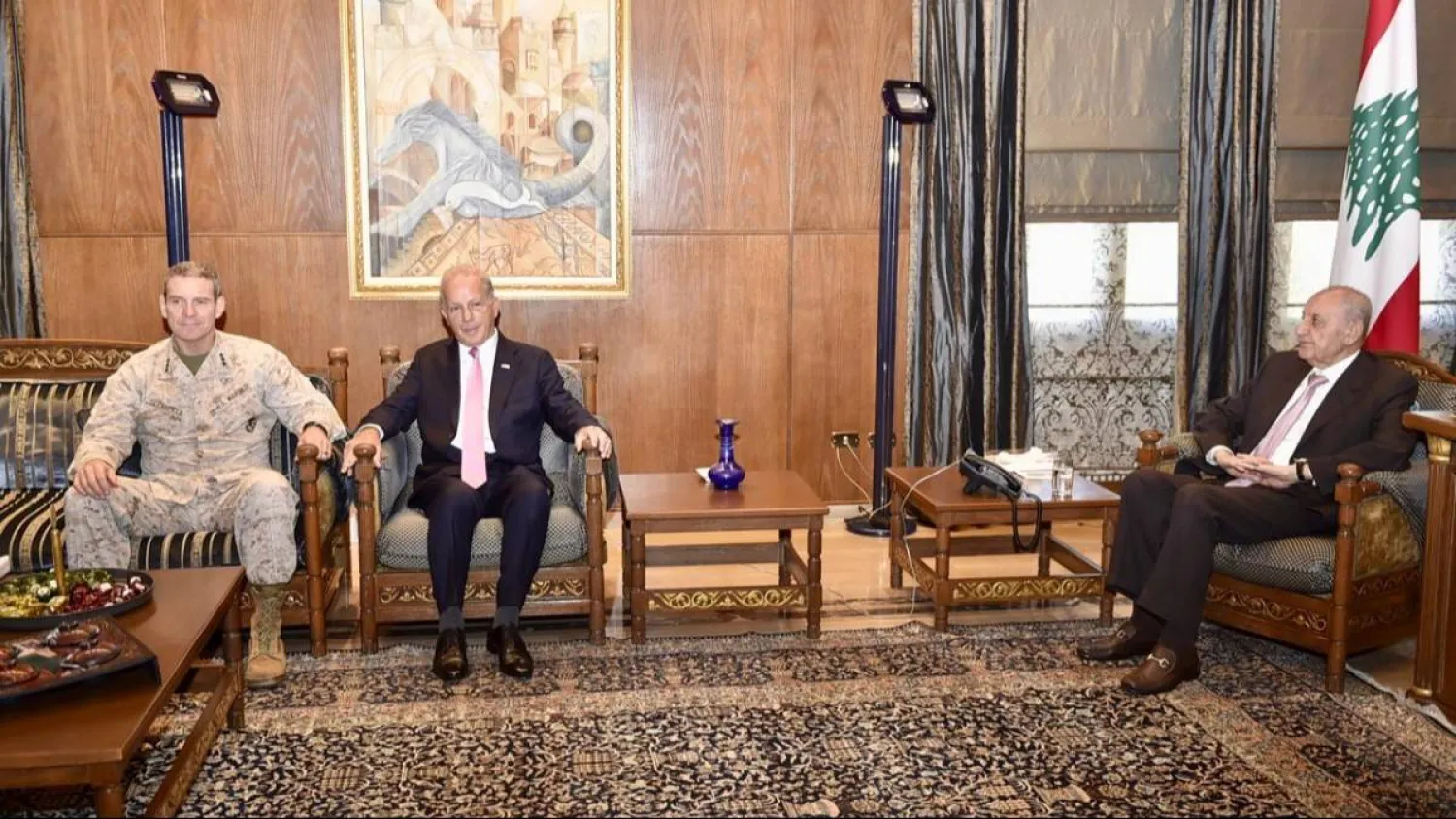
Lebanese Parliament Speaker Nabih Berri receives Issa and Clearfield (National News Agency)
TT

US Engaged in Shuttle Diplomacy between Lebanon, Israel to Salvage the Negotiations

Lebanese Parliament Speaker Nabih Berri receives Issa and Clearfield (National News Agency)

Head of the Military Coordination Group for Lebanon (MCG4L) US General Joseph Clearfield met on Friday with top officials in Beirut as part of follow up efforts with Lebanon and Israel on the military aspect of the framework agreement signed between the two countries in June.

The United States has been trying to broker an end to fighting between Israel and Hezbollah, which has raged since March in parallel with the wider US-Israeli war against Iran.

The June agreement says the Lebanese army will gradually restore control over all of Lebanon, disarming Hezbollah.

The first phase ⁠began in two pilot zones. The talks did not, however, produce an agreement on the next area from which Israeli troops would withdraw so that Lebanese troops could take control.

Clearfield, US Ambassador to Lebanon Michel Issa and the accompanying military delegation, visited on Friday Speaker Nabih Berri in Ain el-Tineh.

The discussions, which were attended by Berri’s Media Advisor Ali Hamdan, touched on the situation in southern Lebanon, as well as the Group’s work in light of the start of identifying the pilot areas and establishing a mechanism to verify the Israeli withdrawal and the deployment of the Lebanese Army.

Berri stressed that "Israel has not ceased its violations and attacks against Lebanon and the south since November 2024,'' adding that the attacks have continued systematically, involving the destruction of villages, bulldozing of fields and agricultural areas, and the burning of forested areas, "not to mention targeting heritage sites and cultural heritage."

Berri said that "the key to stability remains compelling Israel to halt its war and withdraw to the international borders."

Asked about the talks between Lebanon and Israel and the date of the next round, Ambasssador Issa said: "The negotiations will continue, but no date has been set yet."

The US delegation also visited Prime Minister Nawaf Salam at the Grand Serail to discuss the military aspect of the negotiation framework and developments in southern Lebanon.

Salam stressed the need for Israel to halt its destruction operations, expand the scope of the pilot zones, and establish a clear timetable for Israeli withdrawal from Lebanese territory.
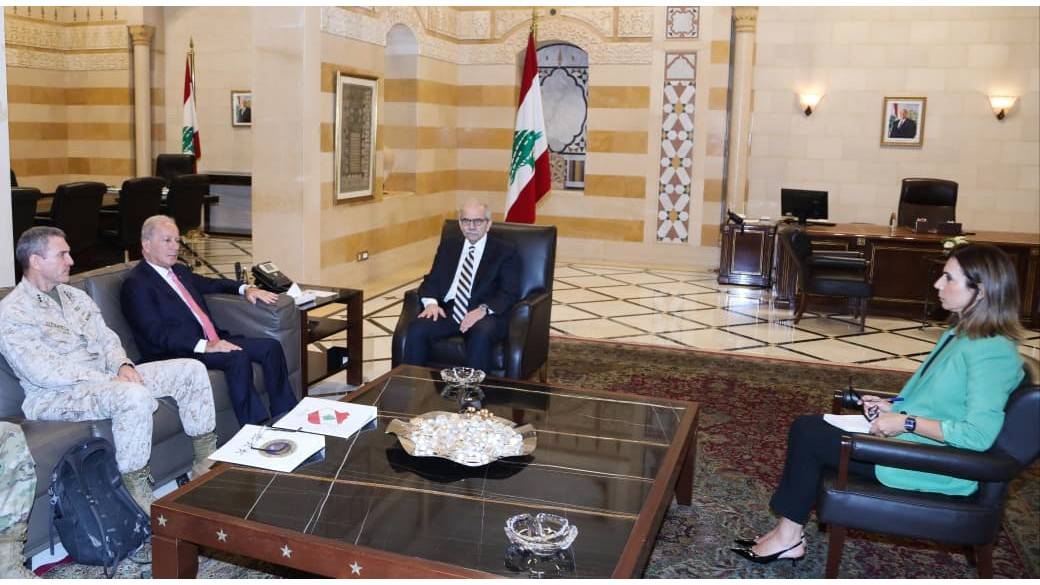
Lebanese Prime Minister Nawaf Salam receives Issa and Clearfield (National News Agency)

Previous rounds of talks had focused on the sequence of the Israeli withdrawal, the deployment of the Lebanese Army, and the verification mechanism, without reaching a decision on moving to a new area. Issa reiterated this point on Friday, stating that defining the status of the current areas must precede discussions about other areas.

Shuttle Diplomacy Between Beirut and Tel Aviv

Friday's meetings were part of a shuttle diplomacy conducted by Clearfield between Beirut and Tel Aviv to follow up on the implementation of military arrangements.

Clearfield arrived in Beirut on Wednesday from Tel Aviv, where he had held talks with Israeli officials.

In the Lebanese capital, he met with President Joseph Aoun and Army Commander General Rodolphe Haykal before departing again for Tel Aviv later that afternoon. He returned to Beirut on Friday.

During that stop in Beirut, Clearfield discussed measures related to implementing the framework agreement and developments in southern Lebanon, at a time when the implementation process continues to face issues related to the Israeli withdrawal, the deployment of the Lebanese Army, the verification mechanism, and the transition to additional pilot areas.



UN Peacekeeping Chief Says Talks on Future of Lebanon Mission Must Begin Soon

 United Nations Under-Secretary-General for Peace Operations Jean-Pierre Lacroix in Beirut, speaks during an interview with The Associated Press, in Beirut, Wednesday, Oct. 14, 2026. (AP)
United Nations Under-Secretary-General for Peace Operations Jean-Pierre Lacroix in Beirut, speaks during an interview with The Associated Press, in Beirut, Wednesday, Oct. 14, 2026. (AP)
TT

UN Peacekeeping Chief Says Talks on Future of Lebanon Mission Must Begin Soon

 United Nations Under-Secretary-General for Peace Operations Jean-Pierre Lacroix in Beirut, speaks during an interview with The Associated Press, in Beirut, Wednesday, Oct. 14, 2026. (AP)
United Nations Under-Secretary-General for Peace Operations Jean-Pierre Lacroix in Beirut, speaks during an interview with The Associated Press, in Beirut, Wednesday, Oct. 14, 2026. (AP)

UN peacekeeping chief Jean-Pierre Lacroix on Wednesday urged the UN Security Council to begin negotiations on the future of peacekeepers deployed in Lebanon, as Beirut campaigns for an extension to the mandate set to expire at the end of this year.

The UN Interim Force in Lebanon (UNIFIL) has been deployed in southern Lebanon since 1978, but the Security Council last year ordered the mission to begin withdrawing at the end of 2026.

Since a new war erupted in March between Israel and Iran-backed Lebanese armed group Hezbollah, ‌the Lebanese government has ‌campaigned for an extension to UNIFIL's mandate, citing its ‌role ⁠in monitoring hostilities ⁠and facilitating aid deliveries to villages in Israeli-occupied zones.

UN Secretary-General Antonio Guterres earlier this year presented proposals for a continued uniformed UN presence in Lebanon, but no action has been taken yet, Lacroix told Reuters in Beirut.

"These proposals are on the table of the Security Council. There has been no movement in the Security Council until now, but I believe that the negotiations will begin ... shortly, in earnest," he said.

"I think ⁠it would be better to have a decision soon ‌rather than later, right? Because that would clarify ‌also the horizon for us, certainly from the more limited point of view of our ‌own planning," he said.

FORCES OPERATE HOTLINE TO EASE TENSIONS

Diplomats say the US ‌is not supportive of an extended mandate for UNIFIL, but Lacroix said it was important to focus on Lebanon’s request and that negotiations at the Security Council could yield a constructive outcome.

Some 7,500 UNIFIL peacekeepers are still deployed at about 50 positions in southern Lebanon, which ‌would be expected to be handed over to Lebanese army troops if no new UN force is agreed.

But since most ⁠of those ⁠posts lie in territory now occupied by the Israeli military, it remains unclear how Lebanese soldiers could deploy to take over the positions.

Lacroix said that clarity on whether a new UN force would deploy to southern Lebanon would help UNIFIL make sure it does not "leave those positions prematurely before we know what could come next".

In addition to facilitating aid deliveries and monitoring hostilities, the force operates a hotline to ease any tensions between the Lebanese and Israeli militaries.

Lacroix said the deconfliction role was particularly crucial given the presence of Israeli troops in a self-declared security zone deep in Lebanese territory.

He said that Israeli and Lebanese troops in the same geographic area presented "the risk of escalation, the risk of incidents getting out of control" and that "there is a need for a third party to de-escalate".


Gaza Officials Say Israeli Strikes Kill Four

 Palestinians walk along a street lined with buildings destroyed during the Israel-Hamas war in Gaza City Wednesday, Oct. 14, 2026. (AP)
Palestinians walk along a street lined with buildings destroyed during the Israel-Hamas war in Gaza City Wednesday, Oct. 14, 2026. (AP)
TT

Gaza Officials Say Israeli Strikes Kill Four

 Palestinians walk along a street lined with buildings destroyed during the Israel-Hamas war in Gaza City Wednesday, Oct. 14, 2026. (AP)
Palestinians walk along a street lined with buildings destroyed during the Israel-Hamas war in Gaza City Wednesday, Oct. 14, 2026. (AP)

Palestinian officials said Israeli strikes killed four people in Gaza on Wednesday, days after the anniversary of the declaration of a US-mediated ceasefire.

Two young men died when Israeli forces struck a vehicle near Khan Yunis in the southern Gaza Strip, civil defense spokesman Mahmoud Bassal and Nasser Hospital said.

Two other people, including a woman, were killed when an Israeli aircraft struck an apartment building in Gaza City, according to Bassal and Al-Shifa hospital.

The Israeli military did not immediately give details on the strikes. Earlier Wednesday, it said it had killed more than 100 "terrorists" over the past four months in an operation in the north of the Gaza Strip.

The military said it also destroyed around eight kilometers (five miles) of tunnels used by fighters.

Israeli Prime Minister Benjamin Netanyahu, who faces a tight reelection battle this month, has vowed no let-up in targeting Hamas despite the ceasefire that went into effect on October 10, 2025, leading Hamas to free its remaining living hostages.

Hamas stormed into Israel on October 7, 2023, the deadliest day ever for the country. The attack resulted in the deaths of 1,221 people, according to an AFP tally from official Israeli figures, with fighters also dragging 251 hostages into Gaza, 44 of them already dead.

Israel's massive offensive in Gaza has since killed more than 74,300 people, according to the territory's health ministry, which operates under Hamas and whose figures are generally considered reliable by the United Nations.


Palestinian Factions Hold Preliminary Talks in Cairo Ahead of Broader Dialogue

A boy sits amid belongings next to a structure used as a living room after it was demolished by Israeli authorities, who said it had been built without a permit, in the Palestinian village of Umm al-Khair, in the Israeli-occupied West Bank, on October 14, 2026. (Photo by HAZEM BADER / AFP)
TT

Palestinian Factions Hold Preliminary Talks in Cairo Ahead of Broader Dialogue

A boy sits amid belongings next to a structure used as a living room after it was demolished by Israeli authorities, who said it had been built without a permit, in the Palestinian village of Umm al-Khair, in the Israeli-occupied West Bank, on October 14, 2026. (Photo by HAZEM BADER / AFP)

A new round of Palestinian diplomatic activity is underway in the Egyptian capital, Cairo, for the second time in less than a week, aimed at paving the way for comprehensive dialogue following the postponement of Palestinian elections to September 2027 from next November, and discussing arrangements for the next phase.

According to Palestinian sources who spoke to Asharq Al-Awsat on Wednesday, four Palestinian factions are beginning a limited round of national dialogue in Cairo through a series of bilateral and group meetings. The talks are part of preparations for a broader national dialogue involving a wide range of factions, including Fatah, and possibly even Palestinian President Mahmoud Abbas.

The four factions are Fatah, Hamas, Islamic Jihad and the Popular Front for the Liberation of Palestine (PFLP). Their delegations will hold bilateral and joint meetings to consult on the participants and agenda for the broader dialogue.

Fatah Rejects Participation of Dahlan's Faction

According to three Palestinian sources who spoke separately to Asharq Al-Awsat, Fatah remains adamantly opposed to the participation of the Democratic Reform Current, a breakaway faction led by Mohammed Dahlan.

Fatah also rejects the participation of Palestinian factions that emerged around the start of the Second Intifada in late 2000, including the Popular Resistance Committees, the Palestinian Mujahideen Movement, the Palestinian Freedom Movement (Al-Ahrar) and other smaller factions that it says receive funding from Iran, Hezbollah and Hamas.

The sources explained that Fatah, by contrast, insists on the participation of all Palestine Liberation Organization (PLO) factions, including those that no longer have a significant popular base or an active political role, such as As-Sa'iqa, the Palestinian Democratic Union (FIDA), the Palestinian Popular Struggle Front and the Palestine Liberation Front.

One source confirmed that the meetings would address arrangements concerning the PLO and the Palestinian internal political landscape as a whole, as well as the Palestinian National Council and other issues.

A third source from a faction participating in the Cairo talks said all outstanding disputes were expected to be resolved during the meetings, which could last two days or be extended if necessary.

The source said discussions would focus on ending the Palestinian division entirely, establishing clear mechanisms for forming the Palestinian National Council and setting an official date for comprehensive national dialogue to be convened at the direct invitation of President Abbas.

The source explained that, if approved, the comprehensive national dialogue would address numerous issues, including the conditions for joining the PLO and restructuring it, the Palestinian National Council and legislative and presidential elections.

Meanwhile, a Palestinian source close to the factions and currently in Cairo told Asharq Al-Awsat on Wednesday that Palestinians were placing considerable hopes on Egypt's role this time, following the election postponement, and on Cairo's sponsorship of efforts to bridge divisions, achieve broad national consensus and convene comprehensive dialogue soon despite the difficulties.

The source noted that the current consultations among Palestinian factions largely center on mechanisms for managing the Palestinian political landscape and its future direction.

The main disagreements concern the nature of the anticipated dialogue and whether it will lead to the establishment of a temporary leadership framework for the PLO and agreement on a national unity government in accordance with previous agreements, or merely result in conventional discussions without binding outcomes, as has happened in the past.

The source said the direction of the talks would become clearer in the coming hours.

Rebuilding the Political System

Fatah spokesperson Abdel Fattah Dawla said the meetings taking place Wednesday with several factions present in Cairo were intended to build on previous consultations and the positive atmosphere established with Egyptian officials and representatives of Palestinian factions.

"The ongoing meetings on Wednesday with some of the factions present in Cairo are aimed at continuing the efforts launched during previous consultations and building on the positive atmosphere achieved with our brothers in Egypt and representatives of Palestinian factions, with the goal of creating the conditions for comprehensive national dialogue. All of this lays the foundation for a new phase of joint national action," he said.

Dawla believes that "the fundamental guarantee for the success of the dialogue is genuine political will among all parties and a readiness to move from managing disagreements to resolving them, and from exchanging positions to committing to implementable national understandings."

He told Asharq Al-Awsat: "We also need specific implementation mechanisms, agreed timelines and follow-up committees to ensure that whatever is agreed upon is translated into practical steps, whether in administering the Gaza Strip, unifying institutions or rebuilding the political system on democratic and participatory foundations, and renewing the legitimacy of its institutions through elections when conditions allow for a fair and inclusive process."

Regarding Cairo's current role, the Fatah spokesperson said Egypt could help create an appropriate environment for dialogue, bring opposing viewpoints closer together and assist the factions in moving beyond discussions of their differences toward agreement on a shared national vision.

Cairo, meanwhile, remains committed to its role in ending the suffering of the Palestinian people, according to a statement issued Wednesday by Egypt's Foreign Ministry marking the first anniversary of the Sharm El-Sheikh Peace Summit.

The ministry stressed Egypt's continued commitment to implementing the peace plan, consolidating the ceasefire, beginning reconstruction efforts and completing the Israeli withdrawal.