Hope Fades for Finding Survivors of Colombia Quake as Rescued Woman Dies

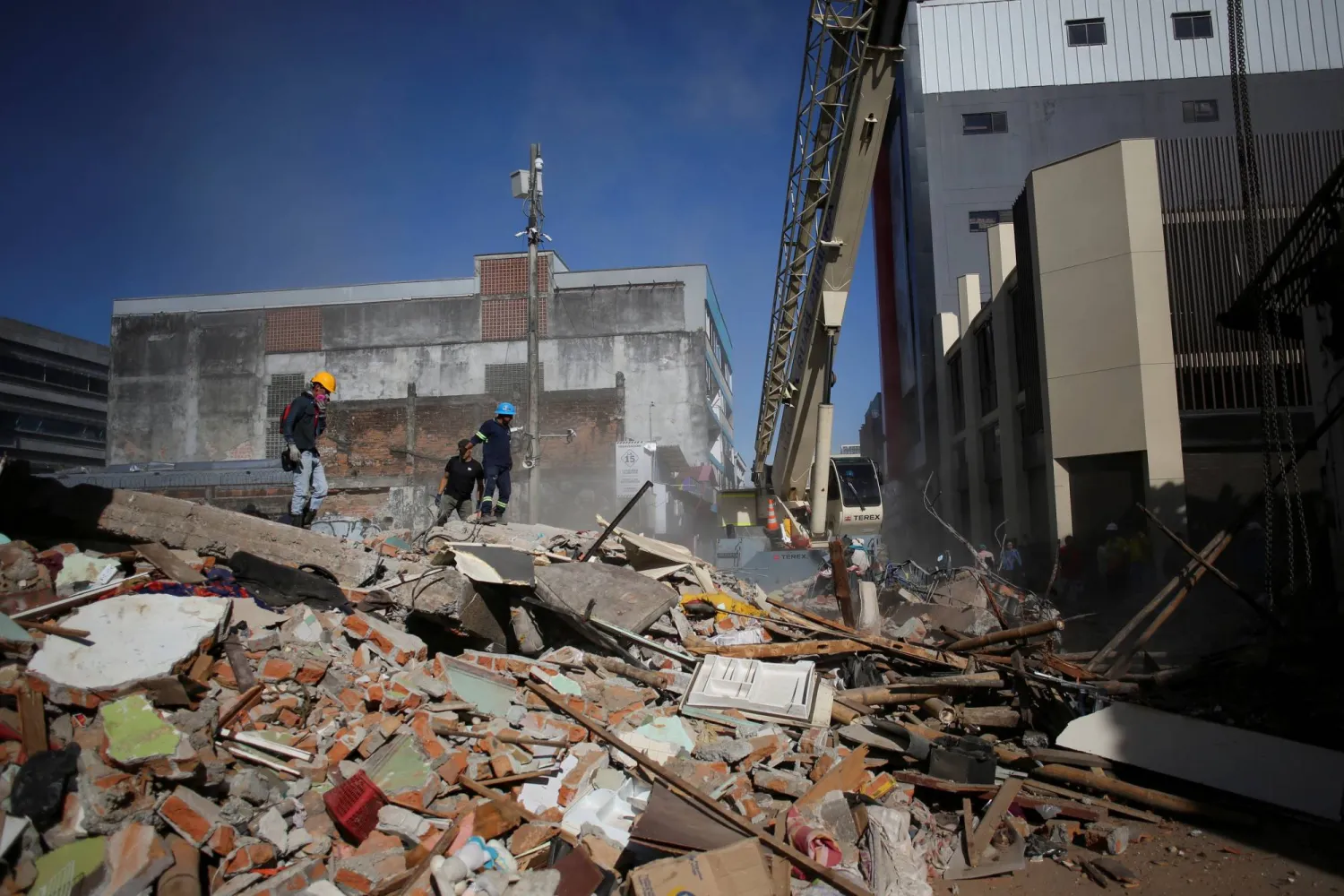
Emergency personnel work at the site of a damaged building following an earthquake in Pereira, Colombia, August 11, 2026. REUTERS/Juan David Duque
TT

Hope Fades for Finding Survivors of Colombia Quake as Rescued Woman Dies

Emergency personnel work at the site of a damaged building following an earthquake in Pereira, Colombia, August 11, 2026. REUTERS/Juan David Duque

A Colombian woman who was rescued after being trapped for nearly 37 hours under the rubble in the wake of a strong earthquake has died of her injuries, her family told AFP on Saturday.

Along with her death comes the painful realization that the chances of finding survivors are dwindling, as rescue teams continue to search for hundreds of missing people after this week's devastating 7.4 magnitude earthquake, AFP said.

Daniela Largo, 32, was pulled from the debris on Tuesday in the city of Pereira to shouts of joy and applause, becoming a symbol of hope for a nation reeling from Monday's disaster.

Largo, who died on Friday, leaves behind a 12-year-old son.

"I just want this all to be over quickly," Largo's mother Sandra Milena Perez told AFP.

Monday's earthquake has so far killed at least 294 people and injured nearly 4,000, authorities say.

Rescuers are still searching for at least 320 people who are unaccounted for, according to data from the disaster management agency. In the most devastated areas, workers are using heavy machinery to remove pieces of roofs and walls.

Residents of hard-hit Pereira are still hoping for a miracle, but optimism is fading.

"If there is someone alive, it would be a miracle, but I don't think there's anyone alive underneath," said Fernando Gaitan, a 55-year-old restaurant delivery worker.

Rescuers have brought in heavy machinery to help remove large sections of roofs and walls and are visibly fatigued after days of grueling work.

"We're going to stay until the last person is recovered," firefighter corporal Javier Jimenez told AFP.

- Appeal to Trump -

When the country's new president Abelardo de la Espriella took office August 7, the news was celebrated by US President Donald Trump, who backed the flamboyant right-winger's candidacy.

On Saturday, De la Espriella said he had a "friendly" 10-minute phone call with Trump, and sought a temporary suspension of the tariffs imposed by the United States, to bring relief during its reconstruction phase.

Tariffs were raised at the end of July from 10 percent to 12.5 percent, with exceptions for some goods such as coffee and oil.

Suspending tariffs would help "our businesspeople who are facing very difficult times because of the effects of the earthquake," De la Espriella said.

He also thanked the US for $26.5 million in aid and the support of its rescue teams, as well as Israel for sending humanitarian assistance and rescuers.

More than 14,000 homes collapsed in the quake. The most hard-hit cities of Cali, Pereira and Manizales will require reconstruction costing millions.

De la Espriella plans to declare a state of economic emergency to empower him to set taxes or reorganize the budget without the approval of Congress.


Chinese Foreign Minister Calls for US and China to 'Overcome Obstacles' Ahead of Presidential Summit

US and Chinese flags are seen in this illustration created on March 20, 2025. REUTERS/Dado Ruvic/Illustration/File Photo
TT

Chinese Foreign Minister Calls for US and China to 'Overcome Obstacles' Ahead of Presidential Summit

US and Chinese flags are seen in this illustration created on March 20, 2025. REUTERS/Dado Ruvic/Illustration/File Photo

China's foreign minister said his country and the United States should overcome obstacles between the nations ahead of an expected summit next month between US President Donald Trump and Chinese President Xi Jinping.

Wang Yi met with US ambassador to China David Perdue on Wednesday and called on both sides to “focus on the positive agenda, properly manage differences, remove interference and overcome obstacles to high-level exchanges between the two countries,” Chinese state broadcaster CCTV reported Thursday.

China-US relations “still face various risks and challenges,” he acknowledged in a statement released by CCTV.

Trump and Xi met in May in Beijing and pledged to keep the relationship stable and maintain the fragile trade truce. Trump invited Xi to meet Sept. 24 in the US, but the exact date of the Chinese leader's visit has not been confirmed, The Associated Press said.

Since then, however, the US and China have continued to take targeted economic action against each other, including the US banning imports of new Chinese-made humanoid robots and China banning American entities engaging in trade and other activities in China.

Also on Thursday, China's Ministry of Foreign Affairs spokesperson Lin Jian said at a regular press conference that China and the US were maintaining communication about the two leaders' upcoming meeting “within the year.”

China-US tensions had been elevated since Trump's return to the White House last year, with the US at one point saying tariffs on China would be up to 145%, although the tariff levels came down substantially later. Tensions have eased in recent months and several agreements were made during the leaders' May meeting, including the setting up of boards of trade and investment between the two countries.

However, the Trump administration has recently been deliberating new tariffs of 7.5% on China as a result of an ongoing US probe against 16 economies on excess industrial capacity and production. An official decision has not yet been finalized or made public. The US also said last month that it was imposing a 12.5% tariff on China as a result of a US probe on forced labor against 60 economies.

In response to the potential 7.5% new tariffs by the US, China's Ministry of Commerce on Thursday told reporters that China “firmly opposes” the US probe on excess capacity, adding that the US was “politicizing economic and trade issues.”

Beijing will continue to closely monitor developments and “reserves the right to take all necessary measures” if needed, the Commerce Ministry added.

Last month, China also hit back against Western criticism of overcapacity in a report titled “China’s Position on the So-called Excess Capacity Issue,” saying China never sought a large trade surplus.


More than 1,300 are Missing in Nepal and Tibet after Catastrophic Floods Caused by Glacier Collapse

People amid damage in the aftermath of flash floods in Devighat in the Nuwakot district in Nepal, Thursday, Aug 27, 2026. (AP Photo/Niranjan Shrestha)
TT

More than 1,300 are Missing in Nepal and Tibet after Catastrophic Floods Caused by Glacier Collapse

People amid damage in the aftermath of flash floods in Devighat in the Nuwakot district in Nepal, Thursday, Aug 27, 2026. (AP Photo/Niranjan Shrestha)

Rescue teams searched on Thursday for hundreds of missing people along the Nepal-China border after a catastrophic and deadly torrent of floods and mud swept through several communities a day earlier following a glacier collapse.

The disaster left at least 168 people dead and more than 1,300 missing, including foreigners and pilgrims, and displaced hundreds of people across the Himalayan region.

Videos of the tragedy showed the flood swallowing up people as they tried to escape, and destroying buildings and bridges. On Thursday, drone footage from Nepal showed the scale of the destruction.

The region’s steep valleys are economic lifelines and travel corridors, but are precarious when disaster strikes. Images showed what appeared to be the second floors of buildings in Nuwakot slathered in mud after the torrent rushed by. Debris hung from tree branches and wires, vehicles were buried and some stunned survivors were caked in mud. The floods halted travel in some areas.

There was little time for anyone to flee.

Resident Jaleshwar Kumar Sahni received a phone call on Wednesday morning from an area close to the border that a lot of water was flowing through there, and later the flash floods destroyed everything in just 15 minutes.

“We don’t have anything left,” he said.

Warming climate threatens communities

The Himalayan mountain range spans several countries in South Asia and has many of the world’s highest peaks and remaining glaciers.

The steep slopes and the lush valleys below the Himalayan mountain range are especially vulnerable to flooding and landslides, and extreme weather events. Melting glaciers have become more common because of warming because of human-caused climate change.

Researchers in Kathmandu found earlier this year that glaciers across the Hindu Kush Himalaya region are melting faster, with ice loss rates doubling since 2000.

Helicopters deployed as roads were damaged

The disaster has left at least 165 dead and 826 people missing in Nepal, and three dead and 558 missing in Tibet, authorities said.

Nepalese officials said that dozens of bridges were destroyed and nearly 40 kilometers (25 miles) of roads were damaged, complicating search efforts.

The Nepalese army has rescued more than 100 people from flood-affected areas through helicopter operations on Thursday morning, army spokesperson Brig. Gen. Raja Ram Basnet said.

At least eight foreign nationals were airlifted to the country’s capital, Kathmandu, he said, adding that army teams also evacuated people trapped inside facilities linked to the Trishuli hydropower project.

Rescuers found bodies hundreds of kilometers downstream from the disaster zone in Chitwan district. Dozens of injured people have been transported to Kathmandu for advanced medical care.

Bishal Kumar Bhandari, chairman of the Nepal Red Cross Society, said they have shifted focus from rescue to large-scale relief operations in the flood-hit districts. He said that around 1,200 people were displaced from at least three villages.

In Tibet, a mudslide that struck near the land border crossing of Gyirong Port on Wednesday left mud in the surrounding areas more than 1½ meters (5 feet) deep on average, with some road sections exceeding 2 meters (6 feet), Chinese state broadcaster CCTV reported. Roads leading to the port were all damaged, while secondary collapses or landslides might occur as rain continued in the area, it added.

CCTV said that a barrier lake has also been discovered in the direction of the port, posing challenges to the rescue operation. Chinese authorities deployed a large military transport aircraft to send a team to the region, it said.

While electricity supply and communication resumed in the central urban areas in Gyirong town, those linked to the port were cut off, it said.

Hundreds of foreigners are missing

According to Nepal’s Tourism Board, 517 of the missing people in the country were foreigners and 178 of them were from India. It wasn't immediately clear how many missing Indian nationals were on a pilgrimage to Mount Kailash in Tibet, a sacred site for Hindus.

More than 60 of those unaccounted for in Nepal were from the US and the rest were from 30 other countries, ranging from Ukraine and the UK to South Africa and Japan, the Tourism Board said.

In addition, China’s Ministry of Foreign Affairs spokesperson Lin Jian said that nearly 100 Chinese citizens were missing on the Nepal side. CCTV earlier reported 260 of those missing in Tibet were foreigners.

Experts say glacier collapse caused devastating floods

The US Geological Survey first reported a magnitude 4.4 earthquake early Wednesday, about 66 kilometers (41 miles) north of Kathmandu, near the border.

The USGS later updated its analysis to say the seismic event it measured was a magnitude 5.2 glacier collapse that sent debris flowing downstream with catastrophic impact on communities. It said its determination was based on data from nearby seismic stations, long period seismic waves and satellite imagery, and that no earthquake had occurred.

Climate experts at the Kathmandu-based International Center for Integrated Mountain Development said an avalanche from a glacier likely caused Wednesday’s flash flood.

“Hydrological observations indicate the exceptional speed and magnitude of the flood wave,” they said in an emailed statement, noting that water levels at one point on the Trishuli river rose by as much as 9 meters (27 feet) over half an hour.

The Lhende Khola River, a tributary of the Bhotekoshi, had maximum flooding, they said.

The disaster in Nepal and Tibet is not a one-off. The increasingly unstable Himalayan ice system threatens communities, infrastructure and water supplies across one of the world’s most densely populated regions.

The region saw similar flash floods in August 2025, when a glacial lake in Tibet overflowed because of high temperatures. Nine people were killed, and critical infrastructure, including a bridge connecting Nepal and China, was damaged.



Iran Unable to Import Petrol amid US Blockade

Drivers queue at a petrol station to refuel in Tehran, on August 25, 2026. (AFP)
TT

Iran Unable to Import Petrol amid US Blockade

Drivers queue at a petrol station to refuel in Tehran, on August 25, 2026. (AFP)

Iran has been unable to import enough petrol to make up for insufficient domestic production because of a US naval blockade, a senior Iranian official said.

"Petrol production is insufficient, and because of the US naval blockade, we cannot import it," the official IRNA news agency quoted Vice President Mohammad Jafar Ghaempanah as saying on Wednesday.

The remarks came as Iranians have in recent days queued outside petrol stations, with the war with the United States increasingly shifting towards economic pressure on Tehran, said AFP.

On Monday, the Iranian president's chief of staff Mohsen Haji-Mirzaei said petrol quotas would be reviewed, without elaborating.

War broke out between Iran and the United States on February 28. Tehran has since seized control of the strategic Strait of Hormuz, with Washington imposing a naval counter-blockade on Iranian ports.

Ghaempanah criticized the distribution of highly subsidized fuel in Iran, saying the current system disproportionately benefits people who own multiple vehicles.

"The distribution of petrol in the country is inequitable. Owners of several vehicles benefit from subsidies, unlike those who do not own one," he said.

Iran, a major oil producer with some of the world's cheapest fuel, has for years heavily subsidized petrol, making any changes to pricing politically sensitive.