The Ukrainian Social Media Channels Tracking Russian Missileshttps://english.aawsat.com/features/5307591-ukrainian-social-media-channels-tracking-russian-missiles
The Ukrainian Social Media Channels Tracking Russian Missiles
Ukrainians use Telegram channels to track incoming Russian missiles and drones. Tetiana DZHAFAROVA / AFP
The chances of a missile attack on Kyiv that night were around 50 percent, according to the administrator of a social media channel monitoring Russian air raids.
His channel, Aeris Rimor -- roughly derived from the Latin for Searcher of the Skies -- is one of dozens sending real-time messages about incoming drones and missiles.
Ukrainians consult them to track potential Russian attacks, like people check weather applications for storms but with less certainty, shorter warning, and deadly stakes.
During one recent overnight attack, AFP journalists were granted rare access to shadow "Esko", the channel's administrator, on condition that his identity and some details of the operation remained undisclosed.
The 19-year-old, sporting a budding beard, usually operates from home, filling lulls by watching the TV show Criminal Minds or honing his drone-flying skills on a simulator.
Twenty-six minutes after midnight, the air raid alert rang, soon followed by a red dot glitching across the map on a screen in front of him.
"Oh, a missile on Kyiv," he said.
Switching to Telegram, he sent a message to 150,000 followers: "KYIV TARGET!"
"It's going to hit Kyiv in about a minute," he said.
He then sent out the names of the districts being targeted, quietly lamenting a few typos.
Seconds later, explosions echoed over the capital.
The red dot disappeared from the map, only for another to pop up shorty after.
"You have to literally stay on duty and stare at the screen the whole time, because you can easily miss it," said Esko, who did not appear to struggle, even late into the night.
Esko was looking at a live map used by Ukraine's air defense units.
Red icons -- depicting Russian drones -- were dotted across the map and disappeared as they were downed by Ukraine's air force.
- Bedtime dilemma -
The channels are tolerated by authorities but operate in a legal grey area as they use information from air force contacts.
Esko would not reveal publicly how he accessed the map.
In its nightly attacks, Moscow increasingly fires ballistic missiles, flying up to thousands of kilometers (miles) per hour and reaching Kyiv within three minutes of an air raid warning.
This poses a haunting dilemma for those in the capital.
Either go to a shelter -- the metro or a basement -- in advance, accepting a disrupted and uncomfortable night of half-sleep.
Or stay home and face the risk of a hit, particularly dangerous for those in high-rise buildings in heavily targeted districts.
Sometimes authorities warn hours before a likely attack.
Telegram channels -- sifting through intelligence data -- close the information gap, putting out daily forecasts on the probability of different types of attacks.
Esko said people often reach out asking for advice.
"You can only say: something might happen... but decide for yourselves."
On a recent night in Kyiv when there were mixed signals about a Russian strike, Kateryna Reshetnyk had gone down to the subway.
She based her decision on "a parallel analysis of several channels that have been posting truthful information for a long time."
She had set up folding chair next to the turnstiles with her mother and grandmother -- their beds for the next hours.
"But no one knows for sure what will happen or not. You just rely on your intuition and survival instinct," the 34-year-old said.
- 'Tension rising' -
Hundreds of others, armed with mats, tents and pillows, had done the same.
Dogs snored next to their owners, who were glued to their phones, screens lighting up weary faces.
"We track what's happening and where, because our relatives, friends and colleagues are all over Kyiv and the region, so at least we understand what is happening and where," Reshetnyk said.
The night passed without a major strike.
Ukraine's air force grudgingly tolerates the monitoring channels.
"We can't ban them. They exist, they inform the public, for some people that's convenient," spokesman Yuri Ignat told AFP.
But he warned those running them not to post "excess information ... that the enemy can use against us."
With people making potentially life-or-death decisions based on his posts, Esko said he felt the weight of responsibility.
Much of his life now is spent at the screen, tracking hundreds of drones on only a few hours sleep.
But he prefers busy nights, rather than uneasy periods of calm when Russia is stockpiling for future attacks.
"You keep waiting, waiting, waiting, and then you start posting warnings because the tension is rising. And still, nothing happens. You post again, and nothing happens..."
Sudanese Families Return to Khartoum Only to Find Homes Uninhabitablehttps://english.aawsat.com/features/5345812-sudanese-families-return-khartoum-only-find-homes-uninhabitable
Sudanese Families Return to Khartoum Only to Find Homes Uninhabitable
A house destroyed by the war in Khartoum (Asharq Al-Awsat)
For many Sudanese families, returning to the capital Khartoum has brought little relief from the hardships of displacement. Instead, they face a new struggle: finding a habitable home. Shelling, fires and looting have devastated countless homes, leaving some as battered structures that will cost a fortune to repair or rebuild.
In Omdurman, Mustafa Saeed is trying to rebuild his home after artillery shelling at the outbreak of the war destroyed about 70% of it. An initial assessment of the damage led him to conclude that the house was beyond repair and would have to be rebuilt.
Saeed told Asharq Al-Awsat he had managed to build two rooms and some basic facilities before soaring construction costs forced him to halt work.
Price monitoring by Asharq Al-Awsat showed that a bag of cement now costs more than 120,000 Sudanese pounds ($11), while prices of reinforcing steel and other construction materials have risen sharply.
The burden of rebuilding
Even families whose homes survived the fighting face mounting expenses. Looters stripped properties of doors, windows, furniture, electrical wiring and plumbing, leaving homeowners to refit their houses from scratch.
In southern Khartoum, Heba Abdullah and her family returned home in early August to find their house stripped of doors, windows and furniture.
The family spent about 11 million pounds ($1,000) restoring electricity and water connections, Abdullah said. Aluminum costs 2.35 million pounds ($205) per meter, and she needs about four meters.
The kitchen still needs refurbishing, while bullet-riddled walls need repairing. The family has spent about 85 million pounds ($7,500) on repairs and electrical appliances, yet much of the furniture needed to resume daily life is still missing.
For Anas Abdel Qader, the situation is even more complicated. Unable to afford repairs to his badly damaged home or buy essential furniture and appliances, he has rented half a house to shelter his family until he can restore his own.
Costs beyond families’ means
Homeowners are returning in the hope of reclaiming their former lives, only to confront soaring material prices, labor costs and transport expenses. Repairs are draining household resources, while declining purchasing power is forcing families to put off buying furniture and household appliances.
Contractor Hashem Moussa said restoring homes damaged by artillery fire and stray bullets requires substantial sums, even when damage is limited to doors, windows, plumbing and electrical wiring.
Costs can run into millions of pounds, sums many families returning from displacement or refuge abroad struggle to raise after losing their livelihoods and facing mounting living expenses.
Moussa said repair costs vary according to the size of the property, the extent of the damage and the work required. Replacing doors and windows and restoring utilities is far less costly than repairing a partially collapsed house or one with extensive structural damage.
In Bahri, part of Amna Ishaq’s home has collapsed, leaving it uninhabitable. Her family cannot afford to repair it.
“My husband lost his job because of the war. He can no longer cover even our daily living expenses, let alone the cost of repairing and rebuilding our home,” Ishaq said.
Her predicament reflects the plight of families who have lost both their homes and livelihoods. With no income, covering daily expenses is a struggle in itself, while the repairs needed to make a return home possible remain on hold until families can raise the money.
Mounting price pressures
Building materials dealer Abbas al-Naji attributed rising prices to the weakening Sudanese pound, fuel shortages and higher transport costs. The dollar has risen above 10,000 Sudanese pounds on the parallel market.
Naji said a metric ton of cement costs about 2.4 million pounds, while a metric ton of 12-mm reinforcing steel fetches about 10.2 million pounds.
A 20-kg container of paint costs about 115,000 pounds, a ceiling fan 1.4 million pounds and a roll of electrical wire 320,000 pounds. The price of 4-mm wire stands at 700,000 pounds.
The cost of restoring a home goes well beyond cement and steel. Electrical repairs, painting and household fittings add to the financial strain on families whose savings or sources of income have been wiped out by the war.
Economist Haitham Mohammed Fathi told Asharq Al-Awsat that soaring construction costs and declining purchasing power had forced many Sudanese to carry out repairs in stages, often months apart, because they could not afford the full cost upfront.
He said rising living costs and falling household incomes underscored the growing need for financing arrangements to help affected families restore their homes.
The downturn in construction activity has also cost thousands of tradespeople and workers in related industries their jobs and livelihoods, while deteriorating economic conditions have limited their chances of finding alternative employment, Fathi added.
He attributed the sustained rise in construction material prices to the depreciation of the Sudanese pound against foreign currencies, rising costs of raw materials, energy and other production inputs, as well as higher transport, import and shipping costs, customs duties and government fees.
In Lebanon, the Opening of a Second Airport Reflects Political Shiftshttps://english.aawsat.com/features/5345657-lebanon-opening-second-airport-reflects-political-shifts
The control tower and terminal area of Rene Mouawad Airport, also known as Qlayaat Airport, in Qlayaat, northern Lebanon, November 12, 2026. (Reuters)
TT
TT
In Lebanon, the Opening of a Second Airport Reflects Political Shifts
The control tower and terminal area of Rene Mouawad Airport, also known as Qlayaat Airport, in Qlayaat, northern Lebanon, November 12, 2026. (Reuters)
Lebanon plans to open a second international airport next month to bring economic growth to the poorer north, in a project that underlines the diminished political sway of the Iran-backed Hezbollah group, which had long opposed it.
Kleiat Airport, located on the Mediterranean coast, about 20 km (12 miles) from the border crossing to Syria, will offer another gateway to Lebanon alongside Beirut international airport, where travel has been disrupted by wars between Israel and Hezbollah in recent years.
The opening comes as Lebanon continues to grapple with occupation by Israel in the south, political dysfunction and deep financial turmoil.
It is "a national economic need", Fayez Rasamny, the minister of public works and transport, told Reuters.
The private sector will invest $5 million to $6 million in the airport and the government will improve the region's roads, Rasamny added.
Also named Rene Mouawad Airport after a president assassinated in 1989, it will initially offer flights to Türkiye, Egypt, and Jordan, Rasamny said.
LEBANON'S IMPOVERISHED NORTH
Politicians from the north had long pressed for the disused airbase at Qlayaat to be turned into a civilian airport, arguing it would boost prosperity in the Akkar region, an area adjoining the Syrian border. More than 300,000 people live in Akkar and the region is seen as Lebanon's poorest.
But the idea faced opposition from Hezbollah, which has long had a decisive say over government affairs, a politician and a political activist from the area told Reuters.
Hady Hobeiche, a former lawmaker from Akkar, said he and a group of MPs from the region had tried to advance the project in 2022, winning the approval of all parties apart from Hezbollah.
Hobeiche, a long-standing critic of Hezbollah, said the group had raised concerns over who would be responsible for security at the airport and had shown "intense hostility" towards the idea at the time.
"When the country's political conditions changed, we were able to open this airport," he said.
Hezbollah's media office didn't respond to a request for comment.
Lebanon's power balance has been turned on its head since 2024, when Israel pummeled Hezbollah in two wars in under two years and Syria's president, Bashar al-Assad, a Hezbollah ally, was ousted, severely weakening the group's grip over Lebanese government affairs.
Assad had also opposed the airport, fearing it might fall under the purview of a hostile security force, a senior politician close to Hezbollah said.
Since taking office in early 2025, Prime Minister Nawaf Salam has pursued a government policy aimed at securing Hezbollah's disarmament.
His agenda also included opening Qlayaat airport.
The government has awarded a four-year concession to a private sector company, Sky Lounge, to run the airport under a public-private partnership.
Sky Lounge Chairman Ziad Monla said the government wants the airport open "as fast as possible". "The north has been forgotten for 30 or 40 years," he told Reuters.
He envisages a hub serving both Syrian and Lebanese passengers and hopes the government can earn up to $20 million from it over four years.
Sky Lounge said it has so far signed with a local airline to run flights from the new airport, while negotiations with regional and international carriers remain ongoing.
When Reuters visited the airport in early November, dozens of workers buzzed around a hangar being transformed into a passenger terminal. Inside, cables snaked across the floor and scaffolding stood against bare walls.
Hamed Zakaria said he has been lobbying officials to open the Qlayaat airport for more than a decade. A local political activist and businessman, he hopes the new airport will be a boon for what he sees as a neglected region.
"Akkar is for development, for prosperity," he said.
Gaza’s 64,000 Widows Fight New Battles Over Custody, Guardianshiphttps://english.aawsat.com/features/5345416-gaza%E2%80%99s-64000-widows-fight-new-battles-over-custody-guardianship
Gaza’s 64,000 Widows Fight New Battles Over Custody, Guardianship
A quarter of households in the Gaza Strip are now supported by bereaved women. (AFP)
Yasmine al-Najjar, 31, from the Jabalia refugee camp in the northern Gaza Strip, never imagined she would have to wage a legal and tribal battle to protect the rights of her three children, who faced harsh treatment at the hands of their grandfather and uncles after their father was killed in an Israeli strike targeting a group of Palestinians in early 2025.
Najjar told Asharq Al-Awsat that she had fought on several fronts to safeguard her rights and those of her children. She turned to a Sharia court to obtain an inheritance certificate that would ensure each heir received their rightful share.
But she met fierce resistance from her husband’s family, who sought to seize the money in their son’s bank account, deny her any entitlements and take her children away.
Now displaced in western Gaza City, Najjar fought for nearly a year before securing her rights under Islamic law, civil legislation and tribal customs. She eventually obtained her entitlements and retained custody of her children following the intervention of community leaders, tribal elders, mediators and legal authorities.
Half a share is better than nothing
Women in Gaza face legal complications stemming from the Palestinian division between the Gaza Strip and the West Bank.
Najjar pointed to difficulties arising from the Palestinian Authority’s suspension, since the outbreak of the war, of its recognition of certain legal procedures in Gaza, including inheritance certificates, transfers of guardianship and other administrative matters, for reasons including changes in the judges responsible for such cases.
Further complications involve banking operations in the enclave and suspected interference by Hamas-affiliated bodies in the work of Palestinian Authority judges. However, Gaza and the West Bank are governed by the same law.
Najjar described her ordeal as a cruel and oppressive battle endured by most of Gaza’s widows, who have lost their husbands and been left without a breadwinner.
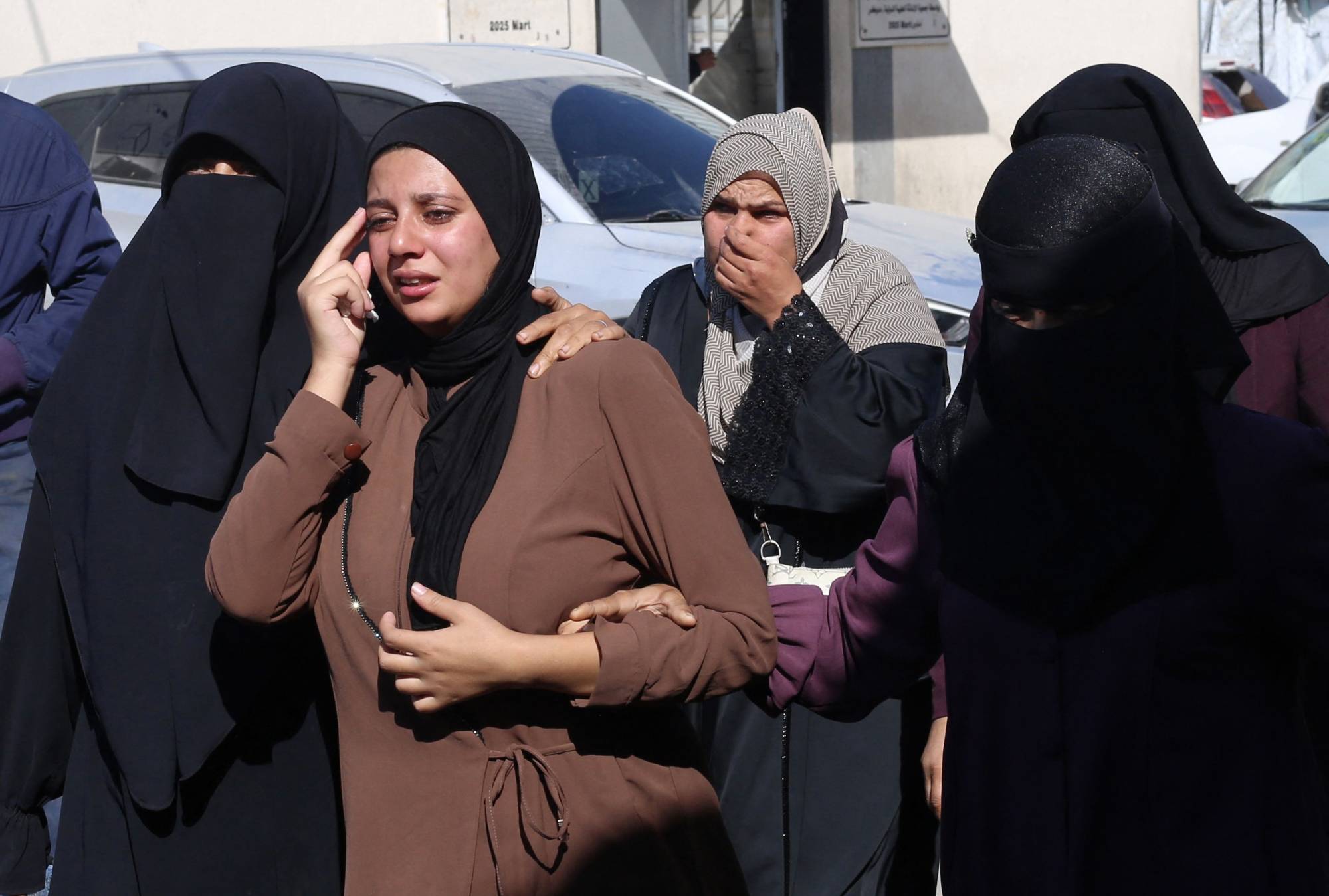
According to Gaza’s Ministry of Social Development, 64,413 women have been widowed during the war, while the number of households supported solely by women has soared to nearly 86,000, accounting for almost a quarter of all households in the enclave.
The ministry said these families needed comprehensive programs extending beyond emergency aid to include regular cash assistance, food, shelter, healthcare, psychological support, economic empowerment for women and provision for children’s needs.
The suffering inflicted on widows and their children by their husbands’ families goes beyond financial hardship. It includes a form of emotional exclusion from the wider family at a time when they are already grieving the loss of a father.
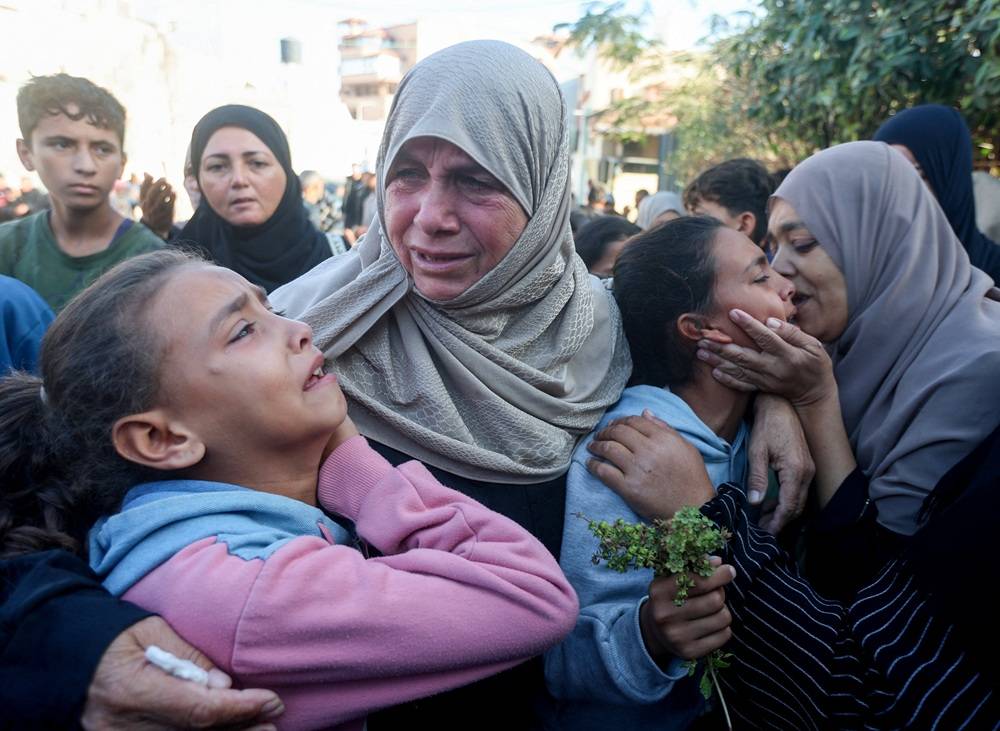
Displaced Palestinians take part in the funeral procession of three people killed earlier this morning in Israeli shelling in the Al-Maghraqa area, central Gaza Strip, on November 24, 2026. (AFP)
Cast out of the grandfather’s tent
Hanan, 37, now lives in Jabalia. She had been sharing a shelter in western Gaza City with her husband and his family.
Barely two weeks after her husband was killed in an airstrike targeting him in early 2026, his family ordered her to leave with her four children, the eldest aged 12, claiming there was no longer room for them.
Hanan, who asked that neither her surname nor that of her husband, an employee of the Hamas government, be disclosed, was stunned by the decision. She had been on good terms with his family, but they left her no choice but to find another place for herself and her children.
Another shock followed when her husband’s relatives laid claim to his modest salary of around 1,000 shekels ($318), which was already being paid at intervals of 60 or 100 days.
“My family’s elders intervened, and I turned to a lawyer to secure my rights. Thanks to the legal measures introduced by the Hamas government in Gaza, I obtained my entitlements and those of my children,” Hanan told Asharq Al-Awsat.
“Although we received only a portion of my husband’s salary, which his family shared with me, I was happy to have secured some of our rights. We could have been deprived of them altogether and ended up with nothing.”
Hamas had introduced several legal measures involving consultations with widows and other eligible heirs to ensure the equitable distribution of deceased husbands’ salaries and assets in accordance with Islamic law and applicable legislation, safeguarding the rights of all beneficiaries without exception.
Salaries and any existing assets were consequently divided under those provisions.
“The greatest shock was that they threw me and my children out of the place where we lived with them, instead of sheltering and helping us cope, especially when my children need affection and care, and someone to make up for the loss of their father,” Hanan said.
After enormous difficulties, she managed to obtain a tent, which she pitched at another shelter.
“I have become both mother and father to my children, their sole breadwinner. I am responsible for everything, under unbearable living conditions,” she said sadly.
Sponsorships and cash shortages
Several Arab organizations are seeking to support widows through grassroots campaigns at home and abroad to secure financial sponsorships for orphans.
The King Salman Humanitarian Aid and Relief Center (KSrelief), as part of efforts undertaken by the Saudi Center for Culture and Heritage in Gaza, has launched a large-scale campaign to register orphans with the aim of providing extensive financial sponsorship in the coming period. Algeria’s Al-Baraka Association has long pursued similar initiatives.
The sponsorships, ranging from $50 to $100 per child a month, help widows provide for their children after losing their breadwinners and seeing their incomes shrink as they are required to share their late husbands’ salaries with the men’s parents, in cases where the deceased held jobs that guaranteed such entitlements.
But tens of thousands of widows and orphans have no regular income because the deceased fathers were either not salaried employees or were unemployed.
Hanan, who receives financial sponsorship for only two of her four children, said organizations struggled to make regular payments because of cash shortages in Gaza and restrictions on financial accounts and transfers from abroad.
She added that organizations limited assistance to children under eight, while the amounts provided were barely enough to meet the needs of a single child amid the soaring prices of the few goods and commodities available.
Mourners attend the funeral of Palestinians who were killed in an Israeli strike, according to medics, at Nasser Hospital in Khan Younis, in the southern Gaza Strip, November 24, 2026. (Reuters)
Forced into marriage
Beyond financial hardship and the struggle to find shelter, Gaza’s widows face painful choices. Some are forced to marry their deceased husbands’ brothers or risk losing their children if they refuse. Others find their freedom and that of their children curtailed by decades-old social customs and traditions.
Maysaa, 33, endured a bitter ordeal at the hands of the family of her husband, who was killed in late 2025. She was forced to marry his brother in a bid to retain custody of her three children. Even after the marriage, the children’s grandfather took them away from her, barely allowing her to see them twice a week, for just two hours at a time.
Their uncle, now their mother’s husband, refuses to support them financially, arguing that they receive a share of the salary of their late father, a Palestinian Authority employee.
Samaher, 29, lost her husband in late 2023, in the early months of the Gaza war. With two children, aged two and four, she fought relentlessly to keep them.
Her father-in-law tried to force her to marry another of his sons, saying the arrangement would protect the children and allow them to remain with their uncle. She categorically refused, she told Asharq Al-Awsat.
Samaher resisted every threat and pressure exerted by her father-in-law and insisted on keeping her children. He eventually demanded that she never remarry if she wished to retain custody.
She recalled the immense pressure she endured as she was made to choose between marrying her brother-in-law and giving up her children.
She chose her children and an uncertain future with them, without a breadwinner, rather than marry her late husband’s brother.
It is a story repeated in different forms across Gaza.
Amal, 25, lost her husband just six months after their marriage in 2023, giving birth to her only child after his father’s death.
She endured overwhelming hardship amid bitter disputes between her family and her husband’s relatives, who pressured her to marry his brother.
After nearly a year of fierce resistance, she was forced to bow to social customs and traditions to protect herself and her child.
But her ordeal was far from over. Becoming a second wife brought a new set of problems and pressures.
Speaking to Asharq Al-Awsat, Amal said the past three years of her life had been exceptionally harsh, marked by psychological torment and humiliation of every kind.
Ceasefire marriages
During periods of ceasefire, grassroots initiatives backed directly or indirectly by Hamas, and other Palestinian factions, organizations, community leaders and tribal elders, sought to encourage marriages between widows and Palestinian men who had lost their wives during the war.
Some succeeded, although they encountered difficulties, including those involving children. Unmarried young men also married the widows of friends or relatives killed in the war.
But such efforts have not always ended well.
Aseel, 24, reached an agreement with the family of her husband, who was killed in the October 7 attack, to marry one of his friends a year and a half after his death. In return for keeping her two children, she agreed to relinquish her entitlements.
About a month after the amicable agreement and her remarriage, the children went to visit their grandparents for the first time. They were kept there and prevented from returning to their mother.
Despite the intervention of numerous influential parties and tribal groups, her late husband’s family refused to return them, demanding that she relinquish her rights in exchange for allowing her children to visit her.
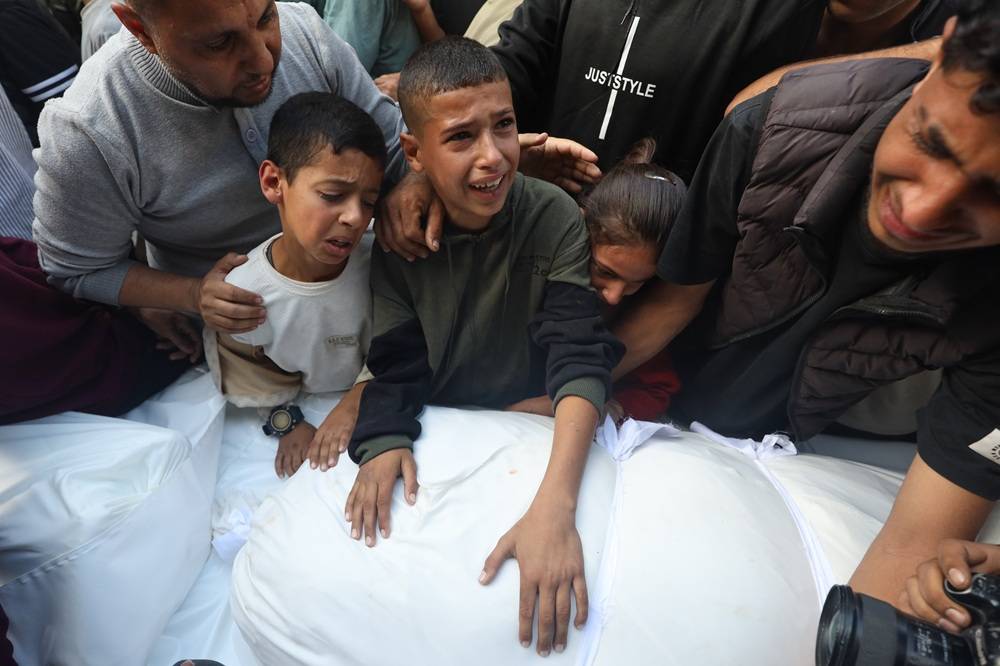
From center left, Mohammad, Awad and Layan grieve over the body of their father, Khaled Naem, during a joint funeral for him, Mustafa Refai and Ahmad al-Sawafiri, who were killed in an Israeli airstrike in Gaza City, Saturday, Nov. 21, 2026. (AP)
A war unlike any before
Before the current war, Hamas would launch projects after each conflict or round of escalation with Israel to arrange marriages between widows and other members of the movement, sometimes providing between $2,000 and $5,000 to help cover marriage expenses.
Weddings were held in mass ceremonies organized through its established institutions.
During the current war, however, Hamas has overseen some of these projects from behind the scenes, keeping a low profile because of difficult security and economic conditions.
It has supported grassroots initiatives and others organized by foreign-funded charities to carry out such projects on the ground.
But the unprecedented numbers of widows and orphans have also strained the ability of Hamas and its institutions to provide care, leaving its role largely confined to mediation and limited arrangements.
The laws of war and peace
Ahmed al-Lahham, a lawyer specializing in Sharia law, said neither Islamic law nor civil legislation prohibits a previously married woman from remarrying.
He said Gaza’s Sharia courts were recording a sharp rise in marriages involving war widows and other widowed women.
Their new husbands include bachelors, men seeking a second wife, widowers and men whose social circumstances have compelled them to enter such marriages.
Among them are men who married the widows of brothers killed during the war to protect the children of the deceased and ensure they were not left without a father or a breadwinner.
Lahham explained that legal guardianship of children passes to their grandfather upon their father’s death, while financial guardianship rests with their mother, even if she remarries, provided that a share of the funds under her guardianship is allocated to the grandfather.
A mother, however, loses custody of her children if she remarries, unless an amicable agreement is reached, he said.
“These laws have been applied in accordance with Islamic law since Ottoman rule in Palestine,” Lahham added. “They have undergone only limited legislative amendments to protect women’s rights in accordance with Islamic law, which remains unchanged, whether in times of war or peace.”
لم تشترك بعد
انشئ حساباً خاصاً بك لتحصل على أخبار مخصصة لك ولتتمتع بخاصية حفظ المقالات وتتلقى نشراتنا البريدية المتنوعة