

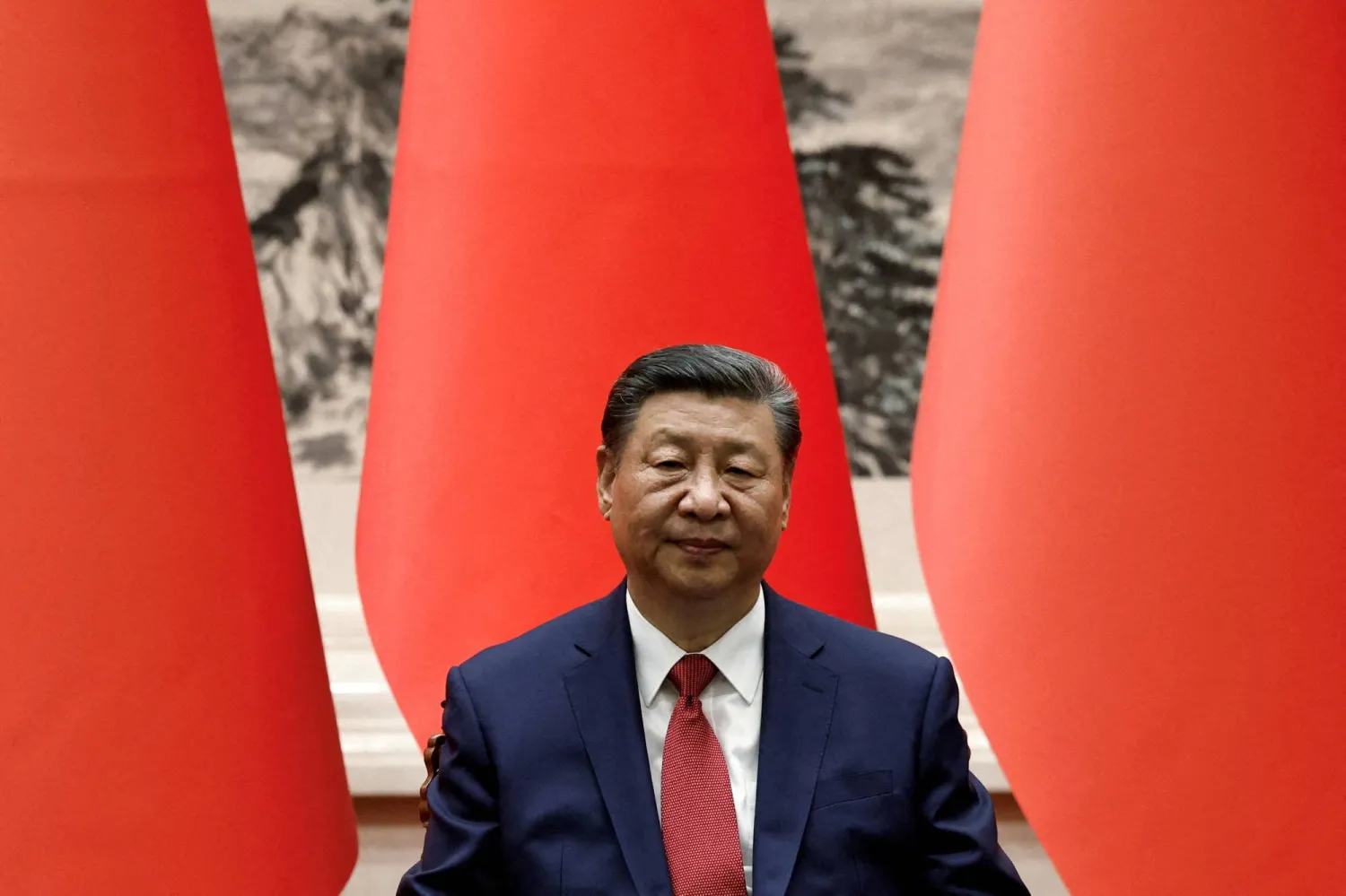

Xi Leads Event Marking Late Leader Jiang Zemin’s 100th Birth Anniversary

Chinese President Xi Jinping attends a signing ceremony with Bahrain's King Hamad bin Isa Al Khalifa (not pictured) at the Great Hall of the People in Beijing, China May 31, 2024. (Reuters)
TT

Xi Leads Event Marking Late Leader Jiang Zemin’s 100th Birth Anniversary

Chinese President Xi Jinping attends a signing ceremony with Bahrain's King Hamad bin Isa Al Khalifa (not pictured) at the Great Hall of the People in Beijing, China May 31, 2024. (Reuters)

Top Chinese officials led by President Xi Jinping gathered in the Great Hall of the People on Monday to commemorate the 100th anniversary of the birth of late leader Jiang Zemin, who led China in a pivotal phase in its rise from a marginal economy to a global growth engine.

Jiang, who died in 2022 at the age of 96, confounded naysayers and led the country through a decade of rapid economic growth after the 1989 Tiananmen crackdown on pro-democracy protesters. His co-partner in governance, the no-nonsense former Premier Zhu Rongji, died last week, with the funeral scheduled on Tuesday.

The passing of the two leaders into China's history books marks a definitive end to the breakneck reforms that both represented during the 1990s and early 2000s, with an emphasis on private entrepreneurship and wealth creation. That stands in contrast to Xi, who has exerted greater central control and pressed a state-driven economic policy focused ‌on technological autonomy and ‌strategic industries.

In a 40-minute speech on Monday, Xi called on the Communist Party to ‌carry ⁠forward Jiang's legacy, ⁠presenting the current leadership as the continuation of his political and ideological project. That message was also carried in state media coverage in recent days.

Under Jiang and Zhu, China pushed through painful changes: shuttering chronically unprofitable state firms, dismantling the old housing system in favor of a commercial property market, weathering the Asian financial crisis of the late 1990s, and joining the World Trade Organization in 2001.

Xi now faces considerable challenges of his own as he seeks to weather trade frictions with the United States and Europe, tensions over Taiwan, slower economic growth and demographic decline.

"On the new journey ahead, we must heighten our sense of vigilance against potential dangers," Xi said during Monday's event.

"With ⁠an indomitable fighting spirit and superb skill in struggle," we must "proactively meet the major tests ‌posed by high winds and rushing waters, or even by raging storms," he added.

Events ‌involving President Xi like the one Monday are closely monitored by China watchers for clues to the political pecking order, and for indications of ‌the health and continued standing of the country's retired elite.

Former President Hu Jintao, Jiang's immediate successor, now 83, was not ‌immediately seen on state media footage of the event, which was attended by current and retired officials.

Hu's premier, Wen Jiabao, as well as former Vice President Wang Qishan, Xi's one-time anti-corruption chief, were seen at the event, suggesting that they remain in favor with the leadership. A number of officials once associated with Wang have come under corruption probes in recent years.

AN UNLIKELY FANDOM

Ahead of Monday's event, China's state broadcaster ‌aired a 12-part prime-time documentary series chronicling Jiang's life and achievements.

The program recounted how, in 1989, Jiang – who had himself been a student protester in the 1940s – forcibly shut down a ⁠reformist Shanghai newspaper after it ⁠called for greater freedom of speech and voiced support for the pro-democracy demonstrations that culminated in the bloody Tiananmen Square crackdown in Beijing.

Under his presidency, the internet arrived in China in the mid-1990s. Yet, a few years later, the so-called Great Firewall was erected to separate China’s internet from the rest of the world to prevent access to information and ideas deemed potentially destabilizing to Chinese society.

Still, some Chinese netizens remember Jiang fondly as a symbol of a more optimistic era when rapid economic growth translated into tangible improvements in everyday life.

On Chinese social media, where current and former leaders' names are routinely censored, Jiang has come to be known as "the Elder", spawning an internet subculture in apparent admiration of the Soviet-trained ex-automobile factory manager who was known for his love of singing and his propensity to recite Lincoln's Gettysburg Address from memory in English.

"There are only two kinds of people in the world," said one comment on Xiaohongshu, or RedNote, about the documentary on Saturday: "those who don't understand him and those who admire him."

Last week, China's central bank announced plans to issue a set of commemorative coins bearing Jiang's image later this month to mark the centenary, delighting the late leader's youthful online fan base.

"The commemorative coins are going to be really hard to get," one said on Weibo, China’s version of X.



Somalia Federal Troops and Armed Opposition Clash in Baidoa City

Civilians gather at a street following clashes between Somalia's federal troops and armed opposition groups, in Baidoa, Somalia August 17, 2026. REUTERS/Stringer
TT

Somalia Federal Troops and Armed Opposition Clash in Baidoa City

Civilians gather at a street following clashes between Somalia's federal troops and armed opposition groups, in Baidoa, Somalia August 17, 2026. REUTERS/Stringer

Somalia's federal troops and armed opposition groups clashed in heavy fighting in Baidoa city center on Monday, a local resident and an army officer told Reuters.

The administrative capital of South West state, Baidoa is home to international peacekeepers and humanitarian agencies. It is one of Somalia's largest cities ‌with a population ‌of over a million people.

Fresh fighting ‌in ⁠the city could ⁠compound a dire humanitarian crisis in the area.

Baidoa hosts hundreds of thousands of displaced people and one in four children at displacement sites there are severely malnourished, according to a July survey by Medecins Sans Frontieres.

"Militias loyal to the ⁠former Baidoa president entered Baidoa from two ‌sides, challenging two battalions ‌of federal military. Fighting has intensified now," Farah Nur, ‌a shopkeeper in the city, told Reuters.

Federal troops ‌have been in charge of the city since March when they seized control, which prompted South West state leader Abdiaziz Hassan Mohamed Laftagareen to resign.

Nur told Reuters ‌federal forces were using heavy weapons and that he had seen at ⁠least two ⁠civilians killed in their houses by stray bullets and that several others who were injured were being taken to hospital.

Hassan Mohamed, Laftagareen's spokesperson, said in a post on Facebook that their troops had captured Baidoa and asked federal forces to surrender. His claim could not be independently verified.

"The armed militias attacked Baidoa this morning, we are pushing them back....there are casualties as stray bullets enter houses," Captain Osman Abdullahi, a Somalia federal military officer, told Reuters.


Rain Brings Respite as Belgium Wrestles Massive Wildfire

Belgian firefighters work in a forest affected by a wildfire in Waimes, Belgium, August 17, 2026. (Reuters)
TT

Rain Brings Respite as Belgium Wrestles Massive Wildfire

Belgian firefighters work in a forest affected by a wildfire in Waimes, Belgium, August 17, 2026. (Reuters)

Much-needed rain brought some respite Monday to firefighters on their fourth day battling Belgium's worst wildfire in a century, which has scorched vast expanses of nature reserve on the German border.

Europe has been swept by weeks of devastating wildfires fueled by dry conditions and a historically hot summer that has already contributed to the deaths of thousands of people.

France, Greece, Portugal and Spain were also battling major fires over the weekend.

In Belgium, currently the continent's most urgent fire front, around 500 firefighters and emergency crews have mobilized to contain the blaze, which broke out Friday for reasons still unknown in the High Fens park, an area of boggy peatlands, pine forests and hiking trails.

Water-bombing aircraft and farmers' tractors have joined forces to help tame the fire, which as of Sunday had spread to 3,000 hectares (7,500 acres) -- an area half the size of Manhattan.

But Tony Hosmans, a crisis management spokesman, told reporters Monday the blaze was no longer advancing towards the German border -- after creeping nearer over the weekend, prompting an evacuation order in the border town of Monschau.

The rain falling Monday on the area -- with more forecast on and off throughout the week -- was a welcome development.

"The wind is favorable and the current rainfall is helping to contain the spread" of the fire, said Hosmans.

"At present, the fire is contained wherever intervention is possible," he said -- although he cautioned it had not yet been brought under control, with an aerial reconnaissance mission due to deliver a fuller picture later in the day.

The blaze broke out in an area that was ravaged by massive fires in 1911, during a similar period of heatwaves and drought.

It is the country's largest wildfire since.

A huge area at the border has been blanketed by a thick plume of yellowish smoke, with fumes detected as far as eastern France, where authorities issued an air-pollution alert.

The smoke hazard has triggered the evacuation of two Belgian villages, whose residents were still under instruction to stay away.

- 'Happening to us' -

On-site operations have been made much harder by the fens' terrain -- a patchwork of heath, peat bogs and raised wooden boardwalks where heavy vehicles risk sinking into the ground, and firefighters struggle to tackle the fire at close range.

They have been counting heavily on aerial assistance to bring the situation under control, with two water-bombing aircraft from Sweden and two Dutch military Chinook helicopters backing up two Belgian helicopters on site.

Local farmers have also poured in to help battle the blaze, with a ballet of tractors pulling in tankers of water drawn from a nearby lake.

"We've provided drinks and some meals," Annick Dodemont, who runs one of many local businesses supporting the firefighting operation, told AFP.

"We can't go up there ourselves, so we help however we can," said the 41-year-old.

Like much of Europe, Belgium has experienced a new spell of intense heat and drought in recent days.

Temperatures reached as high as 37C in some parts of the country on Friday, creating conditions conducive to wildfire outbreaks.

"It's pretty shocking," Dodemont said from her restaurant in Eupen. "You always think it happens somewhere else. Well, not anymore. It's happening to us."


Taiwan's President: Record Defense Spending an Investment in Peace

A Taiwanese military member fires ammunition aboard an armoured vehicle during a drill as part of the annual Han Kuang military exercises in Taipei, Taiwan, August 13, 2026. REUTERS/Ann Wang
TT

Taiwan's President: Record Defense Spending an Investment in Peace

A Taiwanese military member fires ammunition aboard an armoured vehicle during a drill as part of the annual Han Kuang military exercises in Taipei, Taiwan, August 13, 2026. REUTERS/Ann Wang

Taiwan is determined to strengthen its defenses and plans record defense spending next year, President Lai Ching-te said on Monday, describing his government's military budget proposal as an investment in peace.

Taiwan's cabinet will unveil next year's budget on Thursday, including a breakdown of where defense spending will go, but Lai confirmed media reports that 2027's overall defense budget would exceed T$1 trillion ($31.40 billion) for the first time.

His announcement comes as China, which views democratically governed Taiwan as its own territory, has ramped up military ⁠and political pressure over ⁠the past few years to assert its claims, which Taipei strongly rejects.

But Taiwan also faces calls from Washington to spend more on its own defense, mirroring US pressure on Europe, something Lai has enthusiastically embraced.

Addressing a meeting about next year's budget, Lai said defense spending in 2027 would reach T$1.1225 trillion - exceeding 3% of gross domestic product, according to a transcript of the remarks released by his office.

According to Reuters, he said ⁠this "demonstrates Taiwan's determination to strengthen its self-defense capabilities".

"Investing in defense is investing in peace; we will continue to build a more solid defense force to maintain peace and stability in the Taiwan Strait and the region," Lai added.

Taiwan's government has made military modernization a key policy platform and has repeatedly pledged to spend more on its defenses, including developing made-in-Taiwan submarines, given the rising threat from China.

China's military operates almost daily in the waters and skies around Taiwan, and Beijing has also been honing new tactics, such as coastguard "law enforcement" patrols off Taiwan's east coast in the Pacific Ocean.

William Chung, an assistant research fellow at Taiwan Defense ⁠Ministry think-tank the ⁠Institute for National Defense and Security Research, said China's east coast activities were not only aimed at exerting psychological pressure, but also combat training and intelligence gathering.

"If actual hostilities break out across the Taiwan Strait, the entire eastern maritime area of Taiwan will be Taiwan's most critical outlet to the outside world," he told a forum in Taipei earlier on Monday.

Taiwan finished its annual Han Kuang military drills last week, simulating a range of battle scenarios including how to break a potential Chinese maritime blockade.

China's Defense Ministry called the drills a "wasteful charade" that "stoked war panic".

Lai also faces a challenge from Taiwan's opposition-dominated parliament, which only passed this year's budget late on Friday after months of delays.

The two main opposition parties say they will not write blank checks for the government.