
Battered by War, Iran’s Rulers Wary of More Economic Pain and Unrest if US Tightens Pressure

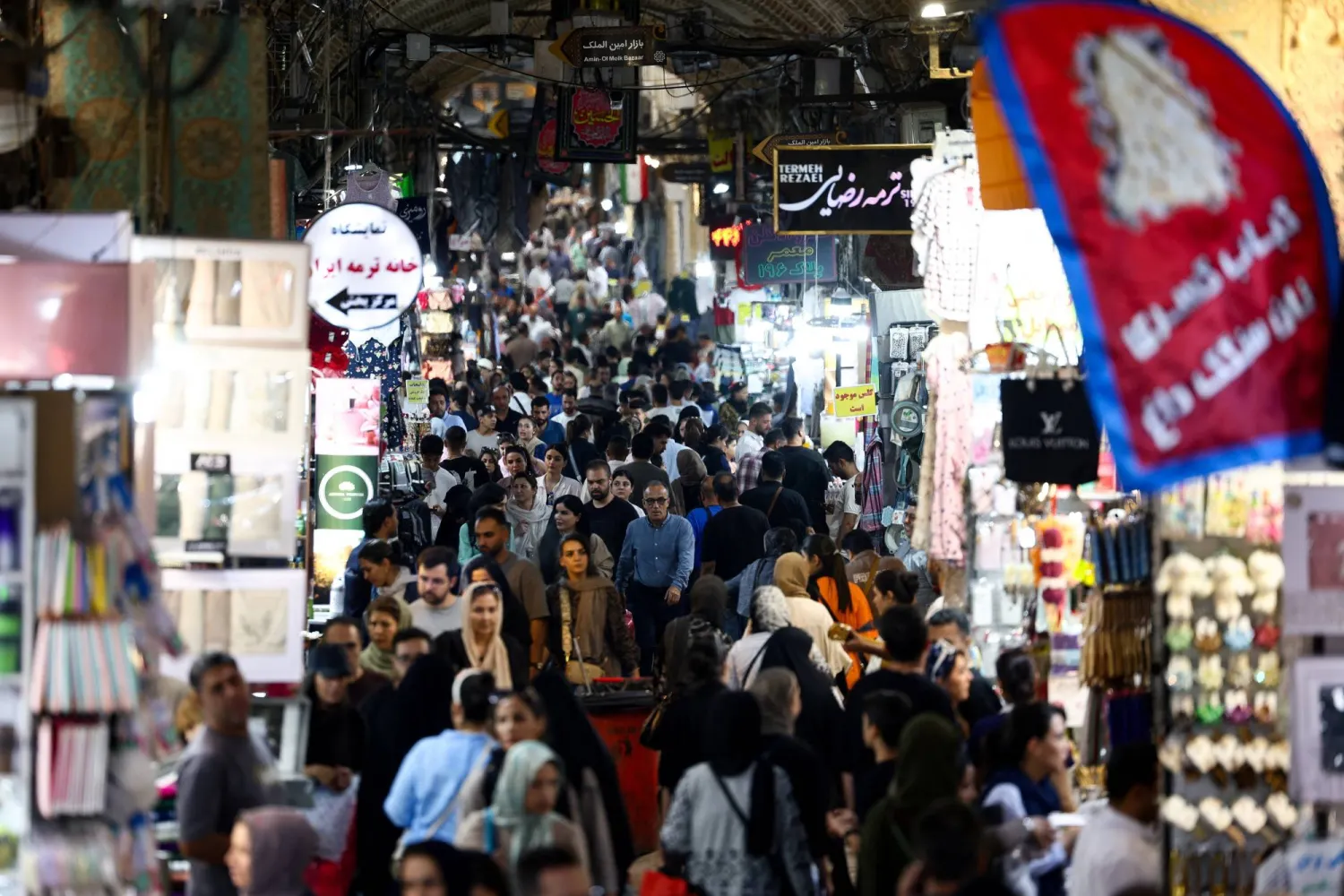
People walk in the Grand Bazaar in Tehran, Iran, August 17, 2026. Majid Asgaripour/WANA (West Asia News Agency) via Reuters
TT

Battered by War, Iran’s Rulers Wary of More Economic Pain and Unrest if US Tightens Pressure

People walk in the Grand Bazaar in Tehran, Iran, August 17, 2026. Majid Asgaripour/WANA (West Asia News Agency) via Reuters

Even as Iran projects resilience in the war with the United States, its leaders are worried that a threat of more economic punishment by Donald Trump could increase hardships, reignite unrest and further erode the regime’s legitimacy.

The US president vowed on Friday to hit Iran hard economically, a day after Treasury Secretary Scott Bessent said Washington would impose measures on Tehran that have "never been seen" as early as next week. Washington has not said what those measures will entail.

For all the bravado of Iran's leaders after holding out in nearly six months of conflict and effectively closing the Strait of Hormuz, a vital global oil supply route, they face mounting pressure at home that could result in nationwide unrest, according to three Iranian officials.

The officials, two political insiders, a former Iranian official and a dozen ordinary Iranians spoke to Reuters for this story on condition of anonymity, either for fear of retribution or because they are not authorized to speak to media.

Iran entered the war with high inflation, a weakening currency, energy shortages, sanctions and deep structural weaknesses, and must now contend with damaged infrastructure, disrupted trade, lost production and the cost of rebuilding.

Arshia, a civil engineer, spent a decade working in Iran’s construction industry before the war that began with US and Israeli attacks on February 28 brought projects largely to a standstill.

He is now struggling ‌to find work as ‌projects are delayed or cancelled and costs soar, with little prospect of a rapid recovery.

"I’m worried. If Trump imposes ‌more sanctions, ⁠how will ordinary ⁠people survive? I don’t want my country to be punished militarily or economically. We’re already struggling,” said the father of two from the central city of Isfahan.

His plight reflects a broader reality across Iran, where US strikes damaged factories, power plants, transport networks and other critical infrastructure, adding to pressure on an already strained economy.

Mohsen, 53, was forced to shut his small import-export business with Gulf countries after Iran retaliated against US strikes by targeting American bases and assets in the region.

"I had to lay off 10 employees. It was painful, but I had no choice. I could no longer afford to pay their salaries, and now I’m relying on my savings to support my family," he said from the southern port city of Bandar Abbas.

INFLATION, UNCERTAINTY HIT HOUSEHOLDS

Iran’s annual inflation rate reached 66% in July, while consumer prices were 87.9% higher than a year earlier, according to Iran’s Statistical ⁠Center. Food inflation hit 128% year-on-year.

For Iran’s rulers, the greater threat may be not economic pain itself, but the risk ‌that worsening hardship reignites mass unrest, said the two insiders and one official.

The appointment of Hossein Taeb ‌last week, a key architect of past crackdowns, to lead Iran’s Basij militia is one of the clearest signs yet of growing concern over a resurgence of unrest, a former reformist ‌official said.

The Basij, a paramilitary volunteer militia, is affiliated with Iran's powerful Revolutionary Guards, which have both been used by the clerical rulers to quell protests.

Economic ‌grievances have repeatedly spilled into nationwide protests in Iran in recent years.

In January, nationwide protests over economic hardships were crushed by the IRGC and the Basij force, with thousands killed.

In recent months, Iran’s clerical rulers have responded to fears of renewed unrest with executions, arrests, summonses and lengthy prison sentences targeting journalists, lawyers, activists, human rights advocates and students, rights groups say.

Officials say the measures are needed to maintain stability during wartime. Critics say they could deepen the divide between the clerical establishment and a public frustrated by rising economic pressures.

SALARY 'GONE WITHIN DAYS'

Families are cutting ‌back on meat and other staples, opting for cheaper alternatives.

"I’m ashamed in front of my children. My salary is gone within days. Meat and chicken have disappeared from our table. I have no idea how we’re going to ⁠get by," said Hossein, a government employee in ⁠the central city of Yazd.

Rents rose 31% year-on-year in March, according to the Statistical Centre, while state media reported Tehran housing prices at roughly 50% above last year.

Iran’s minimum wage was raised by about 60% this year, but continued rial depreciation has eroded purchasing power, with the dollar value of the minimum wage falling from about $105 to $86 since late March.

Bijan, 40, earned about $1,000 a month as an engineer when he entered the job market 15 years ago. He has since turned to online tutoring to make ends meet. Now, he and his wife struggle to make about $400 a month and have left Tehran for a cheaper province.

"I used to work maybe five or six hours a day ... Now, it’s all work or looking for work, or feeling anxious about not having enough work," said Bijan.

For many Iranians, fear of renewed conflict has made planning for the future increasingly difficult.

US NAVAL BLOCKADE RATCHETS UP COSTS

Iran has sought to keep essential goods moving through alternative routes, including land corridors and the Caspian Sea, but those alternatives are also coming under strain.

Strikes on bridges have disrupted overland transport, increasing the cost and time needed to move goods into Iran.

President Masoud Pezeshkian last week acknowledged the squeeze, saying: “Our problems have multiplied several times over, while our income has also fallen.”

Goods that once arrived by ship now take longer routes into Iran, driving up prices, he said, adding that Iran is selling less oil and collecting less tax revenue from damaged or struggling businesses.

The blockade has also effectively cut off Iran’s gasoline imports, lawmaker Reza Sepahvand told Iran's ILNA news agency on Saturday, adding that Iran’s daily gasoline output had reached its limit at about 130 million liters, compared with consumption of 137 million liters.



Trump Wants More Economic Pressure on Iran. What Are his Options?

US President Donald Trump arrives to deliver remarks at the Nassau County Police Academy Center for Training and Intelligence in Garden City, New York, on August 14, 2026. (Photo by Kent NISHIMURA / AFP)
TT

Trump Wants More Economic Pressure on Iran. What Are his Options?

US President Donald Trump arrives to deliver remarks at the Nassau County Police Academy Center for Training and Intelligence in Garden City, New York, on August 14, 2026. (Photo by Kent NISHIMURA / AFP)

US President Donald Trump on Friday vowed to hit Iran hard economically, a day after Treasury Secretary Scott Bessent said that Washington would impose measures on Tehran that have "never been seen" as soon as next week.

The United States, United Nations and European Union have applied sanctions, implemented trade embargoes and frozen assets since the late 1970s over Iran's nuclear program, human rights violations and support for militant groups.

Since the Iran war began in February, Washington has levied additional maritime, energy and financial sanctions and started a naval blockade.

Data from the US Treasury Department's Office of Foreign Assets Control (OFAC) shows the agency has imposed sanctions on more than 1,000 people, vessels and aircraft since Trump began his second term.

Recent measures have targeted Iran's shadow oil fleet; shipping insurers; entities and people enabling Iran's acquisition of weapons; and digital exchanges, freezing an estimated $500 billion in Iran-linked cryptocurrency.

According to Reuters, experts say the Trump administration also can try these options:

SANCTIONS ON CHINESE 'TEAPOT' REFINERS

Chinese independent refineries known as "teapots" account for a quarter of Chinese refinery capacity. They operate with narrow and sometimes negative profit margins.

China buys more than 80% of Iran's shipped oil, according to 2025 data from analytics firm Kpler. Independent refiners absorb much of this trade, exposing them to so-called secondary measures that penalize entities helping a primary sanctions target.

Past ⁠US sanctions have ⁠deterred larger independent refiners from buying Iranian oil. But the independent refineries are somewhat immune since they have little exposure to the US financial system, sanctions experts say.

SANCTIONS ON CHINESE BANKS

OFAC has imposed secondary sanctions on smaller China- and Hong Kong-based entities accused of processing billions of dollars in Iranian oil and helping to fund weapons procurement.

Treasury has warned two larger Chinese banks they could face secondary sanctions if Iranian funds were found moving through their systems, but has stopped short of designating them.

Hitting those two banks, which US officials have not publicly identified, or imposing other sanctions could have a chilling effect on bigger financial institutions, sanctions experts said, although they warned it could ⁠also trigger retaliatory actions by Beijing.

Trump administration officials have sought to play down tensions between Washington and Beijing ahead of an expected meeting between Trump and President Xi Jinping later this year.

They worry that China could curtail exports of critical minerals that are essential to advanced technology production at a time when the US and Western allies are still trying to develop their own supplies.

'WHACK-A-MOLE'

The United States could continue targeting Iranian individuals and entities, as well as others in China and the Gulf, that are helping Tehran evade sanctions to collect revenues for its war effort.

Treasury recently issued sanctions against firms that are springing up to facilitate Iran's trading of oil revenue for imports. But such measures amount to a "whack-a-mole" approach that has not altered Iran's behavior, said Brett Erickson, managing principal of Obsidian Risk Advisors, noting that Tehran simply creates new entities to replace them.

Miad Maleki, a sanctions expert with the Foundation for Defense of Democracies, said Bessent was likely signaling a sharpened enforcement push against oil shippers, purchasers and currency exchangers who help Iran pay for ⁠its imports.

Further aviation sanctions were ⁠also possible, aimed at degrading Iran's ability to move trade now that the US has blockaded shipping via the Strait of Hormuz, he added.

LAND BLOCKADE

Some US and Israeli officials have floated the prospect of a land blockade, which would require assistance from Iran's neighbors: Iraq, Türkiye, Pakistan, Afghanistan, Turkmenistan, Azerbaijan and Armenia.

The Trump administration has varying degrees of closeness with all those countries except Afghanistan, but that border is mountainous and extremely difficult to patrol anyway.

SECONDARY TARIFFS

Trump has repeatedly threatened tariffs on goods from countries that do business with Iran, although the Supreme Court struck down the legal basis for such taxes.

The Senate passed a sweeping Russia sanctions bill last week that included new Iran sanctions and would give Trump new tariff powers that he could potentially use against countries that aid Iran's commerce and weapons procurement. That legislation must still pass the US House of Representatives, which could prove challenging given widespread concerns among Democrats and some Republicans about the tariff measures.


The Ukrainian Social Media Channels Tracking Russian Missiles

Ukrainians use Telegram channels to track incoming Russian missiles and drones. Tetiana DZHAFAROVA / AFP
TT

The Ukrainian Social Media Channels Tracking Russian Missiles

Ukrainians use Telegram channels to track incoming Russian missiles and drones. Tetiana DZHAFAROVA / AFP

The chances of a missile attack on Kyiv that night were around 50 percent, according to the administrator of a social media channel monitoring Russian air raids.

His channel, Aeris Rimor -- roughly derived from the Latin for Searcher of the Skies -- is one of dozens sending real-time messages about incoming drones and missiles.

Ukrainians consult them to track potential Russian attacks, like people check weather applications for storms but with less certainty, shorter warning, and deadly stakes.

During one recent overnight attack, AFP journalists were granted rare access to shadow "Esko", the channel's administrator, on condition that his identity and some details of the operation remained undisclosed.

The 19-year-old, sporting a budding beard, usually operates from home, filling lulls by watching the TV show Criminal Minds or honing his drone-flying skills on a simulator.

Twenty-six minutes after midnight, the air raid alert rang, soon followed by a red dot glitching across the map on a screen in front of him.

"Oh, a missile on Kyiv," he said.

Switching to Telegram, he sent a message to 150,000 followers: "KYIV TARGET!"

"It's going to hit Kyiv in about a minute," he said.

He then sent out the names of the districts being targeted, quietly lamenting a few typos.

Seconds later, explosions echoed over the capital.

The red dot disappeared from the map, only for another to pop up shorty after.

"You have to literally stay on duty and stare at the screen the whole time, because you can easily miss it," said Esko, who did not appear to struggle, even late into the night.

Esko was looking at a live map used by Ukraine's air defense units.

Red icons -- depicting Russian drones -- were dotted across the map and disappeared as they were downed by Ukraine's air force.

- Bedtime dilemma -

The channels are tolerated by authorities but operate in a legal grey area as they use information from air force contacts.

Esko would not reveal publicly how he accessed the map.

In its nightly attacks, Moscow increasingly fires ballistic missiles, flying up to thousands of kilometers (miles) per hour and reaching Kyiv within three minutes of an air raid warning.

This poses a haunting dilemma for those in the capital.

Either go to a shelter -- the metro or a basement -- in advance, accepting a disrupted and uncomfortable night of half-sleep.

Or stay home and face the risk of a hit, particularly dangerous for those in high-rise buildings in heavily targeted districts.

Sometimes authorities warn hours before a likely attack.

Telegram channels -- sifting through intelligence data -- close the information gap, putting out daily forecasts on the probability of different types of attacks.

Esko said people often reach out asking for advice.

"You can only say: something might happen... but decide for yourselves."

On a recent night in Kyiv when there were mixed signals about a Russian strike, Kateryna Reshetnyk had gone down to the subway.

She based her decision on "a parallel analysis of several channels that have been posting truthful information for a long time."

She had set up folding chair next to the turnstiles with her mother and grandmother -- their beds for the next hours.

"But no one knows for sure what will happen or not. You just rely on your intuition and survival instinct," the 34-year-old said.

- 'Tension rising' -

Hundreds of others, armed with mats, tents and pillows, had done the same.

Dogs snored next to their owners, who were glued to their phones, screens lighting up weary faces.

"We track what's happening and where, because our relatives, friends and colleagues are all over Kyiv and the region, so at least we understand what is happening and where," Reshetnyk said.

The night passed without a major strike.

Ukraine's air force grudgingly tolerates the monitoring channels.

"We can't ban them. They exist, they inform the public, for some people that's convenient," spokesman Yuri Ignat told AFP.

But he warned those running them not to post "excess information ... that the enemy can use against us."

With people making potentially life-or-death decisions based on his posts, Esko said he felt the weight of responsibility.

Much of his life now is spent at the screen, tracking hundreds of drones on only a few hours sleep.

But he prefers busy nights, rather than uneasy periods of calm when Russia is stockpiling for future attacks.

"You keep waiting, waiting, waiting, and then you start posting warnings because the tension is rising. And still, nothing happens. You post again, and nothing happens..."

"And then they hit."


US Pulls Last Aircraft Carrier in Asia as Trump Focuses on Iran and the Western Hemisphere

This handout picture released by the US Navy on May 8, 2019 shows the Nimitz-class aircraft carrier USS Abraham Lincoln (CVN 72) while conducting a replenishment-at-sea with the fast combat support ship USNS Arctic (T-AOE 9), while MH-60S Sea Hawk helicopters assigned to the "Nightdippers" of Helicopter Maritime Strike Squadron (HSM) 5, transfer stores between the ships. (Jason WAITE / Navy Office of Information / AFP)
TT

US Pulls Last Aircraft Carrier in Asia as Trump Focuses on Iran and the Western Hemisphere

This handout picture released by the US Navy on May 8, 2019 shows the Nimitz-class aircraft carrier USS Abraham Lincoln (CVN 72) while conducting a replenishment-at-sea with the fast combat support ship USNS Arctic (T-AOE 9), while MH-60S Sea Hawk helicopters assigned to the "Nightdippers" of Helicopter Maritime Strike Squadron (HSM) 5, transfer stores between the ships. (Jason WAITE / Navy Office of Information / AFP)

President Donald Trump's war against Iran is stretching the limits of US aircraft carriers and leaving the western Pacific without one of the key American warships as China shows more signs of aggression.

The USS George Washington is departing the Pacific and expected to replace the USS Abraham Lincoln in the Middle East amid growing concerns about mental health and supply issues aboard the long-deployed carrier. The Lincoln has had its time at sea extended from its original May return date to support operations against Iran.

The lack of a US carrier in the Pacific may be short-lived if the Navy deploys another in the next couple of months. But it shows how the open-ended operations with Iran are running some American sailors ragged, analysts say, while the Trump administration further retreats from the Asia-Pacific region and focuses on the Western Hemisphere.

“The administration says that the Pacific is supposed to be the most important behind the Western Hemisphere,” said Greg Poling, director of the Southeast Asia Program at the Center for Strategic and International Studies. Instead, the US is "doing the exact opposite" of its previously expressed goal of pulling out of the Middle East.

American allies in the Pacific are unsettled over the unpredictability of the Republican administration, Poling said, while Beijing “is quite happy with US distraction, with the frustration of US allies and partners."

China may take advantage of US carrier's absence

Beijing sees the US military presence in the region as a threat to China’s rise and an obstacle to its ambition to seize Taiwan, the self-governing island it claims as its own. But the United States has argued that the Pacific region is too important economically to lose.

No one expects China to invade Taiwan because an American aircraft carrier has left the region. But the carrier's absence gives the Chinese another opportunity to show its strength, said Bryan Clark, a former Navy submariner who is a defense analyst at the Hudson Institute.

“They’re using this as part of the narrative to demonstrate to the Philippines, to Japan, to Indonesia and others that the US is not the big dog in the western Pacific anymore,” Clark said. “They would just prefer that countries in the region decide that China is the bigger power and the US is not able to guarantee their security anymore.”

China conducted naval exercises this week with Indonesia and recently has shown signs of aggression toward Japan and the Philippines, two key US allies that also have territorial disputes with Beijing.

China carried out military drills this month near the Scarborough Shoal in the South China Sea. Both China and the Philippines have claims over the shoal. Last month, a Chinese guided-missile destroyer conducted a live-fire exercise off Japan’s southernmost island of Okinotori.

Adm. Frank Bradley, head of the US Special Operations Command, has been trying to reassure regional allies of Washington’s commitment. He was in Manila on Thursday, telling his Filipino counterparts that US special operations forces are ready to step up joint exercises to strengthen the countries' alliance. He also is expected to travel to Japan.

“We have the ability to project force, the United States, anywhere on the globe,” Bradley told The Associated Press. “And when the threat in the region of the Middle East has been attended to, we will redeploy and reorient and be able to project that force wherever else it might be required.”

“I also feel very confident in the Armed Forces of the Philippines’ ability to protect their sovereignty here and for us to remain close with them,” he said.

Evan Sankey, a policy analyst at the Cato Institute who focuses on US policy toward China, said aircraft carriers provide psychological assurance to US allies. The absence of carriers in the region, he said, “adds to the general sense that the US is distracted by events in the Middle East.”

Trump has relied on aircraft carriers for military actions

Trump has relied heavily on aircraft carriers to support military operations during his second term. For example, the USS Gerald R. Ford returned home in mid-May after an 11-month deployment, the longest since the Vietnam War, during which it supported the US fight against Iran and the capture of Venezuela's then-leader, Nicolás Maduro.

The Ford had experienced a fire in a laundry space that forced the carrier to turn around and return to the Mediterranean Sea for repairs and left hundreds of sailors without places to sleep. Meanwhile, the Lincoln has spent a record uninterrupted time at sea of more than 240 days. Democratic lawmakers have been calling for investigations and greater visibility into conditions aboard the ship.

Warships and their crews can only handle so much, said Robert Farley, who teaches national security and diplomacy at the University of Kentucky and often writes about aircraft carriers.

“People don’t get enough rest. It's psychologically exhausting. And R&R is part of keeping the crew healthy,” Farley said. “Sometimes it’s framed as, ‘These people haven’t had a vacation.’ But we are dealing with well-known limits on the capacity of a crew to operate at top efficiency over time. And that just declines."

Clark, of the Hudson Institute, said the squeeze on the nation's aircraft carriers stems from the lack of preparation and planning for the Iran war.

“If we were going to mobilize to do this kind of conflict, and we anticipated it might go this long, we might have done some changes to the carrier schedule to make sure more would be available,” Clark said.

Clark said the Navy has 11 aircraft carriers and typically deploys two or three at a time. But it could soon deploy four if the USS Theodore Roosevelt leaves San Diego for the Middle East, allowing the Washington to return to Pacific.

But the massive warships will need maintenance, likely causing a bottleneck at the nation's only two carrier shipyards.

“We’ll end up with a maintenance debt that needs to be paid for the next few years,” Clark said. “We’ll probably have less carrier presence than we’ve had in the previous years because carriers will be lined up to get into the shipyard.”

There are questions about the use of aircraft carriers in modern warfare

Michael Swaine, a senior research fellow in the Quincy Institute’s East Asia Program, questions the future need for aircraft carriers as warfare rapidly changes.

Carriers can be more easily targeted with drones and missiles, particularly by an adversary such as China, Swaine said, while smaller ships and submarines can be as effective in striking targets as the fighter jets that launch off a carrier.

Top Navy officials have indicated a desire to move away from a heavy reliance on carriers. Adm. Daryl Caudle, chief of naval operations, told The Associated Press in February that he wants to convince commanders to use smaller, newer ships and other assets instead of consistently turning to huge aircraft carriers.