


Houthis Target Mokha to Halt Port’s Growing Role

Dozens of Houthi missiles and drones targeted Yemen’s Mokha port (AFP)
TT

Houthis Target Mokha to Halt Port’s Growing Role

Dozens of Houthi missiles and drones targeted Yemen’s Mokha port (AFP)

For more than a week, Iran-backed Houthis have pounded Yemen’s city of Mokha, its port and nearby harbors close to the Bab al-Mandab Strait with dozens of ballistic missiles and drones.

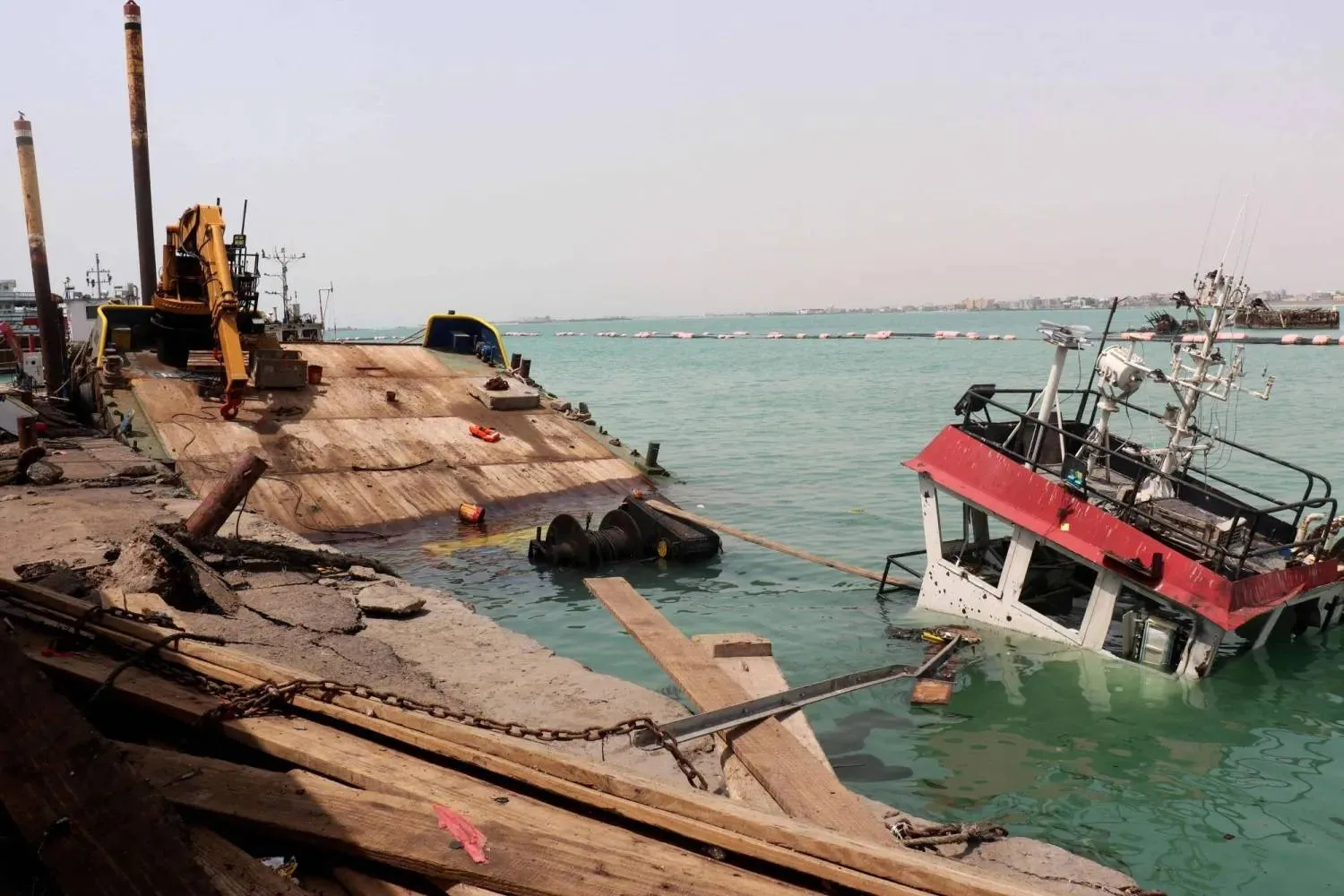
The sweeping escalation in Mokha has knocked the port out of service and caused heavy damage to infrastructure, facilities and docked vessels.

The Houthis say they are targeting military-linked sites and vessels, but those claims have not been verified.

Government and informed sources say the scale and pattern of the attacks point to broader aims, including possible military shifts along the western coast and Houthi fears that Mokha could emerge as a commercial rival to the Houthi-held port of Hodeidah.

Government forces on the western coast say the Houthis have fired 46 ballistic missiles and 55 drones at the commercial port and nearby harbors, while also using explosive-laden boats.

Informed sources told Asharq Al-Awsat that the Houthis fear a surprise government offensive but remain uncertain about where any operation could begin.

That concern, the sources said, has driven attacks on positions held by elite Yemeni army units now ready to take part in any potential battle launched from Marib province.

The Houthis have sharply intensified strikes on Mokha port and nearby facilities in an apparent effort to disrupt its expanding role as a Red Sea commercial hub, just as development and rehabilitation work is nearing completion to allow the port to receive container ships and boost import and export activity.

The unprecedented bombardment has halted port operations and stopped ships carrying food, electrical goods, and other cargo from arriving from the opposite shore of the Red Sea, at a time when the port had been preparing for a new phase of commercial activity.

Informed sources say the scale of the attacks reflects Mokha’s growing importance to importers and traders, especially those moving goods to northern Yemen through Houthi-controlled Hodeidah port, where commercial sources say they face multiple levies and fees.

The targets struck by missiles and drones also point to Houthi fears that Mokha could become an alternative commercial and maritime hub, drawing on its location near Bab al-Mandab and its ability to serve large areas including Taiz, Ibb, and parts of Lahj, Hodeidah, and al-Dhale.

But the Houthis’ calculations go beyond trade, according to the sources. The group also sees Mokha as a possible launch point for military operations against other areas it controls in Hodeidah province, placing the city and its port within a wider military equation.

Civilian facilities hit

The scale of the damage underlines the breadth of the attacks.

In the first days of the bombardment, three commercial vessels docked at the port were destroyed, including a wooden ship carrying goods for several traders and agencies. Unloading operations later stopped after workers were evacuated and rented cranes were put out of service.

The initial strikes killed seven people inside the port, including three civilians — a cook, a laborer, and an administrative employee — and four members of the facilities security force.

The attacks also hit the quay, logistics workshops, and the central hangar, as well as equipment and marine craft used to service vessels, crippling key parts of the port’s operations.

In the following days, the Houthis struck the Tihama, a commercial vessel that carried food and passengers between Yemeni ports, the Horn of Africa, and the Socotra archipelago.

Four crew members were killed, along with two Yemeni rescuers who were trying to save the crew and the vessel, according to local sources.

In the latest attack, the group fired four missiles at a locally owned commercial vessel docked at al-Ardi harbor in the Bab al-Mandab area. The ship, owned by a local contractor, had been under maintenance for several months after unloading its cargo.

Maritime sources said Yemeni contractor Bilal al-Shumairi had bought the vessel, named Amir Khan, from an Indian trader in Indonesia for use in his maritime and commercial activities.

The sources said the crew was Yemeni and had fully evacuated the ship during the previous week, preventing any casualties among its members.

Houthi losses mount

The escalation around Mokha comes as the Houthis suffer battlefield losses along front lines with government forces, particularly south of Hodeidah.

More than 180 Houthi fighters have been killed there, according to government sources, without the group making gains or capturing new positions.

The sources said the losses come as the Houthis seek to reinforce their military presence along western coast fronts while intensifying strikes on Mokha and the Bab al-Mandab area.

They said the pattern suggests an effort to complicate the battlefield and pressure government forces ahead of any possible military move.

The Houthis have also suffered losses on other fronts, including the killing of Hussein al-Hatfi, commander of the guard detail protecting Abdul-Khaliq al-Houthi, brother of the group’s leader and commander of what the Houthis call the “Central Military Region.”

Al-Hatfi was killed in a drone strike carried out by government forces as part of a series of attacks on Houthi positions and gatherings, according to the sources.

Government sources said al-Hatfi was from the Majz area of Saada province and was the fourth of his brothers to be killed while fighting in Houthi ranks since the war began.



Iraqi PM Sets June 30 Deadline for Pro-Iran Factions to Disarm

Iraq's Prime Minister Ali al-Zaidi speaks during the 81st session of the United Nations General Assembly at United Nations headquarters, Friday, Sept. 25, 2026. (AP Photo/Seth Wenig)
TT

Iraqi PM Sets June 30 Deadline for Pro-Iran Factions to Disarm

Iraq's Prime Minister Ali al-Zaidi speaks during the 81st session of the United Nations General Assembly at United Nations headquarters, Friday, Sept. 25, 2026. (AP Photo/Seth Wenig)

Iraqi Prime Minister Ali al-Zaidi on Thursday announced June 30 as a new deadline for armed factions to turn over their weapons to the state, following the end of the US-led coalition's mission in the country.

"October 1 is considered a serious beginning to address the issue of weapons outside state control... according to a clear roadmap and agreed timelines extending no later than June 30, 2027," Zaidi said in a statement, after having backed away from an initial September 30 deadline.


Trump Hails the US Military's Exit from Iraq after 12-year Mission against ISIS

29 September 2026, US, Washington: US President Donald Trump stands at the White House during a meeting with Technology executives. Photo: Matt Kaminsky/ZUMA Press Wire/dpa
TT

Trump Hails the US Military's Exit from Iraq after 12-year Mission against ISIS

29 September 2026, US, Washington: US President Donald Trump stands at the White House during a meeting with Technology executives. Photo: Matt Kaminsky/ZUMA Press Wire/dpa

The US military announced Wednesday that it completed the withdrawal of all American troops from Iraq, ending a 12-year mission to fight the ISIS group and prompting President Donald Trump to hail the conclusion of "a very expensive excursion into Hell.”

The last US troops left an air base in northern Iraq under a deal between Baghdad and Washington, The Associated Press reported.

Trump, in a social media post, described the withdrawal by a Sept. 30 deadline as “orderly." Appearing soon after at a White House event celebrating Hispanics, he spoke at length about the withdrawal and said, “It’s been a long time with very bad decision making that got us involved in this quagmire in the first place. It was a quagmire. For many, many years it lasted. But soon that part of history will be over.”

He said the shift was a victory for the US, Iraq and a sign of victory over the ISIS group.

The withdrawal, agreed on two years ago, comes against the backdrop of the ongoing war between the United States and Iran that has also sometimes spilled over into Iraq, with Iran-backed militias firing on US troops and the US striking the groups' strongholds.

Trump’s comments came as his own decision earlier this year to launch the war with Iran has been compared to the Iraq war for its undefined mission as it nears its seventh month.

Appearing at the White House, Trump made that comparison, arguing both that his one-day military action in Venezuela earlier this year to capture now former President Nicolás Maduro and the Iran war compared favorably, taking far less time and with fewer deaths of US troops.

In recent years, Washington has sought to shift its focus from the Middle East toward Asia, but that shift has been inconsistent, with the Pentagon alternating between reducing its Mideast presence and then finding itself engaging in new conflicts — including the ongoing war in Iran.

Baghdad touted the end of the US mission as a sign of the country's increasing strength and sovereignty.

The withdrawal was also celebrated by Iran-backed groups but raised concerns among some other Iraqis, particularly in the Kurdish region, where many fear a resurgence of the ISIS group as well as more attacks by Iran-linked groups, possibly emboldened by the departure of US forces.

Meanwhile, questions loom around the future of the Iraqi militias, which the Baghdad government has sought to disarm, with little success so far.

A new phase in Iraq after decades of US involvement

Pentagon spokesperson Sean Parnell said in a statement that US troops and equipment had completed an “orderly departure” from the air base in Irbil, in northern Iraq's semi-autonomous Kurdish region.

“This milestone reflects the success of a 12-year campaign that defeated ISIS as an organized military threat in Iraq and across the region,” he said. “It also marks a transition from a wartime coalition mission to an Iraqi-led security effort supported by a more normal bilateral security relationship.”

He added that the US military “will continue to provide targeted training and intelligence support to our Iraqi partners.”

Iraqi Prime Minister Ali al-Zaidi presided over the handover ceremony and described the US withdrawal as the beginning of a “new phase, one defined by Iraq’s sovereignty, the strength of its institutions, the readiness of its forces, the unity of its decision-making, and balanced partnerships with its friends.”

He said Iraqi security forces will continue the fight against ISIS and the government will ensure that non-state groups no longer hold weapons.

Trump in his remarks on Wednesday lavished praise on al-Zaidi, calling him “outstanding,” a “fantastic guy, friend of mine,” and someone who “will hopefully be able to handle things very well.” He also appeared to try to take credit for al-Zaidi's leadership, saying that the Iraqi leader was “running for election” and “wasn’t given even a chance and I endorsed him and politicked for him a little bit, and he ended up winning in a virtual landslide.”

Al-Zaidi was not on the ballot but was selected as prime minister when Iraq’s dominant parliamentary bloc nominated him after weeks of internal debate among its member parties and Trump publicly announcing his opposition to the coalition's previous choice.

US troops invaded Iraq in 2003 to topple Saddam Hussein. They departed in 2011, but three years later, Iraqi authorities invited a smaller US-led mission to fight the ISIS group, which had rampaged across Iraq, seizing large swaths of territory.

With the extremist group reduced to scattered sleeper cells, Washington and Baghdad agreed in 2024 to wind the mission down.

US troops pulled out of bases in most areas of Iraq last year but maintained a small presence of hundreds of troops in the semiautonomous northern Kurdish region. Bases there have regularly come under attack since the US and Israel launched their war against Iran on Feb. 28.

The future of militias remains unclear

The Iraqi government initially linked the Sept. 30 deadline for US withdrawal to the disarmament of non-state armed groups by that date.

While a handful of less-influential militias have agreed to turn over their weapons, powerful groups close to Iran rejected the prospect or set conditions for disarming that the government would be unlikely to meet.

Al-Zaidi has since walked back the deadline. He told The New York Times earlier this month that the deadline for militia disarmament has been pushed to June 2027.

The effects of the US withdrawal may not be immediately visible, particularly since the US military presence had already been scaled down. But officials in Iraq's Kurdish region have expressed anxiety about the departure and particularly about the removal of US air defense systems.

The Kurdish regional government's Peshmerga Ministry said the Kurdish region had faced more than 1,000 drone and ballistic-missile attacks during the recent US-Iran conflict.

“The departure of the United States from the Kurdistan Region under these complex regional circumstances, without the provision of a defense system, is a matter of concern,” the statement said.

Iran-allied groups in Iraq, meanwhile, have celebrated the US withdrawal.

“The expulsion of the occupation forces, defeated, from the land of Iraq is the beginning of full sovereignty,” Abu Mujahid al-Assaf, a security official with the powerful Kataib Hezbollah militia, said in a statement.

He added a warning to al-Zaidi and his government not to carry out American plans, threatening that “any government that does not work for the benefit of the people will be overthrown by all means.”

Kataib Hezbollah leader Ahmad al-Hamidawi took a somewhat more conciliatory tone, calling on the group's fighters to halt their military activities “with the exception of targeting hostile aircraft violating the country’s airspace.”

The Islamic Resistance in Iraq, an umbrella group of Iran-backed militias, said in a statement that negotiations with the government over the regulation of weapons have not resulted in an agreement and that it was “not bound by any timeline or agreement” announced by the government or political entity. The group said it is open to “any dialogue that guarantees Iraq’s sovereignty and dignity.”


What to Know about the Terrifying FlyDubai Flight Bound for Israel

A plane, carrying passengers who were on the FlyDubai aircraft bound for Israel from the United Arab Emirates, which was diverted to Saudi Arabia following an emergency signal, arrives at the Ben Gurion International Airport, in Lod, near Tel Aviv, Israel, September 30, 2026. REUTERS/Ammar Awad
TT

What to Know about the Terrifying FlyDubai Flight Bound for Israel

A plane, carrying passengers who were on the FlyDubai aircraft bound for Israel from the United Arab Emirates, which was diverted to Saudi Arabia following an emergency signal, arrives at the Ben Gurion International Airport, in Lod, near Tel Aviv, Israel, September 30, 2026. REUTERS/Ammar Awad

One pilot stabbed another and attempted to crash a flight from the United Arab Emirates to Israel.

Passengers, many of them Israelis, feared for their lives as the FlyDubai aircraft lost half its altitude in about a minute.

As Israel scrambled fighter jets out of concern for a possible hijacking, a passenger and crew member burst into the cockpit to subdue the attacker, enabling other crew members to gain control of the aircraft, which landed safely in Saudi Arabia.

It was not clear what motivated Wednesday's attack.

The terrifying flight occurred just days before the anniversary of the Oct. 7, 2023, attack on Israel that launched the war in Gaza. It has rekindled anxieties about airline security and focused attention on an unsettling question: Are pilots a significant threat to the flying public's safety?

Here’s what we know — and don’t know — about what happened on FlyDubai flight FZ1073:

A fight, an alert and a rapid descent

The distress call came at 8:44 a.m. local time, about two and a half hours after the flight with about 170 passengers left Dubai and headed to Tel Aviv.

The captain and first officer had been fighting in the cockpit after one stabbed the other and tried to crash the aircraft, according to Israeli Prime Minister Benjamin Netanyahu.

The aircraft swiftly lost altitude — dropping from 33,000 feet to 17,000 feet (around 10,000 meters to 5,100 meters) in the span of about a minute. It then circled close to the Jordanian border before landing in Tabuk, Saudi Arabia, about an hour later.

Aviation experts said they were surprised that the plane did not crash after a descent so extreme that most of the rudder was ripped off the tail.

Both pilots suffered injuries that required hospital treatment, according to a statement from Tabuk's Prince Sultan bin Abdulaziz International Airport.

A plane carrying passengers from the flight landed Wednesday evening in Israel.

Passengers and crew wrest control

A passenger and a crew member managed to enter the cockpit, enabling other crew members to fly the plane to a safe landing, according to Netanyahu, who cited a passenger he had spoken to.

The cockpit door on all aircraft is locked during flight for security reasons — a measure that became the industry standard after the Sept. 11, 2001 attacks, in which hijackers broke into the cockpits of four domestic flights in the United States.

Netanyahu said on X that the pilot who had been stabbed opened the cockpit door, which "enabled passengers and crew to overpower the attacker — preventing a catastrophic midair disaster.”

What security checks do pilots undergo? One question surrounding this incident is how anyone on the aircraft — especially a pilot — was able to get a knife onboard. It's unclear how big the knife was that was used in the attack or if it was a knife.

In an interview with Fox News Channel’s Sean Hannity that aired Wednesday night, Netanyahu said the attacker might have hit the captain with an axe. Airlines are generally required to carry crash axes in the cockpit for use in an emergency to break open a window to escape or break open a panel to access a fire.

Pilots undergo rigorous screening, including passing through metal detectors, at checkpoints at all airports. It's also standard for airlines to vet their pilots' background for criminal and employment history, their physical and mental health, as well as having them undergo intelligence and security screening.

Israel has some of the most stringent airline security measures worldwide. Passengers on Israel-bound flights regularly are taken aside for questioning and baggage searches after passing through normal airport security.

There have been extremely rare occasions when airline security protocols fail. In 2015, the co-pilot of Germanwings Flight 9525 locked the captain out of the cockpit and deliberately set the plane on a collision course with a mountainside, killing all 150 people aboard.

Cockpit struggles have been blamed in past crashes

On Oct. 31, 1999, EgyptAir Flight 990 went down off the Massachusetts island of Nantucket killing 217 aboard, and investigators at the time said the evidence pointed to it being intentionally crashed into the ocean by its co-pilot after a struggle in the cockpit.

In its final report adopted in 2002, the National Transportation Safety Board said the co-pilot was heard on the cockpit voice recorder saying “I rely on God” as the plane was going down, while the captain repeatedly urged him to “pull up with me.”

The evidence led the NTSB to conclude that the crash was not the result of a mechanical failure but was “the result of pilot inputs, including opposing pilot inputs where the relief first officer was commanding nose-down and the captain was commanding nose-up movement.”