


'How Many Will Die?': The Mysterious Ailment Killing Kenyan Elephants

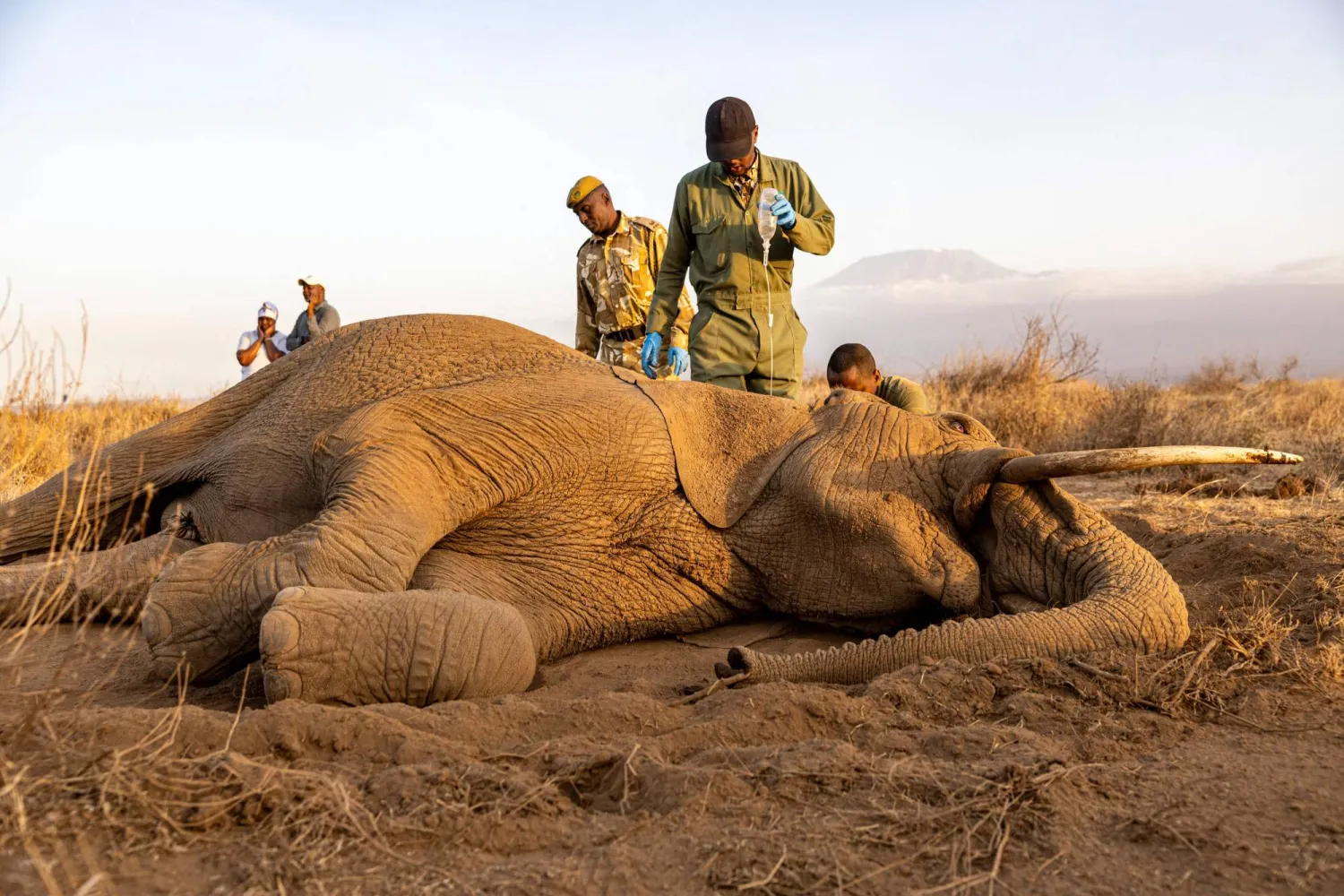
Veterinary officers from the Sheldrick Wildlife Trust and Kenya Wildlife Service (KWS) attend to a male elephant lying on the ground after falling ill at Kitenden B Community Conservancy in Amboseli, Kajiado County, on August 12, 2026. (Photo by SIMON MAINA / AFP)
TT

'How Many Will Die?': The Mysterious Ailment Killing Kenyan Elephants

Veterinary officers from the Sheldrick Wildlife Trust and Kenya Wildlife Service (KWS) attend to a male elephant lying on the ground after falling ill at Kitenden B Community Conservancy in Amboseli, Kajiado County, on August 12, 2026. (Photo by SIMON MAINA / AFP)

Lying on the ground and kicking up a cloud of dust, the elephant slowly exhausted himself in futile attempts to stand, the latest victim of a mysterious ailment in southern Kenya.

Distressed vets administered a glucose injection -- the only option, given that the cause of the ailment remains unknown -- to the 11-year-old male, known as Genghis Khan, who was struggling to breathe and died on Tuesday.

The mystery affliction has killed at least 20 pachyderms, mostly females or young males, since June in Kenya. All of the animals have identical symptoms, including partial paralysis.

Elephant herds have made Amboseli -- overlooked by Africa's highest peak, Mount Kilimanjaro in Tanzania -- a lucrative tourist hotspot and the mysterious deaths in the region are a sensitive issue in a country where tourism is a huge source of revenue.

"You would find one struggling for a day, struggling for two or even three days. Until they completely die," said Patrick Papatiti, head of operations for Olgulului communal lands, which includes the Kitenden B reserve where Genghis Khan was found.

In late July, the Kenya Wildlife Service (KWS) said toxicology reports found high concentrations of cyanide in the animals' carcasses, suggesting possible pesticide poisoning from nearby farms' crops.

While observers still question the possible cause of death, several specialists interviewed by AFP dismiss poisoning.

"It's a disease," said Papatiti, who was born and raised in the local Maasai community, insisting there was "no way" cyanide was involved.

He is one of the very few local voices publicly rejecting the KWS preliminary findings, pointing out that no other animals have died.

Notably, neither scavengers nor flies that fed on the supposedly poisoned carcasses have perished -- creatures that typically succumb after consuming poisoned animals.

"If another animal feeds on that carcass and it is not dying, then definitely it is not a chemical," Joel Nyika, the Amboseli ecosystem manager for the Kajiado County authorities, told AFP.

He dismisses the theory, also put forward by the KWS, that the cyanide might have come from a type of foliage, noting local livestock would have died as well.

"As wildlife managers, we believe it could be a disease that is only affecting these elephants."

On August 7, the KWS said their "findings to date do not indicate an infectious or transmissible disease", assuring tourists that they could continue to visit.

But in the Kimana reserve, AFP journalists saw six carcasses on one day -- some fresh, others older -- with rangers also observing partial paralysis, preventing the animals from standing.

Maasai farmers, like 52-year-old Noah Saatia, rejected the possibility of poison -- pointing out to AFP they eat the same things -- and expressed anger over the animals' deaths.

"When they die, it hurts us," he told AFP, standing in his crop of maize, protected from animals by fences.

"We don't know the cause of the elephant deaths... But they are not dying because of food -- that's for sure."

Some of the deaths occurred only days earlier.

The carcass of a four-month-old calf, swarming with flies, lay half-devoured by hyenas.

About a dozen vultures were feeding on the remains of a pregnant female elephant, who had died near full term, and her unborn calf.

Paula Kahumbu, conservationist and head of Wildlife Direct, highlighted the "lack of evidence" supporting the pesticide theory.

In an interview with AFP, she noted that few adult male elephants had died, even though they are the ones most likely to raid crops.

Olgulului's Papatiti also dismissed the theory of deliberate poisoning. He said the emphasis should not be on pinning blame on individuals but finding the cause: "We need to know what is killing our elephants."

The sensitivity of the deaths has spooked the wildlife community, with several environmental organizations declining to comment to AFP beyond calling for a full investigation, while rangers at the Kimana reserve said they were not authorized to speak.

Papatiti fears that the death toll is being underestimated and that the affliction may also be affecting elephants in neighboring Tanzania.

"How many elephants will die before we can stop this?"


Green Riyadh Launches Tree-Planting and Cleanup Campaign

File photo of the Saudi capital Riyadh - File/AAWSAT
TT

Green Riyadh Launches Tree-Planting and Cleanup Campaign

File photo of the Saudi capital Riyadh - File/AAWSAT

Green Riyadh, one of the programs overseen by the Royal Commission for Riyadh City, has launched a tree-planting and cleanup campaign at Shuaib Umm Qasr to coincide with Saudi National Day celebrations, the Saudi Press Agency said Sunday.

The campaign will be held on September 23 from 1:00 p.m. to 5:00 p.m. and is open to male and female volunteers from all segments of society. Participants will receive volunteer certificates in recognition of their active contributions to environmental service.

The initiative aims to attract volunteers to participate in tree planting and cleanup activities, thereby promoting community engagement and a culture of volunteerism while supporting national efforts to protect the environment and achieve sustainability.


82-year-old Dies after Beach Fight in Greece over Sun Lounger

Tourists from a nearby hotel watch military helicopters fly overhead during Medusa 15, a joint military exercise led by Greece and Egypt, at Maleme on the Greek island of Crete, Friday, Sept. 18, 2026. (AP Photo/Thanassis Stavrakis)
TT

82-year-old Dies after Beach Fight in Greece over Sun Lounger

Tourists from a nearby hotel watch military helicopters fly overhead during Medusa 15, a joint military exercise led by Greece and Egypt, at Maleme on the Greek island of Crete, Friday, Sept. 18, 2026. (AP Photo/Thanassis Stavrakis)

An 82-year-old man died Sunday after he got into a fight over a sun lounger on a beach in Greece near Athens, local media reported.

The octogenarian had a dispute with a 76-year-old man and a 21-year-old woman over the sun lounger, with the argument degenerating into a scuffle between the two men, according to police, the ANA news agency and ERT state television channel reported.

The 82-year-old, badly hurt, was transported to hospital from the Vouliagmeni beach resort area where the argument broke out. He was later declared dead at the hospital, AFP said.

Both the 76-year-old man and the 21-year-old woman were arrested, ANA said, with police investigating what happened.


10 Lions Die in Suspected Poisoning at Tanzania Wildlife Reserve

Lions are seen in their counpound at the Artis Amsterdam Royal Zoo in Amsterdam, Netherlands in this handout photo released to media on January 28, 2021. Artis Amsterdam Royal Zoo/Handout via REUTERS
TT

10 Lions Die in Suspected Poisoning at Tanzania Wildlife Reserve

Lions are seen in their counpound at the Artis Amsterdam Royal Zoo in Amsterdam, Netherlands in this handout photo released to media on January 28, 2021. Artis Amsterdam Royal Zoo/Handout via REUTERS

Ten lions were found dead in Tanzania's Ngorongoro wildlife reserve this week and preliminary findings suggest they may have been poisoned, the area's management authority said.

The deaths raise concerns over the conservation of lions in one of Africa's most renowned wildlife ecosystems. Poisoning has been a recurring threat to large ⁠carnivores across parts ⁠of East Africa, often linked to conflicts between predators and livestock owners.

The lions were discovered on September 18 in the Ndutu area of Endulen Ward in Arusha ⁠region, Reuters quoted the Ngorongoro Conservation Area Authority as saying in a statement released late on Saturday.

"Preliminary findings suggest the animals may have died after ingesting poison," the authority said, adding that it had launched an investigation to determine the cause and identify those responsible.

The Ngorongoro Conservation Area, a UNESCO ⁠World ⁠Heritage Site in northern Tanzania, is one of the country's leading tourism attractions. It is home to a wide range of wildlife, including lions, elephants, buffaloes and endangered black rhinos.

Last month, police arrested four suspects in an investigation into the deaths of 18 elephants across the border in Kenya.
