


Trump Pauses 50% Tariffs on Canadian Goods for Three Days

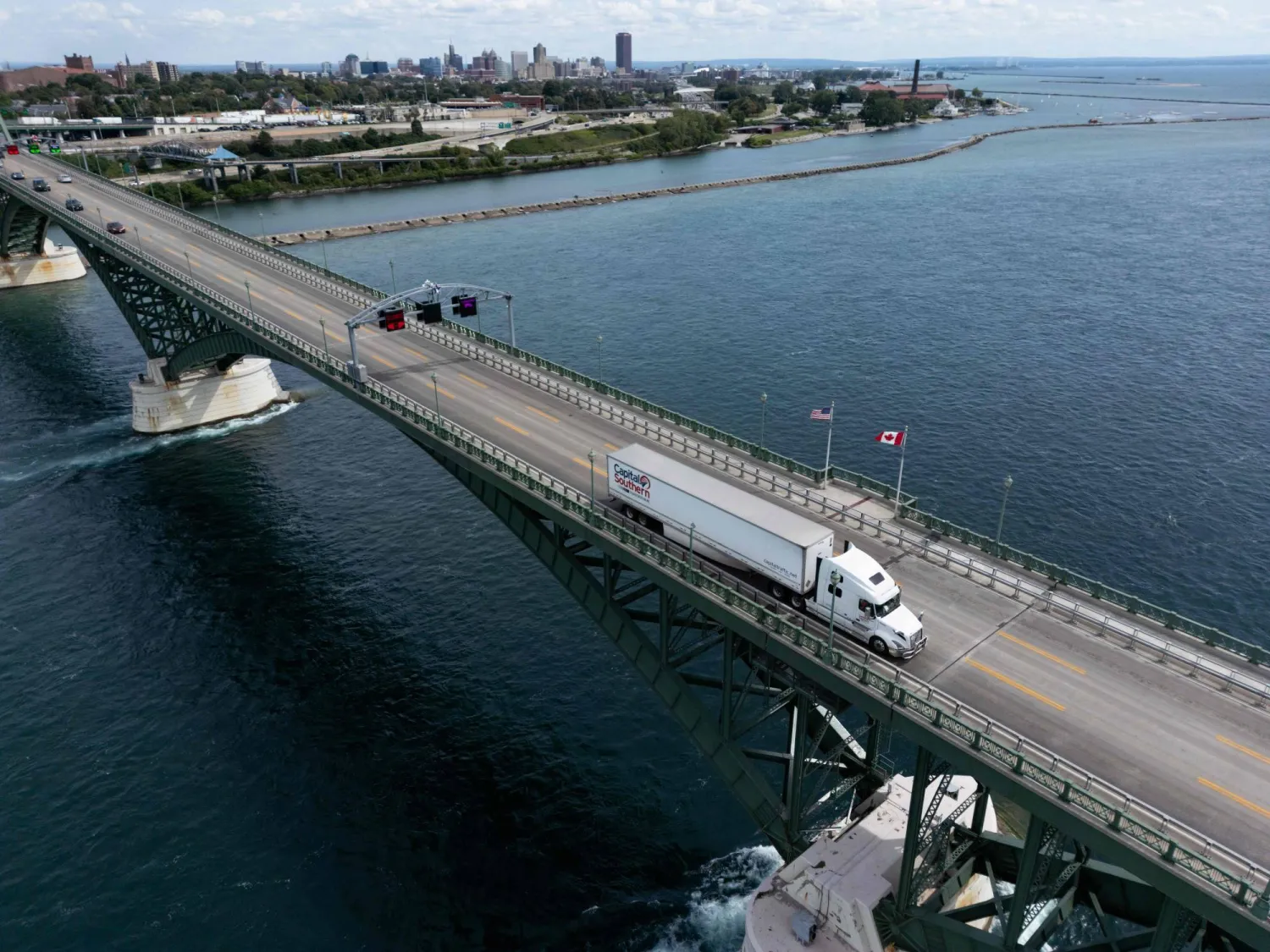
This aerial view shows a Capital Southern Transportation, Inc. truck passing over the Peace Bridge between Canada and the US in Fort Erie, Ontario, on August 18, 2026. (AFP)
TT

Trump Pauses 50% Tariffs on Canadian Goods for Three Days

This aerial view shows a Capital Southern Transportation, Inc. truck passing over the Peace Bridge between Canada and the US in Fort Erie, Ontario, on August 18, 2026. (AFP)

US President Donald Trump paused the planned rollout of punishing new tariffs on Canadian goods late Tuesday, as both sides indicated they were close to a broader trade agreement after weeks of talks.

Trump announced the three-day reprieve from 50-percent duties on select goods just hours before a midnight deadline.

The delay was "based on the fact that Canada and the U.S.A., subject to the finalization of documents, have a DEAL!" Trump wrote on his Truth Social platform.

Canadian Prime Minister Mark Carney was less definitive, saying "substantial progress has been made" towards a comprehensive trade deal, but "there is important work still to be done."

Ottawa and Washington have held intense negotiations on revising their existing deal, the United States-Canada-Mexico Agreement (USMCA), which Trump signed and praised during his first term but now says needs to change.

The US Trade Representative's office said on X that the pact between Washington and Ottawa is set to "include comprehensive market access for all American goods, economic security commitments, digital trade alignment" and other provisions.

A proclamation by Trump to pause the duties added that the suspension came about as "Canada has expressed a commitment to remove the discriminations or unreasonable and unequal impositions at issue."

Carney said the prospective deal aims to "address outstanding trade issues and deliver greater certainty and real benefits for Canadian businesses, workers, farmers and families."

- 'Discriminatory treatment' -

Trump had signed orders for the 50-percent duties last month, with the White House alleging "discriminatory treatment" by Canada against US automobile and dairy products.

The new tariffs would cover products such as wine, hockey sticks and cement.

They target around 5.5 percent of Canada's exports to the United States, worth about $20 billion, Oxford Economics estimates.

While this only poses a "modest" negative risk to Canada's economy, Oxford Economics said in a recent report that the duties would "affect central Canada's manufacturing sector much more severely."

Canadian negotiators have been in Washington to push for a deal to avoid the new tariffs and also secure relief on Trump's sector-specific duties, which have battered Canada's auto, steel, lumber and aluminum industries.

Ottawa reportedly offered concessions like pressuring provinces to put some US beverages back on their shelves.

Without going into details, Trump added in his Truth Social post: "The great Keystone XL Pipeline, long ago killed by Sleepy Joe Biden, may be awoken from the grave!"

Trump has previously called for the revival of the controversial project opposed by environmental activists, which was blocked under his predecessor Biden.

- Political concerns -

"It's not unusual for a trade negotiation to go right up to the deadline," former US commerce official Christopher Padilla told AFP.

He expects that the Trump administration threatened new tariffs to try and win early concessions from Canada as the countries negotiate new terms for the USMCA.

Oxford Economics anticipates that manufacturers who stand to be most impacted include those in the cement, paper, printing, wood, clothing and electronic equipment sectors.

With the US Supreme Court striking down many of Trump's global tariffs earlier this year, the president had tapped an untested legal provision for the new duties targeting Canada.

The US duties will not apply to Canadian energy, potash or goods already facing sector-specific tariffs, but are set to hit products covered by the USMCA.

Trump's trade envoy Jamieson Greer previously said the tariffs aimed to "hold Canada accountable" for its retaliation against the United States.



Trump Says He Is Still Considering Diesel Export Ban

 A semi drives past a sign advertising the price of diesel along Interstate 5 in Williams, California, US, September 28, 2026. (Reuters)
A semi drives past a sign advertising the price of diesel along Interstate 5 in Williams, California, US, September 28, 2026. (Reuters)
TT

Trump Says He Is Still Considering Diesel Export Ban

 A semi drives past a sign advertising the price of diesel along Interstate 5 in Williams, California, US, September 28, 2026. (Reuters)
A semi drives past a sign advertising the price of diesel along Interstate 5 in Williams, California, US, September 28, 2026. (Reuters)

US President Donald Trump said on Wednesday that he has conversations about banning diesel exports "every day" as the White House races to curb soaring energy prices.

Speaking from the Oval Office, Trump said an export ban would "have a negative impact on gasoline" prices, but could lower diesel costs.

He said Russia's war in Ukraine, with strikes ‌from either side ‌impacting energy production and exports, is ‌the ⁠main cause of ⁠rising diesel prices.

He added: "We think we're in a very good place."

Gasoline prices have jumped more than 40% over the past year and diesel climbed to a record of $6.53 a gallon a week ago, according to AAA data. The price spike ⁠is largely driven by a combination of ‌a reduction in supply ‌due to the Iran war and interruptions to refining, in ‌part because of Ukraine's attacks on Russian energy ‌facilities.

The Trump administration and Republican candidates have been under pressure to bring down fuel costs as November's midterm elections approach and Trump's economic approval ratings remain under strain.

Energy Secretary ‌Chris Wright said the disruptions were more widespread.

"We've lost some diesel exports from the ⁠Middle ⁠East, although we're restoring those, and we've lost diesel exports from China," he said. "So that's a lot of interruptions."

He said the administration expected announcements soon from Europe about new diesel supplies.

The White House has urged the European Union to release emergency diesel stocks to help ease prices, Reuters reported.

The Trump administration has also weighed a blanket diesel export ban, voluntary export limits by refiners and allowing broader sales of tax-exempt diesel.


Saudi Arabia Earmarks $371 Bn in Spending for 2027 Budget

The Saudi finance minister at the 2026 Budget Forum (File photo — Asharq Al-Awsat)
TT

Saudi Arabia Earmarks $371 Bn in Spending for 2027 Budget

The Saudi finance minister at the 2026 Budget Forum (File photo — Asharq Al-Awsat)

Saudi Arabia projects spending of 1.392 trillion riyals ($371.2 billion) in 2027 against revenue of 1.202 trillion riyals ($320.5 billion), leaving a budget deficit of about 3.6% of gross domestic product as it funds economic growth and development and strategic priorities.

The Finance Ministry released its preliminary budget statement for fiscal 2027 on Wednesday as the kingdom presses ahead with economic transformation programs and expands non-oil activity. Its fiscal policy seeks to support growth while maintaining fiscal sustainability.

The ministry forecasts revenue rising to about 1.351 trillion riyals ($360.3 billion) by 2029, with spending increasing to about 1.544 trillion riyals ($411.7 billion).

The projections point to sustained spending on development and strategic priorities and projects with economic and social returns, backed by long-term fiscal planning designed to maintain sustainability across economic cycles.

Diversification initiatives and economic reforms have lifted non-oil revenue from about 166 billion riyals ($44.3 billion) in 2015 to 505 billion riyals ($134.7 billion) in 2025, strengthening revenue stability and broadening its sources.

Non-oil growth cushions oil slump

Saudi Arabia’s real GDP is expected to contract by 3.6% in 2026 as oil activity falls by 21.8%, according to preliminary estimates reflecting the impact of economic and geopolitical developments.

Non-oil activity is forecast to grow by 3.2%, cushioning the decline in the broader economy.

In the first half of 2026, non-oil activity grew by 1.8%, lifting its share of real GDP to a record 57.3%, driven by strong domestic demand and private investment inflows.

Saudi unemployment falls to 6.5%

Unemployment among Saudi nationals fell to 6.5% in the second quarter of 2026.

Inflation is estimated at about 2.1% for the full year, amid sustained domestic demand and developments in non-oil economic activity.

Government plans domestic and international financing

The government plans to continue raising funds domestically and internationally in 2027 and over the medium term under its medium-term debt strategy, through bond and sukuk issuance and loans.

It also plans to expand alternative government financing.

These channels include project and infrastructure financing and financing through export credit agencies, providing additional funding for projects and development priorities.

Finance Minister Mohammed Al-Jadaan said the preliminary 2027 budget estimates come amid persistent global economic uncertainty and accelerating geopolitical developments.

The kingdom continues to manage public finances with a long-term view, he said, strengthening its ability to respond to changing conditions and sustain spending on development and strategic priorities while preserving fiscal sustainability and financial strength.

The government is monitoring economic and geopolitical developments and assessing their potential impact on the global economy, supply chains and energy markets, he added. Flexible, proactive policies aim to support the economy and keep it on course toward Saudi Vision 2030 targets.

Al-Jadaan said economic transformation plans would continue to support growth and broaden the economic base, lifting non-oil revenue and making revenue more sustainable and stable over the medium and long term.

Deficit fits long-term fiscal policy

The projected 2027 deficit of 3.6% of GDP is part of a fiscal policy aimed at preserving financial strength and improving fiscal sustainability while maintaining spending on priority projects.

The Finance Ministry said the approach allows the government to pursue balanced fiscal policies across economic cycles, support growth, adapt to changing conditions and manage crises and emergency needs while keeping public debt sustainable and maintaining substantial fiscal reserves.

The government plans to continue domestic and international financing in 2027 and over the medium term under its medium-term debt strategy, issuing bonds and sukuk and securing loans at a fair cost.

It also plans to expand alternative government financing, including project and infrastructure financing and financing through export credit agencies.


Digital Spending Is Reshaping Saudi Consumer Habits

A woman shops at a retail and grocery center in Saudi Arabia (SPA)
TT

Digital Spending Is Reshaping Saudi Consumer Habits

A woman shops at a retail and grocery center in Saudi Arabia (SPA)

Saudi consumers are rapidly reducing their reliance on cash as digital payments expand across everyday sectors, from grocery shopping to entertainment and electronic gaming. The shift is being driven by a young population, widespread smartphone adoption, and increasingly advanced payments infrastructure.

Grocery shopping is emerging as one of the sectors benefiting most from this transformation. Digital spending in the sector grew by 18 percent over the past year, while spending on electronic gaming has surpassed global averages, pointing to the expanding reach of the digital economy and changing consumption patterns in the Kingdom.

The total value of digital transactions across the Gulf countries is expected to grow at an annual rate of 8.7 percent between 2024 and 2028, reaching $178 billion, according to Oxford Business Group (OBG). This growth comes amid wider adoption of digital wallets, money-transfer applications, and cashless payment methods.

Against this backdrop, Mohamed Nana, Mastercard's Senior Vice President for Digital Partnerships in Eastern Europe, the Middle East and Africa, told Asharq Al-Awsat that this growth is being driven by the digital transformation visions adopted by countries across the region.

He also pointed to the launch of Buna, the Arab regional payments system, which is fully owned by the Arab Monetary Fund and supported by Arab central banks. The system aims to reshape cross-border payments and strengthen economic integration both regionally and globally.

Nana said Mastercard has made its Mastercard Move money-transfer solutions available through Buna, in what he described as the first collaboration of its kind between the public and private sectors. In Saudi Arabia, he said, the company is focused on supporting the growth of the digital economy through technology, secure payments infrastructure, and local partnerships.

Saudi Consumers Expand Their Digital Payment Use

Nana said the adoption of a broader range of digital payment methods is accelerating in Saudi Arabia. In addition to becoming familiar with solutions such as digital wallets, money-transfer applications, biometric identification, and installment-payment services, consumers are becoming increasingly comfortable using them in their everyday lives.

They are also turning to more diverse ways of shopping, including through voice assistants and social media platforms.

He said the continuing shift away from cash is being driven by a young, tech-savvy population and widespread smartphone penetration. Speed, security, convenience, and a seamless payment experience are among the main factors encouraging consumers to adopt digital payments.

Maintaining this momentum, he added, requires giving consumers confidence in new payment methods through secure technologies and an interconnected digital payments ecosystem.

Grocery shopping stands out among the Saudi sectors that have experienced notable growth in digital payment use. The sector recorded annual growth of 18 percent over the past year, driven by the expansion of digital platforms, promotional pricing, delivery services, and integration with mobile devices.

Nana said the fashion and electronics sectors have also recorded strong performance, while digital spending on electronic gaming exceeds global averages. This reflects the strength of Saudi Arabia's esports economy, which is valued at $1 billion and is being developed under the National Gaming and Esports Strategy.

Local Infrastructure for Electronic Payment Processing

Alongside growing demand for digital payments, Mastercard is developing local infrastructure for processing electronic transactions in Saudi Arabia. Nana said the company, under the auspices of the Saudi Central Bank, SAMA, has launched technology infrastructure inside the Kingdom, powered by Mastercard Gateway, allowing e-commerce transactions to be processed locally.

He added that Mastercard Gateway has become part of Mastercard Merchant Solutions, a payments platform that brings together the company's services to help businesses manage their commerce operations. He noted that Mastercard received certification last December allowing it to process electronic transactions through SAMA's new e-commerce payment interface.

Artificial Intelligence

Nana said artificial intelligence has been a core part of Mastercard's ecosystem for nearly two decades. It helps make every digital experience more secure, intelligent, and personalized for consumers and businesses, while improving efficiency for customers and partners.

In Saudi Arabia, AI is a key component of the company's strategic collaboration with Riyadh Air, which aims to redefine the travel experience across multiple customer touchpoints. It is also central to the work of Mastercard's Cyber Resilience Center in Riyadh, strengthening its ability to detect and respond to sophisticated cyber threats and fraud attempts.

Data to Help Attract Visitors

Last August, the Saudi Tourism Authority and Mastercard signed a memorandum of understanding to cooperate in supporting the growth of the Kingdom's tourism sector and strengthening Saudi Arabia's position as a global tourism destination. The partnership involves campaigns and initiatives aimed at attracting international visitors from target markets, supporting the Kingdom's goal of receiving 150 million visitors by 2030.

Nana said the partnership with the Saudi Tourism Authority uses Mastercard data and insights to segment visitor groups, analyze spending, monitor travel trends, measure the impact of events, and conduct predictive analytics. These capabilities help inform marketing strategies and policy development.

He added that the company's goal is to design global campaigns and initiatives to attract international travelers from target markets, in conjunction with the Priceless platform, which promotes unique cultural experiences across the Kingdom.