

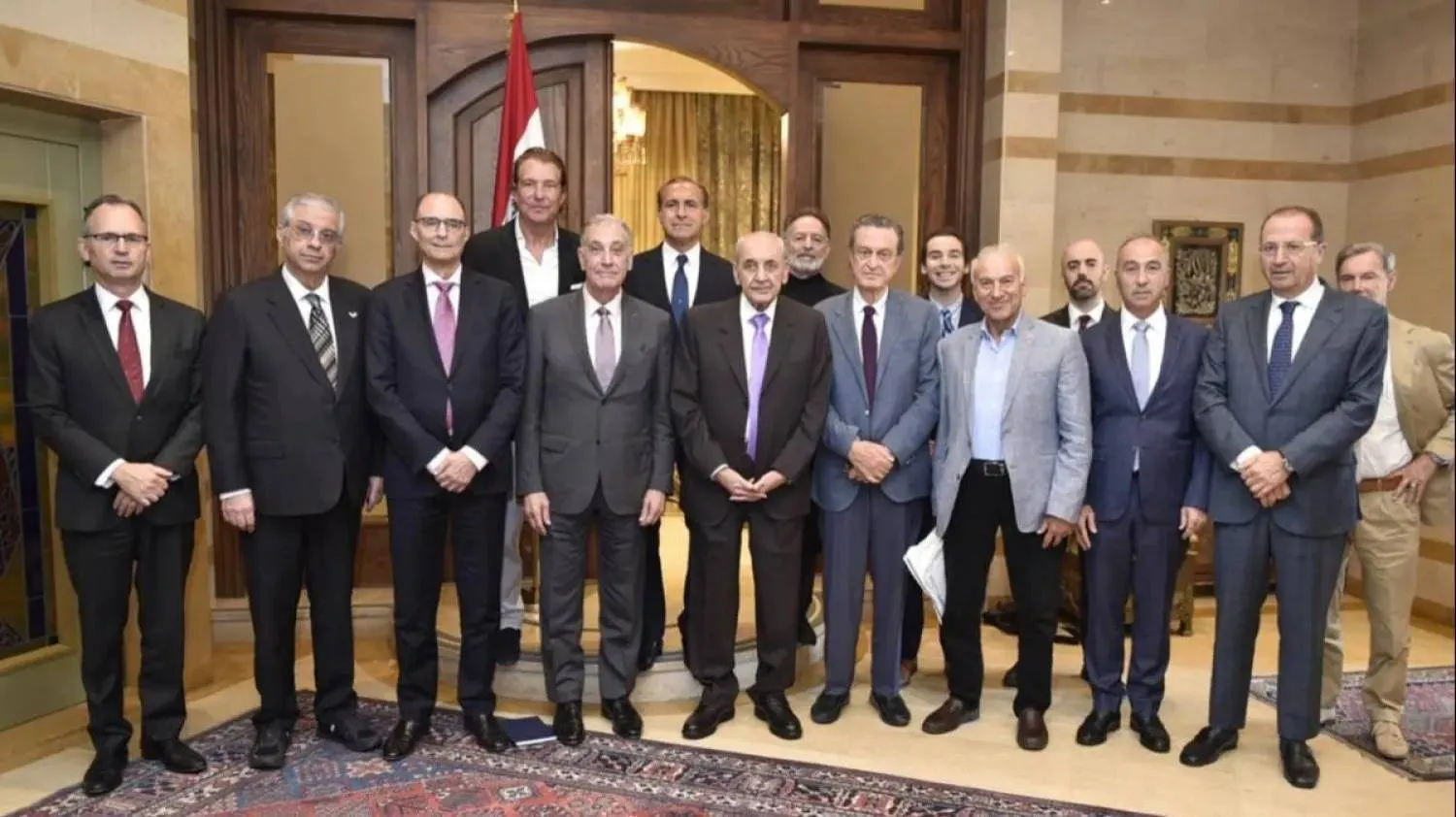

Berri Puts War’s End in Washington’s Hands, Links Army Deployment to Israeli Withdrawal

Parliament Speaker Nabih Berri receives a delegation from the American Task Force on Lebanon (ATFL) (Parliament Speaker’s Office)
TT

Berri Puts War’s End in Washington’s Hands, Links Army Deployment to Israeli Withdrawal

Parliament Speaker Nabih Berri receives a delegation from the American Task Force on Lebanon (ATFL) (Parliament Speaker’s Office)

Lebanese efforts are continuing on several fronts to advance negotiations and implement the “Framework Agreement,” as Parliament Speaker Nabih Berri tied the immediate deployment of the Lebanese army south of the Litani River to an end to Israel’s war, a ceasefire and an Israeli withdrawal to the international border.

Berri said only the United States and President Donald Trump could compel Israel to take those steps.

His remarks come as Israeli escalation continues in southern Lebanon, while uncertainty persists over the eighth round of Lebanese-Israeli negotiations, with no official date set.

Berri: The Army should be the sole security force

Berri made the comments during a meeting with a delegation from the American Task Force on Lebanon (ATFL), headed by Ambassador Edward Gabriel.

The talks covered political and field developments, Israel’s continued military operations and destruction of southern villages, as well as direct negotiations and the “Framework Agreement,” according to a statement from the parliament speaker’s office.

Berri said what was happening in the south was “unbearable,” citing the destruction of villages, attacks on civilians and violations of international and humanitarian laws and norms.

He said some of the destruction and attacks had surpassed “the crimes and massacres against people, buildings and heritage that have occurred and continue to occur in Gaza.”

Berri said the United States was the only country capable of ending the situation.

“The United States is the only country, and its president, Donald Trump, is the only president capable of compelling Israel to end its war, cease fire and withdraw to the international border in the south,” he said.

Berri, whom Hezbollah had previously tasked with negotiating on its behalf, linked those steps to Lebanon assuming security responsibility in the south.

“At that point, I guarantee the immediate deployment of the Lebanese army in the area south of the Litani,” he said.

He said the army should be the sole force responsible for security and the only armed force in the area.

Berri also said the area south of the Litani belonged to its residents, adding that southerners were eager to see the army protect their security and stability.

Ali al-Taher and US pressure

Gabriel described the meeting as “very good,” saying talks covered reform, Lebanon’s security situation and developments in the south, particularly the direct negotiations and the Framework Agreement.

He said the delegation saw strong interest from Berri in making progress on the “pilot zones” and a personal commitment to their success.

On the Ali al-Taher hill, Gabriel said Israel needed to make clear whether it accepted Lebanese army control of the position.

He said people in the south did not want war and wanted to return home, adding that he would convey Berri’s views to US policymakers.

Asked about US pressure on Israel, Gabriel said Trump was working very hard to push the Israelis to stop the death and destruction.

He said Trump had told the Israelis, “Enough, enough”, adding that he expected Washington to keep pressing Israel to end the war.

Eighth round: Tentative timing, low expectations

The timing of the eighth round of Lebanese-Israeli negotiations remains unclear.

Ministerial sources told Asharq Al-Awsat that a date under discussion for early September “remains tentative” and that official invitations have not yet been sent. They said invitations could be issued in the coming days.

The sources said Lebanon would attend any negotiating meeting but voiced limited optimism about the next round, given the current political and military conditions and Israel’s escalating positions.

“There are no high expectations for the outcome of the negotiations, especially before the next Israeli elections in October,” the sources said.

Still, they said Lebanon hoped the talks would produce positive results.

They said Israel’s positions were “clear and concerning to Lebanon” and that Washington needed “to exert pressure to deter Israel.”

Lebanon’s diplomatic outreach has taken on added importance in that context, including President Joseph Aoun’s visit to Rome.

Ministerial sources said the visit has two main objectives.

The first is to meet Pope Leo XIV and brief him on the latest developments surrounding the Framework Agreement, particularly the role he could play in supporting the political track.

The second is to meet with Italian President Sergio Mattarella and Prime Minister Giorgia Meloni to discuss what will follow the end of UNIFIL’s mandate if the international force cannot be extended.

The sources said the issue is linked to an earlier French-Italian initiative proposing that international forces could take on security responsibilities in the south if UNIFIL’s mandate is not renewed at the end of this year.



1,400 Flee Yemen Fighting to Djibouti, Says Minister

Displaced Yemenis rest at a temporary shelter in the Dar Saad district of Aden, Yemen, Saturday, Sept. 12, 2026, after fleeing Houthi attacks in the western coastal cities of al-Khokha and Mokha. (AP Photo/Abdulnasser Alseddik)
TT

1,400 Flee Yemen Fighting to Djibouti, Says Minister

Displaced Yemenis rest at a temporary shelter in the Dar Saad district of Aden, Yemen, Saturday, Sept. 12, 2026, after fleeing Houthi attacks in the western coastal cities of al-Khokha and Mokha. (AP Photo/Abdulnasser Alseddik)

About 1,400 people have fled Yemen for Djibouti due to fighting between government forces and Iran-allied Houthis, Djibouti's minister of economy and finance said Saturday.

Houthi fighters control a large part of northern Yemen, including the capital Sanaa and Hodeida in the west. They have advanced along the coast in just days and on Thursday seized the port city of Mokha.

The Houthis have since taken control of the coastline and islands in the Red Sea, and on Friday tightened their grip on the Bab el-Mandeb Strait, which is vital to global shipping through the Suez Canal.

"1400 #refugees arrived in #Djibouti from #Yemen in just 24 hours," Ilyas Moussa Dawaleh wrote on X.

Located opposite Yemen on the Horn of Africa, tiny Djibouti borders the Bab el-Mandeb Strait at the entrance to the Red Sea from the Gulf of Aden.

Safiya Ibrahim, humanitarian response coordinator for the International Organization for Migration, told AFP that "vulnerable groups such as women and children have reached the shores of Obock, with more expected in the coming days".

According to the United Nations, at least 76,000 people have been displaced in Yemen since July, with the number quadrupling in the last week after the latest fighting.

Last week, Houthi fighters launched a new offensive against Saudi-backed government forces, targeting zones bordering the Bab el-Mandeb Strait.

The waterway has taken on new importance, particularly for Saudi oil exports, since the Strait of Hormuz was blocked by Iran.

Hundreds have been killed in the fighting on both sides.


Yemeni Forces Strike Houthis on Several Fronts

Yemeni soldiers in al-Jawf. (Reuters)
TT

Yemeni Forces Strike Houthis on Several Fronts

Yemeni soldiers in al-Jawf. (Reuters)

Yemeni government forces intensified on Saturday their military operations against the Houthi group on several fronts, carrying out air raids and drone strikes and firing artillery at them in Marib, al-Jawf and Taiz after the militants expanded their control of the west coast, Mokha and areas overlooking the Bab al-Mandeb Strait.

Government strikes focused on Houthi positions in Mokha and the Dhubab district that directly overlooks Bab al-Mandeb. Field sources said the jets struck the Houthis around Mokha port and airport and Jabal al-Nar in an attempt to hamper their military and logistics movements.

Armed forces spokesman Staff Colonel Majid al-Nuzaili had urged civilians to avoid the Taiz-Mokha and Mokha-Dhubab roads until further notice as operations continued in the area.

Government attacks around Mokha port killed several Houthis and destroyed vehicles and weapons used by the group, said al-Nuzaili.

The attacks took place as the government forces were rearranging their deployment in southern Mokha after the battles shifted to east of Bab al-Mandeb near the border of the Lahj province.

In Marib, east of Sanaa, the forces launched air strikes and fired artillery against the Houthis on the southern, western and northern fronts.

Houthi militants ride on a pick-up truck while on patrol in Sanaa, Yemen, 12 September 2026. (EPA)

Field sources said the Houthis brought reinforcements, including dozens of military vehicles and fighters, from Sanaa to Marib, indicating that the fighting will continue and expand.

Government forces have maintained their defensive and offensive positions in Marib, which has for years been its military stronghold in the conflict against the Houthis.

The militants are seeking to use the latest escalation to open new fronts in the war and ease military pressure off the coast and al-Jawf.

In al-Jawf, the government used air raids and artillery fire to attack the Houthis east of al-Hazm city and kept up their siege against the militants inside the al-Labanat camp for the sixth straight day.

In Taiz, field sources detected Houthi mobilization in the Sameh district and the cities of al-Dimnat and Rahida.

On the border of the Lahj province, the Giants Brigades and Houthis were engaged in fighting around the al-Madaribah district.

Military sources said the brigades repelled the Houthi advance.


Iraq Closes Three Iran Crossings, Pursues Those Behind Attacks on Saudi Arabia

Travelers at the Shalamsheh border crossing between Iraq and Iran after Iraqi authorities ordered its closure as a precautionary measure following the latest drone attacks on Saudi Arabia on September 12, 2026 (Reuters)
TT

Iraq Closes Three Iran Crossings, Pursues Those Behind Attacks on Saudi Arabia

Travelers at the Shalamsheh border crossing between Iraq and Iran after Iraqi authorities ordered its closure as a precautionary measure following the latest drone attacks on Saudi Arabia on September 12, 2026 (Reuters)

Iraq closed three border crossings with Iran on Saturday, officials told AFP, after a drone attack on a Saudi Arabian pipeline that both Riyadh and Baghdad said was launched from Iraq.

An Iraqi security source and a government official told AFP that authorities ordered the closing of three border crossings with Iran.

The security source said the decision was "part of an intelligence effort to track down the perpetrators and prevent their escape... and to hinder the smuggling of drones through these crossings".

Both sources, who spoke on condition of anonymity because they were not allowed to speak to the media, could not specify when the crossings would reopen.

The closed crossings are Shalamsheh in Basra province, al-Shib in Missan and al-Mandali in the central province of Diyala.

Other border crossings with Iran are still open.

A security official said that "security forces found drone launchers near the Iraq-Iran border in the al-Tib" region, a remote part of Missan, close to the al-Shib crossing. A second security source gave the same account.

Military spokesperson Sabah al-Numan said the prime minister had approved "Iran's request to conduct a joint investigation into finding drone launch platforms near the Iraq-Iran border".

The government's security media cell said earlier that authorities "have started administrative and security reorganization operations at several border crossings".

It added that they had stepped up "intelligence activities" to determine "the breaches and violations that took place at these crossings".

It later announced that passengers stranded for hours at two crossings were permitted to pass.