

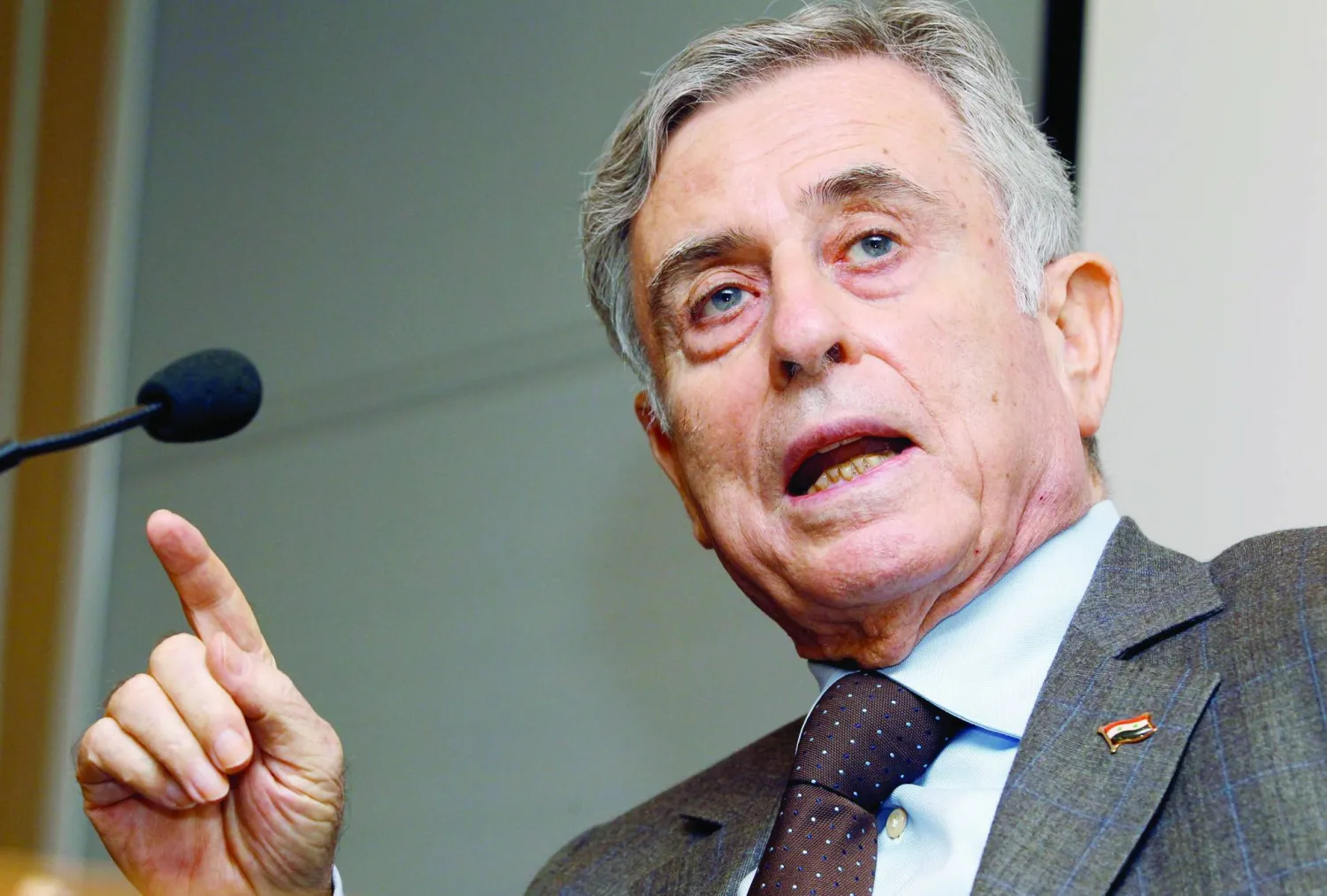

Khaddam Recounts Final Damascus Meeting… Bashar to Hariri: ‘Whoever Defies Me, I Will Break His Bones’

Former Syrian Vice President Abdul Halim Khaddam (Reuters)
TT

Khaddam Recounts Final Damascus Meeting… Bashar to Hariri: ‘Whoever Defies Me, I Will Break His Bones’

Former Syrian Vice President Abdul Halim Khaddam (Reuters)

Former Syrian Vice President Abdul Halim Khaddam reveals new details in his memoirs about a meeting between former Syrian President Bashar al-Assad and Lebanese Prime Minister Rafik Hariri in Damascus in the summer of 2004, describing it as the harshest encounter in the period leading up to Hariri’s assassination.

The memoirs, edited and introduced by Ibrahim Hamidi, are due to be published in early September by Raff Publishing, a subsidiary of the Saudi Research and Media Group (SRMG).

The book cover

According to the memoirs, Assad summoned Hariri in July for a meeting at 7:30 a.m. attended by Maj. Gen. Ghazi Kanaan, Brig. Gen. Rustom Ghazaleh and Col. Mohammed Khallouf. Assad’s harsh words caused Hariri’s blood pressure to rise and his nose to bleed.

The memoirs trace the roots of the crisis to the 1998 election of Lebanese army commander Gen. Emile Lahoud as president. Khaddam recounts that Bashar al-Assad pushed for Lahoud to succeed President Elias Hrawi, persuading his father, President Hafez al-Assad, to back the army commander despite objections from most Lebanese leaders close to Damascus, including Walid Jumblatt, Nabih Berri and Hariri. Khaddam also says Ghazi Kanaan pressured Lebanese lawmakers to support Lahoud.

Khaddam says he subsequently asked Hafez al-Assad to relieve him of responsibility for the Lebanon portfolio because his opposition to Lahoud was well known. The file then passed to Bashar al-Assad.

“Thus ended the political management of this complicated file, and it fell into the hands of the Syrian security services,” Khaddam writes.

Later that same morning, Khaddam says he was scheduled to meet Assad and found him “agitated and tense.” Assad recounted his meeting with Hariri directly to him.

“Rafik Hariri was here, and I spoke to him clearly and frankly in the presence of the officers,” Khaddam quotes Assad as saying. “I told him he was not allowed to work to bring in a president other than Emile Lahoud. I am the one who chooses who governs Lebanon, and whoever defies me, I will break his bones.”
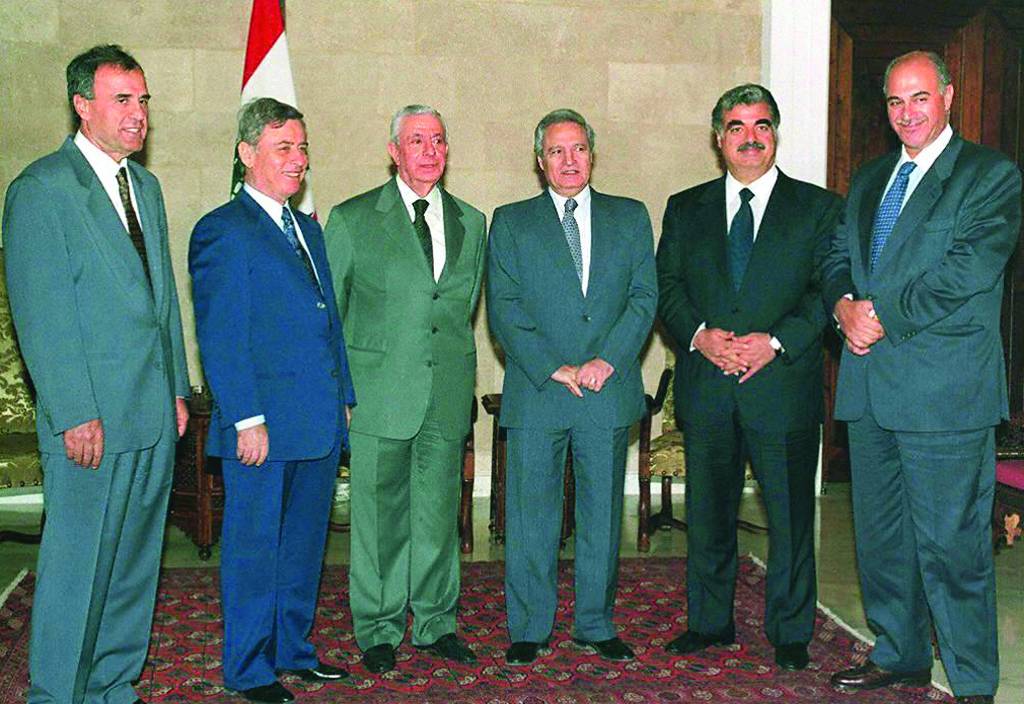
From right: Fares Boueiz, Rafik Hariri, Farouk al-Sharaa, Elias Hrawi, Abdel Halim Khaddam, and Ghazi Kanaan during a meeting at Baabda Palace (Getty)

Khaddam says he was stunned by the remarks and challenged Assad: “You are speaking to the prime minister of Lebanon, who represents the Sunni Muslims in his country. Have you considered the repercussions if your words reach the media? How can you address Lebanon’s prime minister this way in the presence of these officers?”

According to Khaddam’s account, Assad then calmed down and asked his vice president to invite Hariri to meet him in an effort to “erase the consequences” of the encounter.

The memoirs say Hariri initially refused, telling Khaddam by telephone: “After my last visit, I will not visit Damascus.”

He later agreed to meet Khaddam in Bloudan, northwest of Damascus, where he appeared “hurt.”

“I will never forget my meeting with Bashar al-Assad as long as I live,” Hariri told him.
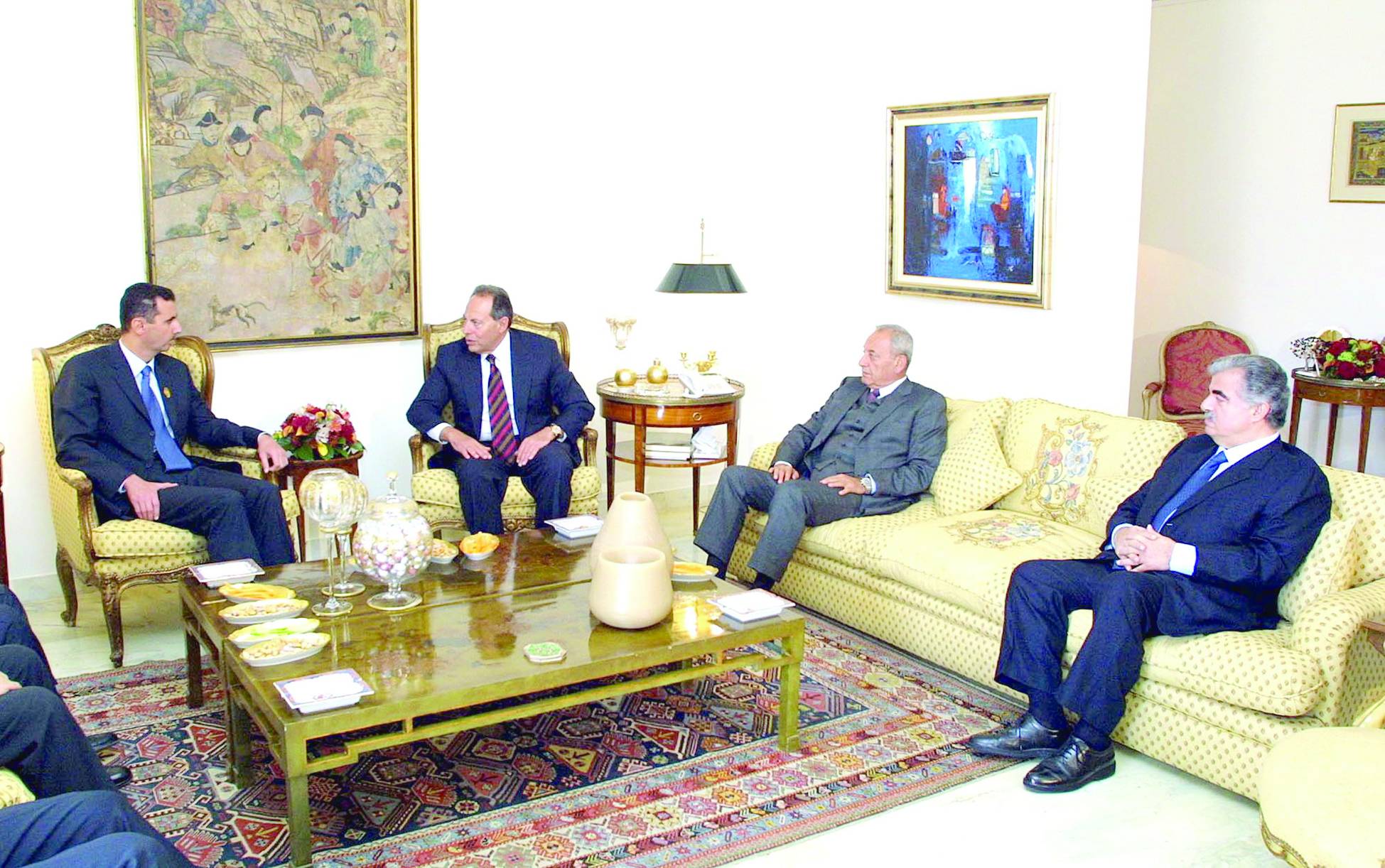
Bashar al-Assad meeting with Emile Lahoud, Nabih Berri, and Rafik Hariri (Getty)

The memoirs go on to recount the dispute over extending Lahoud’s presidential term. On Aug. 18, 2004, Khaddam says Assad told him he had decided against an extension.

“No one in the world supports Lahoud. The Arab states do not support him, and the majority of Lebanese oppose him,” Assad is quoted as saying, adding that he had been “firm” with the Lebanese president.

Just three days later, however, while Khaddam was in France, Hariri called to tell him that Assad had changed his mind and summoned him to Damascus for a brief and tense meeting.

“You have to decide where you stand. Are you with Syria or against it?” Assad told Hariri, according to Khaddam’s account of what Hariri later told him.

Khaddam writes that Hariri told him Jumblatt had advised him to accept the extension and then resign. Khaddam himself advised Hariri to agree to the extension, leave Lebanon and announce his resignation from abroad.

Hariri subsequently informed Rustom Ghazaleh that he accepted the extension and traveled to Sardinia to join his family. Days later, Khaddam says, Hariri called him and asked: “If I return to Lebanon, will my life be in danger?”

Khaddam reassured him that he had agreed to everything demanded of him and that Assad “still needs him because the constitutional amendment has not yet been completed.”

The memoirs also recount a last-minute attempt, through Spanish mediation, to avert a UN Security Council meeting. After five hours of contacts, Washington, Paris and London agreed to cancel the session in return for a Syrian commitment to abandon the extension.

But Syrian Foreign Minister Farouk al-Sharaa told his Spanish counterpart: “Lebanon is an independent state and we have nothing to do with the matter.”
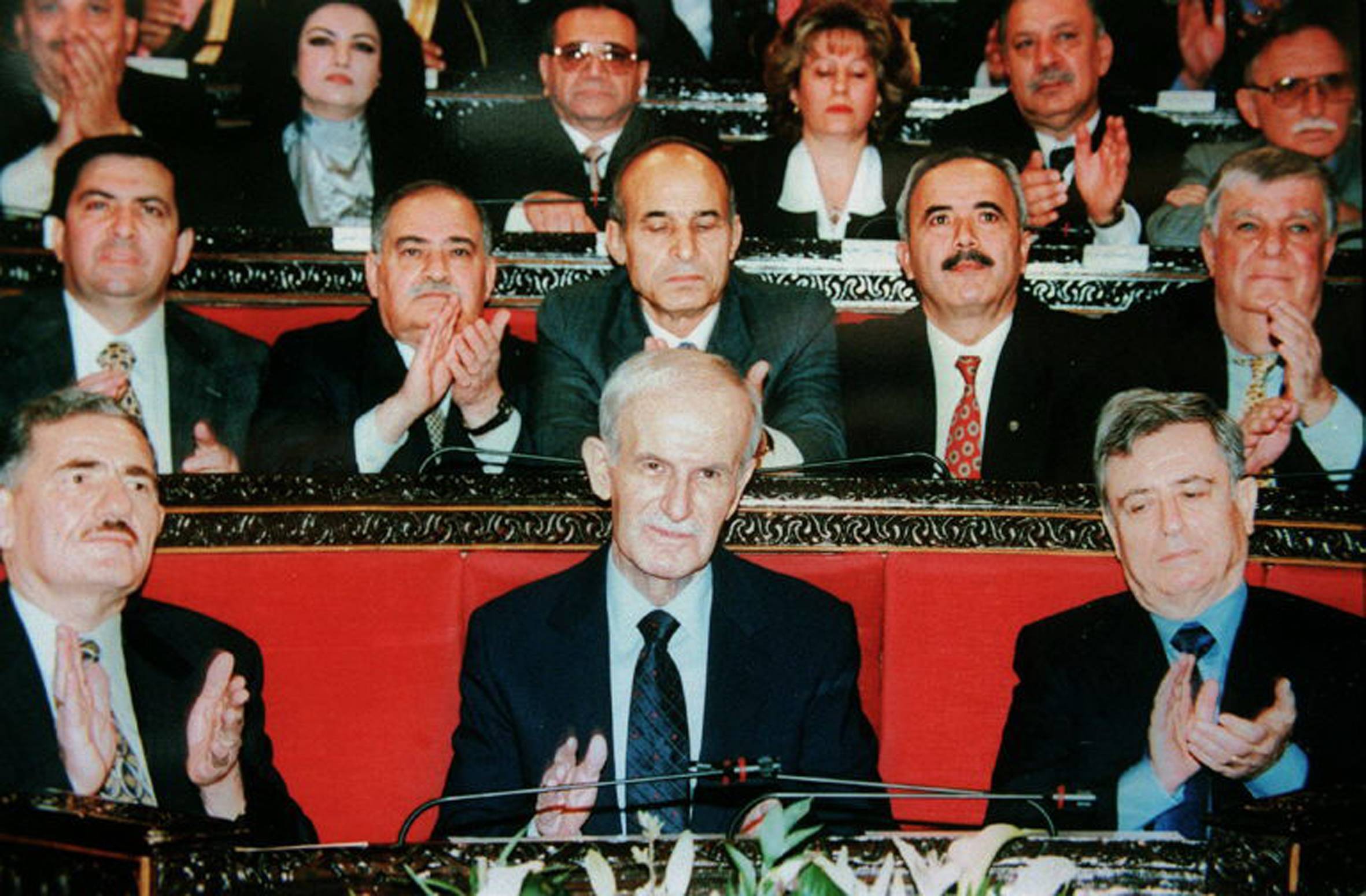
Hafez al-Assad and to his left, Abdul Halim Khaddam in 1999 (Getty)

The Security Council met the following day and adopted Resolution 1559, which called for respect for Lebanon’s sovereignty and political independence, the withdrawal of remaining foreign forces and a presidential election free from foreign interference.

The memoirs characterize the resolution as having been adopted under Chapter VII and as placing the Syrian regime under Security Council scrutiny.

Khaddam’s testimony carries particular significance because of his position at the heart of Syria’s governance of Lebanon. For decades, he was the Syrian official responsible for the Lebanon portfolio before, as he recounts, responsibility passed to Bashar al-Assad and the Syrian security services.

In his account, a single threat uttered during a deeply personal confrontation becomes a key to understanding a period that culminated in a complete breakdown between Damascus and broad segments of Lebanese society.

The full account of the meeting, as well as the events preceding and following it, appears in the book’s chapter titled “The Assassination of Rafik Hariri.”



Syria Detains 16 Former Air Force Pilots in Less Than a Month

Syrian security forces personnel (AFP/File) 
TT

Syria Detains 16 Former Air Force Pilots in Less Than a Month

Syrian security forces personnel (AFP/File) 

Syrian security authorities have detained 16 former air force officers, including senior commanders, in less than a month as part of a widening campaign targeting personnel accused of involvement in airstrikes on populated areas during the country’s war.

The arrests were carried out mainly in the coastal provinces of Latakia and Tartous, as well as in Aleppo province in northern Syria.

State-run Alikhbariah TV reported that the Counterterrorism Directorate arrested former pilot Khaldoun Hussein Mubarak in the countryside of Jableh in Latakia province. Local media reported that he was detained Friday at his home in the village of Ain Qaita.

Mubarak survived the downing of his aircraft near Saraqeb in Idlib province in 2020. State media under the former government reported at the time that his plane had been hit by Turkish aircraft. Activists have since recirculated an interview in which Mubarak vowed after surviving the incident to continue flying military missions even if he were targeted again.

His detention brought to 16 the number of former air force pilots and officers arrested in less than a month.

On Sept. 18, Tartous Internal Security chief Col. Abdul Aal Mohammed Abdul Aal announced the arrest of five senior former air force officers in operations conducted with the Counterterrorism Directorate.

Abdul Aal said the five were suspected of involvement, according to their respective positions and responsibilities, in planning, directing and carrying out airstrikes on populated areas during the war. Investigations were continuing to determine their alleged criminal responsibility before referring them to the judiciary, he added.

Latakia security authorities had announced on Sept. 10 the detention of nine former pilots and officers, who were accused of participating in attacks and violations in several Syrian provinces through their roles in fixed-wing and helicopter aviation.

A Syrian Interior Ministry source said the nine had logged more than 3,200 flight hours and sorties during the uprising and war, including missions over Eastern Ghouta, Aleppo and its countryside, Deir Ezzor and its countryside, and rural Hama, according to state news agency SANA.

Earlier, on Sept. 5, security forces in Aleppo detained Brig. Gen. pilot Hamidi Ali Murad, a former senior air force commander who had overseen several military air bases, including Mezzeh in Damascus, T4 in eastern Homs province and Kuweires east of Aleppo, and had also headed the air force academy.

Syrian authorities accuse the detained officers, according to their respective roles, of helping plan, direct or carry out air operations that struck populated areas, causing deaths, destruction and displacement. The allegations remain under investigation ahead of possible referral to the courts.


Israel Creates Buffer Zone Beyond ‘Yellow Line’ in South Lebanon

Local residents watch an Israeli drone monitoring them in the South Lebanon town of Zawtar al-Gharbiya. (Reuters) 
TT

Israel Creates Buffer Zone Beyond ‘Yellow Line’ in South Lebanon

Local residents watch an Israeli drone monitoring them in the South Lebanon town of Zawtar al-Gharbiya. (Reuters) 

The Israeli military has intensified operations in villages along the Yellow Line in South Lebanon, systematically demolishing homes and civilian infrastructure in what Lebanese sources fear is an effort to create a new buffer zone and pave the way for a prolonged Israeli presence.

The operations are taking place outside the Yellow Line, which Israel drew to demarcate a security zone in South Lebanon extending as far as 12 kilometers into Lebanese territory in some areas. Over recent weeks, Israeli forces have carried out dozens of demolitions in towns beyond that line.

The demolitions have hit Mansouri, Buyut al-Siyad and Majdal Zoun in the western sector; Baraachit, Beit Yahoun and Hadatha in the central sector; and Zawtar al-Sharqiya, Nabatieh al-Fawqa and Kfar Tebnit in the eastern sector.

Israel has also expanded airstrikes and artillery fire to Kfar Rumman, the Jabal al-Rafi heights near Nabatieh, Aita al-Jabal and Wadi Zibqin, among other areas.

Long-term occupation

Although the towns lie outside the Yellow Line, but targeting them, driving out residents and leaving them devastated “means Israel is planning a long-term occupation of the areas it controls,” a security source in South Lebanon told Asharq Al-Awsat.

The source said Israeli forces were turning the area adjacent to the Yellow Line into “a scorched zone that amounts to a new buffer zone beyond the buffer zone it created between the border with Lebanon and the Yellow Line.”

The moves were intended to drive residents away and prevent Hezbollah from monitoring Israeli troop movements and positions inside the occupied area, according to the source, who attributed the measures in part to Israeli concerns over a possible future resumption of resistance activity and military operations.

The source also pointed to a military dimension, saying the operations could clear the way for Israeli forces to rapidly seize additional territory with limited risk should they receive political authorization to advance.

Towns emptied and destroyed

In June, Israeli forces completely emptied Mansouri, south of Tyre, after dropping leaflets ordering residents to leave immediately because of the danger in the area. Thirty-seven families had returned to the town following the ceasefire.

Israeli forces have since carried out more than 130 demolitions, sources from Mansouri told Asharq Al-Awsat. They said Israeli tanks and military vehicles enter the town almost daily to rig buildings with explosives.

The sources added that military vehicles had crossed through the center of Mansouri toward the al-Birkeh area to the west, near the coastal road, where troops rigged homes with explosives and cut down trees. After the town’s mosque was destroyed, they said, it became difficult to determine which neighborhoods were being hit by demolitions or artillery fire because the mosque had served as a landmark for locating the blasts.

Hadatha and Beit Yahoun have also been completely emptied following Israeli incursions and daily shelling, while Baraachit is now nearly deserted, local sources in the central sector told Asharq Al-Awsat.

The sources noted that Aita al-Jabal was subjected to daily artillery fire and incursions around its outskirts, prompting most residents to leave as the town became increasingly dangerous.

Kfar Tebnit and Nabatieh al-Fawqa are similarly deserted and largely destroyed, amid demolitions in the former and shelling and airstrikes in the latter. Nabatieh al-Fawqa was emptied after an Israeli strike in June targeted a teacher and her children as they traveled to their home to retrieve belongings.

Unstable areas

Areas facing Israeli-held towns east of Wadi al-Hujair and Wadi al-Slouqi are meanwhile subjected to daily artillery fire, airstrikes and persistent Israeli drone flights.

The security source said conditions there differed from those in towns directly bordering the Yellow Line because they were relatively farther away and had therefore not been emptied of residents.

Continued bombardment, however, had left them unstable, the source underlined, citing Shaqra and towns along the western edges of Wadi al-Hujair.

Demolitions and airstrikes

On Saturday, Israeli artillery targeted Wadi al-Slouqi near Shaqra and the outskirts of Zawtar al-Sharqiya. Heavy airstrikes also hit Jabal al-Rafi and Rihan between Iqlim al-Tuffah and Jezzine district, with explosions heard as far away as Sidon and surrounding areas.

Three strikes using high-impact missiles hit the outskirts of Sejoud, with the blasts heard as far as Zahrani.

In the western sector, Israeli forces shelled Mansouri, Majdal Zoun and Wadi Hassan. A powerful Israeli demolition rocked Tiri, while another heavy blast struck Majdal Zoun.

An Israeli force was also reported to have advanced into olive groves on the southern outskirts of Deir Mimas in Marjayoun district.

Israeli forces carried out further heavy demolitions overnight Friday into Saturday in Baraachit, Hadatha and around Beit Yahoun.


Hamas Leader Says Israel to Use Gaza 'Blood' in Election

Head of Hamas's political bureau, Khalil al-Hayya (archive - AP)
TT

Hamas Leader Says Israel to Use Gaza 'Blood' in Election

Head of Hamas's political bureau, Khalil al-Hayya (archive - AP)

The leader of Hamas brushed aside the possibility of change from Israel's upcoming election in an interview on Saturday, saying he expected Israelis to campaign off Gaza's "blood".

"Whether this or that person comes to power, or this party or another -- our people have suffered at the hands of all Israeli parties," Khalil al-Hayya told the Qatari station Al-Araby.

"We absolutely refuse to allow the blood, suffering, and cause of the Palestinian people to serve as fuel for Israeli elections. What matters to us is that our people achieve their goals, aspirations, and legitimate rights."

Prime Minister Benjamin Netanyahu is locked in a tight contest as he seeks to stay in power in the October 27 elections.

The Israeli premier has vowed in the run-up to the vote not to withdraw troops from Gaza and rejected a US-led peace initiative in which Hamas said it would surrender weapons, a promise Israel views with skepticism.

The vote is the first since Hamas led the deadliest ever attack against Israel on October 7, 2023, with militants storming into southern Israel and killing 1,221 people and dragging 251 others as hostages to Gaza.

Israel's retaliatory offensive has displaced virtually the entire population of Gaza, damaged or destroyed the vast majority of buildings and killed more than 73,900 people, according to the Gaza health ministry, which operates under Hamas and whose figures are considered reliable by the United Nations.

Polls show Netanyahu's most formidable challenger to be Gadi Eisenkot, a former military chief who served in Netanyahu's war cabinet but has accused him of failing strategically.

- 'Ready to sit down' with Abbas -

The Palestinian Authority in turn has scheduled a legislative election for November 28, which would be the first in two decades, although there are widespread doubts about whether it will go ahead.

Hamas won the last election, held in 2006, defeating Palestinian president Mahmoud Abbas's Fatah. Abbas, 90, has since been ruling by decree, with the legislature not allowed to convene and Hamas seizing control of Gaza.

Abbas is based in the West Bank, where the Palestinian Authority wields limited autonomy.

"We are ready to sit down with President Abbas to lay the foundations for a national program and achieve genuine unity," Hayya said.

"If the Palestinian elections are postponed, that step must serve as an entry point for putting the Palestinian house in order."

Hamas has been working on an alliance with Mohammed Dahlan, a former Fatah figure born in Gaza who has been an interlocutor with the United States on its peace plan.

"In the event of a postponement, the alliance will remain intact and open to all, aiming to forge a unified national front," Hayya said.

It remains uncertain if Hamas could even run in the election as Abbas has required all candidates to accept the platform of the Palestine Liberation Organization, which has recognized Israel's right to exist since 1993 at the start of the Oslo peace accords.