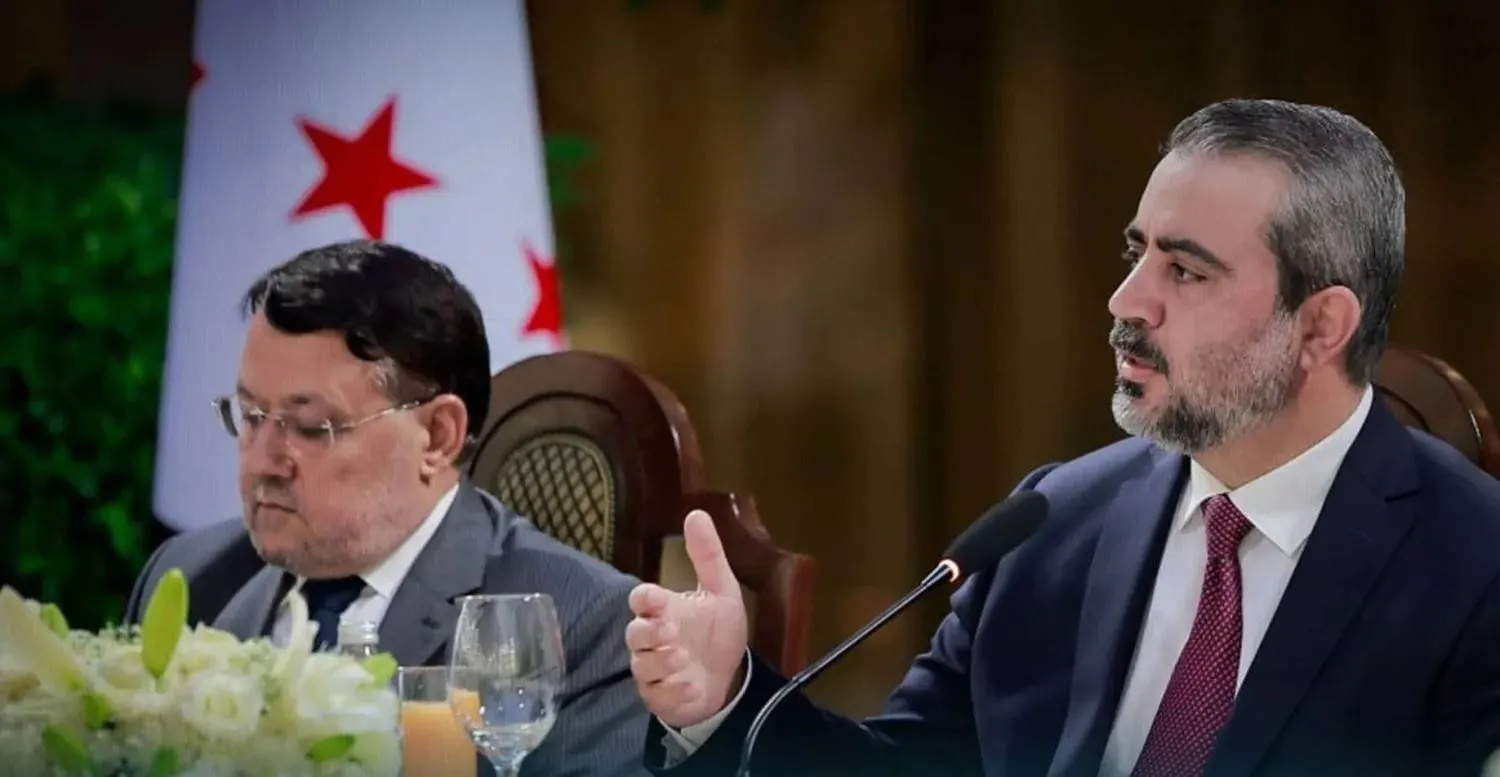

Syrian Foreign Minister Asaad al-Shaibani outlined the record of 606 days of Syria’s new diplomacy, describing a shift from “hard power to soft power” and efforts to promote stability and build balanced international relations for the first time in decades.
During a dialogue lasting more than three hours at the presidential Tishreen Palace, al-Shaibani fielded questions from journalists, researchers, members of parliament and Foreign Ministry officials. The session was coordinated by presidential media adviser Ahmad Muwaffaq Zaidan.
Addressing repeated Israeli attacks, al-Shaibani described Israel as an expansionist “bad neighbor.” He noted that after nearly a year of negotiations, both sides had come to understand each other’s approach. Israel aimed to keep matters ambiguous to continue its provocations, he argued, while Syria wanted stability and sought to avoid being drawn into confrontation.
He revealed that Damascus was working with Washington on a memorandum of understanding aimed at halting Israeli attacks.
Sweida and the SDF
Al-Shaibani maintained that the situation in Sweida was being addressed and was no longer a source of concern, rejecting allegations that Damascus had imposed a blockade or cut roads. More than 1,500 commercial vehicles enter and leave the province daily, he noted.
He added that separatist calls in Sweida no longer posed a serious threat, arguing that the prospect of partition had ended with the agreement with the Syrian Democratic Forces (SDF).
Significant and rapid progress had been made toward integrating the SDF, although some issues remained unresolved. Al-Shaibani described President Ahmed al-Sharaa’s latest meeting with SDF commander Mazloum Abdi as positive but acknowledged continued hesitation over fully committing to integration with the state. Outstanding issues include the fate of commanders and entities yet to be incorporated, as well as disagreements over matters such as education.
He continued that Damascus was approaching the issue “with considerable patience and calm,” adding that the Autonomous Administration was expected to announce its dissolution within two weeks.
US Embassy set to reopen
Turning to foreign policy, al-Shaibani recalled that immediately after the “liberation,” Syria turned first to its Arab partners, particularly Saudi Arabia and the Gulf states.
After a challenging first year, Damascus moved toward “political normalization,” reintegration into the international system and the restoration of diplomatic missions. There are now 55 diplomatic missions in Damascus, preparations are underway to reopen the US Embassy, and Syria maintains active relations with 97 countries.
Al-Shaibani described relations with Jordan as very good, saying Amman had become a strong supporter of Syria after decades of strained ties. Damascus was also pursuing an “open-door policy” toward Iraq, with Iraqi Prime Minister Ali Faleh al-Zaidi expected to visit Damascus following a recent visit by Supreme Judicial Council President Faiq Zidan.
Al-Shaibani disclosed that Syria had asked Iraq and Lebanon to deploy regular forces along their borders with Syria and keep militias away — specifically Iraq’s Popular Mobilization Forces and Hezbollah in Lebanon.
New approach to Lebanon
On Lebanon, al-Shaibani reaffirmed a new Syrian approach fundamentally different from Damascus’ traditional role there, centered on supporting the Lebanese state in establishing a state monopoly over weapons and implementing the Taif Agreement.
Discussing his recent visit to Lebanon, he noted that it was intended to be “comprehensive” and had been coordinated with the Lebanese state. Some meetings with political and party representatives outside official state channels were aimed at explaining Syria’s new approach, including talks with Parliament Speaker Nabih Berri, which he described as “very positive.” Others were meant as a gesture of loyalty to Lebanese opponents of the Assad regime who had paid a heavy price for their stance.
Al-Shaibani stressed that the large public reception he received in Tripoli had not been planned but occurred spontaneously, adding that his remarks there were national in character. “I am not Qassem Soleimani,” he remarked.
Syrian detainees
Al-Shaibani also addressed Syrians accused of ISIS membership who had been transferred to Iraq, noting that Damascus was working, in coordination with Washington, on an agreement for their handover.
In Lebanon, around 1,700 Syrians remain detained without trial, some for years. Damascus has raised the issue with Lebanese officials since their first meeting, he noted, adding that a Lebanese amnesty law could offer a way forward if signed by President Joseph Aoun.
The session also underscored Syria’s emphasis on soft power. Syrian chef Malakeh Jazmati, known as the “ambassador of Syrian cuisine,” prepared the dinner, with her success during her years as a refugee in Germany presented as an example of the new image Syria seeks to project.