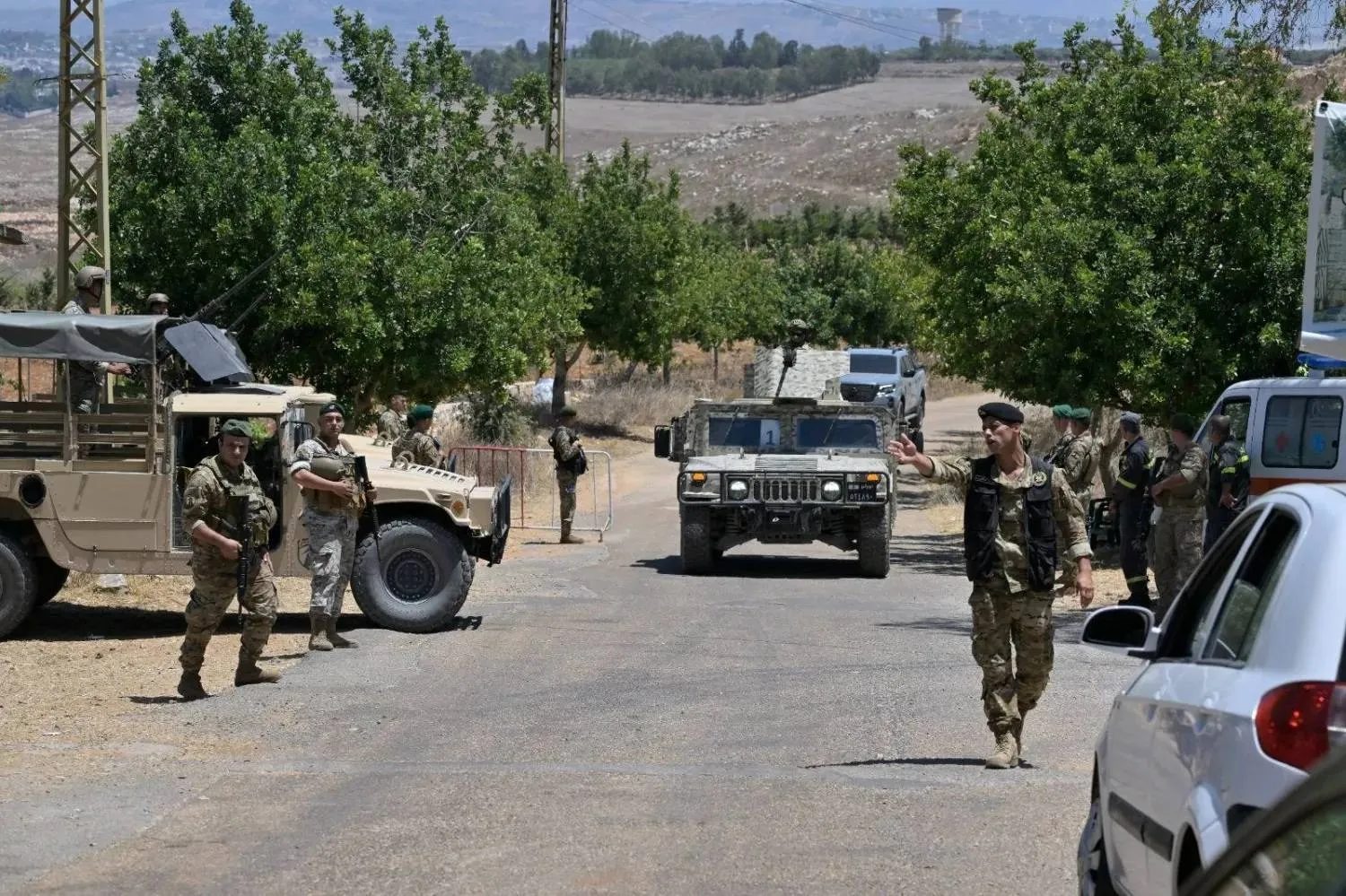

Israel is seeking to gradually seize the strategic Ali al-Taher Heights east of Nabatieh in southern Lebanon, while piling diplomatic pressure on the Lebanese state and Hezbollah, which categorically rejects any discussion of evacuating the site, according to sources familiar with the group’s position.
The standoff raises the risk that Israel could turn to a “third option”: resuming fighting in southern Lebanon.
Hezbollah’s refusal to discuss evacuating Ali al-Taher rests on one point: the site lies “north of the Litani River,” sources familiar with the group’s position told Asharq Al-Awsat.
The group “insists on implementing the Nov. 27, 2024 agreement, based on UN Security Council Resolution 1701, which provides for an end to the aggression, an Israeli withdrawal and exclusive state control over weapons south of the Litani,” the sources said.
Hezbollah’s reading of the resolution and the agreement, they added, is that “exclusive control over weapons applies only south of the Litani, while the resistance’s weapons north of the river are a Lebanese matter governed by the national security strategy.”
Freedom of movement
Hezbollah says the “Islamabad agreement” was what brought about the de-escalation and ended the war in Lebanon.
At the same time, Tel Aviv entered direct negotiations with Lebanon in Washington, seeking to move away from the US-Iranian negotiating track and separate the two files.
Sources familiar with Hezbollah’s position say that reality “gave Israel freedom of movement and freedom to carry out attacks,” leaving unoccupied areas near the yellow line virtually deserted, including Ali al-Taher.
Even so, they said, “the arrangement failed to satisfy part of the Israeli public that supports the war and did not restore confidence among residents of northern Israel.”
That, the sources said, led Israeli Prime Minister Benjamin Netanyahu to inflate the political and security significance of Ali al-Taher, turning it into a symbol so that any seizure of the hill could be presented as a major achievement.
Yet “the presumed facility on the hill is smaller than other facilities Hezbollah handed over to the Lebanese army south of the Litani,” they said.
US proposal to evacuate the site
Israel has been seeking for about 10 weeks to take control of the strategic high ground, with war kept as the last option.
A source said Washington is calling for the Lebanese army to take over the site, after which Israel would verify the handover.
Hezbollah received the proposal but views it as “a maneuver,” the source said, because all sides already know the group will reject it.
The group also sees the request as an attempt by the Lebanese authorities to show Washington that “Lebanon did what was required of it, but Hezbollah refused.”
The source said the proposal offers “no guarantees” that the site would not ultimately be handed to Israel if the Lebanese army were told to withdraw, or if it pulled back under Israeli fire.
Hezbollah also sees the proposal as an attempt to draw it into arrangements outside the agreement it says it continues to uphold: the November 2024 cessation-of-hostilities deal.
The source said the United States had informed Lebanon that it would allow Israel to take control of the high ground without triggering an escalation.
Military option
With Hezbollah rejecting any proposal to evacuate the site, Israel is left with the military option.
That could begin with “gradual encroachment,” Lebanese sources familiar with Israeli movements around the heights said.
The strategy involves “making the area unlivable, cutting off supplies and preventing fighters from being rotated in and out,” they said, weakening the position until it falls and allowing Israel to enter after only a limited battle.
Israel has been pursuing that approach for about 10 weeks, according to the sources.
They said failure of the strategy before Israel’s elections “could lead to an open battle similar to what prevailed before the ceasefire agreement took effect on June 14.”
Hezbollah is betting on Iranian intervention if Israel broadens the fighting and breaks with the rules of engagement in place since the ceasefire.
That calculation rests on Tehran’s stated position that it would not allow any new territory in southern Lebanon to be carved off by force.
Hezbollah also points to remarks by Iranian Parliament Speaker Mohammad Bagher Ghalibaf, made hours after an Israeli strike targeted Hezbollah commanders deep in southern Lebanon last Saturday.
Ghalibaf said he was in contact with Hezbollah fighters on the front and checked on them daily to assess conditions and readiness for any new support operation.
Risk of renewed war
Such developments carry the risk of renewed fighting between Israel and Iran and a fresh deterioration in regional security.
But the prospect of war resuming in Lebanon “remains on the table,” the source said.
“Ali al-Taher Heights is a flashpoint that could reignite the war,” the source added.
“Israel is seeking a security achievement before the elections. Hezbollah, for its part, will not retreat from its firm position that exclusive state control over weapons applies south of the Litani, not north of it.”
The source also rejected reports of proposals under which Hezbollah would evacuate its Ali al-Taher facility in exchange for an Israeli withdrawal from the occupied city of Bint Jbeil or the town of Khiam.
Both lie inside the “yellow line” created by Israel, extending about 10 km (6 miles) into Lebanese territory in what it calls a “security zone.”
Hezbollah says no such proposals exist and describes the reports as “baseless.”
It views them as “part of a disinformation effort” aimed at blaming Hezbollah for any failure by Israel to withdraw if fighting resumes.
The group also accuses the Lebanese state of “deceiving itself,” arguing that Israel “does not accept discussion of a new area, and every time it is given something, it demands more without offering any concession in return.”