


Iran Condemns US Plans to Announce New Sanctions

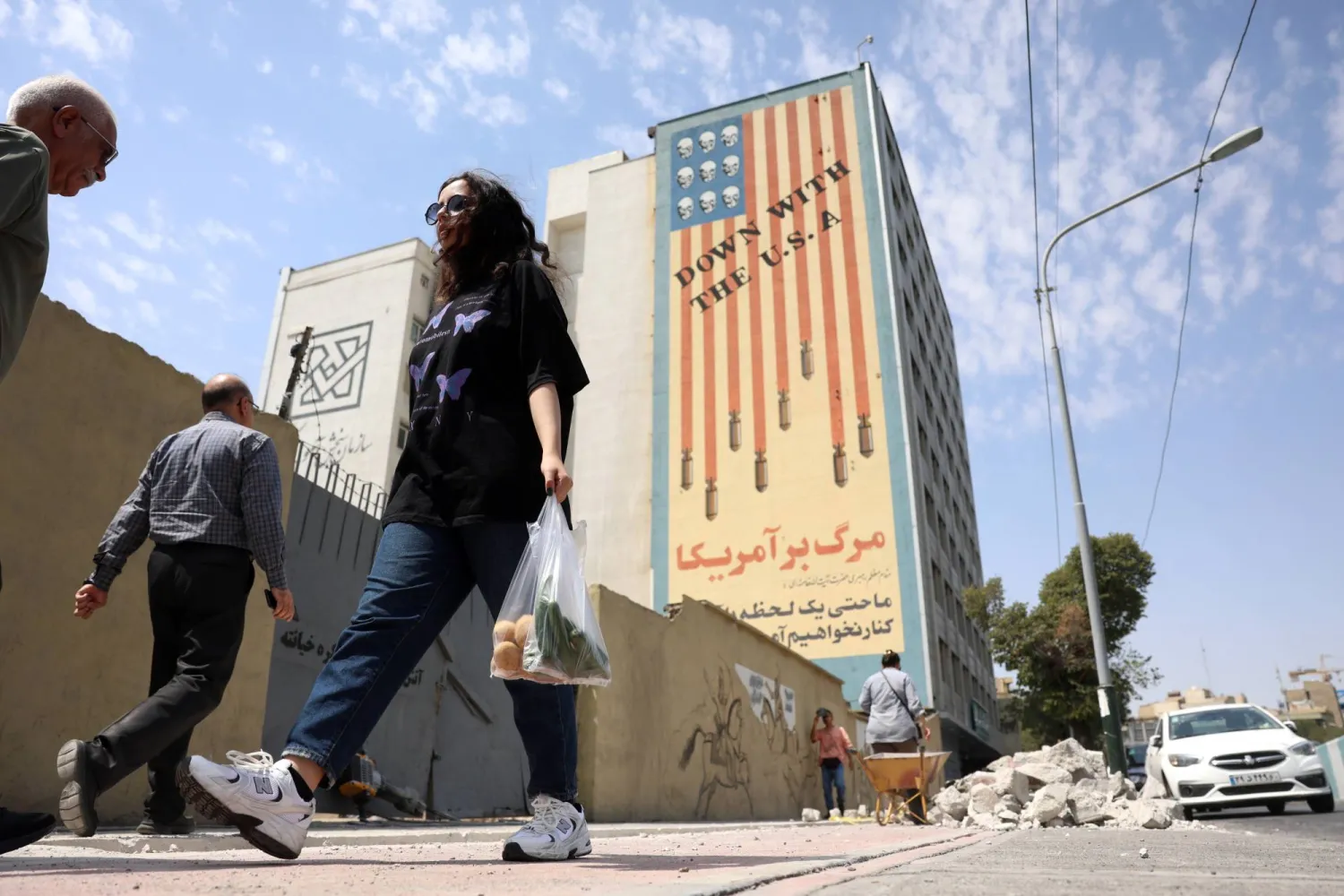
Iranian people walk past an anti-US mural in Tehran, Iran, 17 August 2026. (EPA)
TT

Iran Condemns US Plans to Announce New Sanctions

Iranian people walk past an anti-US mural in Tehran, Iran, 17 August 2026. (EPA)

Iran on Saturday denounced US plans to announce new sanctions that could put further strain on the country’s economy and have an impact on its most important trading partners including China.

After nearly six months of war since the US and Israel launched airstrikes against Iran on February 28, the sides are not firing at each other but also showing no sign of pursuing peace talks.

Oil shipments are at a virtual standstill in the Strait of Hormuz, with Tehran threatening to strike any unauthorized oil tankers that try to transit the vital waterway, and Iran's economy is already under immense pressure from sanctions.

US Treasury Secretary Scott Bessent is due to hold a press conference at 2 p.m. EDT (1800 GMT) on Monday after threatening "the toughest sanctions in history" on Iran.

Bessent has also urged cooperation with Washington by China, which buys more than 80% of Iran's shipped oil, according to 2025 data from ‌analytics firm Kpler. ‌Beijing has urged diplomacy.

Iran's Foreign Ministry spokesperson, Esmaeil Baghaei, said on Saturday the imminent US announcement of ‌new ⁠economic sanctions was an "assertion ⁠of extraterritorial sovereignty over every independent member state of the United Nations."

"Such secondary sanctions find no foundation in international law," he said in a post on X.

The chief of staff of Iran's armed forces, Major General Ali Abdollahi, promised on Friday that Iran would respond to enemy threats militarily with "crushing, punishing and devastating responses.”

US President Donald Trump, who has warned of economic consequences against any country that provides "any type of lifeline to Iran," said on Friday that Washington was observing "what happens" in the conflict.

"They would love to make a deal, but they're not ready to make the right deal, in my opinion," Trump said of Iran.

HORMUZ TRAFFIC HALTED

While the US has effectively blockaded Iranian vessels in their ports, the Strait of ⁠Hormuz remained bottled up with thousands of seafarers stranded on hundreds of vessels.

Only four commodity ships ‌sailed along the strait on Thursday, none of them large crude carriers or liquefied ‌natural gas tankers, ship-tracking data showed.

However, Iran has granted permission for a number of Iraqi oil tankers to pass through the Strait following repeated requests from ‌Baghdad, Iran’s state news agency IRNA reported on Saturday.

IRNA said obtaining special permission for Iraqi tankers was one of Baghdad’s main requests ‌during a visit to Iraq by Parliament Speaker Mohammad Baqer Qalibaf.

US Energy Secretary Chris Wright said the US military helped move a seven-day average of 8 million barrels a day of oil through the strait. That's down from more than 20 million per day before the war or about one of every five barrels consumed worldwide.

US attacks have severely diminished Iran's economy and devastated its navy and air force, but Tehran maintains enough missile and drone capability ‌to impede oil tanker traffic and attack regional rivals.

Abdollahi, the armed forces chief of staff, sought to underline Iran's missile capabilities during a visit to an underground plant manufacturing ballistic missiles that was reported ⁠by state television on Saturday.

"This ⁠plant has been able, much better than in the past, to produce equipment superior both in capacities and quality and in quantity," he said.

Trump, meanwhile, has yet to achieve objectives he set at the start of the war such as dismantling Iran's nuclear program - the state of which remains uncertain given that UN inspectors have been shut out since 2025 - and creating conditions for Iranians to overthrow their clerical rulers.

Thousands have been killed, mainly in Iran, where 168 Iranian school children were killed on the first day of the war. The US has reported more than 750 military personnel wounded and 18 killed.

While Iran remains defiant, President Masoud Pezeshkian has also called for a diplomatic solution.

"It would be better to end the war today, when we are powerful and have dignity, and the whole world acknowledges our victory and emphasizes that America, contrary to all regulations, attacked our schools, hospitals, and infrastructure and is hated in the world," the ISNA news agency quoted him as saying on Friday.

Iran Tells US There is No Military Solution to Mideast War

(FILES) Vehicles drive past a giant billboard reading 'The Strait of Hormuz remains closed' at the Revolution Square in Tehran on April 28, 2026. (Photo by ATTA KENARE / AFP)
TT

Iran Tells US There is No Military Solution to Mideast War

(FILES) Vehicles drive past a giant billboard reading 'The Strait of Hormuz remains closed' at the Revolution Square in Tehran on April 28, 2026. (Photo by ATTA KENARE / AFP)

Iran's top diplomat insisted on Sunday that there would be no military solution to the United States' war against Iran, with talks on ending the conflict apparently at an impasse.

A campaign of heavy bombardment failed to bring a decisive close to the war launched by the US and Israel in late February, and Washington in recent weeks has dialed back military operations in favor of economic pressure.

The main point of contention remains Iran's attempt to blockade the Strait of Hormuz where a UK maritime agency reported on Sunday another tanker struck by an unknown projectile.

"If our enemies again choose the path of military confrontation, our response will be stronger than before, and we will defend ourselves with even more force," Iranian Foreign Minister Abbas Araghchi said at a gathering of foreign ambassadors.

"There is no military solution, nor any solution based on new sanctions," he continued, adding "only negotiations based on justice and fairness" could end the conflict.

The two sides agreed a memorandum of understanding in June that spelled out a framework for a permanent resolution, but Iranian attacks on vessels in the Hormuz prompted a return to US military operations.

On Sunday, the British maritime security agency UKMTO said a tanker in the Hormuz "reported being struck by an unknown projectile, causing damage to the engine room", though the crew were reported safe and no environmental impact was recorded.

The agency did not specify the date of the incident, the vessel's origin or destination, or whether it was an oil tanker or LNG carrier.

Iranian and US officials last week held indirect talks on the sidelines of the UN General Assembly, with Tehran saying it presented seven conditions for reopening the strait.

Iran has demanded, among other things, a ceasefire across the Middle East, the unfreezing of its assets abroad, the lifting of sanctions on its oil sector and an end to the US naval blockade.

Trump, however, rejected the proposal, while leaving the door open both to further talks or renewed military operations.

Iranian foreign ministry spokesman Esmaeil Baqaei on Sunday characterized the latest US counterproposal as being "in line with their previous proposals concerning nuclear issues".

"We have clearly indicated that we are focusing on the issue of the Strait of Hormuz," he said, adding that reopening the waterway required "an end to the disruptions to Iranian commercial maritime traffic and the lifting of sanctions".


Japan: US Marine Arrested on Suspicion of Murdering Woman

Military Osprey aircraft are seen at the US Marine Corps' Futenma Air Base in Ginowan City, Okinawa Prefecture, where the suspect involved in the robbery and murder is stationed (Reuters)
TT

Japan: US Marine Arrested on Suspicion of Murdering Woman

Military Osprey aircraft are seen at the US Marine Corps' Futenma Air Base in Ginowan City, Okinawa Prefecture, where the suspect involved in the robbery and murder is stationed (Reuters)

A US Marine stationed on Japan's southern island of Okinawa was arrested on suspicion of the murder of a Japanese woman, police said on Sunday.

The suspect "killed the 39-year-old woman at a hotel in Naha and stole her wallet on Saturday," a local police spokesman told AFP.

US Ambassador George Glass posted on social media that he had spoken with Japan's foreign ministry and Okinawa's governor to offer "our sincere condolences and pledging full cooperation as the investigation continues".

Prime Minister Sanae Takaichi called the crime "exceptionally brutal and vicious" on X.

The government has urged the US "to provide maximum cooperation with the investigation, enforce stricter discipline among US military personnel, and take thorough measures to prevent the recurrence of similar crimes," Takaichi said.

Public broadcaster NHK and other Japanese media outlets, citing investigation sources, reported that CCTV footage from near the scene showed a foreign man entering a room with a woman and later leaving with her belongings.

Police then found the 20-year-old man, who matched the description of the suspect seen in the footage, and asked him to accompany them voluntarily to a local police station where he was arrested, NHK reported.

He reportedly denied the charges.

The United States has around 54,000 military personnel stationed in Japan, mostly on Okinawa.

A series of crimes including rapes, assaults, hit-and-run and drink-driving accidents by US personnel have long sparked protests on Okinawa and have been a frequent thorn in relations between close security allies Japan and the US.

Last year, a Japanese court sentenced a US Marine accused of choking and attempting to rape a woman in her 20s to seven years in prison.

In 2017, a former US Marine and civilian military base worker was sentenced to life in prison for the rape and murder of a local woman in Okinawa.

In the same year, US Forces in Japan banned all personnel from consuming alcohol after a drunken US Marine crashed his vehicle into a mini-truck, killing its 61-year-old local driver.


US Carrier George H.W. Bush Visits Thailand after Middle East Deployment

The USS George H.W. Bush arrives near Phuket Deep Sea Port before docking for a rest stop following a long deployment in the Middle East, in Phuket, Thailand, October 4, 2026. REUTERS/Sooppharoek Teepapan
TT

US Carrier George H.W. Bush Visits Thailand after Middle East Deployment

The USS George H.W. Bush arrives near Phuket Deep Sea Port before docking for a rest stop following a long deployment in the Middle East, in Phuket, Thailand, October 4, 2026. REUTERS/Sooppharoek Teepapan

The US aircraft carrier George H.W. Bush arrived off Thailand's resort island of Phuket on Sunday with about 4,800 personnel aboard for a rest-and-recreation break after months of supporting US operations in the Middle East.

The Nimitz-class carrier had been operating in the Arabian Sea during the ⁠conflict with Iran, ⁠according to multiple media reports.

The carrier will anchor offshore, while crew members are expected to come ashore through Phuket Deep Sea ⁠Port and spend time on the popular southern resort island from October 4 to 9, local media reported.

The visit follows a five-day port call by the US carrier Abraham Lincoln at Laem Chabang in eastern Thailand last month, with about 5,000 sailors ⁠and ⁠Marines aboard.

A local mayor had estimated each US service member from the Lincoln could spend up to 3,000 baht ($89) per day during the visit, Reuters reported.

Thailand is the United States' only treaty partner in mainland Southeast Asia.
