


Alibaba Shares Slide after $10.2 Billion AI Share Sale Offered at Sharp Discount

FILE PHOTO: An Alibaba logo is displayed at the company's booth at China International Fair for Trade in Services (CIFTIS) in Beijing, China, September 10, 2025. REUTERS/Maxim Shemetov/File Photo
TT

Alibaba Shares Slide after $10.2 Billion AI Share Sale Offered at Sharp Discount

FILE PHOTO: An Alibaba logo is displayed at the company's booth at China International Fair for Trade in Services (CIFTIS) in Beijing, China, September 10, 2025. REUTERS/Maxim Shemetov/File Photo

China's Alibaba shares slumped in Hong Kong trade on Monday after it launched a $10.2 billion share sale at a steep discount to fund its AI ambitions, with investors focused on stock dilution and execution risks.

The e-commerce and cloud computing giant said it would sell HK$80 billion ($10.2 billion) of new shares at HK$112.70 each, an 8.4% discount to Friday's close, to fund chips, AI infrastructure and models.

AI has become Alibaba's biggest driver of revenue growth at a time when e-commerce growth is stagnating, and its Qwen AI models are some of the most popular in China. Even so, some investors have reservations about how successful it will be.

"Alibaba's DNA is in e-commerce, not advanced tech," said Yang Tingwu, vice general manager of asset manager Tongheng Investment.

"No matter how much it invests in AI hardware, it will likely be outmaneuvered by competitors in tech innovation."

Its Hong Kong shares fell as much as 10.5% but pared losses in the afternoon to trade in line with the discount offered.

The sale of 710 million ordinary shares is equivalent to 3.6% of enlarged total shares outstanding.

It drew strong demand, attracting $28 billion of orders, including $6 billion from long-only and sovereign investors, three people with knowledge of ⁠the matter said.

About ⁠40% of the book will go to long-only and sovereign investors, including major sovereign wealth funds in Europe, Asia and the Middle East, two of the people said.

Investors included the Qatar Investment Authority (QIA), Norway's Norges wealth fund and Hillhouse, according to one person.

Alibaba, Hillhouse, QIA and Norges did not immediately respond to Reuters requests for comment.

Alibaba chairman Joe Tsai bought 720,000 Hong Kong shares at an average price of HK$112 apiece, for about HK$80 million in aggregate, while Eddie Wu, the group's chief executive, bought 350,000 Hong Kong shares at an average price of HK$111.6 per share, totaling HK$40 million, according to the group's stock exchange disclosures later on Monday.

As the US and China vie for tech supremacy, investment in AI and related infrastructure such as data centers ⁠has reached dizzying heights.

The biggest Chinese AI names are, however, investing only a fraction of what their US counterparts are spending. Most fundraising globally is also conducted via heavy debt issuance — a trend that has begun to test the limits of investor demand. Japan's SoftBank on Monday announced it would issue $6.3 billion in bonds to retail investors — its biggest debt offering to date.

Alibaba's stock sale is the largest-ever follow-on offering of new shares by a Hong Kong-listed company and the third-largest globally this year after offerings of nearly $85 billion from Alphabet and $20 billion from Intel.

"Alibaba's placement — landing alongside massive capital raises by Alphabet and Intel in the US — proves that American and Chinese tech giants are operating off the exact same strategic playbook," said Winston Ma, an adjunct professor at NYU School of Law and former head of North America for sovereign wealth fund China Investment Corp.

"The global sovereign investors aren't blind to US-China tech friction — they are compartmentalizing it," Ma said, adding that they were more comfortable with compliance issues when investing in Chinese commercial cloud and open-weight AI plays over restricted semiconductor hardware.

Capital Group, one of the world's largest active investment managers, estimates that AI-related capital expenditure by the biggest US hyperscalers — Microsoft, Amazon, Alphabet, ⁠Meta and Oracle — reached $791 billion as of ⁠July 31. That compares with $118 billion for China's ByteDance, Alibaba, Tencent and Baidu.

Part of the reason for the more subdued Chinese spending has been a lack of access to Nvidia's most advanced AI chips due to US export controls. That in turn has pushed Chinese firms to develop more efficient AI models and infrastructure that require less computing power and capital.

The share placement comes a week after Alibaba reported quarterly net profit that tumbled 75% from a year earlier, primarily due to AI-related spending.

Underscoring how AI has leapt to become a key priority, Alibaba this year separated its AI operations from its cloud business, with the new unit to be led by CEO Eddie Wu.

In addition to positioning itself as a key AI partner for companies operating in China, it is preparing a listing of its chipmaking arm T-Head and developing AI agents linking services across its sprawling ecosystem, including shopping, food delivery, travel and entertainment.

Separately, Alibaba has helped train a large language model that Apple will sell in the Chinese market, sources have said.

At earnings, Alibaba said it had committed nearly half of its three-year capital expenditure plan of 380 billion yuan ($56.5 billion), but that AI computing investments have a "high certainty" of returns.

Wu said such investments are expected to break even within three years, possibly even 2.5 years, as margins improve and proprietary chips replace third-party hardware.



Manus Raises More Than $500 Million after Meta Exit

FILE PHOTO: The logo of Meta is seen at the entrance of the company's temporary stand ahead of the World Economic Forum (WEF) in Davos, Switzerland January 18, 2025. REUTERS/Yves Herman/File Photo
TT

Manus Raises More Than $500 Million after Meta Exit

FILE PHOTO: The logo of Meta is seen at the entrance of the company's temporary stand ahead of the World Economic Forum (WEF) in Davos, Switzerland January 18, 2025. REUTERS/Yves Herman/File Photo

Butterfly Effect, the parent company of AI startup Manus, said on Thursday it completed a funding round of more than $500 million as the firm resumed independent operations after unwinding Meta's $2 billion-plus acquisition.

The round was co-led by Boyu Capital and IDG Capital, with existing investors Tencent, Sequoia China and ZhenFund ⁠also participating, Reuters reported.

Here are some ⁠details:

Manus develops general-purpose AI agents that can autonomously carry out tasks such as research and automation with minimal human input.

In April, Beijing ⁠ordered Meta to unwind its acquisition of Manus amid tightening scrutiny of US investment in Chinese startups developing advanced AI technologies.

Manus said in August it would resume operating as an independent company and delete some user data as part of its separation from ⁠Meta.

The Information reported in June that Manus' annualized revenue run rate had surged to about $500 million, up from $100 million when Meta acquired it, and that the firm was considering a joint-venture structure incorporated in China, paving the way for a Hong Kong listing.


Microsoft Pushes AI Vision with New, Expensive Surface Laptop

Windows laptops powered by Nvidia's RTX Spark chips are displayed at a Windows event on October 07, 2026 at Dogpatch studios in San Francisco, California. (Getty Images/AFP)
TT

Microsoft Pushes AI Vision with New, Expensive Surface Laptop

Windows laptops powered by Nvidia's RTX Spark chips are displayed at a Windows event on October 07, 2026 at Dogpatch studios in San Francisco, California. (Getty Images/AFP)

Microsoft is pushing a "hybrid intelligence" future with a new Surface Ultra laptop that runs on Nvidia artificial intelligence (AI) chips and will cost more than $2,500, the company announced Wednesday.

The launch is part of a broader push by tech companies to release hardware that can handle more AI computing on-device and offline, so users don't have to rely solely on remote cloud data centers, where running AI is slower and more expensive.

It also sees Nvidia, whose data center processors power the AI revolution, make a move into personal computing, a sector dominated for decades by chips from Intel and Qualcomm.

"The trajectory for me is so clear. There will never be a moment where we will go and look and say: 'Oh, this runs locally, this runs in the cloud.' You will expect this hybrid intelligence to be everywhere and pervasive," CEO Satya Nadella said during an event in San Francisco.

He was joined onstage by Nvidia CEO Jensen Huang, who echoed the idea that AI will be integrated into all computing going forward and on all devices.

Agentic AI, in particular, will be central to software development, Huang said, referring to systems programmed to be autonomous and perform tasks without supervision.

With all the changes from AI, "the computer has to be revolutionized," Huang said.

The partnership between the two US-based tech titans helps them compete with Apple, Intel and AMD in the personal computing market.

Apple unveiled two desktop computers in September, the Mac mini and Mac Studio, which it touted as powerful new options capable of processing AI software locally.

Microsoft has been working on building "AI PCs" since at least 2024, when its laptops were powered by Qualcomm chips.

The new Surface Ultra will use Nvidia's state-of-the-art AI chip, RTX Spark, which the semiconductor giant announced earlier this year.

It will cost $2,599 and begins shipping on October 16.

Some AI computing power and data will be processed locally, or on the device, while other applications are still handled remotely via Microsoft's cloud computing services.

"We built it for developers and creators pushing the limits of performance," Microsoft Executive Vice President of Windows and Device Pavan Davuluri said on Wednesday.

The news comes just a couple of weeks after Microsoft announced it would integrate Word, Excel and Powerpoint into its AI-powered assistant Copilot, in an effort to make AI the entry point for its famous suite of productivity software.

OpenAI, the company behind ChatGPT, and Claude-maker Anthropic each launched their own document creation tools in recent months.

The two San Francisco-based AI labs are also key suppliers for Microsoft, since Copilot runs primarily on their models.

Microsoft's in-house models currently only power a few products, such as GitHub's Copilot coding tool.

In June, Microsoft also unveiled its own cutting-edge artificial intelligence models -- a crucial step toward reducing its dependence on OpenAI, the creator of ChatGPT.


Trump to Give Musk Top US Science Medal

US President Donald Trump and SpacexAI Founder and CEO Elon Musk speak to the media at the White House driveway following a luncheon for tech leaders in the East Room, in Washington, DC, US, September 29, 2026. (Reuters)
TT

Trump to Give Musk Top US Science Medal

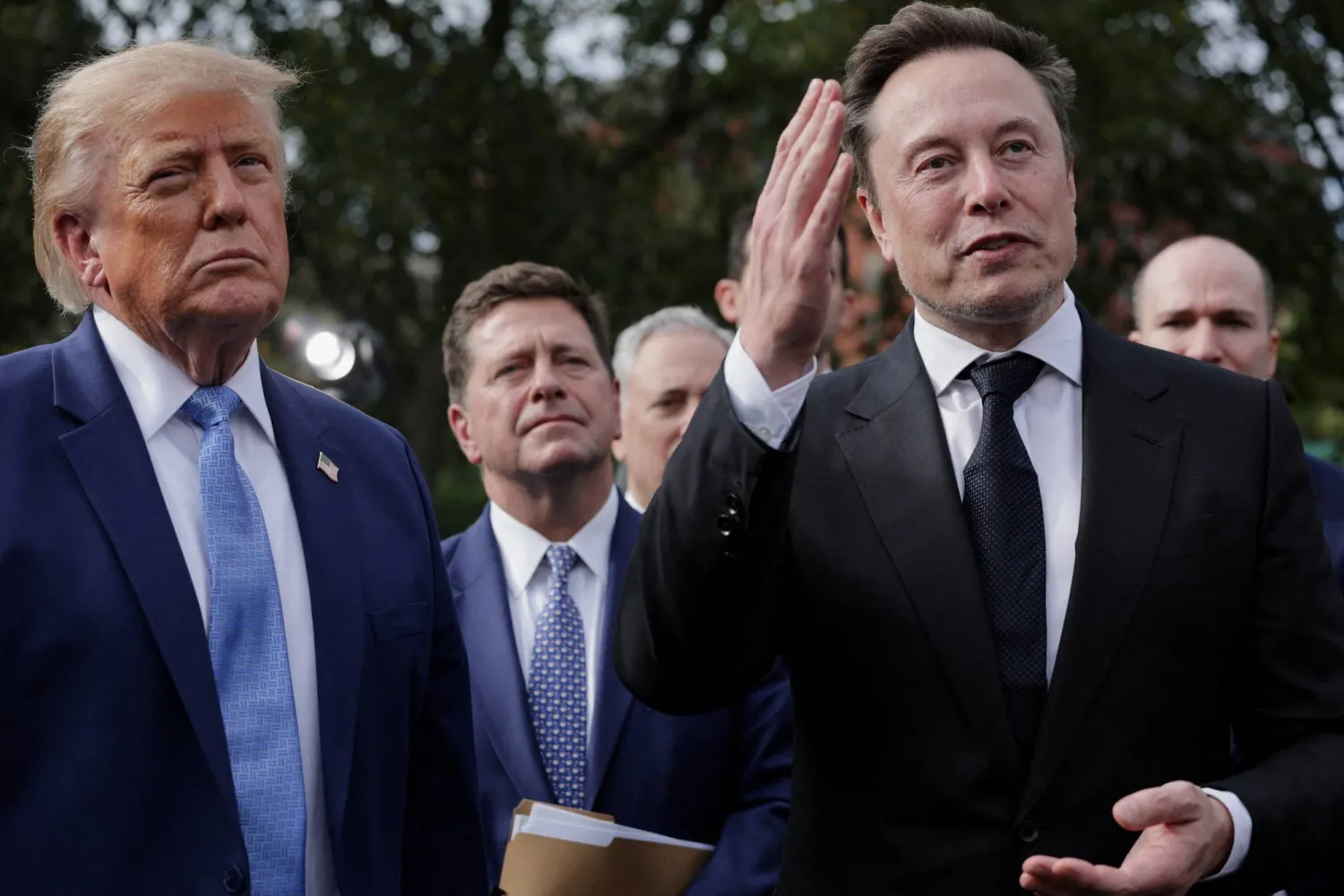
US President Donald Trump and SpacexAI Founder and CEO Elon Musk speak to the media at the White House driveway following a luncheon for tech leaders in the East Room, in Washington, DC, US, September 29, 2026. (Reuters)

President Donald Trump will present close ally Elon Musk and other tech bosses with the top US scientific award at a ceremony on Thursday, the White House said.

Google co-founder Sergei Brin, Nvidia CEO Jensen Huang and AMD chief Lisa Su will also receive the National Medal of Science at the "Science: A New Golden Age" summit.

Computer mogul Michael Dell and Microsoft CEO Satya Nadella will get the National Medal of Technology and Innovation, the top award in its field.

"The Trump Administration is grateful for the contributions of these incredible leaders in science and technology. These recipients are helping ensure America keeps leading the world in innovation," White House spokeswoman Liz Huston said in a statement to AFP on Wednesday.

Space X and Tesla tycoon Musk has returned to Trump's good graces after they fell out last year over his role heading the cost-cutting Department of Government Efficiency.

He was also the biggest donor to Trump's 2024 presidential campaign.

Musk and Huang were both at Trump's state dinner for Chinese President Xi Jinping last month.

Along with other tech bosses they were also at the White House last week for talks in which tech chiefs promised to self-regulate against possible threats from artificial intelligence.

Trump has dismissed warnings that AI could wipe out humanity, insisting it is crucial for what he calls the "Golden Age" of the US economy in his second term.

But Trump's Republican Party could lose control of Congress in midterm elections next month amid voter concerns over the Iran war and the cost of living.